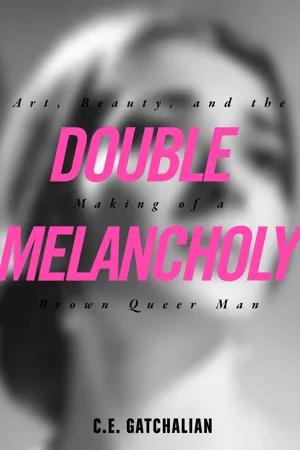
- English
- ePUB (mobile friendly)
- Available on iOS & Android
eBook - ePub
Trusted by 375,005 students
Access to over 1.5 million titles for a fair monthly price.
Study more efficiently using our study tools.
Information
1 | RUPTURE: ANNE OF GREEN GABLES
Even as a young child, I knew I was odd. But that doesn’t necessarily mean I always felt at odds with the world.
In the beginning, before the rupture, was pure consciousness. I was one with the world; my rhythms were its rhythms. Even after the inevitable ego boundaries had formed and I’d realized that my will was not necessarily the will of the universe, I still felt—until the age of ten—enough concord with the world to not feel particularly estranged by it.
On the contrary—I thought the world my oyster. I was an only child; my father left us when I was three. Consequently, there was no one with whom I had to compete for my mother’s attention (at least not early on; later, her boyfriends would wreak havoc on our mystical union). As well, I was reading fluently by age three and by age four had taught myself to play piano by ear. I was identified as “gifted” and treated duly by the adults around me. I was “well behaved” and “conscientious,” according to my grade two report card. Only child, teacher’s pet. As a child, I had some privilege.
June 5, 1983
[my earliest surviving journal entry]
Upon blowing out my birthday candles on this, the night of my ninth birthday, I made the following wishes (I know we’re only supposed to make one, but I made three, because I can):
1. That I get straight As in school this year (yes, even math, and PE doesn’t count—only ignoramuses get As in PE)
2. That I get the highest mark in the province on my grade four piano exam
3. That we win the dream house at this year’s PNE [Pacific National Exhibition, Vancouver’s annual summer trashy, petit bourgeois fun fair]
I visualized all three of these things happening just before I blew my candles out, because everything I set my heart on, I get. Always. I am a good person and I work hard and I deserve it.
I don’t remember there being a birthday party for me that year. In fact, I think I was thrown only two birthday parties my entire childhood—not because my mother was anti-social or stingy, but because of my own, seemingly innate, aversion to anything that smacked of society (except school—I welcomed it as society’s proxy, as the thing to struggle against and transcend). Parties seemed to celebrate society—and why would anyone want to do something as insipid as that?
So as a child, my political leanings were anti-collectivist; I subscribed to a philosophy of meritocratic, heroic individualism. I attribute this early political conservatism to my mother, who remains the fiercest embodiment I know of unadulterated self-reliance. When she separated from my father—with whom she immigrated to Canada from the Philippines three years before I was born—she was ostracized by her Filipinx friends, whose ethics dictated they render my parents immoral. And although the dictum was officially about both of them, it was my mother who bore the brunt of it; in Filipinx culture, as in many others, the wife is expected to endure all of the husband’s transgressions.
Being branded a “bad woman” turned my mother off community, so she disentangled herself from the mob and focused single-mindedly on motherhood. This worked out well for me, but there were other benefits as well: when my mother severed ties with her community, she also severed ties with that community’s hegemon: the Church. So I was spared the autocratic indignities forced upon most Filipinx children: attending Mass, serving at Mass, Sunday school, Catholic school. I was baptized but never confirmed (which doesn’t make me any less of a Catholic according to official church doctrine, but does in the court of popular opinion); my knowledge of the Bible remains fragmentary. The relics prominently displayed in our home—multiple statues of the Blessed Virgin; the obligatory painting of the Last Supper; the torsioned, slightly glossy, and inevitably erotic hand-carved Jesus on the cross—were simply nods to our Filipinxness, for we had evolved past colonial thrall and become merely cultural Catholics.
Further padding my sense of entitlement was the presence of Lola (Tagalog for “grandmother”), who lived with my mother and me for most of the first twenty-seven years of my life. Mother and daughter had always had a fractious relationship, but whatever generosity Lola had failed to show her only child (one of my mother’s many and oft-aired complaints) she certainly didn’t fail to show her grandchild (to either compensate or make a point—I’m not sure which). So between my grandmother and mother (who was resolute about being exactly the kind of parent her own ostensibly unaffectionate mother wasn’t), the coddling was ferocious. Under this heaving, sheltering matriarchy, I was safe.
(Is the narrator jettisoning complexity in favour of an overly quaint and therefore palatable narrative?)
April 30, 1984
So last night I scored 90% and second place in the [piano] competition. Afterwards people came up to me and Mom and said I should have won. They said I was much more musical, played with much more feeling than the girl who won. I am furious, apoplectic—I practice so hard, wish so hard. I don’t know what else to do.

Speaking mostly Tagalog at home and being brown didn’t strike me as strange, living as we did in Vancouver’s West End, which by the late 1970s had become a dense Babelian hotbed of multiple settler communities. (From preschool to grade twelve, I attended schools where white kids were the minority.) Culturally, however, Tagalog notwithstanding, our household was very white: virtually everything we watched on TV was white, and between the ages of five and ten, the music I most remember hearing was Judy Garland (whom my mother was fixated on) and ABBA (who, for better or worse, were just ubiquitous).
My mom and Lola seemed distinctly proud of two facts: their fair skin (Lola was a quarter Spanish, another fact they both seemed proud of), and that they hailed from Manila, or at least the general vicinity (Imus, Cavite, was only forty minutes away) and not, God forbid, the provinces (especially, for some reason, the Visayas). They weren’t bakya (bumpkins), they told me; they had some privilege back home. Somehow, I grasped these as facts to hold on to, when in doubt.
So my early life was idyllic—and I was anxious to keep it that way. I think I was faintly aware that, like all paradisiacal illusions, it could rupture any second, and I remember being easily disquieted by anything or anyone that might precipitate that rupture. I developed an intense phobia of strangers—I would hide in my bedroom whenever we had guests and go into fits whenever a passerby on the street threw me what I interpreted as the evil eye. My mental space was my shelter, my sanctum; it would permit no aggression, no invasion, no rape.
July 6, 1984
Mom had guests over tonight—a couple of white women from work. She forced me out of my room to play piano for them. It was horrible playing for these strangers, having them evaluate me, judge me. What do they know about music? Who do they think they are? And I’m upset at Mom for inviting them over without my permission. Anyways, I hate them. They think me a weirdo. That’s because they are savages, with no feeling for the divine.
(By referring to the skin colour of his mother’s friends, the boy is betraying a nascent awareness of his racialization.)
When pressed, most people, I think, can pinpoint the exact moment when their innocence ended, when heaven split away from earth, when things started to fall apart.
My rupture happened when I was in grade four.
The location: the playground. The time: morning recess.
I was sitting by the water fountain and a male classmate sat next to me.
“Do you play?” he asked cryptically.
“Play what?”
“You know, the gay way.”
I knew what “gay” meant (I enjoyed watching Three’s Company, lowbrow as it was—later, I would intellectualize my weakness for it by trumpeting its formal roots in Georges Feydeau and French farce). But I twigged to the unusual way the question and its explanation were phrased, in particular the deployment of that rhyming mnemonic. It was pointed, playful, gently malicious—and the first time such a question had been directed at me.
“No!”
I remember that no as welling from a place of utter horror. I was not that, could not be that. To be that was unspeakable, if not worse—much worse.
For it was 1985, and the world had just found out about AIDS. Put bluntly, to be that was just about the vilest thing one could be.
But I was that, and I knew it. I’d been flashlit, outed.
I’d always read a lot, but it was around this time that it became well-nigh compulsive.
The rupture had happened. I needed to cope.
It was one noon hour in the school library—where I usually hid during my lunch breaks—that I discovered L.M. Montgomery’s Anne of Green Gables. The library’s books, I remember, were alphabetized by title, so Anne was probably one of the first three or four books in the fiction section.
I connected instantly with the cover art for Anne: it was the famous 1942 edition with the young protagonist propped atop a heap of wood, enclosed in an oblong iris, which was in turn enclosed by rows of green and white abstractions that ably and efficiently suggested gables. I was drawn to Anne’s plaintive looks—all old-soul, melancholy eyes. Her aching solitariness—underpinned by a bursting, indescribable sweetness—moved me, I remember, utterly.
That I was a boy reading a “book for girls” was not something that overly concerned me—at least, not enough to dissuade me from borrowing it. I probably did have a vague notion linking the liking of “girls’” things with that vile “way” in which I was accused of “playing”: I remember being careful to read Anne only at home, and to never be seen reading or carrying it in school. But I also had enough chutzpah to be true to myself—I had no interest in G.I. Joe, or even boy-focused classic literature like Huckleberry Finn.
Anne saved my life, and that was that.
(Why doesn’t the narrator go beyond scare quotes and interrogate why Anne of Green Gables has been routinely pigeonholed as a “book for girls,” not to mention why such a pigeonhole should even exist in the first place? Books like Huckleberry Finn and Treasure Island are rarely referred to as “books for boys,” despite being as male-centric as Anne is female-centric.)
There are the obvious reasons why a little brown queer boy would fall in love with Anne Shirley. Anne is an orphan and, consequently, like virtually every queer child, an outsider in every family she ends up with. With her red hair and freckles, she is, in her own way, racialized, given the still-present stigma against redheads in white society. She is a girl in a world that vastly prefers boys, shipped by mistake to a family expecting and wanting a boy. In the face of these challenges she strives, Herculean, towards unadulterated poetry, beauty, transcendence. This she achieves with her most unassailable attribute, her imagination, constructing a divine counterworld to the colonial conservatism of early-twentieth-century Prince Edward Island.
But even in the actual world, Anne—as her guardian Marilla would drily say—does well for herself. She transforms her fury at the world into a ferocious work ethic, leading to impressive academic and artistic achievements. She stands up to bullies who belittle her orphan status and red hair—can anyone resist cheering her epic takedown of the town busybody, Rachel Lynde? She’s a feminist who stands up to and runs with the boys; her response to Gilbert Blythe is particularly admirable. Rather than crumble like Spanish shortbread before his good looks, she refuses to forgive him for the wrong he does her—he calls her “Carrots”—fiercely repudiating his advances for most of the book. Above all, she magically transforms her weaknesses into strengths, appropriating the stigmatized categories of orphan girl and redhead for her own triumphant individuation.
(Shouldn’t Voice Proper critique this disturbing early appropriation of female experience? It’s perhaps fine at this early age for him to find e...
Table of contents
- Cover
- Title Page
- Copyright
- Contents
- Acknowledgments
- Prelude to a Fugue
- 1 | Rupture: Anne of Green Gables
- 2 | Order: A Room with a View
- 3 | Retreat: A Streetcar Named Desire
- 4 | Geist: Death in Venice
- 5 | Cure: Queer as Folk
- 6 | Besotted: Camille Paglia & Susan Sontag
- 7 | Divine: Maria Callas
- 8 | Flip-Flop: Being Brown
- 9 | Caesura
- Cadenza, or Coda
- References
Frequently asked questions
Yes, you can cancel anytime from the Subscription tab in your account settings on the Perlego website. Your subscription will stay active until the end of your current billing period. Learn how to cancel your subscription
No, books cannot be downloaded as external files, such as PDFs, for use outside of Perlego. However, you can download books within the Perlego app for offline reading on mobile or tablet. Learn how to download books offline
Perlego offers two plans: Essential and Complete
- Essential is ideal for learners and professionals who enjoy exploring a wide range of subjects. Access the Essential Library with 800,000+ trusted titles and best-sellers across business, personal growth, and the humanities. Includes unlimited reading time and Standard Read Aloud voice.
- Complete: Perfect for advanced learners and researchers needing full, unrestricted access. Unlock 1.5M+ books across hundreds of subjects, including academic and specialized titles. The Complete Plan also includes advanced features like Premium Read Aloud and Research Assistant.
We are an online textbook subscription service, where you can get access to an entire online library for less than the price of a single book per month. With over 1.5 million books across 990+ topics, we’ve got you covered! Learn about our mission
Look out for the read-aloud symbol on your next book to see if you can listen to it. The read-aloud tool reads text aloud for you, highlighting the text as it is being read. You can pause it, speed it up and slow it down. Learn more about Read Aloud
Yes! You can use the Perlego app on both iOS and Android devices to read anytime, anywhere — even offline. Perfect for commutes or when you’re on the go.
Please note we cannot support devices running on iOS 13 and Android 7 or earlier. Learn more about using the app
Please note we cannot support devices running on iOS 13 and Android 7 or earlier. Learn more about using the app
Yes, you can access Double Melancholy by C.E. Gatchalian in PDF and/or ePUB format, as well as other popular books in Social Sciences & Social Science Biographies. We have over 1.5 million books available in our catalogue for you to explore.