Curation: the act of imagining and overseeing an exhibition or art experience. Worship Curation: the act of imagining and overseeing a worship experience.
Worship curator Jonny Baker introduces this original approach to the design and sharing of worship. Rather than simply presiding over liturgy or leading a worship team, Baker and a new generation of leaders are negotiating between institutions and artists, crafting beauty for God out of whatever they've got on hand, helping people to make connections between their own lives and stories and the life and story of God.
Curating Worship is presented in two parts. The first considers the kind of thinking, skills and disciplines involved in good curation. The second part features in-depth interviews that tease out the ideas, theories and processes behind the creative approaches of people who are curating worship experiences around the world.
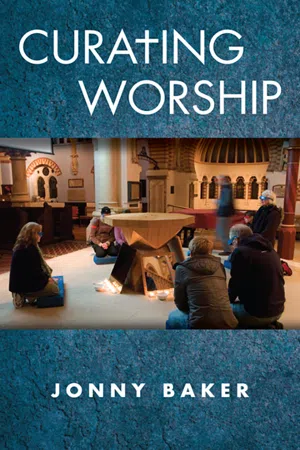
- 192 pages
- English
- ePUB (mobile friendly)
- Available on iOS & Android
eBook - ePub
Curating Worship
About this book
Information
Topic
Theology & ReligionSubtopic
Christian Rituals & PracticePart 1
CURATION IN THE ART WORLD AND IN WORSHIP

A space for encounter
Somehow, something happens. Sometimes that’s hard to remember when you’re taping down cords or lighting coals or dashing down the hall to the photocopier (again).
Somehow, something happens. People gather. And in silence and words. Sound and movement. Stillness. Between the clumsiness and the elegance and the whimsy and the beauty. Somewhere, there, something happens.
And that’s the grace of it. That’s the Life in it. That’s the hope for it.
A space for allowing our humanity to be held gently. A space for wonder. A space to be at home. A space for lamenting. A space for hoping. A space for playing. A space for encounter.1
In an old disused church in Bermondsey at Dilston Grove a pool is filled a few feet deep with black water. On the edge are some steps up and one solitary stepping stone. It’s inviting someone to step out from the edge and see what happens. This is the Bridge, an installation by Michael Cross.2 It’s actually a trial, a prototype for something he hopes will be on a bigger scale on a lake. The way it works is that when you take the risk of stepping out, the force of your weight on the stepping stone triggers another one to appear from underneath the water. In this way the viewer slowly leaves the edge one step at a time to make their way out into the water. It’s a wonderful location for it. And it is nerve-racking. That experience lingered with me for quite some time. For several weeks, when I prayed I could picture that step of faith and trust.
One of the most memorable exhibitions I think I have ever been to was New Ocean by Doug Aitken at the Serpentine Gallery. He is an artist who works in film and photography. The journey through the exhibition began in the basement with a film and recorded sound of ice cracking. Writing about it seems somehow too far removed from the experience but I found I was moved to tears standing listening as the coldness and hardness cracked. It was particularly the sound. The exhibition then took you through several film installations. These were layered narratives of people in busy city lives who were on the train to work, or running down a corridor, and they would all shift between the urban pressure to a slowed-down or quiet movement that felt like breathing. This was something simple, like focusing on the gentle closing of eyes in an almost meditative fashion or a graceful gymnast in slow motion. In one sequence a man running home from work ended up lying on the floor in a wilderness, collapsed but somehow peaceful. This multi-layered set of sequences moved me to reflect on living in fast-paced city life, to pause and reflect on where the spaces of solitude and quiet and prayer are in the city, when travelling on the Underground. The journey ended in the upstairs room, which is a lovely round space at the Serpentine. The sound of rushing water filled the air; projected all around were waterfalls and overhead a projection of the ocean from beneath the surface. There was a sequence of someone falling into the water. It was like being immersed. This was such a renewing and healing sensation. I obviously bring my own self and stories and interpretations to the art but I was prayerfully asking for God to immerse me in Godself in a new way, to renew me. I stayed in the space a long time and went away changed, slowed down. What struck me about this exhibition wasn’t just that I loved some of the works of the artist. It was also the way that the art used the context of the building, and that the journey through the art, while subtle, had a wonderful flow and development to it. It was brilliantly curated.
On Carnaby Street busy shoppers are rushing to get ready for Christmas. They race past a strange-looking store adorned with spray paint and camouflage netting and graffiti. This is Santa’s Ghetto, which pulls together a collective of street artists who take over a store in London for a few weeks in the run-up to Christmas. Its deconstructed underground feel, set in the context of the glittery Christmas decorations all around, is just the perfect location. This is a different kind of experience – designed to shock, to pull a rug from under the feet of consumer Christmas. Banksy has a piece there, set in a stable but Jesus is stencilled onto a huge piece of cardboard – crucified but holding in his outstretched hands bags of shopping. This image provokes, asks questions, unmasks. One of the images that most lingered in my mind was a piece called Liberty Shame. The image is of the Statue of Liberty holding her face in her hands in shame. The way this is put together is brilliant. Context here makes it. It just wouldn’t work in a nice gallery or museum. And the arrangement and décor enhance the underground street feel of the art.
The Tate Modern Turbine Hall is a huge space. Every six months an artist fills the space with an installation. It is an incredible challenge. They have pretty much all been brilliant in their own way. How It Is by Balka occupies the space at the time I am writing this. It is a huge container that has black walls, floor and ceiling. It is a void, a room of darkness. If you arrive and go straight into it, because your eyes have not had time to adjust it’s impossible to see anything, though you can hear voices of other people in the darkness. I entered with hands in front of me and gradually made my way to the back. I then turned around; gradually my eyes began to adjust to the darkness and I could make out other people, and looking back see the light of the entrance. After ten minutes it really didn’t seem so dark or fearful at all. The write-up on the installation, by the artist or curator, says this:
How shall I move forward? You might ask yourself as you stand at the threshold, confronted by the darkness ahead. The unknown can be terrifying, especially if it is also without light. How you approach it is unique, as your first encounter with anything can only ever be as an individual. Staring ahead into the black void may make you wonder whether to move ahead at all.
It’s one thing to think about an experience like this but actually navigating it is so much more evocative. I imagine people have reflected on all sorts of unknowns they face as they have walked into the darkness. I found myself thinking about my work and life’s direction, as I have recently taken on a new role and it feels at times a bit like going into the unknown. But it was reassuring to think that the unknown began to be less dark and fearful than it seemed at first. I was also thinking about the darkness of God, the starlit darkness.
I feel spoilt, living in London where there is so much amazing art. These spaces are experiential, contemplative, spaces of en -counter, spaces to change speed. Galleries and museums are one of the few public spaces where people in cities slow down and reflect, where slowness and silence can flourish. Equally, where artists and curators take art into public spaces the same effects can be received. Antony Gormley’s astonishing installation of around 100 life-size sculpted figures, staring out to the ocean, spread along a stretch of sand on Crosby beach near Liverpool, is a great example.
Art can do different things, have different effects. At times it evokes wonder. Every year I go to the Wildlife Photographer of the Year exhibition for a dose of wonder. Other times it is simply a different kind of space. At times it provokes questions, evokes grief, and can be difficult to take – it certainly shouldn’t always be comfortable. As a Christian I find these spaces spiritual, prayerful: places to encounter God. They move me and touch my soul. And I find that experiences tend to linger for a long time in the memory rather than be gone in a moment. They communicate at a depth. I have had many moments of epiphany.3 This is part of what makes a great exhibition. The curator makes exhibitions as spaces for experience.4 The curator enables connections and communication to take place between artists, art and the public without getting in the way. There is a place for educating the public in a particular artist’s work and how that is located in the tradition, but the best curators tend to let the art speak for itself so that viewers can look and look and look again and immerse themselves in the experience. Exhibitions where the viewers spend all the time reading the explanations have generally got the balance wrong.5 People can follow up on the artist afterwards through the catalogue or online.
Worship curation, drawing inspiration from the world of contemporary art, creates spaces: for encounter, for experience, for reflection, to change speeds, for prayer, for questions, for exploration, for meditation, for provocation, for moments of epiphany. Creativity and imagination are brought to bear to open up encounters between God, art, worship and the people. Lots of examples in both public spaces and church spaces are explored through the book in the interviews.
Part of the motivation for writing this book and conducting interviews with practitioners is that creative processes can seem mysterious and unattainable, even intimidating. The hope is that lifting the lid off the process and thinking might help demystify curating worship, and encourage people: ‘You can do it!’ Most of the communities involved in curating worship are not populated by professional artists. Their currency is the power of ideas, cultivating environments where creativity can flourish, rather than technical skills or artistry – although if those gifts are available in the community then obviously they will be welcomed, and by getting involved in this sort of worship artistry certainly does develop. Most of the worship is done with the resources that are to hand rather than on large budgets.
There isn’t one way to curate worship – the interviews demonstrate that. Some groups spend a year on a project, others have two planning sessions and then leave it to people to create the content. Some have a large group involved in planning, while others work in small teams. Some are worshipping communities and others are more like art collectives.
Grace is the Christian community I belong to. It’s a creative congregation of an Anglican church, and has been part of the alternative worship movement in the UK. We generally work in small teams, planning around 12 worship events a year. Typically someone might curate a worship service once or twice in the year and get involved in a team at four or five events. Some people don’t ever get involved in any, though – it’s not their thing! We’ll often manage to plan with just two meetings, and people then work on their contributions. We don’t rehearse or look at contributions in advance, as we like to retain the rough edges and the element of surprise at what people bring. Curating worship requires a set of instincts, skills and mindset that is different from other ways of leading worship. There are quite a number of considerations to hold together. It can get complex. For this reason, in Grace we wrote some practical guidelines and considerations for people taking the curation role. These make the task look more like project management, and are pragmatic rather than theoretical. I have included these guidelines in the Appendix because it’s probably helpful to see curation at this practical level, as well as at the level of ideas articulation, negotiation and world-making, explored in the next chapter.
One of the main differences between curators in the art world and worship curation is that the norm in worship is to work in creative teams. The task is to enable a group to develop something creative together rather than to realize their own personal vision. That isn’t always easy, particularly if you naturally want to control things. Nic Hughes reflects in our interview on his journey from having a very controlling approach in the early days of Vaux to arriving at a place where open source principles apply, particularly that ‘whoever comes is the right people’. At the heart of this is trust. A curator needs to operate on the basis of trust: trust of the process, trust of the people who are the creative team, trust of the community, trust in the institutions and relationships that the community is located in, trust of the people who come, that they will do what they need to do and receive what they need to receive, trust that there will be moments of epiphany, trust that God will indwell what has been created. The curator’s posture is best when he or she is able to hold open the space for ideas and contributions generously rather than acting as a control filter.
The approaches curators may take can be described in many ways: as a midwife, helping bring something to birth out of the community, as a DJ, remixing and sampling out of the tradition and ideas, as a broker of opportunities, as a fool who looks for the craziest ideas and dares to believe they can be realized, as a middle woman acting as a negotiator between artists and institutions, as a permission giver, as an encourager who has learned how to nudge and swerve things in new directions, as a magpie making do from what is to hand. Curators are contextual. They are happy out of the way rather than in the spotlight. They are creators of environments. They are hard workers who will go the extra mile to make things happen. And they are amateurs, who do it for love not money. Above all they are lovers – lovers of God, of worship, of creativity, of the tradition, of people, of their culture.
1 A reflection from Jemma Allen – see <http://exilicchaplain.wordpress. com/2009/11/08/curating-worship-2/>.
2 See <www.michaelcross.eu/morebridge2.html>.
3 Moments of epiphany is a term used by curators in the art world. See, for example, Ann D’Harnoncourt in Hans Obrist, A Brief History of Curating (Zurich: JRP Ringier, 2008), p. 193.
4 Mary Jane Jacob in Paula Marincola (ed.) What Makes a Great Exhibition? (Philadelphia: Philadelphia Exhibitions Initiative, 2006), p. 141.
5 This seems to be a recurring theme among curators. See for example Robert Storr in Marincola (ed.) What Makes a Great Exhibition?, p. 24.
Making a world
Worship imagines a world, nothing less. In curating worship perhaps the single most important question is what kind of a world is imagined, made, constructed. Simon Sheikh1 suggests, in relation to exhibition-making, that if the curator is happy with the way the world is now they should continue to create exhibitions as always, repeating formats and circulations. But if they are not content with the world they are in, and the art world, then they will have to produce other exhibitions. This is a very resonant idea. Restlessness is a sure sign that the world being made by other imaginaries doesn’t ring true and that a counter-imagination is called for. Worship curation is not simply about stylistic difference, a bit of creativity and tweaking around the edges. It cuts deeper. As illustrated by the interviews in the second half of the book, it is and has been about imagining new worlds, new relationships, new strategies and tactics, and counter-publics, about saying that other worlds are possible, that business as usual in the church, in worship, in theology, in consumer culture, in the world at large, in life, simply will not do.
This world-making, or terra-forming,2 involves articulation, imagination and continuity.3
A work of art is at best an articulation of something as much as it is a representation of someone: it is a proposal for how things could be seen, an offering but not a handout. Articulation is the formulation of your position and politics, where you are and where you want to go, as well as a concept of companionship: you can come along or not.4
It’s interesting to rework this quote from Sheikh replacing ‘art’ with ‘worship’. Worship is an articulation of something, of how things could be seen. A community or a curator has a vision, a take, something to articulate. It might not be fully worked out but it is not neutral. There is a lot of pretence around being neutral but one of the gifts of postmodern culture has been to make us suspicious of anyone m...
Table of contents
- Cover
- Title
- Copyright
- Dedication
- Contents
- Contributors
- Foreword
- Introduction
- Part 1
- Part 2
- Appendix: Grace curation practical guidelines
Trusted by 375,005 students
Access to over 1.5 million titles for a fair monthly price.
Study more efficiently using our study tools.
Frequently asked questions
Yes, you can cancel anytime from the Subscription tab in your account settings on the Perlego website. Your subscription will stay active until the end of your current billing period. Learn how to cancel your subscription
No, books cannot be downloaded as external files, such as PDFs, for use outside of Perlego. However, you can download books within the Perlego app for offline reading on mobile or tablet. Learn how to download books offline
Perlego offers two plans: Essential and Complete
- Essential is ideal for learners and professionals who enjoy exploring a wide range of subjects. Access the Essential Library with 800,000+ trusted titles and best-sellers across business, personal growth, and the humanities. Includes unlimited reading time and Standard Read Aloud voice.
- Complete: Perfect for advanced learners and researchers needing full, unrestricted access. Unlock 1.5M+ books across hundreds of subjects, including academic and specialized titles. The Complete Plan also includes advanced features like Premium Read Aloud and Research Assistant.
We are an online textbook subscription service, where you can get access to an entire online library for less than the price of a single book per month. With over 1.5 million books across 990+ topics, we’ve got you covered! Learn about our mission
Look out for the read-aloud symbol on your next book to see if you can listen to it. The read-aloud tool reads text aloud for you, highlighting the text as it is being read. You can pause it, speed it up and slow it down. Learn more about Read Aloud
Yes! You can use the Perlego app on both iOS and Android devices to read anytime, anywhere — even offline. Perfect for commutes or when you’re on the go.
Please note we cannot support devices running on iOS 13 and Android 7 or earlier. Learn more about using the app
Please note we cannot support devices running on iOS 13 and Android 7 or earlier. Learn more about using the app
Yes, you can access Curating Worship by Jonny Baker in PDF and/or ePUB format, as well as other popular books in Theology & Religion & Christian Rituals & Practice. We have over 1.5 million books available in our catalogue for you to explore.