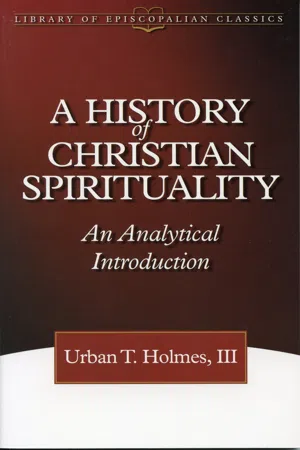
This modern classic explores the key concepts and people who have shaped our Christian spiritual heritage.
Concise and readable Holmes begins this introduction to Christian spirituality with the Jewish antecedents, and proceeds through the New Testament period, monasticism, the Middle Ages, Byzantine spirituality, and the modern period. Holmes ends his overview with key contemporary figures such as Simone Weil, Thomas Merton, and Martin Luther King, Jr. Brief bibliographies of the books written by each notable figure are included for those who wish to read more extensively.
A History of Christian Spirituality is the perfect book for introductory classes at the M. Div. level, for diaconate programs, lay people or parish study classes of all Christian denominations, and for any reference collection. This is a unique and invaluable learning tool and reference for readers, students, or teachers who want a quick explanation of the significance of a person or idea, or who are interested in a broad overview of the entire field.
- 176 pages
- English
- ePUB (mobile friendly)
- Available on iOS & Android
eBook - ePub
About this book
Information
IV. The Modern Period
The Spanish School
The sixteenth century is, more than anything else, when reason drives out all else. We become obsessed with logic, analysis, and explanation. This brings many gifts and loses us much. As a consequence, however, we get the first science of the spiritual life, beginning with three great Spanish spiritual masters: IGNATIUS LOYOLA (1491 or 1495–1556), TERESA OF AVILA (1515–1582), and JOHN OF THE CROSS (1542–1591). Ignatius was the founder of the Jesuits; the latter two were reformers of the Carmelites. The Carmelites are an order founded in the twelfth century in Palestine during the Crusades. Its first house was on Mt. Carmel, where St. Mary was reputed to have been assumed into heaven and where the prophet Elijah slew the prophets of Baal. Scientific spirituality means a systematic analysis of the totality of the spiritual experience with the intention of describing both the means and ends of that experience in such a way that it can be taught and followed, as well as compared with other systems.
The precursor of sixteenth-century Spanish spirituality was a talented man, GARCIA XIMENES DE CISNEROS (1475–1510). He wrote a book entitled The Spiritual Exercises, which heralded the more famous treatise of the same name. He represented a late medieval interest in the methodology of meditation developed among the Franciscans and the leaders of the Devotio moderna.
Ignatius was born of a noble family, whose castle was Loyola. He was a soldier until in 1521 when at the siege of Pampeluna a cannon ball passed between his legs, wounding him. During his recovery he underwent a profound change in his life and, having hung his sword in the Lady Chapel at Montserrat, went “on retreat” to Manresa. The Society of Jesus was the result of a group of six young men Ignatius gathered around him while he studied for the priesthood in Paris, 1528–1535. They first called themselves “the companions of Jesus.” The society itself was founded in 1539, with the drawing up of the so-called “Deliberation of the First Fathers.” The Spiritual Exercises are really Ignatius’ notes in leading other individuals to an openness to the experience of God. They are ascetical outlines for directors (unlike Ximenes’ work, which was aimed at the directees). “Spiritual Exercises” (a phrase that goes back many centuries in Christian spirituality) are what Ignatius called his retreats. His book is therefore entitled Spiritual Exercises, but was not intended by him to exhaust all possible spiritual exercises or even those “Spiritual Exercises” he provided. There is great flexibility in his system.
One thing needs to be made very clear. Ignatius warns against the indiscriminate use of methods of meditation by unschooled and unguided persons. In making this warning he finds common cause with many spiritual masters—Western and Eastern—because meditative techniques without direction can trigger irreversible mental disorder or be the cause of alienation from God. The analogue would be those in contemporary times who advocate the use of LSD, but never without the presence of a guide and prior knowledge of what to expect. The deautomization of consciousness in any form—intentional or chemical—is dangerous, even while necessary.
Ignatius’ motto was Ad majorem gloriam Dei, “To the greater glory of God.” It is very reminiscent of the statements of reformed religion as to the true end of man. Ignatius was a sixteenth-century man, who believed himself to be a soldier of Christ, reforming the church within, suppressing heresy, and converting the pagans. The Exercises trained the soldiers, but with understanding of individual needs. They also sought to assist the retreatant in making a life choice.
Ignatius takes the classical faculties of the mind—memory, understanding, and will—and treats them in a systematic manner. Memory exists to recall the sin of the fallen angels, to arouse our emotion to seek the salvation of our souls. This is the main concern of the Christian person: to save his or her soul. Understanding is the application of reason to our situation. Through our reason God illumines our world. Our will is then moved and it is joined to the will of God. Since Ignatius is concerned for the apostolate, it is the action of the will that is the supreme good.
In contemplation Ignatius tells us that we will experience both consolation and desolation. This is in accord with contemporary psychological studies which report that ecstatic experience usually involves conflicting emotion: joy and terror, bliss and sadness, and attraction and repulsion. Consolation is where love is present. It is a common word in medieval mysticism, but it will take on a special significance in late-seventeenth-century pietism. Desolation is the darkness of the soul, a time of great temptation. Ignatius advises that one never make any change of resolution when experiencing desolation.
The purpose of the Exercises was to enable the retreatant to be open to the same experience of God that Ignatius found at Cardoner in 1522 in a mystical vision. They are not the mechanical imposition of categories, although Ignatius’ imagery, which was typical of his age, may seem to imply this. It would appear, on the contrary, that Ignatius uses the action mode of consciousness to move his readers into the receptive mode of consciousness. Ignatius was a Spaniard influenced by the romantic ideals of feudalism, who chose to be a medieval man rather than a citizen of the Reformation. Therefore, the image of Christ was very much related to the vassal-lord relationship, and he saw himself and his followers as knights errant for Christ. He is kataphatic and moderately speculative.
It is impossible to compress the teaching and significance of Ignatius into this outline, but it is important that the bare bones of his methods in prayer be provided.
First Method (for the illiterate)
I. Preparation
- Consider what one will do (composition of place).
- Pray for grace.
II. Body
Consider a chosen subject, such as the Ten Commandments, the Commandments of the Church, the Seven Deadly Sins, the powers of the soul (memory, understanding, will), the five senses, the works of mercy. (The powers of the soul have, as we have seen, been common categories in medieval spirituality and are now in Ignatius. They reappear again and again, as, for example, in the Anglican, William Law, in the eighteenth century.)
III. Colloquy (i.e., an intimate, familiar, loving conversation such as a child has with a father).
This method is very much like an examination of one’s conscience, only more. All Ignatian methods follow in some way the threefold shape of this method: preparation, body, colloquy.
Second Method (word by word)
Related to monologistic prayer but not the same thing; in the body of this method the participant reflects upon each word of a prayer, such as the Lord’s Prayer.
Third Method (by way of musical measure)
This requires the association of breathing with the second method. It seeks a set rhythm. One word only is said between each breath and the participant thinks during each breath of the following:
- The meaning of the word.
- The person to whom one is speaking.
- or the state of one’s own life,
- or the contrast between God and ourselves.
Fourth Method (using the five senses)
The body of this method requires that in turn we take an image—e.g., the Trial of Jesus, his Passion, the Resurrection, etc.—and apply each of the five senses to that image: sight, hearing, smell, taste, feeling.
Fifth Method (Ignatian proper)
Two things precede the preparation. Read a passage of Scripture the night before, reflect upon it, and choose one or two points for meditation. The next morning arise quickly and focus the mind on the passage and its inspiration.
I. Preparation
- Briefly recall the subject and points chosen.
- See the place, which is to imagine the scene and focus on the significant images.
- Pray to know, love, and follow the Lord.
II. Body
Apply to the scene and its central images:
- memory, and then
- understanding, and finally
- will, so that one may act.
III. Colloquy
Pray for grace to keep our resolutions.
Contrary to Aquinas, Ignatius seems to define meditation as simply thinking about God, and contemplation as looking at some scene from the life of Christ.
TERESA OF AVILA (sometimes described as “of Jesus”) (1515–1582) was one of the greatest Christian women that ever lived. She reformed the Carmelite Order—she is considered the founder of the Order of Discalced (i.e., without shoes) Carmelites (ODC)—and was a person of great practicality. At the same time she is a remarkable mystic and teacher of the prayer life. On the whole she is kataphatic, but she possesses a remarkably balanced style of spirituality—affective and speculative, occasionally apophatic.
Her original contribution to spiritual theology was the description of the process between discursive meditation and union with God. She knew the process from her own experience. She experienced a long period of spiritual aridity and then, in 1557, had the first of a series of ecstasies, which she calls “raptures.” She describes them in strongly sexual images.
She defines the degrees of prayer by means of the image of watering the garden.
- Discursive meditation (the use of reason—watering bucket by bucket, carried by hand from the well).
- Recollection (affective prayer)—the water wheel.
- Quiet—springs of water.
- Union—drenching rain.
This classification is found in her Life. A more developed treatment of spiritual growth is the subject of the Interior Castle, in which she describes seven kinds of “rooms” in the “castle” of the soul.
- A state of grace in which we are still very much in love with the world.
- An openness to the practice of prayer and edifying books, sermons, and conversations, while still in the world.
- A life of high virtue, still susceptible to lapses.
- The experience of spiritual consolations, as in the prayer of quiet.
- A kind of incipient union.
- A growth in intimacy with God.
- Spiritual marriage.
The “rooms” from four to seven are the degrees of mystical experience. The last three rooms correspond to the prayer of union, which Teresa describes as the drenching rain. The sign of advance in the prayer of union, is a death-like experience that moves us beyond seeing, hearing, and understanding. An example would be Carlos Castañeda’s vision of the coyote at the end of The Journey to Ixtlan. In the sixth room we find a sense of power, tranquillity, and awareness of God’s word in our life as signs of the authenticity of the experience.
There has probably never been a more “healthy” Christian than Teresa. She embodies an intrinsic religious motivation. There is a balance of piety and politics, religious experience and prophetic insight, that is a witness to us all. It has been noted that there are seven elements that characterize Teresa. They are (1) trust in persons and the universe; (2) hope in the direction of history; (3) a sense of grace, or being loved for nothing; (4) an identity that is open to the new; (5) an integrity of life, which maintains a consistency between the intuitive and rational realms of consciousness; (6) a willingness to sacrifice for the public good; and (7) a vision of the future.
JOHN OF THE CROSS (1542–1591) was a cofounder with Teresa of the Discalced Carmelites. A poet, a native psychologist, a Thomistic theologian, and the mystic’s mystic, he is, with Teresa, a giant in the history of Christian spirituality. He combines a number of influences: Gregory of Nyssa, Dionysius, Augustine, Bernard, Richard of St. Vi...
Table of contents
- Cover
- Title
- Copyright
- Contents
- Foreword
- Preface
- Introduction
- I. The Early Church
- II. The Middle Ages
- III. Byzantine Spirituality
- IV. The Modern Period
- Index
Trusted by 375,005 students
Access to over 1.5 million titles for a fair monthly price.
Study more efficiently using our study tools.
Frequently asked questions
Yes, you can cancel anytime from the Subscription tab in your account settings on the Perlego website. Your subscription will stay active until the end of your current billing period. Learn how to cancel your subscription
No, books cannot be downloaded as external files, such as PDFs, for use outside of Perlego. However, you can download books within the Perlego app for offline reading on mobile or tablet. Learn how to download books offline
Perlego offers two plans: Essential and Complete
- Essential is ideal for learners and professionals who enjoy exploring a wide range of subjects. Access the Essential Library with 800,000+ trusted titles and best-sellers across business, personal growth, and the humanities. Includes unlimited reading time and Standard Read Aloud voice.
- Complete: Perfect for advanced learners and researchers needing full, unrestricted access. Unlock 1.5M+ books across hundreds of subjects, including academic and specialized titles. The Complete Plan also includes advanced features like Premium Read Aloud and Research Assistant.
We are an online textbook subscription service, where you can get access to an entire online library for less than the price of a single book per month. With over 1.5 million books across 990+ topics, we’ve got you covered! Learn about our mission
Look out for the read-aloud symbol on your next book to see if you can listen to it. The read-aloud tool reads text aloud for you, highlighting the text as it is being read. You can pause it, speed it up and slow it down. Learn more about Read Aloud
Yes! You can use the Perlego app on both iOS and Android devices to read anytime, anywhere — even offline. Perfect for commutes or when you’re on the go.
Please note we cannot support devices running on iOS 13 and Android 7 or earlier. Learn more about using the app
Please note we cannot support devices running on iOS 13 and Android 7 or earlier. Learn more about using the app
Yes, you can access A History of Christian Spirituality by Urban T. Holmes III in PDF and/or ePUB format, as well as other popular books in Theology & Religion & Christian Theology. We have over 1.5 million books available in our catalogue for you to explore.