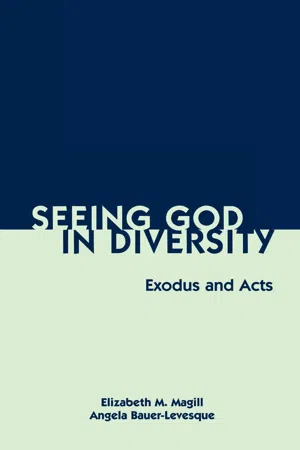
Finding God in the diversity of races, cultures, and creeds that make up our neighborhoods and cities, our country and our world, is one of the most important tasks for people of faith today. Seeing God in Diversity: Exodus and Acts, takes that task seriously. Here readers will find a parish study resource that promotes tolerance, diversity, and inclusiveness by looking at two biblical stories from multiple points of view: the story of the returning Jews in the Book of Exodus and the story of the new Christian community in the Book of Acts.
The lessons of these ancient communities - and the way they dealt with many of the issues we face today - lead readers to put themselves in the place of each group and re-examine their faith and work for greater inclusiveness in their own communities. Lessons are arranged as six two-hour sessions, and include background commentary for study leaders, readings, activities, and discussion questions.
- 80 pages
- English
- ePUB (mobile friendly)
- Available on iOS & Android
eBook - ePub
About this book
Information
Topic
Theology & ReligionSubtopic
ReligionAPPENDIX 1
A Native American Perspective3
Most of the liberation theologies that have emerged in the last twenty years are preoccupied with the Exodus story, using it as the fundamental model for liberation. I believe that the story of the Exodus is an inappropriate way for Native Americans to think about liberation.
No doubt, the story is one that has inspired many people in many contexts to struggle against injustice. Israel, in the Exile, then Diaspora, would remember the story and be reminded of God’s faithfulness. Enslaved African Americans, given Bibles to read by their masters and mistresses, would begin at the beginning of the book and find in the pages of the Pentateuch a god who was obviously on their side, even if that god was the god of their oppressors. People in Latin America base communities read the story and have been inspired to struggle against injustice. The Exodus, with its picture of a god who takes the side of the oppressed and the powerless, has been a beacon of hope for many in despair.
God The Conqueror
Yet, the liberationist picture ofYahweh is not complete.A delivered people is not a free people, nor is it a nation. People who have survived the nightmare of subjugation dream of escape. Once the victims have been delivered, they seek a new dream, a new goal, usually a place of safety away from the oppressors, a place that can be defended against future subjugation. Israel’s new dream became the land of Canaan. And Yahweh was still with them:Yahweh promised to go before the people and give them to Canaan, with its flowing milk and honey. The land, Yahweh decided, belonged to these former slaves from Egypt and Yahweh planned on giving it to them—using the same power used against the enslaving Egyptians to defeat the indigenous inhabitants of Canaan. Yahweh the deliverer became Yahweh the conqueror.
The obvious characters in the story for the Native Americans to identify with are the Canaanites, the people who already lived in the promised land. As a member of the Osage Nation of the American Indians who stands in solidarity with other tribal people around the world, I read the Exodus stories with Canaanite eyes. And, it is the Canaanite side of the story that has been overlooked by those seeking to articulate theologies of liberation. Especially ignored are those parts of the story that describe Yahweh’s command to mercilessly annihilate the indigenous population.
To be sure, most scholars, of a variety of political and theological stripes, agree that the actual events of Israel’s early history are much different than what was commanded in the narrative. The Canaanites were not systematically annihilated, nor were they completely driven from the land. In fact, they made up, to a large extent, the people of the new nation of Israel. Perhaps it was a process of gradual immigration of people from many places and religions who came together to form a new nation. Or maybe, as Norman Gottwald and others have argued, the peasants of Canaan revolted against their feudal masters, a revolt instigated and aided by a vanguard of escaped slaves from Egypt who believed in the liberating god, Yahweh. Whatever happened, scholars agree that the people of Canaan had a lot to do with it.
Nonetheless, scholarly agreement should not allow us to breathe a sigh of relief. For historical knowledge does not change the status of the indigenes in the narrative and the theology that grows out of it. The research of Old Testament scholars, however much it provides an answer to the historical question—the contribution of the indigenous people of Canaan to the formation and emergence of Israel as a nation—does not solve the narrative problem. People who read the narratives read them as they are, not as the scholars and experts like them to be read and interpreted. History is no longer with us. The narrative remains.
Though the Exodus and Conquest stories are familiar to most readers, I want to highlight some sections that are commonly ignored. The covenant begins when Yahweh comes to Abram saying, “Know of a surety that your descendents will be sojourners in a land that is not theirs, and they will be slaves there, and they will be oppressed for four hundred years; but I will bring judgment on the nation they serve and they shall come out” (Gen. 15:13, 14). Then, Yahweh adds: “To your descendents I will give this land, the land of the Kenites, the Kenizzites, the Kadmonites, the Hittites, the Perizzites, the Rephaim, the Amorites, the Canaanites, and the Jebusites” (15:18–21). The next important moment is the commissioning of Moses. Yahweh says to him, “I promise I will bring you out of the affliction of Egypt, to the land of the Canaanites, the Hittites, the Amorites, the Perizzites, the Hivites, and the Jebusites, a land flowing with milk and honey” (Exod. 3:17). The covenant, in other words, has two parts: deliverance and conquest.
After the people have escaped and are headed to the promised land, the covenant is made more complicated, but it still has two parts. If the delivered people remain faithful to Yahweh, they will be blessed in the land Yahweh will conquer for them (Exod. 20–30 and Deut. 7–10). The god who delivered Israel from slavery will lead the people into the land and keep them there as long as they live up to the terms of the covenant.“You shall not wrong a stranger or oppress him [sic], for you were strangers in the land of Egypt. You shall not afflict any widow or orphan. If you do afflict them, and they cry out to me, I will surely hear their cry; and my wrath will burn, and I will kill you with the sword, and your wives shall become widows and your children fatherless” (Exod. 22:21).
Whose Narrative?
Israel’s reward for keeping Yahweh’s commandments—for building a society where the evils done to them have no place—is the continuation of life in the land. But one of the most important of Yahweh’s commands is the prohibition on social relations with Canaanites or participation in their religion. “I will deliver the inhabitants of the land into your hand, and you shall drive them out before you. You shall make no covenant with them or with their gods. They shall not dwell in your land, lest they make you sin against me; for if you serve their gods it will surely be a snare to you” (Exod. 23:31b-33).
In fact, the indigenes are to be destroyed:
When the Lord your God brings you into the land which you are entering to take possession of it, and clears away many nations before you, the Hittites, the Girgashites, the Amorites, the Canaanites, the Perizzites, the Hivites, and the Jebusites, seven nations greater and mightier than yourselves, and when the Lord your God gives them over to you and you defeat them; then you must utterly destroy them; you shall make no covenant with them, and show no mercy to them. (Deut. 7:1, 2)
These words are spoken to the people of Israel as they are preparing to go into Canaan. The promises made to Abraham and Moses are ready to be fulfilled. All that remains for the people is to enter into the land and dispossess those who already live there.
Joshua gives an account of the conquest. After ten chapters of stories about Israel’s successes and failures to obey Yahweh’s commands, the writer states, “So Joshua defeated the whole land, the hill country and the Negeb and the lowland and the slopes, and all their kings, he left none remaining, but utterly destroyed all that breathed, as the Lord God of Israel commanded.” In Judges, the writer disagrees with this account of what happened, but the Canaanites are held in no higher esteem. The angel of the Lord says, “I will not drive out [the indigenous people] before you; but they shall become adversaries to you, and their gods shall be a snare to you.”
Thus, the narrative tells us that the Canaanites have status only as people Yahweh removed from the land in order to bring the chosen people in. They are not to be trusted, nor are they allowed to enter into social relationships with the people of Israel. They are wicked, and their religion is to be avoided at all costs. The laws put forth regarding strangers and sojourners may have stopped the people of Yahweh from wanton oppression, but presumably only after the land was safely in the hand of Israel. The covenant of Yahweh depends on this.
The Exodus narrative is where discussion about Christian involvement in Native American activism must begin. It is these stories of deliverance and conquest that are ready to be picked up and believed by anyone wondering what to do about the people who already live in their promised land. They provide an example of what can happen when powerless people come into power. Historical scholarship may tell a different story; but even if the annihilation did not take place, the narratives tell what happened to those indigenous people who put their hope and faith in ideas and gods that were foreign to their culture. The Canaanites trusted in the god of outsiders and their story of oppression and exploitation was lost. Interreligious praxis became betrayal and the surviving narrative tells us nothing about it. . . .
Is There a Spirit?
What is to be done? First, the Canaanites should be at the center of Christian theological reflection and political action. They are the last ignored voice in the text, except perhaps for the land itself. The conquest stories, with all their violence and injustice, must be taken seriously by those who believe in the god of the Old Testament. Commentaries and critical works rarely mention these texts. When they do, they express little concern for the status of the indigenes and their rights as human beings and as nations. The same blindness is evident in theologies that use the Exodus motif as their basis for political action. The leading into the land becomes just one more redemptive moment rather than a violation of innocent peoples’ rights to land and self-determination.
Keeping the Canaanites at the center makes it more likely that those who read the Bible will read all of it, not just the part that inspires and justified them. And should anyone be surprised by the brutality, the terror of these texts? It was, after all, a Jewish victim of the Holocaust, Walter Benjamin, who said, “There is no document of civilization which is not at the same time a document of barbarism.” People whose theology involves the Bible need to take this insight seriously. It is those who know these texts who must speak the truth about what they contain. It is to those who believe in these texts that the barbarism belongs. It is those who act on the basis of these texts who must take responsibility for the terror and violence they can and have engendered. . . .
No matter what we do, the conquest narratives will remain. As long as people believe in Yahweh of deliverance, the world will not be safe from Yahweh the conqueror. But perhaps, if they are true to their struggle, people will be able to achieve whatYahweh’s chosen people in the past have not: a society of people delivered from oppression who are not so afraid of becoming victims again that they become oppressors themselves, a society where the original inhabitants can become something other than subjects to be converted to a better way of life or adversaries who provide cannon fodder for a nation’s militaristic pride.
With what voice will we, the Canaanites of the world, say, “Let my people go and leave my people alone?”And, with what ears will followers of alien gods who have wooed us (Christians, Jews, Marxists, capitalists), listen to us? The indigenous people of this hemisphere have endured a subjugation now 100 years longer than the sojourn of Israel in Egypt. Is there a god, a spirit, who will hear us and stand with us in the Amazon, Osage County, and Wounded Knee? Is there a god, a spirit, able to move among the pain and anger of Nablus, Gaza, and Soweto? Perhaps. But we, the wretched of the earth, may be well advised this time not to listen to outsiders with their promises of liberation and deliverance. We will perhaps do better to look elsewhere for our vision of justice, peace, and political sanity—a vision through which we escape not only our oppressors, but our oppression as well. Maybe, for once, we will have to listen to ourselves, leaving the gods of this continent’s real strangers to do battle among themselves.
3. Excerpts from “A Native American Perspective: Canaanites, Cowboys, and Indians” by Robert Allen Warrior, reprinted in Voices from the Margin: Interpreting the Bible in the Third World, ed. R. S. Sugirtharajah (Maryknoll, NY: Orbis Books, 1991), pp. 288-92, 293-94.
APPENDIX 2
Reading Exodus in the First World4
In reading Guider, Williams, Warrior and other writers like them, it became clear to me that if I was going to learn anything new or authentic about Exodus, it would be by attending to my own situation and reading from the perspective of those in the text whom I most resemble.
It seems to be inadequate simply to transpose this theology, wrung from suffering into the “First World.” It is inadequate because we of the first world live in a different socio-ec...
Table of contents
- Cover
- Title
- Copyright
- Contents
- Acknowledgments
- Foreword
- Introduction
- Leading the Study
- Introduction to Exodus and the Acts of the Apostles
- Session One: What Is Perspective?
- Session Two: A Christian Perspective: Acts
- Session Three: Exodus from a Canaanite Perspective: Looking from the Underside
- Session Four: Diversity: Who Are the Pagans?
- Session Five: Exodus from the Egyptian Perspective: What is the Good News?
- Session Six: Jews in Acts: A Perspective of Roman Rule
- Appendix 1: Excerpts from “A Native American Perspective . . .”
- Appendix 2: Excerpts from Set Them Free: The Other Side of Exodus
- Bibliography
- About the Authors
Trusted by 375,005 students
Access to over 1.5 million titles for a fair monthly price.
Study more efficiently using our study tools.
Frequently asked questions
Yes, you can cancel anytime from the Subscription tab in your account settings on the Perlego website. Your subscription will stay active until the end of your current billing period. Learn how to cancel your subscription
No, books cannot be downloaded as external files, such as PDFs, for use outside of Perlego. However, you can download books within the Perlego app for offline reading on mobile or tablet. Learn how to download books offline
Perlego offers two plans: Essential and Complete
- Essential is ideal for learners and professionals who enjoy exploring a wide range of subjects. Access the Essential Library with 800,000+ trusted titles and best-sellers across business, personal growth, and the humanities. Includes unlimited reading time and Standard Read Aloud voice.
- Complete: Perfect for advanced learners and researchers needing full, unrestricted access. Unlock 1.5M+ books across hundreds of subjects, including academic and specialized titles. The Complete Plan also includes advanced features like Premium Read Aloud and Research Assistant.
We are an online textbook subscription service, where you can get access to an entire online library for less than the price of a single book per month. With over 1.5 million books across 990+ topics, we’ve got you covered! Learn about our mission
Look out for the read-aloud symbol on your next book to see if you can listen to it. The read-aloud tool reads text aloud for you, highlighting the text as it is being read. You can pause it, speed it up and slow it down. Learn more about Read Aloud
Yes! You can use the Perlego app on both iOS and Android devices to read anytime, anywhere — even offline. Perfect for commutes or when you’re on the go.
Please note we cannot support devices running on iOS 13 and Android 7 or earlier. Learn more about using the app
Please note we cannot support devices running on iOS 13 and Android 7 or earlier. Learn more about using the app
Yes, you can access Seeing God in Diversity by Angela Bauer-Levesque,Elizabeth Magill in PDF and/or ePUB format, as well as other popular books in Theology & Religion & Religion. We have over 1.5 million books available in our catalogue for you to explore.