Every Sunday we walk through those doors and enter a sacred space. It is familiar, maybe comforting--or maybe not. It might be downright uncomfortable and unwelcoming. What can we do about it?
In twelve thoughtful and provocative essays, the writers ask important questions about the relationship between sacred spaces and the worship that takes place in them:
-How do our buildings convey a vision of God's kingdom on earth?
-How are our places of worship reflecting our beliefs?
-In what visible, tangible forms are we proclaiming a faith in the living God?
-How are our church buildings helping this church bring the Gospel into a new century?
eBook - ePub
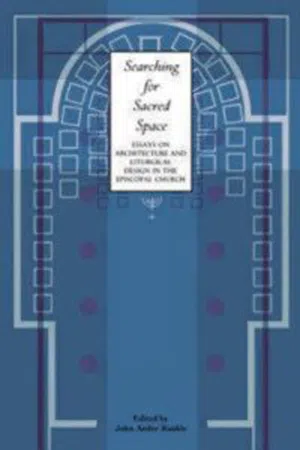
Searching for Sacred Space
Essays on Architecture and Liturgical Design in the Episcopal Church
- 180 pages
- English
- ePUB (mobile friendly)
- Available on iOS & Android
eBook - ePub
Searching for Sacred Space
Essays on Architecture and Liturgical Design in the Episcopal Church
About this book
Information
Topic
Theology & ReligionSubtopic
Architecture GeneralOn Round Liturgical Spaces:
Not Quite a Circular Argument
I.
Once upon a time, I had the good fortune to visit the English industrial city of Liverpool, shortly after the completion, or near completion, of their Roman Catholic and Anglican cathedrals. I was in the midst of a sabbatical stay at the University of Birmingham in the Midlands, working with J. G. Davies at the Institute for the Study of Worship and Religious Architecture. My visit to Liverpool was a “fieldtrip” related to sabbatical studies.
Liverpool Cathedral (Cathedral Church of Christ), which serves the Anglican diocese of Liverpool, is a rectilinear building, very like many earlier large English and European churches. Begun in 1904, it was dedicated in October 1978. It boasts of being the largest of the English cathedrals, splendid in its brick facade and “gothic” character. In design, though not in construction, it could have been conceived in any of the preceding five to seven centuries. It looked like a cathedral, the bricks notwithstanding.
In a way, it struck me as being what might prove to be the last of the “old” English cathedrals, ones built innocent of the liturgical awakening of the twentieth century and prideful of its consistency with certain strands of “tradition.” In a subsequent conversation, the former dean of the cathedral, F. W. Dillistone, reported confidently that the cathedral had adapted to the more modern liturgy quite handily—by which he meant that the high altar had been essentially abandoned in favor of a forward altar at the crossing, surrounded on three sides by chairs.1 This accommodation had become necessary even before the cathedral was finished. During the seventy-odd years of design and construction, much has happened in the liturgical life of the church and those developments have, in some measure, bypassed this massive building.
On the day of my Liverpool visit, after a morning’s tour of the Anglican cathedral, I walked from that “gothic” and “traditional” building to what the Roman Catholics had built for themselves nearby. Metropolitan Cathedral bore absolutely no resemblance to its Anglican counterpart, except perhaps in scale. The Anglican rectangle had been countered by a Roman Catholic circle.
The difference in the impact of these two buildings on me was remarkable. At the Anglican cathedral, I walked through the space with a kind of knowing familiarity. Even in my first visit, I knew that I had “been there before.” Arches, pathways, elevations, order—I had seen all that elsewhere. What I did was analyze, form opinions, evaluate, take notes and slides.
When I walked into the Metropolitan Cathedral, all I could do was sit down, and that for a good long while. I was full of marvel—overwhelmed in my senses and calm in my analytical mind. It was a striking and, to that point in my life, brand new experience.
Begun in 1962 and consecrated on the Feast of Pentecost, 1967, this building differed from the Anglican cathedral in shape, in time of construction, in liturgical accommodation or expectation, and in historical antecedents. If the Anglican cathedral was expressive of “tradition” understood in a particular fashion, the Roman Catholic cathedral was expressive of something else—imagination, wonder, even adventure.
The explorations that follow in this essay are an outgrowth of the day I spent in Liverpool and in these two buildings. The matters to be discussed are frankly related to the differences in my reactions to the two buildings. As the reader will discover, my wonderment at the daring “rotundity” of the Metropolitan Cathedral was significantly tempered as I regained the use of my “analytical mind,” but my initial reaction did not disappear, then or now.
What follows is a limited consideration of the circle as a template for the design of liturgical spaces. I have chosen to look at this matter from three varied and unequally developed perspectives—story, performance, and ecclesiology. Each of these seems to lead to its own conclusions. And the conclusions of each section admittedly do not always sit so well with those of the other sections—thus there will likely be more questions posed than answers given. Nonetheless, I will attempt to make something of all this at the end.
II.
In storytelling that could easily characterize geometry, the circle would have a primary and ascendant place. Rudolf Schwarz describes it forthrightly as “the great, simple, elemental form”2 and the medieval Italian architect Leone Battista Alberti declares, “it is manifest that nature delights principally in round figures, since we find that most things which are generated, made or directed by nature are round.”3 The circle has no beginning and no end. Its “perfection” is manifest. Whether understood as simply a perimeter or a circumference, on the one hand—something linear—or, on the other, as the outer boundary of something contained within it, the circle (and its sibling the sphere) have no equal for signaling perfection, the incontestable resolution of things.
In addition, consider how frequently it is, in common parlance, that the circle serves the geography of the heart, as it does in this small sample from the novelist Rick Bragg’s story about his grandfather’s world.
It was a simple ceremony at a birth, once the hard part was over. The baby would be handed to a relative or a respected neighbor or friend, usually one of the eldest, to honor them. Then the relative would carry the newborn slowly, slowly around the house, talking to it, telling it good, fine, hopeful things. They would hold the baby close to their hearts, so the child could feel that beat, and when the circle was complete the old people would give it back to the mother without a word.4
This “sacred circle” is the place of safety for the infant, the place of counsel and advice—“good, fine, hopeful things”—that work to the well-being of the child. The circle is the genesis place for the making of the family and the circling did the necessary work to gather the child in, and to set the child on the right path, to give the child “a little something extra.” The circle was necessary by its very nature.
To this literary example, we could add countless other sorts of instances where circularity and rotundity play an important and yet incidental role in our language. “Circle the wagons,” “circle of friends,” “sewing circle,” “curling up,” “gathering round”—these are but a few instances. Yet these add their own nuances to the evidence we are gathering; they signal the variety of meanings and uses to which this image is commonly put.
In a more analytical vein, the Norwegian architect, Christian Norberg-Schulz, has explored the relationship between a human being and the occupancy of physical space, particularly in its geographical expression. In this exploration, he speaks about the ordering of what he calls “existential space.”5 He goes on to say that it is possible “to describe some basic structural properties which are common to all existential spaces. These properties are related to the archetypal relations of primitive symbolism and constitute the point of departure for any further development of spatial images and concepts.” These concepts Norberg-Schulz called “places, paths and domains.”6
As I described these “motifs” in an earlier publication, “Domains constitute the field upon which the other two reside [places and paths]. They have a unifying function in existential space for they form a relatively unstructured ground on which places and paths appear as more pronounced figures.” In one sense, domains are the “remainder”; in another, they constitute what is ordinary. Places are “centers,” the most basic element in existential space, experienced as “insides,” and typically round. They are, however, not only “goals or foci” but also “points of departure from which we orient ourselves.” Paths can be horizontal or vertical; they are relational and interconnective; they give our existential space “a more particular structure.”7
In this typology, it is “places” that are particularly important to our current conversation since they are understood to be “round.” They are points of settlement. One goes to them and departs from them, traversing on paths. Yet, between arriving and departing, one dwells.8One is “in place.” As Schwarz uses this figure—which he most often calls a “ring”—he finds this “the warm and inward form.”9 Indeed, his consideration of the ring as an architectural form he entitles “sacred inwardness.”10
Moving along the same line and engaging a very similar vocabulary, Rudolf Arnheim, in The Dynamics of Architectural Form, writes about the way that the transept, when introduced into Gothic church buildings, creating the “crossing,” transformed the building “from a channel into a place because any crossing marks a place.” He continues, “Mere passage gives way to stable position. A building can be said to become a “place” … when its basic patterns occupy both horizontal dimensions, not just one. The building makes its mark.”11 A bit later, Arnheim describes the ascendancy of the centralized church plans of the Renaissance saying that “these buildings eliminate the sense of the linear path and also of the crossing, and offer instead a self-contained, closed-off dwelling place.”12
At the same time, it is important to acknowledge the “path” that runs vertically through a “place,” the vertical that runs through the circle, often understood to be the “axis mundi,” that around which everything revolves. Norberg-Schulz describes this vertical path as not only the connection point of earth with all that is above and below, but also as the point at which all horizontal points begin and end. In this way, it is either the end or the beginning of everything.13
Engaging this same matter from a different perspective is Lauren Artress’s book, Walking the Sacred Path: Rediscovering the Labyrinth as a Spiritual Tool.14 On the cover is clearly a circle with a very distinct center. Yet the book is about a path, the walking of which is the “centering” aspect. Arrival in any physical sense is the servant of the spiritual pilgrimage. Here we find circle, center, and path richly intermingled as images.
To this point, we are beginning to accumulate a certain set of words used to describe the nature of circular configuration—“perfect,” “complete,” “inward,” “stable,” “ingathering,” “self-contained,” “center,” “closed-off.” We add to this list from Gaston Bachelard, whose book, The Poetics of Space, a lyrical and imaginative excursion into more dense philosophical terrain, concludes with a consideration of “The Phenomenology of Roundness.”15
Using what he calls “an image that is outside all realistic meaning,” Bachelard describes the use of bird and birdsong by Michelet and Rilke ...
Table of contents
- Cover
- Title
- Copyright
- Contents
- Acknowledgments
- Introduction
- A Call for Bold Leadership in New Church Building Design
- It’s Not About Us
- Can We Talk about A Theology of Sacred Space?
- Monuments, Myths and Mission: Are these Ruins Inhabited?
- Highly Effective Episcopal Architecture: Integrating Architecture and Worship to Reflect A Church’s Identity
- Anglican Church Plans: A Brief History
- A House for The Church that Sings
- On Round Liturgical Spaces: Not Quite A Circular Argument
- Sacred Political Space: An Anglican Ethos
- House of Justice
- Rending the Temple Veil: Holy Space in Holy Community
- The Making of A Cathedral
- Appendix: Resource Bibliography
- Contributors
Trusted by 375,005 students
Access to over 1.5 million titles for a fair monthly price.
Study more efficiently using our study tools.
Frequently asked questions
Yes, you can cancel anytime from the Subscription tab in your account settings on the Perlego website. Your subscription will stay active until the end of your current billing period. Learn how to cancel your subscription
No, books cannot be downloaded as external files, such as PDFs, for use outside of Perlego. However, you can download books within the Perlego app for offline reading on mobile or tablet. Learn how to download books offline
Perlego offers two plans: Essential and Complete
- Essential is ideal for learners and professionals who enjoy exploring a wide range of subjects. Access the Essential Library with 800,000+ trusted titles and best-sellers across business, personal growth, and the humanities. Includes unlimited reading time and Standard Read Aloud voice.
- Complete: Perfect for advanced learners and researchers needing full, unrestricted access. Unlock 1.5M+ books across hundreds of subjects, including academic and specialized titles. The Complete Plan also includes advanced features like Premium Read Aloud and Research Assistant.
We are an online textbook subscription service, where you can get access to an entire online library for less than the price of a single book per month. With over 1.5 million books across 990+ topics, we’ve got you covered! Learn about our mission
Look out for the read-aloud symbol on your next book to see if you can listen to it. The read-aloud tool reads text aloud for you, highlighting the text as it is being read. You can pause it, speed it up and slow it down. Learn more about Read Aloud
Yes! You can use the Perlego app on both iOS and Android devices to read anytime, anywhere — even offline. Perfect for commutes or when you’re on the go.
Please note we cannot support devices running on iOS 13 and Android 7 or earlier. Learn more about using the app
Please note we cannot support devices running on iOS 13 and Android 7 or earlier. Learn more about using the app
Yes, you can access Searching for Sacred Space by John Ander Runkle in PDF and/or ePUB format, as well as other popular books in Theology & Religion & Architecture General. We have over 1.5 million books available in our catalogue for you to explore.