![]()
PART I
No one who has given thought to the way we talk about God can adequately grasp the terms pertaining to God. “Mother,” for example, is mentioned (in the Song of Songs 3:11) instead of “father.” Both terms mean the same, because there is neither male nor female in God.
St. Gregory of Nyssa
Fourth Century
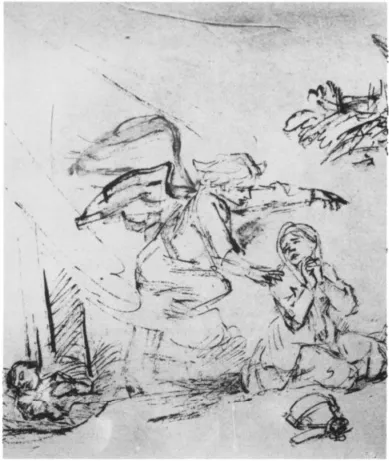
The appearance of an angel to Hagar is the first incident of angelic visitation recorded in Scripture.
The Angel appearing to Hagar in the desert, circa 1655-57.
Rambrandt van Rijn (1606-1669). Kunsthalle, Hamburg, Germany.
Photo credit: Foto Marburg/Art Resource, NY.
![]()
CHAPTER ONE
WE BELIEVE IN ONE GOD
Fools say in their hearts, “There is no God.” This first line of Psalm 53 reminds us that not all can say the powerful life-changing first words of the Nicene Creed, “We believe in one God.”
Throughout the centuries, theologians and philosophers have grappled with how these words can be uttered with conviction. In the thirteenth century, St. Thomas Aquinas, one of the greatest classical theologians of the Christian church, used human reason to deduce that there must be a God. He postulated that if life exists, there must have been a first cause that brought life into existence. His first-cause theory sought to explain God’s existence in rational terms.
Others, such as Ludwig Feuerbach, a nineteenth-century German philosopher whose writings influenced Nietzsche and Marx, used human reason to reach the opposite conclusion. He asserted that “the Christian God was nothing else than the projection of human wishes and needs. Men and women should be liberated from this illusion.”1
Thus, human reason can devise logical constructs to prove that God both exists and does not exist. It is for this reason that we do not say as we recite the creed, “There is one God” but rather, “We believe in one God.”
The Latin word for “I believe” is credo, from which the English word creed derives.2 Thus, this statement of faith takes its name from the word for believe. For it is, in the final analysis, belief that is required when one speaks of God.
This first article of the Nicene Creed was originally a profession of monotheistic faith, in opposition to the pagan belief in many gods. The creed begins with the statement that as Christian people we believe in the one true God, not in the many gods of Canaanite, Roman, or Greek culture, but in the one true God revealed through scripture.
In addition, through these first five words of the creed, Christians are linked with their Jewish and Islamic sisters and brothers throughout the world, for all three faiths profess belief in the one true God. “We believe in one God.” As we say these words, if we could remember this common bond, bridges might be crossed and the bricks of the walls that can separate us might be removed one at a time.
In remembering our common bond, it is important not to forget how it was established, for to ignore the hurt that was inflicted at the inception of Islam, as recorded in Genesis, is to reinflict that pain and hurt.
The sixteenth chapter of Genesis tells us:
Now Sarah, Abraham’s wife, bore him no children. She had an Egyptian slave-girl whose name was Hagar, and Sarah said to Abraham, “You see that the Lord has prevented me from bearing children; go in to my slave-girl; it may be that I shall obtain children by her. And Abraham listened to the voice of Sarah … He went in to Hagar, and she conceived; and when she saw that she had conceived, she looked with contempt on her mistress … Then Sarah dealt harshly with her, and she ran away from her … Hagar bore Abraham a son; and Abraham named his son, whom Hagar bore, Ishmael … And Abraham said to God, “O that Ishmael might live in your sight!” God said, “No, but your wife Sarah shall bear you a son, and you shall name him Isaac. I will establish my covenant with him as an everlasting covenant for his offspring after him. As for Ishmael, I have heard you; I will bless him and make him fruitful and exceedingly numerous; he shall be the father of twelve princes, and I will make him a great nation” (Gen. 16:1, 2, 4, 6b, 15, 17-20).
As tradition has it, Ishmael’s offspring became primarily the Islamic people of the world, while Isaac’s offspring became the Jewish people. It is, of course, the Jewish faith that gave birth to Christianity.
Therefore, Christianity, Judaism, and Islam share a common heritage that began when both Sarah and Abraham used their Egyptian slave-girl Hagar to meet their own needs. The inequality in the relationship between these two women holds special meaning for victims of inequality today.
In her book Just a Sister Away, womanist biblical scholar Renita J. Weems writes: “For black women, the story of Hagar in the Old Testament book of Genesis is a haunting one. It is a story of exploitation and persecution suffered by an Egyptian slave woman at the hands of her Hebrew mistress … For black women, Hagar’s story is peculiarly familiar. It is as if we know it by heart.”3 She goes on to state: “As black and white women in America, as Israeli and Lebanese women, as white South African and black South African women, as Asian and European women … working for righteousness in splendid isolation from one another is a luxury we cannot afford.”4
As we work for righteousness in harmony with one another, it is helpful to remember the common heritage of Judaism, Christianity, and Islam that underlies the first five words of the Nicene Creed. Let us not ignore or gloss over the pain that was inflicted at the inception and throughout the history of Jewish/Islamic, Jewish/Christian, and Christian/Muslim relations. In remembering our common ancestry in all its detail, perhaps we will not repeat the mistakes of the past.
However differently these three faiths may articulate the reality of God and live out their understanding of God, the common heritage remains. This heritage finds its connecting point in Abraham, Sarah, and Hagar and in God’s relationship to their offspring, yet it is often only Abraham’s name that is mentioned in the liturgy of the church. It is important to remember Sarah and Hagar and their pain as women within the patriarchal tradition, a pain that was lived out in their relationship with one another. In remembering their gift to us, perhaps the ties that bind will grow ever stronger.
This tie that binds is encapsulated in the beginning of our creed, “We believe in one God.” This is not to say that the writers had this in mind when the Nicene Creed was formulated - far from it. Yet, in our pluralistic world today such connections beg to be uncovered, brought into the light, and realistically examined.
Who is this God in whom we profess belief? The most frequently used Hebrew name for God, “Yahweh,” tells us a great deal about who God is. “Whatever else ‘Yahweh’ might have connoted - it meant ‘the one who is with you’ (Exodus 3:12, ‘I AM with you’).”5
God is the one who is with us at our birth, throughout our life, at our death. God is the one who is with us when human constructs and situations fail us. God is the one who is with us in our suffering and pain, as well as in our relief and joy.
But now thus says the LORD, he who created you, O Jacob, he who formed you, O Israel: Do not fear, for I have redeemed you; I have called you by name, you are mine. When you pass through the waters, I will be with you; and through the rivers, they shall not overwhelm you; when you walk through fire you shall not be burned, and the flame shall not consume you. For I am the Lord your God, the Holy One of Israel, your Savior. (Isa. 43:1-3)
Yes, “We (Christians, Jews, and Muslims) believe in one God.” This one God has been with all of us throughout the troubled history of our relations. This one God must yearn for us all not to repeat the mistakes of the past.
As we recite the Nicene Creed, may we remember this common heritage and what it can mean for peace in our world today.
![]()
CHAPTER TWO
THE FATHER ALMIGHTY
In his catechetical lectures, delivered in the fourth century, St. Cyril of Jerusalem tells us, “This alone will be a sufficient incentive to piety, to know that we have a God, a God who is one, a God who is, who is eternal, who is ever the self-same … who is honored under many names.”1
God is “honored under many names” throughout scripture and within the tradition of our faith. In Hebrew scripture, God was known by many variants of name. In Exodus 6:2ff, we are told: “The Elohim spoke to Moses, and he said to him, ‘I am Yahweh’; and I appeared to Abraham, to Isaac, and to Jacob as El Shaddai, but by my name Yahweh I did not become known to them.”2 Thus, within Hebrew scripture, God is spoken of as Elohim, Yahweh, and El Shaddai, with Yahweh being the most frequently used name for God.
Throughout scripture, diverse images arising out of human experience and nature are used to describe God.3 These images are written as metaphors, similes, or even descriptions of the Kingdom of God, yet all describe a God who is indeed beyond our naming. Within scripture, God is imaged as judge (Gen. 18:25); midwife (Ps. 22:9-10) dew, gardener (Hos. 14:5-7); bearer and protector (Isa. 46:3-4); rock, fortress, deliverer (2 Sam. 22:2-3); daddy or father (Mark 14:36); comforting mother (Isa. 66:13); “I am” (Exod.3:14); good shepherd (Ps. 23:1); lion, leopard, she-bear (Hos. 13:4-8); shepherd looking for a lost sheep and woman searching for a lost coin (Luke 15); consuming fire (Heb. 12:29); and compassionate mother (Isa. 49:14-16).4
Can the totality of your experience of God be contained within one image, or are numerous images needed? The writers of scripture needed a host of images to describe the richness of their experience of God; the same is true of some of the church fathers.
For example, St. Clement of Alexandria (150-215) uses both male and female images of God. St. Clement writes: “The Word is all to the child, both father and mother, tutor and nurse.”5 Likewise, St. Ambrose (339-397), Bishop of Milan, uses both female and male imagery to describe God when he describes Jesus as being the only begotten Son from God’s “paternal womb.”6 Martin Luther writes that when we suffer, God comforts us as a mother comforts a child at her breast and that through the Word and faith we receive a “profoundly paternal love and thoroughly maternal caresses.”7 In a similar vein, John Calvin writes that God is not content “with proposing the example of a father … but in order to express his very strong affection, he chose to liken himself to a mother.”8
In Legatus, written in the thirteenth century by St. Gertrude of Helfta, God is described as a mother who uses her robe to cover a child that is too young for clothes. God is also imaged as a mother who teaches her daughter to work by guiding her hand.9
Thus, throughout scripture and the tradition of our church, numerous male and female images are used to refer to God. Why then was only one image for God, Father, used in the creed?
Throughout the tradition of our church, God has been referred to predominately as Father because Jesus addressed God as abba, which literally translated means “daddy.” Through his designation of God as abba, Jesus expressed the extremely personal and intimate nature of his relationship with God. In Resurrection, Rowan Williams writes: “The Spirit is given so that we may name God as ‘Father,’ more exactly, as ‘Abba’, as Jesus’ father (Rom. 8:15; Gal. 4:6). ‘God’ appears in human history under the name of ‘the one whom Jesus calls Abba.’” Even so, Williams goes on to acknowledge that “‘Father’ is a colossally problematic word.”10
Whereas Jesus’ naming of God as abba is clearly an important part of his revelation about God, it does not stand alone but in conjunction with other revelations. “Jesus’ language about God is not monolithic but is diverse and colorful, as can be seen in the imaginative parables he spun out. A woman searching for her lost money, a shepherd looking for his lost sheep, a bakerwoman kneading dough … the birth experience that delivers persons into new life, an employer offending workers by his generosity.”11 If we take Jesus’ revelations about God seriously, shouldn’t we take all of his revelations into account? The use of one to the exclusion of others distorts the image of the one God who is beyond our naming, the one God clothed in divine incomprehensibility.
In Spiritual Friend, Tilden Edwards writes:
The names of God in scripture reflect al...