The story of Episcopalians in America is the story of an influential denomination that has furnished a large share of the American political and cultural leadership. Beginning with the Episcopal Church's roots in sixteenth-century England, The Episcopalians offers a fresh account of its rise to prominence. Chronologically arranged, it traces the establishment of colonial Anglicanism in the New World through the birth of the Episcopal Church after the Revolution and its rise throughout the nineteenth century, ending with the complex array of forces that helped shape it in the 20th century and the consecration of Gene Robinson in 2003.
The authors focus not only on the established leadership of the church but also to the experience of lay people, the form and function of sacred space, the evolution of church parties and theology, relations with other Christian communities, and the evolving ministries of women and minorities.
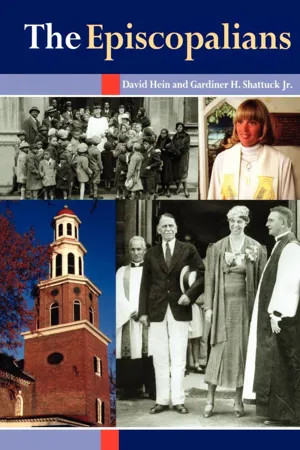
- 361 pages
- English
- ePUB (mobile friendly)
- Available on iOS & Android
eBook - ePub
The Episcopalians
About this book
Information
Topic
Theology & ReligionSubtopic
Christian DenominationsPart One
THE EPISCOPALIANS: A HISTORY
1
ENGLISH AND AMERICAN BEGINNINGS: 1534–1662
Episcopalians in the United States trace their religious roots back to the sixteenth century, when Anglicanism emerged as a distinct denominational tradition out of the Protestant Reformation in England.1 Originally a missionary extension of the Church of England in colonial America, the Episcopal Church itself was organized in the aftermath of the American Revolution. Because “Church of England” was no longer suitable as an ecclesiastical designation in the new United States, a convention of Anglican clergy and laity meeting in Chestertown, Maryland, in 1780 chose the name “Protestant Episcopal Church” instead. The term “Protestant” differentiated the denomination from Roman Catholicism, and “Episcopal” signified that the church’s polity had retained the ministry and authority of bishops.2 From the outset, Episcopalians emphasized that their church included Catholic as well as Protestant elements—a heritage both ancient and reformed.
PRE-REFORMATION BRITISH CHRISTIANITY
Although there is no certain date for the planting of Christianity in Britain, it was probably established there by soldiers during the Roman occupation. The earliest archaeological evidence dates from the fourth century, after Christianity had become the official religion of the Roman Empire, and three bishops from England are known to have attended the Council of Arles in 314. The British monk Pelagius, whose views on human free will brought him into conflict with the theologian Augustine of Hippo, had a profound impact on church life in the early fifth century. Whereas Pelagius believed that Christians could rely on their own willpower to live morally perfect lives, Augustine argued that men and women attained salvation by virtue of divine grace alone. Augustine’s ideas prevailed, and Pelagianism was eventually condemned as heretical at the Council of Ephesus in 431.
With the sack of Rome in 410 and the general collapse of imperial authority in the West, Saxons and other pagan tribesmen effectively destroyed the structures of government, culture, and religion in England. Although the British churches were cut off from communication with the papacy in Rome, the Celtic monastic tradition in Ireland and in the western and northern regions of Britain remained vibrant over the next two centuries. To restore papal authority over the British isles, Pope Gregory the Great organized a mission under the leadership of the Benedictine monk Augustine in 597. Augustine landed in Kent, where he was well received by the pagan Saxon king. A few months after his arrival, he was consecrated as the first bishop of the English people, and according to one report, he baptized about ten thousand pagan converts in the Canterbury area at the end of the year.3 Despite Augustine’s success in evangelizing the Saxons, inconsistencies between Celtic and Roman Christianity—most notably, disagreement about the dating of Easter day—proved to be troublesome and enduring. Not until the Synod of Whitby in 664 were Celtic liturgical practices and beliefs finally brought into line with those of the church at Rome.
Its official allegiance to the traditions of Roman Catholic Christianity notwithstanding, the church in England, like the church in France, enjoyed a considerable measure of autonomy throughout the medieval period. Moreover, during the fourteenth and fifteenth centuries, western Christendom as a whole was torn by a series of crises that further undercut papal power: first, the removal of the papacy from Rome to Avignon in France (1305–1377); second, the development of the Great Schism (1378–1417), when there were two, and later three, popes; and finally the rise of the conciliar movement (1418–1449), when the reunited papacy contended against a succession of general councils for supremacy within the church. As the prestige of the papacy waned during this era, English bishops increasingly recognized the authority of the king, rather than of the pope, in ecclesiastical matters in their nation. The passage of several secular statutes in the fourteenth century further curtailed the ability of the papacy to exercise control over the church in England—legislative actions that would be used as precedents for severing ties to Rome two centuries later.
Reformer John Wyclif was undoubtedly the most influential religious leader in English Christianity in the late Middle Ages. Wyclif not only attacked priests and bishops who abused their power in the church but also emphasized the importance of the Bible and encouraged its translation from Latin into English. In addition, he expressed strong doubts about papal supremacy, suggesting that the papacy was an institution of the Antichrist and arguing that it was the God-given responsibility of secular rulers to reform a corrupted church. The fact that criticism of Wyclif was relatively muted during his lifetime (he died in 1384) suggests a far broader range of acceptable theological opinion in England than in other Catholic countries in Europe during the fourteenth century. Indeed, a follower of Wyclif put to death in 1401 was the first person to be executed for heresy in England since 1216—a remarkably tolerant record given the nature of religious affairs in those times.4 Although Wyclif’s teachings were not an immediate cause of the English Reformation, his ideas certainly helped foster the intellectual atmosphere in which later church reforms were nurtured.5
One of the most heated debates among modern-day scholars concerns the character of religious faith in England immediately preceding the Reformation. On the one hand, widening educational opportunities in the sixteenth century helped create a relatively literate laity within the ranks of leading landowners and merchants. This group became increasingly aware of both the criticisms of conventional piety and the demands for church reform that were then surfacing in the great centers of learning on the European continent. On the other hand, traditional Catholicism still retained a strong hold on the English population as a whole. As historian Eamon Duffy has argued, the beliefs and practices of most English Christians on the eve of the Reformation were remarkably conservative. Despite inroads made by the earliest Protestants, much of the older imagery and forms of reverence in English parishes remained largely unchanged in the early sixteenth century.6 Because this liturgical and theological conservatism was so strong, the unwarranted secular privileges of the church, rather than any defects in traditional Catholic piety, tended to motivate the first ecclesiastical changes that occurred in England.7
Although the medieval ideal of a unified Christendom was still officially intact when Henry VIII ascended the English throne in 1509, the long-standing symbiosis of church and society in Europe was about to be destroyed. This unity was irrevocably sundered on December 10, 1520, when Martin Luther publicly burned both the papal bull condemning his teachings and the books of canon law binding Western Christianity to the authority of the pope. Yet despite the religious revolt led by Luther in Germany and by Ulrich Zwingli in Switzerland in the 1520s, English church leaders initially resisted the spread of Protestantism into their country from the Continent. The bishop of London and the archbishop of Canterbury both condemned William Tyndale’s groundbreaking translation of the New Testament into English, and Henry himself received the title “Defender of the Faith” from Pope Leo X for his opposition to Luther’s teachings on the sacraments. Thomas More also rose in the king’s favor at this time and took an active role in suppressing Lutheran ideas in England. Thus, when Henry’s break from Rome finally did take place, those who favored the independence of the English church advanced their arguments primarily in political, not theological or liturgical, language.
THE REFORMATION ERA
Although Henry originally had no intention of encouraging the growth of the Reformation in his realm, an unplanned series of events effected a profound revolution within the church in England. The process of ecclesiastical change began during the reign of Henry’s father, Henry VII. In an effort to secure a useful diplomatic alliance, Henry VII gave his eldest son, Arthur, into marriage with Catherine of Aragon, daughter of the powerful King Ferdinand and Queen Isabella of Spain. When Arthur died after only a few months of marriage, the English king offered his second son, Henry, to the young widow. Since church canons forbade such a union on the basis of biblical passages in Leviticus (ancient Israelite laws that equated sexual relations between a man and his brother’s wife with incest), a special papal dispensation had to be obtained from Pope Julius II.
Julius allowed Henry and Catherine to be married in 1509, but despite receiving the pope’s blessing, the English royal couple saw only one child (Mary Tudor, born in 1516) survive from Catherine’s numerous pregnancies. By the time Catherine reached age 40 in 1525, Henry believed that his wife would no longer be able to conceive or bear children. Because he needed a male heir to secure the stability of the Tudor reign, and because he may genuinely have believed that he had committed a grave sin by marrying his brother’s wife, Henry asked Pope Clement VII to annul his marriage to Catherine. The pope, however, refused. Since he was a virtual prisoner of the most powerful ruler in Europe—Charles V, Holy Roman emperor and Catherine’s nephew—Clement was in no position to grant the English king’s request.8
The pope’s understandable rebuff set the stage for Henry to declare the independence of the English church from obedience to Rome. In January 1533, Thomas Cranmer, the newly appointed archbishop of Canterbury, pronounced Henry’s marriage to Catherine invalid, and at the same time he officiated at the king’s marriage to his mistress Anne Boleyn, then pregnant with the future queen, Elizabeth I. Meanwhile, a series of parliamentary acts culminated in the 1534 declaration that the king was “the only supreme head on earth of the Church of England.” At the same time, the English clergy officially affirmed that no foreign bishops, including the pope, had any right to exercise jurisdiction over ecclesiastical affairs in Henry’s realm.9 Although Thomas More, the former lord chancellor, and John Fisher, bishop of Rochester, were later executed for refusing to accept the royal supremacy in church matters, most religious and secular leaders in England acquiesced because they did not think that ecclesiastical independence implied the repudiation of Catholic doctrine. Indeed, Henry’s Six Articles act of 1539 upheld such traditional Catholic teachings as transubstantiation (the substance of the communion bread and wine is miraculously transformed into the actual body and blood of Christ), private confession to a priest, and mandatory clerical celibacy.
When Henry died in 1547, he was succeeded by Edward VI, the child of his third wife, Jane Seymour. Since Edward was only a boy when he ascended the throne, his uncle Edward Seymour was appointed lord protector, thereby assuming control over the affairs of state. Since both Seymour and his successor, John Dudley, were avowed Protestants, significant changes began to occur in English church life during Edward’s reign. All persecution of Protestants was ended, and a number of leading continental reformers, such as Martin Bucer and Peter Martyr Vermigli, were invited to serve at university posts in England. In addition, laws prohibiting clerical marriage were abandoned, and the use of English (instead of Latin) in worship was strongly encouraged. The scholarly archbishop Thomas Cranmer proved to be the principal architect of church reform in this period. He was the author of the first Book of Common Prayer in 1549, and when some militant reformers criticized his work as too “popish” and conservative, he helped produce a revised, more identifiably “Protestant” prayer book, which was mandated for use in English parishes three years later, in 1552. Cranmer also composed the Forty-Two Articles, a statement of faith that took a mediating position between the theological views of Martin Luther and John Calvin, repudiated papal supremacy and key medieval eucharistic doctrines, and vigorously condemned the radical, antinomian Protestantism espoused by Anabaptists on the Continent.
Despite the significance of the many church reforms introduced during Edward’s reign, the young king’s early death and the accession of his half-sister Mary in 1553 brought about the temporary restoration of Roman Catholicism in England. Viewed from Mary’s perspective, the situation was extraordinarily serious, for the English people had fallen into a state of mortal sin when her father severed the nation’s ties with Rome.10 Thus, in an effort to save souls, she employed her powers as supreme head of the church to forbid further use of the English Prayer Book, to depose any priest who had broken his vow of celibacy, and ultimately to repeal all antipapal legislation.
Although these actions were by no means unacceptable to the majority of the English people, whose hearts and minds were still strongly attached to Catholicism, Mary’s religious zeal led her to make two crucial mistakes. First, to bring her country into a closer relationship with continental Catholicism, she married the son of Emperor Charles V, Philip II of Spain, thus identifying her reign with the nation that was England’s most bitter rival. Second, against the advice of even Philip and Charles, she revived the application of medieval heresy laws—a policy that occasioned the martyrdom of about three hundred Protestants, including leading figures such as Thomas Cranmer. The threat of martyrdom also forced many other Protestants to flee to the Continent, where in areas controlled by Lutherans, Zwinglians, and Calvinists their theological views were further radicalized. Thus, contrary to Mary’s fondest wishes, her actions succeeded only in turning her subjects against the faith in which s...
Table of contents
- Cover
- Title
- Copyright
- Contents
- Preface
- Abbreviations for Standard Sources
- Part One The Episcopalians: A History
- Part Two A Biographical Dictionary of Leaders in the Episcopal Church
- Index
- About the Authors
Trusted by 375,005 students
Access to over 1.5 million titles for a fair monthly price.
Study more efficiently using our study tools.
Frequently asked questions
Yes, you can cancel anytime from the Subscription tab in your account settings on the Perlego website. Your subscription will stay active until the end of your current billing period. Learn how to cancel your subscription
No, books cannot be downloaded as external files, such as PDFs, for use outside of Perlego. However, you can download books within the Perlego app for offline reading on mobile or tablet. Learn how to download books offline
Perlego offers two plans: Essential and Complete
- Essential is ideal for learners and professionals who enjoy exploring a wide range of subjects. Access the Essential Library with 800,000+ trusted titles and best-sellers across business, personal growth, and the humanities. Includes unlimited reading time and Standard Read Aloud voice.
- Complete: Perfect for advanced learners and researchers needing full, unrestricted access. Unlock 1.5M+ books across hundreds of subjects, including academic and specialized titles. The Complete Plan also includes advanced features like Premium Read Aloud and Research Assistant.
We are an online textbook subscription service, where you can get access to an entire online library for less than the price of a single book per month. With over 1.5 million books across 990+ topics, we’ve got you covered! Learn about our mission
Look out for the read-aloud symbol on your next book to see if you can listen to it. The read-aloud tool reads text aloud for you, highlighting the text as it is being read. You can pause it, speed it up and slow it down. Learn more about Read Aloud
Yes! You can use the Perlego app on both iOS and Android devices to read anytime, anywhere — even offline. Perfect for commutes or when you’re on the go.
Please note we cannot support devices running on iOS 13 and Android 7 or earlier. Learn more about using the app
Please note we cannot support devices running on iOS 13 and Android 7 or earlier. Learn more about using the app
Yes, you can access The Episcopalians by David Hein,Gardiner H. Shattuck,Gardiner H. Shattuck, Jr. in PDF and/or ePUB format, as well as other popular books in Theology & Religion & Christian Denominations. We have over 1.5 million books available in our catalogue for you to explore.