The "difficult psalms" which amount to more than a third of the Psalter, shock us with their cries of pain, anger, and alienation. They call on God for revenge on their enemies and mercy for themselves. Lyn Fraser, following the lead of Old Testament theologian Walter Brueggemann, shows how to integrate these "psalms of disorientation" in Sunday morning worship, pastoral care, and any situation of extreme need.
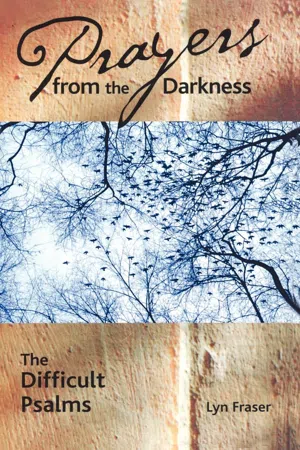
- 144 pages
- English
- ePUB (mobile friendly)
- Available on iOS & Android
eBook - ePub
About this book
Information
Topic
Theology & ReligionSubtopic
Biblical Studies
PART ONE
Corporate Worship
CHAPTER ONE
Yours Is the Day, Yours Also the Night
The Difficult Psalms
Some psalms are never a part of Sunday worship. Among those we do not hear on Sundays are psalms with such unsavory themes as the desire for vindication (“Let ruin come on them unawares,” Ps. 35:8), the violation of sacred spaces (“The enemy has destroyed everything in the sanctuary,” Ps. 74:3), mistreatment by friends (“You have caused my companions to shun me,” Ps. 88:8), acute isolation (“I am like a lonely bird on the housetop,” Ps. 102:7), and our own mortality (“You have made my days a few handbreadths, and my lifetime is as nothing in your sight,” Ps. 39:5).
More commonly, we chant, pray, or read responsively about joy (“Therefore my heart is glad, and my soul rejoices,” Ps. 16:9), blessings (“I will bless the LORD at all times,” Ps. 34:1), the wonders of God’s creation (“O LORD, how manifold are your works! In wisdom you have made them all; the earth is full of your creatures” (Ps. 104:24), and thanksgivings (“I give you thanks, O LORD, with my whole heart,” Ps. 138:1). If we consider the psalms to be integral to our lives of faith through worship, however, all of these voices need to be heard because they reflect important aspects of how things actually are—in our lives, in our world, and within the church itself.
Well over two thousand years ago the psalmists related their personal and communal experiences of spirituality, collected as the book of Psalms. The psalms provide a major source in the Old Testament of the personal voice: humans speaking directly to God, rather than God speaking to humans or humans addressing one another. This body of work remains an incomparable spiritual resource in part because the psalmists’ beliefs and feelings are much the same ones that we live with on a daily basis in the twenty-first century. Whatever our current condition—from the darkness of despair, grief, alienation, and anger to the brightness of joy, delight, praise, and thanksgiving—the psalmists invite us to honest and direct communication with God without holding anything back.
Much of what the psalmists express is not pleasant. The psalmists whine and complain. They are angry, bitter, and frustrated. They bargain and manipulate. They have crises and confrontations with neighbors, friends, and enemies. They grieve and moan. They are scared and insecure and self-pitying. They are spiteful and vindictive when things don’t go their way. But they also embrace paradox, acknowledging that lightness and darkness can coexist in our lives, that God can be both present and absent. Even when sinking in deep mire where there is seemingly no foothold, they express their faith in God.
The psalms were written for a culture quite different from ours. C. S. Lewis, writing about the “cursing” psalms in Reflections on the Psalms, reminds us that the psalmists “lived in a world of savage punishments, of massacre and violence, of blood sacrifice. . . . And of course, too, we are far more subtle than they in disguising our ill will from others and from ourselves” (25). In spite of—and in some ways because of—differences in time and place, the psalms embody a transforming power by providing access to the psalmists’ personal expressions of thoughts and feelings as they experience a living God. Their openness and honesty reflect an overwhelming trust in God.
Those Awful Ones
When Jim told me the story in the introduction about helping Lila, the young woman who had been raped, he said that she referred to some psalms as “those awful ones.” Of course, I knew right away what psalms she meant. Lila is not alone in referring to some of the psalms with this and other similarly negative terms. They are the psalms, such as those cited in the introduction and at the beginning of this chapter, that readers find difficult to read and hear. They are awful, in the sense of being unpleasant, appalling, dreadful, and fearsome. Over the history of the English language, however, “awful” is one of the many words that has changed in meaning. When James II first saw St. Paul’s Cathedral he called it, among other things, “awful,” by which he meant that it was “deserving of awe” (Bryson 78). So these psalms are awful from several perspectives, but they are also more than awful.
One term for the body of psalms that I am going to use throughout the book is based on the work of Old Testament scholar and theologian Walter Brueggemann. In The Message of the Psalms, Brueggemann presents a scheme for categorizing the psalms in a way that reflects our life process by using themes of orientation, disorientation, and new orientation. An essential understanding is that life is not static; we move from one situation to another, changing and being changed. Brueggemann suggests that the life of faith, as expressed through the psalms, reflects that dynamic process. We move out of settled orientation into seasons of disorientation, and from disorientation into times of new orientation, where we are surprised by new gifts from God and experience a fresh sense of coherence. This progression applies both communally—to families, groups, organizations, congregations, a nation, the world—and to each of us as individuals.
Psalms of orientation reflect our seasons of well-being. These psalms articulate joy, goodness, delight, and order; they recognize and celebrate God’s word, God’s reliability, and God’s creation. An example is Psalm 8, a psalm of creation that articulates God’s overriding majesty while conveying security for humankind in a well-ordered creation where humans have authority, slightly below God, over the works of God’s hands. As a border, the psalm begins and ends with the same doxology verse, praising God.
Orientation: Psalm 8
O LORD, our Sovereign, how majestic is your name in all the earth!
You have set your glory above the heavens. Out of the mouths of babes and infants
you have founded a bulwark because of your foes, to silence the enemy and the avenger.
When I look at your heavens, the work of your fingers, the moon and the stars that you established;
what are human beings that you are mindful of them, mortals that you care for them?
Yet you have made them a little lower than God, and crowned them with glory and honor.
You have given them dominion over the works of your hands; you have put all things
under their feet,
all sheep and oxen, and also the beasts of the field,
the birds of the air, and the fish of the sea, whatever passes along the paths of the seas.
O LORD, our Sovereign, how majestic is your name in all the earth!
Psalms of disorientation acknowledge periods of alienation, despair, and suffering, evoking emotions of anger, resentment, vengeance, self-pity, fear, shame, hostility, and grief. The psalms of disorientation express anguish, disarray, and alienation from God. Psalm 6, for example, is a personal lament.
Disorientation: Psalm 6
O LORD, do not rebuke me in your anger, or discipline me in your wrath.
Be gracious to me, O LORD, for I am languishing;
O LORD, heal me, for my bones are shaking with terror.
My soul also is struck with terror, while you, O LORD—how long?
Turn, O LORD, save my life; deliver me for the sake of your steadfast love.
For in death there is no remembrance of you; in Sheol who can give you praise?
I am weary with my moaning; every night I flood my bed with tears; I drench my couch with my weeping.
My eyes waste away because of grief; they grow weak because of all my foes.
Depart from me, all you workers of evil, for the LORD has heard the sound of my weeping.
The LORD has heard my supplication; the LORD accepts my prayer.
All my enemies shall be ashamed and struck with terror; they shall turn back, and in a moment be put to shame.
In a lament, whether personal or communal, the psalmist typically makes a personal plea to God (“O LORD”); describes specific complaints (“languishing,” “struck with terror,” “weary with my moaning,” “eyes waste away”; lists the actions needed by God (“save my life,” “deliver me”); explains why God should intervene (“for the sake of your steadfast love”); offers something in return for God’s help (praise); and indicates that God has heard the prayer (“the Lord has heard the sound of my weeping. The Lord has heard my supplication; the Lord accepts my prayer”). The psalmists are masterful bargainers; consider the psalmist’s question: how can I praise you if I’m in Sheol?
Psalms of new orientation affirm the overwhelming new gifts of God when joy breaks through the despair, light through the darkness. These psalms (such as Psalm 30, which is a song of thanks to God for rescue) often include not only a statement of the problem but also its resolution, leading to celebration, praise, and thanksgiving. Scholars believe that this psalm may be associated with the Feast of Hanukkah, celebrating the restoration of worship in the Temple in 164 B.C. (Craven and Harrelson 776).
New Orientation: Psalm 30
I will extol you, O LORD, for you have drawn me up, and did not let my foes rejoice over me.
O LORD my God, I cried to you for help, and you have healed me.
O LORD, you brought up my soul from Sheol, restored me to life from among those gone down to the Pit.
Sing praises to the LORD, O you his faithful ones, and give thanks to his holy name.
For his anger is but for a moment; his favor is for a lifetime.
Weeping may linger for the night, but joy comes with the morning.
As for me, I said in my prosperity, “I shall never be moved.” By your favor, O Lord, you had established me as a strong mountain; you hid your face; I was dismayed.
To you, O LORD, I cried, and to the Lord I made supplication: “What profit is there in my death, if I go down to the Pit? Will the dust praise you? Will it tell of your faithfulness?
Hear, O LORD, and be gracious to me! O LORD, be my helper!”
You have turned my mourning into dancing; you have taken off my sackcloth and clothed me with joy, so that my soul may praise you and not be silent.
O LORD my God, I will give thanks to you forever.
All three of these categories of psalms are integral to the wholeness of the Psalter. While this book concentrates on psalms of disorientation for use in prayer and worship, it is with a keen awareness of their relationship to the other categories. In Psalm 8 (orientation), the psalmist celebrates the orderliness of God’s creation and the marvelous place of humans in that order. From a contrasting life situation, the speaker in Psalm 6 (disorientation) languishes in grief, desperate for healing; this psalm flows between anguish and faith in God, expressed here in verses such as God’s hearing the sound of weeping and accepting the psalmist’s prayer. In Psalm 30 (new orientation), the speaker has emerged from the darkness and acknowledges with praise and thanksgiving God’s help and healing; the desperate cry from the Pit of disorientation is answered, turning mourning into dancing.
When we are mired in a period of disequilibrium, we want to get out of it; the speaker in Psalm 6 raises the very human question of how long will this situation last. The grieving journey is an example of the movements we make in this process. When we experience a major loss—such as the loss of a loved one from death, the loss of a family unit from divorce, the loss of employment, the loss of a relationship, the loss of a pet, the loss of vitality from aging—we are thrust from relative orientation into disorientation, the severity of which depends upon the nature and circumstances of the loss. We are in the...
Table of contents
- Cover
- Half title
- Title
- Copyright
- Dedication
- Contents
- Acknowledgments
- Introduction
- Part One—Corporate Worship
- Part Two—Pastoral Care
- Part Three—Personal Prayer Life
- Appendix
- Works Cited
Trusted by 375,005 students
Access to over 1.5 million titles for a fair monthly price.
Study more efficiently using our study tools.
Frequently asked questions
Yes, you can cancel anytime from the Subscription tab in your account settings on the Perlego website. Your subscription will stay active until the end of your current billing period. Learn how to cancel your subscription
No, books cannot be downloaded as external files, such as PDFs, for use outside of Perlego. However, you can download books within the Perlego app for offline reading on mobile or tablet. Learn how to download books offline
Perlego offers two plans: Essential and Complete
- Essential is ideal for learners and professionals who enjoy exploring a wide range of subjects. Access the Essential Library with 800,000+ trusted titles and best-sellers across business, personal growth, and the humanities. Includes unlimited reading time and Standard Read Aloud voice.
- Complete: Perfect for advanced learners and researchers needing full, unrestricted access. Unlock 1.5M+ books across hundreds of subjects, including academic and specialized titles. The Complete Plan also includes advanced features like Premium Read Aloud and Research Assistant.
We are an online textbook subscription service, where you can get access to an entire online library for less than the price of a single book per month. With over 1.5 million books across 990+ topics, we’ve got you covered! Learn about our mission
Look out for the read-aloud symbol on your next book to see if you can listen to it. The read-aloud tool reads text aloud for you, highlighting the text as it is being read. You can pause it, speed it up and slow it down. Learn more about Read Aloud
Yes! You can use the Perlego app on both iOS and Android devices to read anytime, anywhere — even offline. Perfect for commutes or when you’re on the go.
Please note we cannot support devices running on iOS 13 and Android 7 or earlier. Learn more about using the app
Please note we cannot support devices running on iOS 13 and Android 7 or earlier. Learn more about using the app
Yes, you can access Prayers from the Darkness by Lyn Fraser in PDF and/or ePUB format, as well as other popular books in Theology & Religion & Biblical Studies. We have over 1.5 million books available in our catalogue for you to explore.