In the Anglican churches of North America, and sometimes elsewhere, there are two complaints about deacons in the liturgy: Bishops and priests complain that deacons don't know how to do liturgy. Deacons complain that bishops and priests won't let them do liturgy.
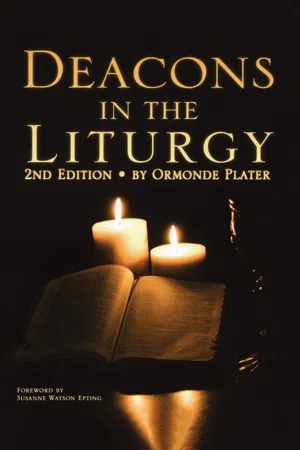
The solution lies in liturgical formation, both theological and practical. This book is designed to help provide that formation for bishops, priests, deacons, and indeed for all the people of God. The introduction provides a brief history of the use of deacons in Anglican liturgies, from 1549 to the present, including characteristics and statement of purposes.
- 144 pages
- English
- ePUB (mobile friendly)
- Available on iOS & Android
eBook - ePub
About this book
Information
Subtopic
Dénominations chrétiennes
1
GENERAL NORMS

ORDINARY FUNCTIONS
Deacons are the principal assistants, the most active of all who serve in the liturgy. They are heralds of the word, servants of the church, and agents of the bishop. Deacons act for the good of others by setting them free for worship of God and action in the world. At the ordination of deacons, the bishop tells the ordinands: "You are to assist the bishop and priests in public worship and in the ministration of God's Word and Sacraments" (BCP 543; BAS 655). The presence of deacons, however, goes beyond mere assistance. It imparts a special quality that rises to the level of symbol.
As symbols, deacons embody two ancient concepts, angels and waiters. They are messengers and heralds of the word. They proclaim the good news of God in Christ and interpret the world to the community of faith. They oversee the sacrificial meal, wait on table, prepare, serve, and clean up. They enable the hungry to eat and the thirsty to drink, as they serve in the sacramental liturgies of the church and among God's poor in the world. Both angel and waiter appear in every deacon in every diaconal role and function in every liturgy.
Deacons' roles in liturgy reflect their roles outside the liturgy. The bishop presides in all liturgies because the bishop presides in the diocese, and the priest presides in the Eucharist and other congregational liturgies because the priest presides in the congregation. Deacons serve in liturgy because deacons mobilize the church, especially for works of love in the world.
Works of love for those in need, with emphasis on "the poor, the sick, the suffering, and the helpless" (BCP 510; BAS 631), focus in worship through the liturgical words and actions of deacons. In this way the messiness of human existence, filled with complexity, ambiguity, and contradiction, enters Christian liturgy, and Christian people present God's creation to God for the salvation of God's people. In this way, too, deacons reveal the diakonia of Christ as God's agent in creation and salvation, God's face reflected in the faces of God's people. The role of deacons in the liturgy reveals the nature of deacons as proclaimers and evangelists, messengers and bearers of the good news to the poor, and servants in the image of Christ.
Deacons serve in an assembly of faithful worshipers. With kindness and respect they submit to the customs of the congregation and the practices of the priest in charge. Never competing with others for place and prerogative in liturgy, they enlist and involve other baptized persons in proper liturgical roles, as in ministries of mercy and justice.
The liturgical role of deacons comes to us partly by descent from the early church, especially of the first four centuries, and partly by intelligent reform in our own age. The text and rubrics of each rite, especially the Eucharist and the Ordination of Deacons, clearly reveal the essential or ordinary functions of deacons. These occur in two main groups, Liturgy of the Word and Liturgy of the Sacrament.
LITURGY OF THE WORD
Deacons proclaim the word of God, assuming the role of angel, messenger, and bearer of good news. Specifically they act as:
(1) Reader of the gospel
A deacon normally proclaims the gospel reading. There are three main exceptions:
(a) In the absence of a deacon functioning liturgically, the presider or an assisting priest reads the gospel.
(b) Other baptized persons may read or sing the passion gospel on Palm Sunday and Good Friday.
(c) When part of a congregation speaks a foreign language, another person may read the gospel in that tongue (perhaps in addition to the gospel in English).
(2) Occasional preacher
Preaching is normally a function of the presider. Bishops and priests preach because they are ordained for that task, without excluding others from the function. The bishop may license other baptized persons to preach, and in some places gifted persons preach at the invitation of the presider. Deacons preach as gifted persons, as agents of the bishop, or as those whose duty is "to make Christ and his redemptive love known" (BCP 543; BAS 655). In some dioceses, the bishop assumes that deacons have the right to preach by the authority of their ordination; in others, the bishop licenses or otherwise grants deacons the faculty of preaching.
(3) Leader of intercessions
A deacon is the ordinary leader of the biddings inviting the people to pray for those in need. Other baptized persons may also lead the prayers of the people, or a deacon and others may share in leading the prayers.
(4) Herald
Deacons announce, exhort, call to worship, invite confession, instruct, keep order, and act as master of ceremonies. (Some places with large or at least formal celebrations use another person to act as master of ceremonies.) By overseeing many practical details of worship, deacons enable priests and bishops to preside prayerfully and help the people to take part actively. It is an old custom for deacons to announce the feasts of the church year, and on the holiest of nights, at the Great Vigil of Easter, they proclaim the paschal feast by chanting the Exsultet.
LITURGY OF THE SACRAMENT
Deacons serve the table, assuming the role of butler of the house, maître d'hôtel, and steward of the banquet. Specifically they act as:
(1) Headwaiter
Deacons prepare the table, receive, prepare, and place on it the bread and wine. After the meal they eat and drink the remaining bread and wine (aside from what is to be kept) and cleanse the vessels. Typically, others help with these functions.
(2) Steward of the wine
Standing at the presider's right, a deacon raises the cup during the doxology (ending words of praise) of the eucharistic prayer and at the invitation to communion. At communion, deacons normally give the wine to the faithful, and they may also give the bread. At a large celebration, with several deacons and priests, some may serve the bread and some the wine. Other persons licensed by the bishop (called eucharistic ministers) may give the wine "in the absence of sufficient deacons and priests" (BCP 408); canon law permits them also to give the bread. The Canadian church allows persons authorized by the bishop to give communion (BAS 183).
(3) Dismisser
A deacon ends the liturgy by telling the people to go or inviting them to "bless the Lord." The dismissal is part of a deacon's angelic role of making announcements, exhorting, giving directions to come and go and to use certain gestures and postures, and otherwise aiding the active participation of the people.
(4) Minister of the reserved sacrament
After their ordination, new deacons have the privilege of carrying the reserved sacrament "to those communicants who, because of sickness or other grave cause, could not be present" (BCP 555). The Canadian church omits the provision. This continues to be a function of deacons during their lifetime of ordained ministry. Deacons also oversee the work of eucharistic visitors, those licensed to bring the sacrament to the absent. Many congregations reserve the sacrament in a tabernacle or aumbry. For easy access during the week, deacons may reserve it at home in a safe place, marked by a lamp or icon. The older custom was to keep the sacrament only under the form of bread, easy to carry and give, but increasingly the consecrated wine is also reserved. Deacons and other ministers carry the bread in a small metal or ceramic box called a pyx (Latin pyxis or box). They may carry the wine in a small bottle, or intinct (dip) pieces of bread in the wine before taking it to communicants.
DEACONS AND THE BISHOP
Deacons act as emissaries and deputies of the bishop, and this relationship is reflected in their liturgical role. From Ignatius of Antioch at the beginning of the second century, deacons have stood in a special place alongside the bishop, representing closeness and solidarity in ministry. At their ordination, the bishop tells the ordinands: "God now calls you to a special ministry of servanthood [diakonia] directly under your bishop" (BCP 543, see BAS 655), a phrase stressing line of authority. Two deacons normally attend the bishop as presider of any liturgy, while in the Eucharist another serves as liturgical deacon. Even if priests are present, deacons serve in their proper role and functions. Deacons especially help the bishop at ordinations. In the rites for investing and seating a diocesan bishop, the number of attendants is set at two deacons (BOS 349, 357).
WORSHIP SPACE
Most worship spaces are arranged in one of three ways, emphasizing different locations and orientations (both spatial and theological) for offering prayer:
(1) Versus populum (toward the people)
Presider and deacon face the people across a freestanding altar, emphasizing the presence of Christ in the gathered assembly. In most places, during the Liturgy of the Word the presider and deacon occupy chairs facing the people.
(2) Ad orientem (toward the actual or liturgical east)
Presider and deacon, at the head of all the people, face the east end of the space (where the altar is located against the wall or freestanding), place of the rising sun and risen Christ. In most places, during the Liturgy of the Word the presider and deacon occupy chairs on the side of the altar space, facing inward or toward the people.
(3) In medio populi (in the middle of the people)
The people, including presider and deacon, face a central space, either in two lines (antiphonal, as in monastic worship) or in the round, or as a combination of both. Everyone, including presider and deacon, faces the center of the church, toward the real presence of Christ in word and on the altar. During the Liturgy of the Word the presider and deacon occupy chairs on one side or at one end or within the circle.
MOVEMENT AND GESTURES
Deacons normally sit to hear the word read and preached. They stand to perform duties and to pray, even during the eucharistic prayer.2 In practice many Roman Catholic deacons remain standing. Anglican deacons preferably stand throughout the prayer to emphasize its unity.
In a procession, the deacon carrying the gospel book walks just ahead of the presider, other deacons, and concelebrating bishops and priests. If not carrying the gospel book, the deacon walks beside the presider. If the presider is a bishop, two attending deacons walk a little behind the bishop. In a procession with the paschal candle, the deacon bears the lighted candle and leads the procession (in place of the cross), perhaps behind a thurifer.
A single deacon usually sits at the presider's right, and two deacons sit on either side. During the Liturgy of the Word, however, deacons may remain closer to the people, as in the Orthodox liturgy. Deacons' seats should be visible and preferably face the people. Like other ministerial leaders, deacons sit upright and place their hands on their knees (which are never crossed).
During the Liturgy of the Sacrament, deacons stand and move near the altar. At the altar the normal position of thedeacon assisting with the cup is at the presider's right, two or three steps back. A deacon assisting with the book stands on the left in the same position. They step forward to handle the cup and turn pages. (With the Altar Book placed on the left, a single deacon may walk to that side as needed to turn pages, unless someone else turns them.) Since in many churches the freestanding altar is near the back wall, deacons may have to stand two or three steps to the side rather than to the back. In churches celebrating ad orientem, deacons stand a step to the side and one step down (or back), facing east. When addressing the people, deacons turn to face the people.
While standing, except when performing a function requiring hands, deacons hold hands joined, fingers interlocking or palm to palm, following the presider's preference.3 In the early church, in most places, during prayer all persons stood facing east (hence, they were oriented) and held their hands raised and extended to the side, palms turned forward and upward. When leading the prayers of the people, standing in the midst of the people and facing east, a deacon may use this orans or prayer gesture.
As much as possible, deacons should be familiar with the words, music, and rubrics of the liturgy. They should memorize their parts and listen attentively while others read scripture or lead song or prayer. It is distracting for liturgical leaders to carry or gaze at books and leaflets, including the Book of Common Prayer or Book of Alternative Services, unless those publications are needed for a particular function.
Decisions about movement depend on the reality of the worship space as well as on ancient tradition. What is the size and configuration of this space? What is its lighting and capacity for sound? How should the presider and deacon, and others, stand and move? How do people see the action and participate in the liturgy?
V E S T M E N T S
The historic vestments of deacons in the western church are the alb and the dalmatic. In a practice originating in the eastern church and now universally observed, deacons also wear a stole over the left shoulder.
Deacons wear vestments in all liturgies. At their ordination the ordinands wear as their b...
Table of contents
- Cover
- Half Title
- Title
- Copyright
- Contents
- Foreword by Susanne Watson Epting
- Preface
- Introduction
- Chapter 1 - General Norms
- Chapter 2 - Christian Initiation
- Chapter 3 - The Holy Eucharist
- Chapter 4 - The Daily Office
- Chapter 5 - Seasonal Liturgies
- Chapter 6 - Pastoral Liturgies
- Chapter 7 - Liturgies with a Bishop
- Appendix
Trusted by 375,005 students
Access to over 1.5 million titles for a fair monthly price.
Study more efficiently using our study tools.
Frequently asked questions
Yes, you can cancel anytime from the Subscription tab in your account settings on the Perlego website. Your subscription will stay active until the end of your current billing period. Learn how to cancel your subscription
No, books cannot be downloaded as external files, such as PDFs, for use outside of Perlego. However, you can download books within the Perlego app for offline reading on mobile or tablet. Learn how to download books offline
Perlego offers two plans: Essential and Complete
- Essential is ideal for learners and professionals who enjoy exploring a wide range of subjects. Access the Essential Library with 800,000+ trusted titles and best-sellers across business, personal growth, and the humanities. Includes unlimited reading time and Standard Read Aloud voice.
- Complete: Perfect for advanced learners and researchers needing full, unrestricted access. Unlock 1.5M+ books across hundreds of subjects, including academic and specialized titles. The Complete Plan also includes advanced features like Premium Read Aloud and Research Assistant.
We are an online textbook subscription service, where you can get access to an entire online library for less than the price of a single book per month. With over 1.5 million books across 990+ topics, we’ve got you covered! Learn about our mission
Look out for the read-aloud symbol on your next book to see if you can listen to it. The read-aloud tool reads text aloud for you, highlighting the text as it is being read. You can pause it, speed it up and slow it down. Learn more about Read Aloud
Yes! You can use the Perlego app on both iOS and Android devices to read anytime, anywhere — even offline. Perfect for commutes or when you’re on the go.
Please note we cannot support devices running on iOS 13 and Android 7 or earlier. Learn more about using the app
Please note we cannot support devices running on iOS 13 and Android 7 or earlier. Learn more about using the app
Yes, you can access Deacons in the Liturgy by Ormonde Plater in PDF and/or ePUB format, as well as other popular books in Théologie et religion & Dénominations chrétiennes. We have over 1.5 million books available in our catalogue for you to explore.