- 160 pages
- English
- ePUB (mobile friendly)
- Available on iOS & Android
eBook - ePub
About this book
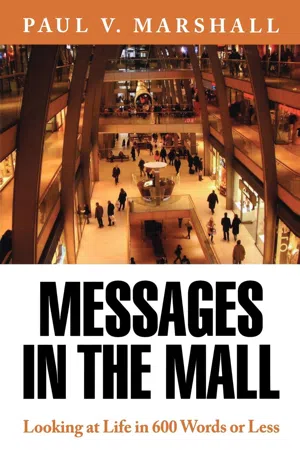
For more than a decade the author has been writing a "Saturday religion column," syndicated in ten newspapers in the 14 counties of Pennsylvania that comprise the Episcopal Diocese of Bethlehem. The "600 words or less" in the title comes from the rigorous discipline of writing to strict space requirements. The intent of the columns is to engage the secular culture and to bring the church's message to it by commenting on the realities of the human condition and on issues of general interest. This book is a compilation of many of the columns, organized along thematic lines.
This book will be an ideal cross-denominational trade book for individual reading or group use. The short-take format lends itself to episodic reading and will appeal to the individualdaily-prayer market. Clergy will find the book an excellent source for sermon ideas.
Information
Topic
Theology & ReligionSubtopic
Christian Denominations
CHAPTER ONE
Virtues and Vices

Grace in an African Airport
Can lost luggage be an act of God? Do angels disguise themselves as porters? I do not know, but the possibilities are intriguing.
With my body screaming in several places after eighteen hours that are best left undescribed, I got off the plane in Johannesburg to find my main piece of luggage lost. Turtles are built for survival, not speed, and thus I do not travel light. In my carry-on I had only a partial change of clothes because of the room taken up by my other survival tools. I thought bitterly of the old joke about the Concorde: breakfast in Paris, lunch in New York, baggage in Bermuda.
Then the gift came in the form of a young man whose name tag said “Daniel.” He zoomed in on my wounded and fretful appearance and offered to help me. Daniel spoke English, but in accents that were difficult for me to understand. I gave him a brisk “No, thank you” and moved on.
He followed me! This was not good news to a city boy. He persisted even when I dodged into a telephone area, only to discover that I had no idea how to work the South African telephone system. He cornered me and asked me somewhat urgently if I wouldn’t please let him help me, as it was his job to help strangers. I started to realize how much I had mentally locked my car doors because Daniel was black. Like many other people of good will, I thought I had “gotten over” that.
Out of guilt I let him guide me to the shuttle bus, and found myself apologizing for my resistance on the grounds that I was upset that I had lost my luggage, was generally disoriented, and had never been to South Africa before. His response was odd. He shoved an open hand to me, almost at eye-level, and said something I could not understand, and said it again when I did not respond. I bent my head close to his, and he said very slowly for the third time (by the grace of God a rooster did not crow), “Wel-come.” I took his hand gratefully.
It would have been enough if this were the end of it. For some strange reason the shuttle bus kept on not coming. This left us standing together, and we did what males of our species do instead of conversing: we asked each other questions. In response to something I asked he said, “If you are going to have a good visit in South Africa, you will have to be patient.” I said, finally getting it, “Just like you’ve been patient with me?” Somehow proper grammar does not seem necessary during an epiphany.
In my first hour in the country I had been opened to experience and to human community when I had been focused on disorder and inconvenience. It took them four days to get my luggage to me. In the meantime, up in Swaziland I learned what it was like to wash out one’s underwear each night, and what it is like to have “only” two shirts in places where some people feel fortunate to have one.
It is only as I write this that I remember that “Daniel” means “gift of God,” a fact that may set the indoor record for slowness of perception. All of this took place as described, and perhaps gives us something to think about during the first Lent in what will be Africa’s century.
Maturity: The Accessible Virtue
I’ve always loved the title of the AARP magazine, Modern Maturity. It suggests an intangible aspect of having lived a few years that no hair dye commercial can approach. I am not in a position to comment on other religions but, every time Modern Maturity arrives, I wonder what a Christian magazine describing spiritual maturity would contain.
When St. Paul describes the virtues Christians should display as they share their gifts, he begins by saying that spiritual renewal, transformation of the mind, comes first: “Do not think of yourself more highly than you ought.” In twenty-eight years of full-time church work I have never gotten used to Christians who get insulted. There is nothing more silly—or obscene—than a Christian with his or her nose out of joint! But it happens. I have no particularly immunity, either.
When it happens to me, I find myself wondering how someone like me, who follows an incarnate God who was spat upon, rejected by his own, beaten, and crucified, can ever feel insulted or insufficiently recognized. To feel that way, and to make it known, is the worst possible witness—it is a denial of Christ much worse than Peter’s. Peter simply pretended not to know Jesus. The Christian with hurt feelings says to the world, yes, I know the crucified Messiah, but I don’t think he’s worth following at the risk of having my feeling tweaked. Well, we all know that temptation—it’s why, to use St. Paul’s words, our minds need transforming.
A very useful definition of neurosis is a fixation on one’s worth in comparison with others. Thus, if others are praised, the neurotic feels put down or slighted. Gore Vidal once put it this way: “It is not enough to succeed—others must fail.” That is perhaps a little strong but it does reflect much of the attitude of those who feel slighted, however briefly, when others are in the limelight.
Such an attitude can seriously hamper the witness and mission of any religious organization. The personal consequences are quite high also. Whenever we are seriously worried about questions of status or recognition among Jesus’ disciples, the evil one has got us. “If you belonged to the world, the world would love you as its own,” Jesus said. “You do not belong to the world, but I have chosen you out of the world—therefore the world hates you. Remember the word that I said to you, ‘Servants are not greater than their master.’ If they persecuted me, they will persecute you.”
I do not necessarily recommend the movie The Devil’s Advocate, but the closing scene is unforgettable. Our hero finally does the right thing—the principled thing—and then when a reporter seeks him out to suggest an interview about this, he begins to feel special about being raised up for admiration. Immediately there is a close-up of Satan, Al Pacino, who looks right into the camera and says, each syllable a dagger of ice, “Vanity is still my favorite sin.” End of movie.
The reason St. Paul puts the reminder about pride at the beginning of his long list of Church virtues is that as long as we keep that sin at bay, the great things can flourish. Put positively, as long as we keep Christ’s attitude of self-giving as the measure of each of our motives and actions, we will in fact be transformed by the renewal of our minds. All those other gifts will have the space and light they need to grow—a good start toward eternal maturity.
Pride Is a Silly Thing to Die For
My wife is shoveling snow. I’ve been struggling with a respiratory problem and it would be insanity to join her. I know this, yet guilt and anxiety are with me, despite the fact that she is not showing any signs of martyrdom or self-sacrifice.
There’s this guy thing: the heavy lifting is my domain. Navigating our steep, twisting driveway with my enormous snowblower is the one place I still get to be the pioneer, making the cave safe and accessible. Instead of hearing the roar and inhaling the exhaust of the engine, I type this to the scrape-scrape of a patient and relentless woman’s unceasing efforts with a shovel. It’s embarrassing.
Few of us are good at doing the work of being sick, especially when the sickness is not dramatic or life threatening, just boring and frustrating. Staying still, being intentionally quiet, adopting the discipline of rest. They go against the grain for those who enjoy being productive.
The forced downtime reminds me of how little rest most of us build into our lives. The question occurs to me with new emphasis. Perhaps rest and recreation are like investing for retirement—which you need to do intentionally over the long haul to get the benefits. The religious word for this is stewardship, management of resources with a goal in mind.
Then there is control. Not being able to organize and administer one’s life and work because of physical weakness is too clear a reminder that in the end we will have to give up absolutely everything. The usual ability to be active, to be in charge of one’s life, enables us to deny that each of us is living on borrowed time. I now have enough relatives and friends nearing life’s end for this thought to be uncomfortable. My turn will come. Let’s change the subject.
I am fascinated by the recent revelation that Prince Charles has a man who uses a golden key to squeeze out the prince’s toothpaste for him every morning. Being waited on when one is well and in charge is an experience of power. Being waited on to that extent must make one feel, well, royal.
Being waited on when one is weak and vulnerable is not so pleasant, but it does bring a choice. It can be an experience of frustration, defeat, and humiliation or an experience of grace. That slippery word means receiving what we are not entitled to because somebody is kind. One can either get tired of having to say thank you, or one can learn to cherish each opportunity for acknowledging human kindness. When she comes back in, I will try the latter path.
One of the reasons Christianity is challenging is that it involves the concept of a savior, someone who does for us what we cannot do for ourselves. For most of us it seems un-American to step outside the circle of self-reliance, of self-actualization, of paying one’s own way—in this country being bailed out by the government is for the very rich and to some extent for the very poor. We in the middle are used to taking care of ourselves. To have to accept the fact that we need someone to show us how to live and how to die puts us precisely where I am with my snow-shoveling wife.
So I find that the choice in attitude I make about the snow shoveling is a measure of my attitude toward the big things of life. Pride is a very silly thing to die for. Will I allow myself to be cared for and be genuinely grateful for that care, or will I resist the grace that is offered me?
Accepting Responsibility Leads to Life
Two people covered with leaves sit in the back of an open convertible driven by a man with a long white beard. The drawing is a child’s depiction of God driving Adam and Eve out of paradise.
The ancient story evokes mixed reactions. Some of its themes are not so helpful, as when humanity’s fear of snakes, the pain of childbirth, and the domination of women by men, and the sweat and blood it can take just to stay alive, are explained in terms of the tale of the garden.
There is a lesson in the ancient story about the difference between shame and guilt. What if Adam and Eve had said, “Yes, we betrayed your trust. We accept responsibility and hope we can resume our relationship.” The Bible may have been reduced to twelve pages entitled, “Paradise Retained.”
As the story goes, Adam strayed from appropriate guilt, which can become the occasion of grace, into shame that feels exposed and protects itself with flimsy fig leaves of evasion and passing the buck. Nothing graceful can happen when I deny, rationalize, or defend against my guilt. There can be no forgiveness and reconciliation. There can never be learning from mistakes I insist I didn’t make.
The most important thing we can ever say to our children is, “I was wrong; I’m sorry, and I hope you will forgive me.” I cringe when people who carry unresolved hurts from their childhood say, somewhat mechanically and with little conviction, “Well, my parents did the best they could.” That is simply not true. Every parent knows times we put ourselves first and let our children down. Where guilt is accepted, however, grace can happen. How much different to say, “My parents made mistakes, and sometimes they hurt me. I know that I bear that pain still, and I choose to forgive them.”
The inability to accept personal responsibility plagues our society. Suppose the allegations brought against Clarence Thomas were true and he had simply said, “Yes, in a very different culture, I made remarks that I now know were simply wrong. I know better now, and apologize to anyone I offended or hurt.” It would have been the shortest confirmation process in history.
The world is generally not prepared to deal with adults who take responsibility for what they’ve done, make restitution where they can, and move on in grace. Responsible adults don’t look for deniability.
This notion of adult responsibility appears again in the gospel story—this time from the point of view of maturity and health—when Jesus’ family, for whatever reason, wants him to stop being, well, so weird and embarrassing, and come home. Jesus counters that his true family are those who seek to know and do God’s will.
There comes a time in each of our lives—perhaps more than one time—when we choose no longer to live under the protective umbrella of letting our parents or anyone else say what is true, good, or desirable for us. Though we never stop loving our parents, we build close relationships with those who share our own beliefs and values and work to implement them.
The Christian claims that the relationship with God—which Adam and Eve forgot as they started dodging responsibility—is restored in Jesus Christ. Life in Christ’s Church is meant to be life in a kind of garden, with many kinds of nourishment available for the picking. All it takes to go back there—to go forward there—is to accept the gift that comes to those who will own who they are and accept what God will give them as they walk the earth in relationship with their Creator.
Embracing Necessary Pain
Next to my wife, Diana, the most important person in my life recently has been Jeff. When I am with him, I experience deep, prolonged, and burning pain. The pain is necessary. Without the brutal physical therapy that follows the repair of a massive tear in the shoulder muscles and some carpentry on the bones themselves, my shoulder would quickly freeze, and my arm would be almost useless.
Jeff dislikes hurting people. He knows, though, that unless he does his job ruthlessly I will be a cripple. He has a goal in mind, so he moves my muscles and tendons, painful as that is. I owe him a great deal for that pain.
More ordinary suffering is at times also necessary. It, too, is a gift. When I was a child, my mother diligently sat for three years and made me practice the piano until the spark caught. I will never b...
Table of contents
- Half title
- Title
- Copyright
- Dedication
- Contents
- Preface
- The First Column, February 1997
- Chapter One: Virtues and Vices
- Chapter Two: Not Far from the Kingdom
- Chapter Three: Bittersweet Love
- Chapter Four: Public Issues
- Chapter Five: Preaching to the Choir—Church Life
- Chapter Six: Conversations with Others
- Chapter Seven: Holidays and Holy Days
Trusted by 375,005 students
Access to over 1.5 million titles for a fair monthly price.
Study more efficiently using our study tools.
Frequently asked questions
Yes, you can cancel anytime from the Subscription tab in your account settings on the Perlego website. Your subscription will stay active until the end of your current billing period. Learn how to cancel your subscription
No, books cannot be downloaded as external files, such as PDFs, for use outside of Perlego. However, you can download books within the Perlego app for offline reading on mobile or tablet. Learn how to download books offline
Perlego offers two plans: Essential and Complete
- Essential is ideal for learners and professionals who enjoy exploring a wide range of subjects. Access the Essential Library with 800,000+ trusted titles and best-sellers across business, personal growth, and the humanities. Includes unlimited reading time and Standard Read Aloud voice.
- Complete: Perfect for advanced learners and researchers needing full, unrestricted access. Unlock 1.5M+ books across hundreds of subjects, including academic and specialized titles. The Complete Plan also includes advanced features like Premium Read Aloud and Research Assistant.
We are an online textbook subscription service, where you can get access to an entire online library for less than the price of a single book per month. With over 1.5 million books across 990+ topics, we’ve got you covered! Learn about our mission
Look out for the read-aloud symbol on your next book to see if you can listen to it. The read-aloud tool reads text aloud for you, highlighting the text as it is being read. You can pause it, speed it up and slow it down. Learn more about Read Aloud
Yes! You can use the Perlego app on both iOS and Android devices to read anytime, anywhere — even offline. Perfect for commutes or when you’re on the go.
Please note we cannot support devices running on iOS 13 and Android 7 or earlier. Learn more about using the app
Please note we cannot support devices running on iOS 13 and Android 7 or earlier. Learn more about using the app
Yes, you can access Messages in the Mall by Paul V. Marshall in PDF and/or ePUB format, as well as other popular books in Theology & Religion & Christian Denominations. We have over 1.5 million books available in our catalogue for you to explore.