This is a practical how-to guide introducing new, mission-shaped practices in a traditional parish setting. This book looks at the church's bread-and-butter activities -- worship, pastoral contacts, civic and public responsibilities, faith formation, administration and leadership -- and creatively points out how to reframe them with a focus on God's mission.
eBook - ePub
Mission-Shaped Parish
Traditional Church in a Changing World
- 160 pages
- English
- ePUB (mobile friendly)
- Available on iOS & Android
eBook - ePub
Mission-Shaped Parish
Traditional Church in a Changing World
About this book
Information
Topic
Theology & ReligionSubtopic
Christian Denominations1The value of values
Paul Bayes
Build mission-centred values at the heart of the church as it is.1
We do what we value and we value what we do.2
We do what we value and we value what we do.2
Tie-break!

In St Mungo’s PCC it is time for the treasurer’s report as usual. Shoulders slump around the room, in anticipation. But astonishingly the treasurer is smiling; she has received some good news and has been saving it until now to surprise everyone. Mrs Johnson, a long-standing member of the church who died peacefully a few months ago, has left St Mungo’s the residue of her estate and it is a six-figure sum. Best of all – the bequest comes with no strings attached!
A delighted hubbub breaks out and then the ideas begin to flow. Pay the parish share? No, pay off our debt! Redecorate the church? No, a new carpet! A new sound system for the worship group? No, renovate the organ! A disabled toilet? No, a new kitchen! A new administrator? No, a new youth worker! Give ten per cent to Tearfund? No, to Christian Aid!
A loud voice rises above the rest. Mrs Johnson was on the flower arranging team – why not give them two hundred pounds a week for ten years to make the church look really glorious? And we could have a lovely new set of vases in her memory, each with a brass plaque! Others feel that this might not be quite right – but how do you say so without seeming to belittle Mrs Johnson?
The hubbub increases but somehow the delight seems to be vanishing. Almost every one of the ideas seems good and most of them seem necessary and even urgent. But the trouble is that, even with what the PCC is now calling the Johnson Fund, there are simply not enough resources to go around.
From the chair the vicar tries to get a grip, but he’s not sure what to say. He watches the ideas fly around the room with a sinking pastoral heart. The curate is being icily polite with Mr Alderson over whether the choir needs new robes. The curate thinks not – ‘with all due respect’. The vicar knows what that means, and he hopes they won’t come to blows before coffee.
Then a possible solution – the PCC’s resident diplomat is talking enthusiastically – why not just split the bequest and support everything? But now the treasurer is looking gloomy as the huge bequest shrinks before her eyes into 20 or more small projects, each of which will need matched funding from somewhere. In the Council a grumble begins to gather strength – why, oh why, didn’t Mrs Johnson just tell us what to do with her money? And the treasurer wishes she had never mentioned the bequest – or at least that she’d bought a crash helmet first …
This scene is both unfamiliar and all too familiar. Unfamiliar because generous bequests from parishioners, although not unheard of, are not that common. All too familiar because at every level of church life the topics that are debated are like icebergs, floating on a sea of assumptions and values, 90 per cent of which are not in view. So for those who are trying to build mission-shaped parish life, a vital part of the task must be opening these values to inspection.
This isn’t easy. Parish life is hectic, and urgent matters crowd in all the time. Most churches find it very hard to give people space to reflect together on the reasons why decisions are made, and on exactly why their leaders make the choices they do.
The problem at St Mungo’s is quite specific. Between the preaching of God’s word in worship on the one hand, and the decisions of the church council on the other, there is a missing link. Despite his pastoral heart, their vicar has not equipped St Mungo’s PCC for their work. They are trying to build their church on decisions without foundations. And yet it could have been so different. Long before that meeting, a shared and owned vision of God’s purposes and a set of shared values could have issued in a strategy.
More management-speak? Or something more Godly? Bishop John Taylor, writing in the 1970s in his wonderful, prophetic book Enough is Enough, points to an answer: Perhaps we might learn, he says:
by taking as our model, for example, the suburban parish which was looking forward to its centenary gift-day as a chance to redecorate the rather shabby interior of its church and refurnish its sanctuary. Then came Bangladesh: and that church remains shabby, and more truly glorious.3
Unlike our fictional St Mungo’s, the suburban parish in this real-life story did not have the money in the bank. Like most churches they had a plan, and they were aiming to do some good things but not others. Renovating the church, helping the poor – maybe there was no clear winner, maybe it was a tie. But they had to choose, to break the tie. And, again unlike St Mungo’s, it seems they had a clear, agreed vision of God’s call on them, and some values. All this gave them a tool, a tie-breaker, so that when they had to choose between good things, they could say ‘yes’ to some and ‘no’ or ‘not yet’ to others.
Strategy with a human face
There doesn’t have to be anything mechanistic or driven about this process. It is true that talk of ‘strategy’ can be annoying, and indeed it can bring out the worst in the people who defend it as well as those who dislike it. Jesus seems to have managed pretty well without using it. All the same, despite its military–industrial flavour, the word points to a good and necessary process for any local church. We believe that strategic planning is one of the many tools that are necessary for the local church to flourish. What prevents ‘strategy’ from becoming hard-edged and unlovely is ensuring that it is built on a Christian foundation – and that means a foundation of values based on faith. Values are the hinge. They swing what we know of God into action, and bring the theology of a church to bear on its practice.
The dynamic can be seen like this:
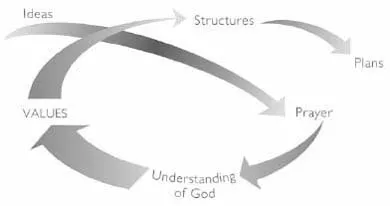
Every person and every institution has values – and usually it is the unexamined ones that are held most dear. In laying their mission foundation a local church doesn’t have to ignore anyone’s values, but it will have to put them in a particular order for the time being.
Back at St Mungo’s Mr Alderson’s values include offering good and well-ordered worship to God. The curate would not disagree with this, but perhaps she values relevance in mission even more highly. So they argue with each other – but when they almost come to blows, both of them think it is not over values but over robes.
And what was happening with the other PCC, the real-life suburban parish in the case study earlier? Perhaps it was this – that the Bangladeshi famine spoke to their understanding of God as one who loves the poor. And because they were a church that highly valued helping the poor, the hinge to action swung smoothly and cleanly and their finance committee knew what to do. Not without argument and debate, no doubt – they too may have had their Mr Aldersons – but in the end this common concern to help the poor was the basis for a corporate vision and an agreed strategy, although perhaps they would not have put it that way. Perhaps they would have said they were just doing the obvious thing, the right thing.
So every church has values, whether explicit or not; and almost every church thinks it’s doing the right thing. But if a church has mission-centred values then its understanding of God is of one who is love, and who sends love.
Like the rest of the worldwide Christian family, the authors of Mission-shaped Church are deeply indebted to the great South African missiologist David Bosch, whose 1991 book Transforming Mission is such a gift and resource to the Church, and whose early death in a car crash was such a loss. In his book Bosch writes: ‘Mission has its origin in the heart of God. God is a fountain of sending love. This is the deepest source of mission. It is impossible to penetrate deeper still: there is mission because God loves people’.4
If that’s your understanding of God then your values will move you to mission. This will not be because mission is the flavour of the month, or Mission-shaped Church the book of the last few years. It will not even be because the bishop tells us there’s a need to get something done. It will be because God is who God is.
In the new image mission is not primarily an activity of the church, but an attribute of God.
(David Bosch)5
Mission-shaped Church follows this way, and its life and theology are rooted here. In the middle of the report there is a list of fresh expressions of church, each with its stories and its reasons. Then follows the theological centre of the book, reflecting on all this good practice. But in the hinge-place, between the stories and the theology, there come the report’s five values:
Mission-shaped values
[The missionary values] are intended to offer a framework that can be applied to an existing local church or to any strategy to develop, grow or plant a church or a fresh expression of church … (they) provide a broad standard to help discernment at a time when the shape of the Church of England is increasingly varied and in flux.6
• A missionary church is focused on God the Trinity
Worship lies at the heart of a missionary church, and to love and know God as Father, Son and Spirit is its chief inspiration and primary purpose …
• A missionary church is incarnational
It seeks to shape itself in relation to the culture in which it is located or to which it is called …
• A missionary church is transformational
It exists for the transformation of the community that it serves, through the power of the Gospel and the Holy Spirit …
• A missionary church makes disciples
It is active in calling people to faith in Jesus Christ … It encourages the gifting and vocation of all the people of God, and invests in the development of leaders. It is concerned for the transformation of individuals, as well as for the transformation of communities.
• A missionary church is relational
… It is characterized by welcome and hospitality. Its ethos and style are open to change when new members join.7
The trouble with lists of values is that if they stand alone, they’re just a collection of abstract nouns. But clarifying values, making them concrete – really working at what they will mean locally – is the best practical first step any local church can take in its mission planning. This is because, in a church like ours, clear values are the sovereign remedy for anxiety.
Mission values and anxiety
‘Hrum, Hoom’, murmured the voice, a very deep voice like a very deep woodwind instrument. ‘Very odd indeed! Do not be hasty, that is my motto.’
(Treebeard the Ent, in J. R. R. Tolkien, The Two Towers)
In the West the twenty-first century-Church is living through anxious and fretful times. Christian believers look around and see evidence of churches in numerical decline. Often the Church in general, and in Englan...
Table of contents
- Cover
- Title
- Copyright
- Contents
- Series introduction
- Acknowledgements
- Foreword
- Preface
- Chapter 1 The value of values
- Chapter 2 That was then … a Church built on mission values
- Chapter 3 Mission-shaped worship
- Chapter 4 The chores of grace?
- Chapter 5 Mission-shaped Isle of Dogs
- Chapter 6 Friendship, community and mission
- Chapter 7 On being mission-shaped civic church: the view from Wimborne Minster
- Chapter 8 The place of nurture within a mission-shaped church
- Chapter 9 We can’t go on meeting like this: shaping the structure of the local church for mission
- Chapter 10 Mission-shaped cathedrals
- Afterword
- Notes
- Index
Trusted by 375,005 students
Access to over 1.5 million titles for a fair monthly price.
Study more efficiently using our study tools.
Frequently asked questions
Yes, you can cancel anytime from the Subscription tab in your account settings on the Perlego website. Your subscription will stay active until the end of your current billing period. Learn how to cancel your subscription
No, books cannot be downloaded as external files, such as PDFs, for use outside of Perlego. However, you can download books within the Perlego app for offline reading on mobile or tablet. Learn how to download books offline
Perlego offers two plans: Essential and Complete
- Essential is ideal for learners and professionals who enjoy exploring a wide range of subjects. Access the Essential Library with 800,000+ trusted titles and best-sellers across business, personal growth, and the humanities. Includes unlimited reading time and Standard Read Aloud voice.
- Complete: Perfect for advanced learners and researchers needing full, unrestricted access. Unlock 1.5M+ books across hundreds of subjects, including academic and specialized titles. The Complete Plan also includes advanced features like Premium Read Aloud and Research Assistant.
We are an online textbook subscription service, where you can get access to an entire online library for less than the price of a single book per month. With over 1.5 million books across 990+ topics, we’ve got you covered! Learn about our mission
Look out for the read-aloud symbol on your next book to see if you can listen to it. The read-aloud tool reads text aloud for you, highlighting the text as it is being read. You can pause it, speed it up and slow it down. Learn more about Read Aloud
Yes! You can use the Perlego app on both iOS and Android devices to read anytime, anywhere — even offline. Perfect for commutes or when you’re on the go.
Please note we cannot support devices running on iOS 13 and Android 7 or earlier. Learn more about using the app
Please note we cannot support devices running on iOS 13 and Android 7 or earlier. Learn more about using the app
Yes, you can access Mission-Shaped Parish by Paul Bayes,Tim Sledge,John Holbrook,Mark Rylands,Martin Seeley in PDF and/or ePUB format, as well as other popular books in Theology & Religion & Christian Denominations. We have over 1.5 million books available in our catalogue for you to explore.