- 224 pages
- English
- ePUB (mobile friendly)
- Available on iOS & Android
eBook - ePub
About this book
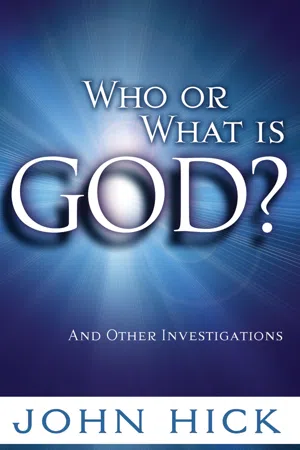
In Who or What is God? John Hick reflects on questions of the nature and the accessibility of God in the context of Christianity and other faith traditions. The essays in this book cover a wide range of issues centered on the search for truth, justice, and peace. This search concerns the ultimate reality to which the world's great religions point, involving discussion of religious experience, religious language, the relations between religions, death, and Christian belief.
The book does not focus on theology of religions or religious pluralism for which Hick is so well known but on different, nevertheless related areas as the nature and accessibility of God, God's relevance for the meaning of life and eschatology, the reconstruction of Christian theology under contemporary conditions, and finally the need to combine spirituality with the search for social justice.
Information
Topic
Theology & ReligionSubtopic
Christian Theology1
Who or What is God?
If you ask the educated man or woman in the street, or in a church, what they mean by ‘God’, they will probably say something like this: God is the infinite personal Being who has created the universe, whom religious people worship and to whom they pray, and who has the power, when he (or she) so decides, to intervene in human affairs in response to our prayerful requests. And so in church we pray for world peace, for the victims of flood, earthquake, famine, war and other disasters, that the rulers of the nations may have wisdom and, in a Church of England service, for the health and well-being of the Queen and the royal family; and we pray privately for ourselves and our own family and friends, especially those in any special need or danger. Thus God is seen as an active all-powerful force who is motivated by a limitless love, tempered by justice, and who has knowledge and wisdom infinitely surpassing our own. When our prayers are not answered, this is because he always knows better than we do, and indeed knows infallibly, what is the best thing to do or refrain from doing.
I think this is a fair depiction of the concept of God that operates today in Western society, and has operated for many centuries. It applies to Jews and Muslims as well as to Christians, and it applies to atheists as much as to theists. This is the ‘God’ whom people wholeheartedly or tentatively believe in, and equally whom people wholeheartedly or tentatively believe not to exist, and whom Nietzsche declared to be dead.
This concept of God can be described as anthropomorphic. That is to say, God is a being like ourselves in the fundamental respect that we are both – God and ourselves – persons. But whereas we are finite, created, dependent persons, God is an infinite, eternal, uncreated and omnipotent Person. Some theologians, uncomfortable with such an explicitly anthropomorphic characterization, say that God is not a person, but rather is personal. But this is a distinction without a difference. We cannot conceive of a personal being who is not a person. And we know what a person is only because we are ourselves persons. God, then, is like us – or rather we are like God – in this very basic respect.
I am not going to bring in here the doctrine of the Trinity, which distinguishes Christianity theologically from Judaism and Islam, because I don’t think that it makes any practical difference within Christian worship. Trinitarian language is of course firmly embedded in our liturgies; but is not prayer itself in practice invariably addressed to God our heavenly Father? We add ‘through’ or ‘in the name of our Lord Jesus Christ – except of course in the prayer which he himself taught, the Lord’s Prayer, in which we address God directly. But adding ‘we ask this in the name of does not alter the fact that we are consciously addressing the heavenly Father. So I am leaving aside for now the trinitarian complication.
The central aspect of this prevailing concept of God, on which I want to focus, is divine activity in the course of nature and of human life. God can and does perform miracles, in the sense of making things happen which would not otherwise have happened, and preventing things from happening which otherwise would have happened. These interventions are either manifest or – much more often – discernible only to the eyes of faith. But it is believed that God does sometimes intervene in answer to prayer. The Bible, and church history, and contemporary religious discourse are full of accounts of such occasions. And prayers of intercession in church and in private devotion presuppose that he at least sometimes operates on earth in these ways. Otherwise, what is the point of those prayers? And how often have we heard in the media someone telling of their miraculous escape when, for example, they survived unhurt in a car crash in which the two others were killed, or even more dramatically how a soldier in war was saved by wearing a medallion which stopped the bullet that would have killed him, or how when a family were at their wits’ end in some terrible dilemma something unexpectedly happened to save the situation? Or there was recently the American who on winning $5 million in the US lottery said, ‘I just praised God and Jesus.’ Of course most of those who speak like this today in our pervasively secular age are not using the word ‘miracle’ in a religious sense but merely as an expression of wonder and relief. Likewise ‘Thank God for that’ is usually no more than an expression of heartfelt relief. But seriously devout believers who give God thanks for a lucky escape, or for recovery from a serious illness, or for the resolution of some problem, do often believe that they have experienced a divine intervention on their behalf, a miracle which confirms and strengthens their faith and evokes gratitude to God.
It is this serious and literal use of the idea of divine intervention that concerns us here. The problem that it raises has led many to atheism. For example, in the car crash case, if God intervened to save only one of the people in the car, who then gave God thanks for a miraculous delivery, this implies not only that God decided to save that person, but equally that he decided not to save the other two. It presupposes that it is, so to speak, OK from God’s point of view to intervene whenever he so chooses, and this inevitably poses the question why he intervenes so seldom, leaving unprotected the great majority of innocent victims of natural disasters and of human cruelty and neglect. Some years ago the then atheist (but now deist) philosopher Antony Flew wrote:
Someone tells us that God loves us as a father loves his children. We are reassured. But then we see a child dying of inoperable cancer of the throat. His earthly father is driven frantic in his efforts to help, but his Heavenly Father reveals no sign of concern.1
And given the biblical and traditional assumption that God does intervene miraculously whenever he so decides, one can understand why this belief led Flew and many others to atheism. It is this implied picture of God as arbitrary, protecting some but not others, and thus as deliberately leaving so many in pain, hardship, misery and peril, that is so repugnant to so many people. If there is such a Being, why regard him or her as good and as worthy of worship, except by the chosen few who benefit from the special divine interventions?
The problem arises from the belief that it is, as I put it, OK from God’s point of view to intervene on earth whenever he chooses. Suppose, however, that, regardless of whether or not it is within God’s power to intervene, it is for some good reason not OK from the divine point of view to do so. Suppose this would be counter-productive from the point of view of a creative purpose which requires both human freedom (which is directly or indirectly the source of much the greater part of human suffering) and also elements of contingency and unpredictability in the evolution of the universe. The kind of theodicy sketched in this brief formula has been developed in a number of works, including my own Evil and the God of Love.2 This does not require the idea of special divine interventions in the form of open or covert miracles. However, as we shall see presently, while I still think this is a viable position I now want to suggest going a good deal further.
A non-intervening anthropomorphic God, who does not act within human history and human life, who does not cause things to happen which would not otherwise have happened and does not prevent things from happening which would otherwise have happened, seems religiously unsatisfying to many practising Christians, a kind of deism which is little better than atheism.
So we have a dilemma. Can we find any way through it or beyond it? At this point I want to suggest enlarging our field of vision – since we are no longer living in the BC (Before Computers) age and have so greatly extended our database – by taking account of the other world religions as well as our own. After all, the large majority of religious people in the world are not Christians, and yet their religions involve forms of life and thought that claim to lead to a transforming relationship, of limitless value, with an eternal reality that both transcends, and in the case of the Eastern traditions is also immanent within, us. But Buddhism and Taoism and Confucianism and some strands of Hinduism do not see that eternal reality as an infinite Person. Suppose then, as an experiment, we now use the word ‘God’ as our Western term for the ultimate reality which some do and others do not believe to be an infinite person. We then broaden the question, Who or what is God? by not confining it at the outset to a particular concept of the religious ultimate. When we do this some prefer not to use the term ‘God’, finding it almost impossible to detach it in most people’s minds from the notion of an infinite divine person, and use instead such terms as Ultimate Reality, or the Ultimate, or the Real. But let us for our present purpose stick with the familiar term ‘God’, reminding ourselves however from time to time that we are not now using it in a sense restricted to what are called the Western monotheisms – although in fact none of them originated in the West.
Where do we now go from here? I suggest that at this point it will be helpful to take account of an enormously important distinction drawn by some of the great Christian mystics, as well as by mystics of the other major traditions. Although the writer who has been given the derogatory sounding name of Pseudo-Dionysius is largely unknown outside the history of Christian mysticism, he has in fact probably been the most influential single individual in that history. He wrote in the name of Dionysius, the disciple of St Paul (Acts 17.34), thus assuming a near apostolic authority, and he was a major theological influence throughout the thousand years prior to the Reformation. Thomas Aquinas, for example, quotes him as an authority some 1,700 times. He is generally believed today to have been a Syrian monk writing around the year 500, and whether he would have exerted the same immense influence if this had been known before Erasmus and others became suspicious of his identity is one of history’s fascinating unanswered questions. But he did exert this immense influence, and in my opinion it was a very creative influence. For it reinforced the existing emphasis on the ultimate ineffability of God. I am not fond of the word ‘ineffable’ and prefer ‘transcategorial’, meaning beyond the range of our human systems of concepts or mental categories. Theologians have nearly always taken the ultimate divine ineffability or transcategoriality for granted, though usually without taking its implications to their logical conclusion. Augustine, for example, about a century before Pseudo-Dionysius, said that ‘God transcends even the mind’,3 but did not develop this further. But Dionysius – or Denys, to give him a more user-friendly name – makes the divine ineffability central and begins at least to struggle with its implications. In his central work, The Mystical Theology, he says in every way he can think of that God is utterly and totally transcategorial. God is ‘indescribable’, ‘beyond all being and knowledge’. God, the ultimate One, is:
not soul or mind, nor does it possess imagination, conviction, speech, or understanding … It cannot be spoken of and it cannot be grasped by understanding … It does not live nor is it life. It is not a substance, nor is it eternity or time. It cannot be grasped by the understanding … It is neither one nor oneness, divinity nor goodness … It is not sonship or fatherhood … There is no speaking of it, nor name nor knowledge of it… It is beyond assertion and denial.4
This last statement, that that to which the term ‘God’ refers is beyond assertion and denial, is crucial. For Denys is not simply doing negative theology, saying that God does not have this or that attribute but, much more radically, that our entire range of attribute-concepts do not apply to God at all, either positively or negatively. To apply them to God in God’s ultimacy is, in modern philosophical terms, a category mistake. To say, for example, that molecules are not stupid, although true, is misleading because it assumes that molecules are the sort of thing of which it makes sense to say that they are either stupid or not stupid. And to say that God is not ‘one nor oneness, divinity nor goodness’, although true would likewise, by itself, be deeply misleading because it assumes that God is the kind of reality to which such qualities could be rightly or wrongly attributed. We have to take on board the much more radical idea of a reality which is what it is, but whose nature lies beyond the scope of our conceptual and linguistic systems. When we speak about such a reality we are not, then, speaking about it as it is in itself, totally beyond the range of our comprehension, but about its impact upon us, the difference that it makes within the realm of human experience, to which our concepts and hence our languages do apply.
It is worth stressing that the divine ineffability does not entail that the ultimate reality, which we are calling God, is an empty blank, but rather that God’s inner nature is beyond the range of our human conceptual resources. This is also, incidentally, what Mahayana Buddhism intends when it speaks of the Ultimate Reality as sunyata, emptiness: it is empty of everything that the human mind inevitably projects in its acts of cognition. Going back to Denys, although he himself does not make this further qualification, modern philosophical discussions of ineffability have introduced a distinction between, on the one hand, what we can call substantial attributes, meaning attributes which tell us something positive about the divine nature, and on the other hand purely formal, linguistically generated attributes, which do not tell us anything about the divine nature. Thus that God is ineffable formally entails that God has the attribute of ineffability. And even to refer to God at all entails that God has the attribute of being able to be referred to. But such purely formal attributes give rise only to trivial truths, trivial in the sense that they do not in any way contradict or undermine the divine ineffability.
But given divine ineffability, problems immediately arise for Christian theology. Denys was, we presume, a devout worshipping Christian monk. And as well as teaching the total divine transcategoriality, he also took for granted the main body of Christian doctrine. Although Denys takes surprisingly little interest in the traditional dogmas, he does nevertheless take it for granted that God is a Trinity of Father, Son and Holy Spirit, and that the second person became incarnate as Jesus Christ. But how can one both hold that God is totally ineffable and also profess to know all these substantial truths about God? God cannot both have no humanly knowable attributes and also have such humanly knowable attributes as being a Trinity, and so forth. On the face of it this is a sheer contradiction. And Denys saw this quite clearly. He asks, in his book on The Divine Names:
How then can we speak of the divine names [that is, attributes]? How can we do this if the Transcendent surpasses all discourse and knowledge, if it abides beyond the reach of mind and of being, if it encompasses and circumscribes, embraces and anticipates all things while itself eluding their grasp and escaping from any perception, imagination, opinion, name, discourse, apprehension, or understanding?5
And he makes at least a beginning in answering this question. He has said that God is self-revealed in the scriptures. But then he goes on to say that the scriptural language about God is metaphorical. He does not use the modern term ‘metaphor’, but a later Denys, Denys Turner of Yale, points out very clearly that when Dionysius speaks of symbols he means what today we call metaphors.6 Denys – the early medieval one – says that ‘the Word of God makes use of poetic imagery’,7 and he speaks of ‘what scripture has revealed to us in symbolic and uplifting fashion’ (121A), and of how the divine Light makes truth known to us ‘by way of representative symbols’ (121B). Further, he says that the function of the scriptural symbols and poetry is practical, to draw us forward on our pilgrim’s progress: ‘By itself [the ineffable One] generously reveals a firm, transcendent beam, granting enlightenments proportionate to each being, and thereby draws sacred minds upward to its permitted contemplation, to participation and to the state of becoming like it’.8 Again, God ‘uses scriptural passages in an uplifting fashion as a way … to uplif...
Table of contents
- Cover
- Title
- Copyright
- Contents
- Acknowledgements
- Introduction
- 1 Who or What is God?
- 2 Mystical Experience as Cognition
- 3 The Religious Meaning of Life
- 4 On Being Mortal
- 5 Reincarnation
- 6 Believable Christianity
- 7 Literal and Metaphorical Incarnation
- 8 The Resurrection of Jesus
- 9 Is the Doctrine of Atonement a Mistake?
- 10 Christianity and Islam
- 11 Apartheid Observed (1980)
- 12 Is there a Global Ethic?
- 13 Mahatma Gandhi’s Significance for Today
- 14 The Second Form of the Ontological Argument
- Index
Trusted by 375,005 students
Access to over 1.5 million titles for a fair monthly price.
Study more efficiently using our study tools.
Frequently asked questions
Yes, you can cancel anytime from the Subscription tab in your account settings on the Perlego website. Your subscription will stay active until the end of your current billing period. Learn how to cancel your subscription
No, books cannot be downloaded as external files, such as PDFs, for use outside of Perlego. However, you can download books within the Perlego app for offline reading on mobile or tablet. Learn how to download books offline
Perlego offers two plans: Essential and Complete
- Essential is ideal for learners and professionals who enjoy exploring a wide range of subjects. Access the Essential Library with 800,000+ trusted titles and best-sellers across business, personal growth, and the humanities. Includes unlimited reading time and Standard Read Aloud voice.
- Complete: Perfect for advanced learners and researchers needing full, unrestricted access. Unlock 1.5M+ books across hundreds of subjects, including academic and specialized titles. The Complete Plan also includes advanced features like Premium Read Aloud and Research Assistant.
We are an online textbook subscription service, where you can get access to an entire online library for less than the price of a single book per month. With over 1.5 million books across 990+ topics, we’ve got you covered! Learn about our mission
Look out for the read-aloud symbol on your next book to see if you can listen to it. The read-aloud tool reads text aloud for you, highlighting the text as it is being read. You can pause it, speed it up and slow it down. Learn more about Read Aloud
Yes! You can use the Perlego app on both iOS and Android devices to read anytime, anywhere — even offline. Perfect for commutes or when you’re on the go.
Please note we cannot support devices running on iOS 13 and Android 7 or earlier. Learn more about using the app
Please note we cannot support devices running on iOS 13 and Android 7 or earlier. Learn more about using the app
Yes, you can access Who or What is God? by John Hick in PDF and/or ePUB format, as well as other popular books in Theology & Religion & Christian Theology. We have over 1.5 million books available in our catalogue for you to explore.