Written from a post-Christendom/emergent worldview, this books was born of a singular question asked in hundreds of ways: "What do we do to be faithful in this changed and changing reality?" Whether shaped by anxiety, a foretaste of coming changes, excitement, or energy at the prospects of witness and service the future holds, the question remains the same and the answers elusive.
Part one addresses church functions under categories of governance, modeling, collaboration, champion, catalyst, mission, covenant, disciple, change and leadership. Part two offers further explication of the functions, including books recommended for in-depth study, application ideas, and further exploration of themes.
eBook - ePub
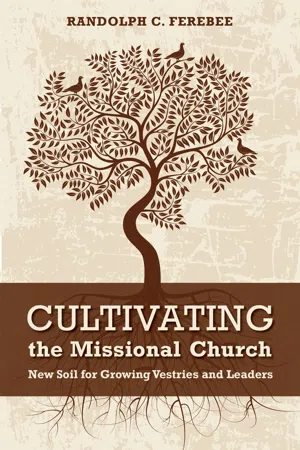
Cultivating the Missional Church
New Soil for Growing Vestries and Leaders
- 128 pages
- English
- ePUB (mobile friendly)
- Available on iOS & Android
eBook - ePub
About this book
Information
Topic
Theology & ReligionSubtopic
Christian ChurchPART ONE

CHAPTER 1
A Reordered Path of
GOVERNANCE
GOVERNANCE
In 2011, the Presiding Bishop of the Episcopal Church, Katharine Jefferts Schori, used a stark phrase when speaking to the church’s Executive Council. She said we were in danger of committing “suicide by governance.” Later in her remarks, Jefferts Schori said, “We need a system that is more nimble, that is more able to respond to change,” calling for “a more responsive and adaptable and less rigid set of systems.”13
As the church evolved, it took on more and more of the marks of an institution. Structures and rules were put in place to govern the behavior of those who banded together in congregations. This evolution was often marked with a movement from simplicity to greater and greater complexity. In Acts 6 we have the story the church uses to support the ordination of deacons. There was a need and in short order the apostles set apart seven men to minister to the need. Today the path to ordination as a deacon, be it a vocational deacon or a deacon who is preparing for ordination to the priesthood, is complex and elaborate.
Take any process that the local, diocesan, or national expression of church engages over time and the normal track is that the processes move more and more in the direction of complexity and regulation.14 In the governance function of the vestry, it is helpful that all process be as nimble, responsible, and as useful as possible. Remember the axiom “keep it simple”? The best approach is often the most straightforward and simple path.
Some, perhaps much, of the vestry’s encounter with inherited governing processes might not be, as yet, nimble and responsive. It is necessary to consider what the church’s laws, called canons, expect and how vestries honor their responsibility. Leadership bodies who are rerooting themselves to be effective in this new age are finding ways to honor the important truth conveyed in the law by returning to or discovering ways that are more straightforward and less cumbersome. Keeping on the simple path in canonical responsibilities will become a trait with transferable usefulness in general vestry discussions.
Though there may be local or diocesan variances in governing law, vestries are “selected,”15 according to the national canons, to tend to the temporal (or worldly) affairs of the church alongside the clergy who are to tend to the spiritual affairs of the church. This distinction is clean only on paper. In reality, both worldly and spiritual things are the concern of all leaders.
The worldly functions include tending the buildings and grounds, maintaining proper stewardship of all funds, stewarding annual giving and spending, making reports to the diocese and governmental entities, care of the temporal needs of a rector (or equivalent), auditing all financial and physical assets at least annually, and, when necessary, calling a new rector or vicar. The vestry is also responsible for keeping and preserving the minutes of its meetings; this is normally designated to a secretary or clerk. The vestry is the legal representative of the congregation.
Any of these actions that can, should be delegated to others who have a special calling or expertise. The vestry gratefully receives their gifts of time and talent, and then takes necessary action. In doing so the vestry utilizes a classic Anglican bit of wisdom called “subsidiarity.” A simple definition is that the vestry takes on only those tasks that cannot be performed effectively by others. An example is having a person skilled in finances manage an audit or bookkeeping or cost estimating, and report to the vestry for any needed action. When delegated, the vestry should trust the person(s) to whom the ministry has been entrusted.
The vestry in its governing responsibility is accountable for compliance with all applicable rules and regulations. These include the national canons (laws) of the Episcopal Church, the canons and policies of the diocese, and the bylaws and formal or informal policy of the local congregation. So that these responsibilities do not surprise anyone who serves on a vestry, an annual review of all governing rules should be engaged by the vestry, normally upon the seating of new members.16 These principles should be readily available at any meeting.
Whoever wishes to be great among you must be your servant, and whoever wishes to be first among you must be your slave.
—Matthew 20:26b–27
In general, the overtly governmental functions should claim only a small minority of the vestry’s meeting time. If governance does consume excessive time, discipline yourselves to spend more time with the functions in chapters 2 through 10 in this book. It may be helpful to appoint someone as a process observer to monitor meetings and time discussions in order to bring all vestry work into balance. “A congregation easily becomes an end in its own mind—recruiting people to an empty discipleship of committee service, finance, and building maintenance. Institutional maintenance is a necessary, but ultimately secondary, function of a congregation. If souls are not transformed and the world is not healed, the congregation fails no matter what the treasurer reports.”17
If the vestry is not a board of directors managing the temporal affairs and keeping the rules and regulations as a primary function, what should a vestry be? Beyond the governance of a congregation lies the larger horizon of where God is calling those in your faith community as they are formed as disciples of Jesus Christ. Congregations are unique and gifted collections of people endowed with abilities and talents that, when aggregated, offer God both voice and hands to accomplish the ongoing work of making whole that which is broken.
The major work of the vestry, which transforms governance into a generative, sense-making experience, is to create a frame of reference through which leaders process all governing issues and challenges. The output of such a process both builds health in individual members and energizes a congregation to move forward with growing capacity for participation in the reign of God.
Much of the time the vestry spends together has this purpose: How do we make God present in our families, our neighborhood, our town, and our world? As the vestry discerns its own unique answer to this question, it opens the ministry to everyone while helping to create a meaningful path through the complex adaptive changes every community needs to negotiate.

Two Kinds of Change
Saint Dunstan’s Church18 is above average in size for an Episcopal church. It has about one hundred worshippers on Sunday. This has been true for about a decade, but twenty years ago the number was twice that. During that earlier period, the church had a rector, an associate, a part-time youth minister, and a director of Christian education. Now, they have one priest and volunteer leaders in youth ministry and Christian education.
Located in a suburban area of a small city, Saint Dunstan’s has a small amount of capital debt from a Christian education wing built about the time attendance began to drop. Thinking that the church was no longer appealing to families with children, a building dedicated to the education of children and youth was intended to “fix the problem.” However, young families have not made Saint Dunstan’s their church home. The new wing is now mostly vacant on Sundays and in need of some minor repairs.
The twelve members of the vestry meet monthly in a corner of their parish hall. They open with prayer, approve the minutes, listen to a budget report, and resume what they believe to be a never-ending discussion. The repairs needed on the education wing surface again. “Do we need to have a rummage sale to help pay for repairs?” “Where are the kids it was built for?” “Why aren’t we attracting new folks, especially younger members?” “Maybe we need to hire a part-time youth minister or something.”
In the midst of this discussion another wrinkle is added. “Visitors don’t feel welcome here. I invited a coworker a month ago and she came when I wasn’t here. No one spoke to her.” Problem solving sets in. “Let’s train our greeters better.” “Maybe the rector needs to make a bolder welcoming announcement.” “I think the rector should be visiting more people, at least that is what some parishioners have said to me. She spends too much time in her office.”
After two hours, the meeting adjourns. Most members are exhausted and no solutions seemed to be put forth. The issues will be revisited at the next meeting.
The real resolution to the situation is the purpose of this book. It is important to note one dynamic here before moving on. The place where the vestry is stuck has to do with change. Change comes in two kinds: technical change and adaptive change.19
Technical change is familiar to everyone. We encounter problems and circumstances for which there is a known remedy. When our faucet leaks in the bathroom, we call a plumber. The inculcated reaction in most of us is to seek a technical change when we are faced with a problem. Our default inclination is to fix the problem. This is the realm of management as opposed to leadership.
Adaptive change is about learning new ways, changing attitudes, remodeling behaviors, and broadening our values. Without engaging adaptive change, many of the problematic experiences we have will go unresolved and, over the long term, fester. Adaptive change is about changing us, changing processes, changing our lives. Probably the most common source of leadership failure is the temptation to treat challenges with a technical fix rather than employ the longer, harder work of adaptive change.
Saint Dunstan’s was using technical change when adaptive change was needed. The good news for Saint Dunstan’s is that their rector attended a diocesan study day for clergy. She came back with an aha moment to share with the vestry. There was no overnight cure, but with the help of a nearby Presbyterian minister who was schooled in change theory, they began to break out of their cycle of limitation and lament.
RESOURCES
See a fuller description of subsidiarity in “The Principle of Subsidiarity” in the resource section (p. 91).
There is a suggested Order of Meeting (agenda) in “Vestry Meetings” on p. 81 of the resource section.
QUESTIONS
What do you think the Presiding Bishop could have been saying to your
church when she said that the church was in danger of committing “suicide by governance”?
church when she said that the church was in danger of committing “suicide by governance”?
Do you know your diocesan canons on vestries? Are you in compliance? Do you have parish bylaws or customs that need adjustment?
A board of directors has become a frequently used analogy for a church vestry. How does it help or hurt to refer to a vestry in this way?

13. Mary Frances Schjonberg, “Presiding Bishop Warns Executive Council of ‘Suicide by Governance,’” Episcopal News Service (Oct. 24, 2010).
14. This is true in virtually every human process, not just the church!
15. Note well that the...
Table of contents
- Cover Page
- Title Page
- Copyright
- Dedication
- Contents
- Preface
- Appreciation
- Introduction
- Prologue: Setting the Context
- PART ONE
- PART TWO: Resources
Trusted by 375,005 students
Access to over 1.5 million titles for a fair monthly price.
Study more efficiently using our study tools.
Frequently asked questions
Yes, you can cancel anytime from the Subscription tab in your account settings on the Perlego website. Your subscription will stay active until the end of your current billing period. Learn how to cancel your subscription
No, books cannot be downloaded as external files, such as PDFs, for use outside of Perlego. However, you can download books within the Perlego app for offline reading on mobile or tablet. Learn how to download books offline
Perlego offers two plans: Essential and Complete
- Essential is ideal for learners and professionals who enjoy exploring a wide range of subjects. Access the Essential Library with 800,000+ trusted titles and best-sellers across business, personal growth, and the humanities. Includes unlimited reading time and Standard Read Aloud voice.
- Complete: Perfect for advanced learners and researchers needing full, unrestricted access. Unlock 1.5M+ books across hundreds of subjects, including academic and specialized titles. The Complete Plan also includes advanced features like Premium Read Aloud and Research Assistant.
We are an online textbook subscription service, where you can get access to an entire online library for less than the price of a single book per month. With over 1.5 million books across 990+ topics, we’ve got you covered! Learn about our mission
Look out for the read-aloud symbol on your next book to see if you can listen to it. The read-aloud tool reads text aloud for you, highlighting the text as it is being read. You can pause it, speed it up and slow it down. Learn more about Read Aloud
Yes! You can use the Perlego app on both iOS and Android devices to read anytime, anywhere — even offline. Perfect for commutes or when you’re on the go.
Please note we cannot support devices running on iOS 13 and Android 7 or earlier. Learn more about using the app
Please note we cannot support devices running on iOS 13 and Android 7 or earlier. Learn more about using the app
Yes, you can access Cultivating the Missional Church by Randolph C. Ferebee in PDF and/or ePUB format, as well as other popular books in Theology & Religion & Christian Church. We have over 1.5 million books available in our catalogue for you to explore.