Of particular interest to scholars and practitioners across the Anglican Communion with contributions from a wide breadth of scholars.
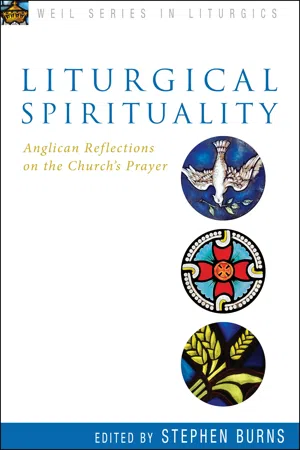
Liturgical Spirituality is a collection of Anglican reflections on the spirituality of the liturgy, inviting readers into the Church's patterns of prayer, seasons of the year, and sacramental action. With contributions from all over the world, from the North Atlantic to Australia, the collection helps develop a comprehensive understanding of contemporary Anglican spirituality.
- 208 pages
- English
- ePUB (mobile friendly)
- Available on iOS & Android
eBook - ePub
About this book
Information
Topic
Theology & ReligionSubtopic
Christian DenominationsPart One
Moods of Prayer
AT FIRST LOOK, PRAYER MIGHT seem easy. After all, the Latin precai, from which we get the word “prayer,” simply means to beg. When we draw in some of the basic meanings carried by the words translated as “pray/er” in the Hebrew Bible, we then find at least: ask, bend, and bow. Each of these might be part of begging. From the Greek of the New Testament, we have vow, wish, and call for. So the range of meanings expands again slightly. Prayer is a word or gesture that combines honor and beseeching.
Yet these simple words pale alongside the manifold, complex elaborations that the Christian tradition, over time, has nurtured in relation to prayer. To begin to do its richness justice, we need to consider prayer in its public and private modes (the former linking back at least to memories of Jesus in the synagogue and temple, the latter linking back to Jesus’ talk of “secret” prayer in Matthew 6:6)—that is, expressions of both devotional and communal prayer (though with both in relation to the prayers of the saints and the “whole company of heaven”). We need to consider creative and extempore1 forms (including glossalalia, that is, “speaking in tongues”) alongside disciplined forms of silence, song,2 music, and other arts (e.g., of icons being painted as acts of prayer). Alongside spontaneous and sensory experiences of prayer, we then need to remember particular texts and patterns of prayer we inherit from our forebears, some of which draw, in a wide variety of ways, from the scriptures—leaning into the Prayer That Jesus Taught and the Lucan songs that shape daily offices3 are just two of the most obvious examples. And all this is before we start to name different traditions, schools, and styles of prayer that have developed in different times and places, all of which leave a lively legacy and offer orientation to present-day pray-ers: the early desert abbas and ammas, Benedict and Francis and their heirs, Julian of Norwich4 and her mystic revelations—these as a handful of examples among a massive host of others. Towering figures in the Christian spiritual tradition—Julian, Francis, Benedict, et al.—take their place in a company that encircles the spiritual companionship available through the pages of the writings of more recent seekers: Evelyn Underhill, Henri Nouwen, and Dorothee Soelle, for example, apart from contemporary spiritual classics and introductions to the fertile realms of “spirituality” that will fascinate and beckon those willing to be open to them. All of this means that there is plenty of help available to encourage the contemporary person who desires to pray, if they can learn where to look and are willing to live with a measure of strangeness inevitably involved in an attempt to attend to others’ particular experiences across time and space. These rich seams of prayer take us beyond “techniques” and in many various ways can teach pray-ers to ally their prayer to action, perhaps even to consider their intent to live a life of love and share caring acts as itself a kind of prayer, or indeed, to come to see themselves as a “living prayer.” So, on action as a kind of prayer, Ann Loades writes of child-rearing like this:
For Christians at any rate, having children is now a vocation, a witness to our faith in God as well as a kind of living prayer for the future of the world in which they live. Having children can be seen as a kind of ministry, in which adults receive from children as much as vice versa …5
And the idea of actually becoming a prayer comes to dazzling focus in the hagiographies of St. Francis, of whom it is said: “More than someone who prayed, he had become a prayer.”6
Part One of this book attends to particular modes and moods of prayer in the liturgy: thanksgiving, praise, confession, and intercession. These forms of prayer are present in the liturgy in different ways—surfacing, as it were, in hymns and songs; in “prayers we have in common” like the kyrie eleison, Gloria in excelsis, and so on—themselves often sung—apart from the thanksgiving of the eucharistic prayer; or the intercessions that shape the Prayers of the People. The Prayers of the People themselves invite a blending of thanksgiving and intercession. And the collect is a distinct, succinct style of prayer that honors and asks things of God in a single terse, graceful sentence.
Stephen Platten writes about giving thanks. He begins and continually returns to the much-loved story of Gerald Durrell, My Family and Other Animals, tracing connections between thanksgiving, happiness, gift, and grace. As his chapter unfolds, he draws not only on the magic of Durrell’s narratives, but amongst other things on writing that emerged in the awful context of Nazi concentration camps, where—remarkably—some persons forced into such hideous places found it somehow possible to find cause to give thanks to God. Platten turns to other pieces of literature, between the charms of Durrell and the horror of the Holocaust, to explore “the ambiguity of Christian thanksgiving.” So a diverse range of reference shapes his evocative speech of “profitable wonders,” of being “un-selfed” by God, and other dynamics involved in becoming “a eucharistic person.” While his explorations do indeed make special reference to eucharistic prayer (as well as the “general thanksgiving”), in fact he offers not simply an understanding of liturgical modes of thanksgiving, but a vision of grace-filled life in a world of both beauty and terror, and beloved by God.
Mark Earey focuses on praise, an activity he describes as “resulting from something wonderful.” Like Platten, he places the mode of prayer that is his particular focus within an understanding of other modes of prayer in and beyond the setting of eucharistic worship, and especially suggests how praise is an outward and communal expression of adoration. It is embodied—possibly resulting in persons who give praise “looking funny”—and this is one dimension of it being public, “political” even, possibly putting the ones giving praise at odds with all that might contest or distract from the center of the wonderful “something” of God to whom praise is offered. As such, praise is much more than joyful singing; it is a way of life within which every action of the worshipers may come to express.
Harriet Harris writes on confession. She finds orientation for her reflections in Luke 15, the parable of the forgiving father/prodigal son. Harris sets this parable at the center of a rich tapestry of biblical references, into which she also draws extracts from spiritual writings, liturgical texts, and narrative testimony from Poland and Kenya. Likewise, she sets the penitential rite of Holy Communion within a wider frame of “multiple opportunity to confess throughout the service.” She argues that the eucharist “schools” us in repentance, and throughout she places emphasis on God’s mercy, which is “God’s perfection.”
Unlike Harris’ essay, the final chapter includes no direct reference to biblical texts; rather John Pritchard provides a vivid reflection on experience, beginning from his sense of something “amiss” with the way the prayers of the people can be offered. As well as clearly pointing to problems with how intercession is sometimes approached, he also asserts the opportunity for them to be lively, engaging, and helpful, giving us a stream of ideas and directly discussing a number of possible practices. In doing so, he helps us to “stretch the possibilities” of our common prayer so that we might “get hold of God.”

1. Ruth Duck, Finding Words for Worship: A Guide for Leaders (Louisville, KY: Westminster John Knox Press, 1995); Laurence Hull Stookey, Let the Whole Church Say Amen! A Guide for Those Who Pray in Public (Nashville, TN: Abingdon Press, 2002).
2. See Brian Wren, Praying Twice: The Music and Words of Congregational Song (Louisville, KY: Westminster John Knox Press, 2000).
3. These with other scriptural and ancient texts form the “prayers we have in common,” ecumenically, across many Christian traditions.
4. Benedict: July 11; Francis: October 4; Julian: May 8 in the sanctorale of the Uniting Church in Australia. Uniting in Worship 2 (Sydney: Uniting Church Press, 2005), 566–71.
5. Ann Loades, “Death and Disvalue: Some Reflections on ‘Sick’ Children,” Hospital Chaplain 93 (1985): 11.
6. William Short, OFM, Poverty and Joy: The Franciscan Tradition (London: DLT, 1999), 31.


Thanksgiving
Stephen Platten
In Newness of Life:
Eucharistic Living
Eucharistic Living
“CHAIRETE,” HE CALLED IN HIS deep voice, the beautiful Greek greeting, “chairete, kyrioi” … be happy.
The goats poured among the olives, uttering stammering cries to each other, the leader’s bell clonking rhythmically. The chaffinches tinkled excitedly. A robin puffed out his chest like a tangerine among the myrtles and gave a trickle of song. The island was drenched with dew, radiant with early morning sun, full of stirring life. Be happy. How could one be anything else in such a season?1
Gerald Durrell’s My Family and Other Animals has been a popular favorite since its first publication in 1956. Transformed into television programs, it continues to weave its magic spell. That brief opening quotation suggests why the book touches peoples’ hearts. For alongside the humor and Durrell’s perceptive reflections about his family, it is ultimately a celebration of life. The humor itself is part of that celebration, but the focus is broader still. In that paragraph above, the animal and plant life of Corfu sing the song of happiness. There are countless other extracts in the book which pick up a similar resonant note. Durrell’s youthful life on Corfu was formative, indeed seminal. Page by page his book celebrates the beauty of nature and the rich tapestry of human life. The characters, not only from within his own family but all who are caught up in his experience, are drawn with humor and generosity. It is not an overtly religious book, but much of the narrative, and certainly the description of the celebrations for St. Spyridon, the island’s patron, in Corfu Town, capture the same sense of excitement and celebration.
That extract above begins with a Greek word chairete. Durrell translates it as: “Be happy.” These same words are encountered in the New Testament. In Philippians 4:4, Paul exhorts his readers in almost precisely the same words: “Chairete, en kyrio,” he writes. Here he means “rejoice in the Lord” and he refers us to Jesus, the incarnate Lord. Durrell’s exhortation, from the lips of Yani, the Greek shepherd, are less portentous. He simply means “rejoice,” or “be happy, sir!” Kyrios in modern Greek has come to have a less exalted feel; it has become a term of politeness, almost a part of social etiquette. But the resonances are still strong. Anyone knowing the New Testament could hardly fail to respond to these echoes. Durrell clearly intends a profound sense of happiness and thanksgiving to sound out from the lips of that Corfot shepherd. It says something about an attitude to life and indeed an attitude to the whole of creation.
Ironically, the echoes between modernity and antiquity, between contemporary Mediterranean culture and that of New Testament times, between Yani the shepherd and the life of Jesus do not end here. For, along with kalimera (good day) and yasas (hello), perhaps the most frequently used word in modern Greece, and so in Corfu, is the word eucharisto. It simply means “thanks,” and although it is pronounced quite differently from our word eucharist, it is precisely the same word. So, it would not be pressing the meaning too far to say that Greek people (whether they consciously realize it or not) live “a eucharistic life.” That same resonant word, which stands at the very heart of the Christian community, is on the lips of Greek men, women, and children, morning, noon, and night. It is one of the keynotes of their culture. Who would have thought that we could have found ourselves so profoundly caught up in elements of the Christian life starting from My Family and Other Animals?
Echoes and Resonances:
“In Newness of Life”
“In Newness of Life”
Of course, we have only just got started. These are but echoes and resonances. It would be unfair to Durrell to turn his magical book, by sleight of hand, into a Christian classic. Nonetheless, it has set us out on our way. For these Greek words take us into the very center of Christian life down the ages and into the present day. What might this mean for Christian people? In the general confession, we are called to acknowledge our sins and to repent:
Ye who do truly and earnestly repent you of your sins, and are in love and charity with your neighbors, and intend to lead a new life, following the commandments of God, and walking from henceforth in his holy ways: Draw near with faith, and make your humble confession to Almighty God …2
Repentance means a radical turning again, and the confession very positively moves on to make us say: “And grant that we may hereafter serve and please thee in n...
Table of contents
- Cover Page
- Title
- Copyright
- Contents
- Introduction to the Series
- Introduction
- Contributors
- Part One: Moods of Prayer
- Part Two: Sacramental Actions
- Part Three: Seasons of Celebration
- Acknowledgments
Trusted by 375,005 students
Access to over 1.5 million titles for a fair monthly price.
Study more efficiently using our study tools.
Frequently asked questions
Yes, you can cancel anytime from the Subscription tab in your account settings on the Perlego website. Your subscription will stay active until the end of your current billing period. Learn how to cancel your subscription
No, books cannot be downloaded as external files, such as PDFs, for use outside of Perlego. However, you can download books within the Perlego app for offline reading on mobile or tablet. Learn how to download books offline
Perlego offers two plans: Essential and Complete
- Essential is ideal for learners and professionals who enjoy exploring a wide range of subjects. Access the Essential Library with 800,000+ trusted titles and best-sellers across business, personal growth, and the humanities. Includes unlimited reading time and Standard Read Aloud voice.
- Complete: Perfect for advanced learners and researchers needing full, unrestricted access. Unlock 1.5M+ books across hundreds of subjects, including academic and specialized titles. The Complete Plan also includes advanced features like Premium Read Aloud and Research Assistant.
We are an online textbook subscription service, where you can get access to an entire online library for less than the price of a single book per month. With over 1.5 million books across 990+ topics, we’ve got you covered! Learn about our mission
Look out for the read-aloud symbol on your next book to see if you can listen to it. The read-aloud tool reads text aloud for you, highlighting the text as it is being read. You can pause it, speed it up and slow it down. Learn more about Read Aloud
Yes! You can use the Perlego app on both iOS and Android devices to read anytime, anywhere — even offline. Perfect for commutes or when you’re on the go.
Please note we cannot support devices running on iOS 13 and Android 7 or earlier. Learn more about using the app
Please note we cannot support devices running on iOS 13 and Android 7 or earlier. Learn more about using the app
Yes, you can access Liturgical Spirituality by Stephen Burns in PDF and/or ePUB format, as well as other popular books in Theology & Religion & Christian Denominations. We have over 1.5 million books available in our catalogue for you to explore.