• An all-in-one volume sharing the history, practice, and viewpoints of Confirmation in the Episcopal Church and the first book on the subject for at least 15 years
• Resolutions regarding Confirmation are coming to the 2015 General Convention
• Includes questions for reflection and study by individuals and groups
Many clergy and educators would say that the rite of Confirmation in the Episcopal Church today is a sacrament in search of a meaning. Some believe Confirmation is an essential rite of passage for adult leadership in the governance of the church. Some believe it is a rite that no longer has a place in the life of the church, understanding the importance that Baptism now holds in the 1979 Book of Common Prayer's ecclesiology.
Following a history of how the rite of Confirmation came about and its implications for youth and adults in the church today, voices in the Episcopal Church (bishops, liturgical scholars, confirmation leaders, and youth themselves) offer fresh viewpoints here in a conversational format to engage the reader.
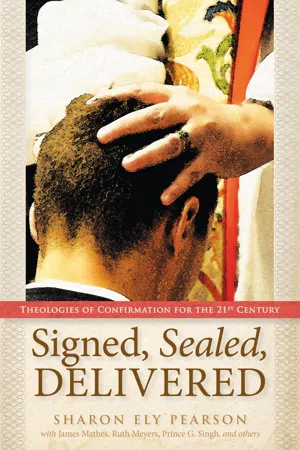
eBook - ePub
Signed, Sealed, Delivered
Theologies of Confirmation for the 21st Century
- English
- ePUB (mobile friendly)
- Available on iOS & Android
eBook - ePub
About this book
Trusted by 375,005 students
Access to over 1.5 million titles for a fair monthly price.
Study more efficiently using our study tools.
Information
Topic
Teologia e religioneSubtopic
Denominazioni cristianePART I
CHRISTIAN INITIATION
I therefore, the prisoner in the Lord, beg you to lead a life worthy of the calling to which you have been called, with all humility and gentleness, with patience, bearing with one another in love, making every effort to maintain the unity of the Spirit in the bond of peace. There is one body and one Spirit, just as you were called to the one hope of your calling, one Lord, one faith, one baptism, one God and Father of all, who is above all and through all and in all.
— Ephesians 4:1 –6
CHAPTER 1
Rites of Initiation
in the Christian Tradition
in the Christian Tradition
Christian baptism in the New Testament is a complete and adequate entrance into a new relationship with the Father, the Messiah and the Holy Spirit, becoming a full member of the new Church. Households were baptized together, including slaves and children. If children could not answer the questions of renunciation and commitment for themselves, others answered for them.1 The newly baptized emerged from the water and (in many parts of the Church) were anointed, usually over the entire body. Being marked with the sign of the cross with oil, a part of the rite called consignation, the newly baptized were then re-clothed (later in the era they received white garments). Being brought into the Eucharistic assembly for the first time, they shared in the kiss of peace and the people’s prayers, made their own offering of bread and wine, and received the Body and Blood of Christ. Baptism was seen as a water moment of the washing from sin and a cleansing act of forgiveness. The anointing, a representation of the rich, flowing life of the Spirit,2 was a sealing of the gift of the Holy Spirit, being marked as Christ’s own forever. The name “Christian” means anointed.3 The use of anointing in making prophets, priests, and kings would carry a spiritual association to any Jew, including the first Christians.
There are many allusions to anointing, such as in 2 Cor 1:21–22, that speak of receiving the seal of the Holy Spirit as a sign of commissioning for apostolic ministry. In the King James Version of the Bible, the Greek word translated as “commissioned” means literally “anointed.”4 The conveying of responsibility by the laying on of hands was also an ancient practice existing in Israel; it was a regular and agreed upon method of either transferring or shifting responsibility in the community. This custom predates Exodus, and following this laying on of hands, or public binding, a participation in a common meal as a form of communion with the divine ancestor was shared. Many of these Jewish customs found their way into the initiation rites of the early Church.
While the water ritual was the central part of baptism and was seen as the act of initiation, the laying on of hands, the “stirring up” of the Spirit, had an eschatological quality.5 In Acts 8:4–8, 14–17, the mission of Peter and John to Samaria laid hands on those who had previously been baptized, and they received the Holy Spirit. Daniel Stevick believes this narrative is about a missionary advance into schismatic Jewish Samaria and should not be seen as a continuation of the initiation rite.6 In Acts 19:1–7, twelve disciples in Ephesus had been baptized with John the Baptizer’s “baptism of repentance,” but had not received (nor heard of) the Holy Spirit. They are then baptized “in the name of the Lord Jesus” by Paul, and then through the laying on of Paul’s hands, receive the Holy Spirit. These stories from Acts of the Apostles have led to many interpretations of how the Spirit is received throughout Church history.
The writings of the Apostolic Fathers speak of water as Spirit-giving. Clement of Rome (c. 90) is aware that we have “one God and one Christ and one Spirit of Grace who was poured out on us.” The Epistle of Barnabas (c. 90s) opens by asking its readers to share how the Spirit is “poured out on them from the riches of the Lord’s fount.”7 In the Shepherd of Hermas (c. 140–150), there are six examples of where the readers are said to have received the Spirit, in most cases with water.
At this time, converts to Christianity were now being made almost exclusively from the ranks of pagans, so a period of preparation for baptism became an important rule. The immediate and personal responsibility for the spread of the Christian mission that characterized the apostolic age was not as important as renouncing Satan and confessing the faith of Christ. There was a period of catechesis in which the story of Jesus Christ was shared, as well as the teachings of the apostles and prayers of the people. This preparation took place over a period of time prior to the celebration of Easter when all new converts were baptized into the Church. The earlier “confirmation” to mission of the Gospel was no longer as immediate as it had been during the apostolic period. Following their baptism, the new Christians were welcomed into the household of faith and participated in the community meal, the Eucharist.
As the early church grew and spread, there were differences in the rite of initiation as practiced in Carthage and in Rome. The first documented description of baptism in the Church is from Tertullian (c. 155–220) of Carthage, describing the washing as cleansing and blessing of our bodies so that the imposition of hands can invite the coming of the Holy Spirit. He speaks of the Spirit’s resting on the waters of baptism, being active throughout the rite.8 In Tertullian’s Liber de Baptismo, he says, “the giving of Baptism is the right of the High Priest, who is the bishop and others have it only as delegates.”9 For him, it is not the water but the “seal” which imparts the Spirit, being given by the bishop. The whole rite remains one service, and its “minister” is the bishop. Noted liturgist Dom Gregory Dix asserts that this is the general pre-Nicene understanding of the rite of Baptism.
The first known text of a full baptismal liturgy can be found in the Apostolic Tradition (c. 215) of Hippolytus (c. 170–236), from the church in Rome.10 It is elaborate: thanksgiving over oil of thanksgiving, exorcism of oil of exorcism, renunciation of Satan, anointing with oil of exorcism by a presbyter, affirmation of a creed, baptism in water, anointing with oil of thanksgiving by a presbyter. Following their baptism, drying themselves and being newly vested, the neophytes are brought into the church. At the end of the rite according to Apostolic Tradition 21–22, the bishop laid a hand on each of the candidates, in prayer.11 Although the rite of Hippolytus appears to presuppose that most of the candidates would be mature persons who had gone through extensive preparation, there is also a rubric regarding who these neophytes might be:
They shall baptize the little children first. And if they can answer for themselves, let them answer. But if they cannot, let the parents answer or someone from their family.12
Thus we have sponsors speaking on behalf of children who were too young to speak for themselves. Infant candidates are baptized, confirmed, and communicated at one sacramental action with the bishop present, just as adult candidates are initiated into the Christian community.
Theologian Aidan Kavanagh does not believe that the bishop’s “confirmation prayer” is an epiclesis of the Holy Spirit, but a dismissal, or missa, leading to the breaking of the bread and admission to the Eucharistic community.13 He believes that the structure we know as “confirmation” today originated with this liturgical action. The purpose of a missa rite was to conclude and formally “seal” a unit of public worship or instruction by dismissing the assembly with prayer and physical contact by its chief minister—bishop or presbyter.
Cyprian (c. 200–258), Bishop of Carthage, believed in the presence and power of the Spirit in Baptism, but the Spirit was given and received by the power of the laying on of hands.14 Ambrose of Milan (340–397) speaks of a “spiritual seal” and a “perfecting” or invocation of the Holy Spirit and its gifts on the neophytes, which takes place after the post-baptismal anointing and foot washing.15 With Ambrose, it appears that this northern Italian practice began the Western theory that confirmation is the “completion” of baptism.16
During the fourth century, the Church increased in numbers and many of its members lived in remote rural areas. The presence of a bishop was not always possible, as baptisms were a more frequent occurrence in an expanding church. Jerome (c. 347–420) writes of his distress that presbyters and deacons in churches that are far from the bigger cities have baptized many without the bishop’s presence.17
As the Church expanded, practices adapted and changed to the local circumstances. John Chrysostom (347–407) describes the rites of Antioch as having no anointing following baptism; it is in the water that the Holy Spirit descends on the baptized “through the words and hands of the priest.”18 In different regions of the Church, the newly baptized received a signing with the cross (Milan, Rome, Spain, and North Africa), a laying on of hands (Rome and North Africa), a second anointing by the bishop (Rome), and even in some places pedilavium, or foot washing (Milan and Spain).19
During Augustine’s time (354–430), people were largely illiterate, so Christian preparation took place through worship, biblical preaching, and reading Scripture aloud. Catechumens continued to go through a lengthy period of instruction in the faith. Augustine’s doctrine that baptism cleansed inherited sin and guilt reinforced the practice of baptizing children as early as possible. Pope Innocent I also stated that children were to receive the sacrament upon their baptism, and he decreed that consignation of baptized infants should be only by the bishop, for this specific ministry belongs only to those of “the highest rank of the pontificate.”20 The hand laying and bishop’s participation were viewed as a pastoral presence, not to be seen as a completion of the full initiation rite of the water baptism.
Local councils (Riez in 439 and Orange in 441) are when the words confirmare or perficere are used in reference to particular rites associated with the ministry of bishops in baptismal initiation.21 These rites involved the imposition of hands with prayer for the Holy Spirit. Innocent I reinterpreted the missa as to be a ceremonial g...
Table of contents
- Cover Page
- Title
- Copyright
- Contents
- Introduction
- PART I / CHRISTIAN INITIATION
- PART II / A PUBLIC AFFIRMATION
- PART III / DULY PREPARED
- PART IV / A THEOLOGY OF CONFIRMATION FOR THE FUTURE
- Discussion Guide
- Appendix I: News Articles
- Appendix II: Annotated Bibliography of Confirmation Resources
- Appendix III: Sample Diocesan Guidelines
Frequently asked questions
Yes, you can cancel anytime from the Subscription tab in your account settings on the Perlego website. Your subscription will stay active until the end of your current billing period. Learn how to cancel your subscription
No, books cannot be downloaded as external files, such as PDFs, for use outside of Perlego. However, you can download books within the Perlego app for offline reading on mobile or tablet. Learn how to download books offline
Perlego offers two plans: Essential and Complete
- Essential is ideal for learners and professionals who enjoy exploring a wide range of subjects. Access the Essential Library with 800,000+ trusted titles and best-sellers across business, personal growth, and the humanities. Includes unlimited reading time and Standard Read Aloud voice.
- Complete: Perfect for advanced learners and researchers needing full, unrestricted access. Unlock 1.5M+ books across hundreds of subjects, including academic and specialized titles. The Complete Plan also includes advanced features like Premium Read Aloud and Research Assistant.
We are an online textbook subscription service, where you can get access to an entire online library for less than the price of a single book per month. With over 1.5 million books across 990+ topics, we’ve got you covered! Learn about our mission
Look out for the read-aloud symbol on your next book to see if you can listen to it. The read-aloud tool reads text aloud for you, highlighting the text as it is being read. You can pause it, speed it up and slow it down. Learn more about Read Aloud
Yes! You can use the Perlego app on both iOS and Android devices to read anytime, anywhere — even offline. Perfect for commutes or when you’re on the go.
Please note we cannot support devices running on iOS 13 and Android 7 or earlier. Learn more about using the app
Please note we cannot support devices running on iOS 13 and Android 7 or earlier. Learn more about using the app
Yes, you can access Signed, Sealed, Delivered by Sharon Ely Pearson in PDF and/or ePUB format, as well as other popular books in Teologia e religione & Denominazioni cristiane. We have over 1.5 million books available in our catalogue for you to explore.