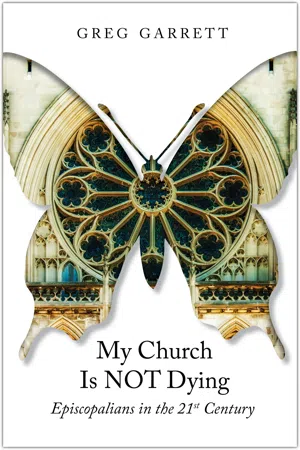
The old way of "being church" is being replaced by something new and beautiful for those with the eyes, ears, heart, and soul to experience it.
Prolific author Greg Garrett reminds Episcopalians of the many gifts that our tradition can offer a doubting and hurting world. He reveals a church that values intellect, beauty, diversity, and community, and promotes thoughtful engagement with questions of faith, ethics, and community. This church espouses a generous orthodoxy, welcoming left and right, mystic and doubter. It values education, social justice, and engagement with
literature and culture. And in opposition to the radical individualism espoused by most of American Protestantism, it offers the unique gift of a tradition shaped by English culture that believes the individual is a part of her or his community—not in opposition to it.
- 160 pages
- English
- ePUB (mobile friendly)
- Available on iOS & Android
eBook - ePub
About this book
Information
Topic
Theology & ReligionSubtopic
Christian DenominationsDoing Justice: A Church That Works

In the fall of my second year in seminary, I was given my field placement. That meant that for the next two years I was going to be attached as a sort of priest-in-training to a new church where I’d been matched through a process something like being sorted for a house at Hogwarts, and there I would learn the behind-the-scenes details about faith, practice, and church management that watching Greg Rickel preach and preside on Sunday had not yet given me. My assignment was Calvary Episcopal in Bastrop, Texas, a lovely and historic little church about forty minutes outside of Austin.
From everything I’d heard from others and during the process of my assignment, I had the impression that my placement at Calvary was going to serve two purposes. I was going to learn from my rector, the Reverend Matt Zimmerman, about what a priest does and how he does it, and I was expecting to observe this new community to see how a church operates. For my part, I was guessing that I would give something back to that community by teaching and preaching, two things I did pretty well and would learn to do even better. But just after I arrived in August 2005, something happened that made it clear that I would be learning much more from them than they would ever learn from me.
That something was Hurricane Katrina. It smashed a path across the Gulf Coast from Florida to Texas, killing almost two thousand people (over a hundred people are still categorized as “missing”), wiping homes, businesses, schools, and churches off the map, or flooding them, as it did in New Orleans.
I was in shock. As a longtime lover of New Orleans, I had long talked with dear friends there about how someday the city would get hit by “the Big One,” but somehow we never believed it would happen. Like everyone, I was heartbroken by the news and images coming out of the city.
I was in shock, but the good people of Calvary Episcopal were not. The first Sunday after the hurricane, they were already organizing. People were gathering things to send to the Gulf region, and others were already planning to go and help the residents to rebuild. It was clear that not only were we at Calvary going to pray for those afflicted by this terrible natural disaster, but we were going to do tangible hands-on things to try to make their lives better. People were going to set aside their own lives to help those in need. They were going to live out their faith in a tangible way that I wasn’t sure I had ever witnessed before, because, frankly, I hadn’t lived it out much myself.
Fay Jones and her husband, Pete, led Calvary’s response to Katrina, and ended up staying and working on the Mississippi Gulf Coast for six months, from the immediate response to the disaster through the snarled recovery period and into the time when people began to recover and rebuild. Fay recently shared a few of her memories of and reflections on that powerful time with me, saying that where Katrina had brought devastation, Episcopalians and hippies brought healing!
In September 2005, my husband, Pete Jones, was invited to join a group of Christian men from Bastrop County, Texas, on a mission to the people of Waveland, Mississippi, which had been devastated by Hurricane Katrina. After a week in the very primitive camp on a parking lot in Waveland, Pete was asked to be the operations manager of the mission because he was retired and the other men needed to return home to work and families. At that time, I joined Pete in Waveland. A family in Bastrop had donated the use of a travel trailer, and this became our home until after Christmas that year.
Soon after the storm, the Rainbow People, a group of hippies, set up camp in conjunction with our camp. They set up a massive kitchen and prepared three nutritious meals a day for the volunteers and for the now homeless residents of the Mississippi Gulf Coast. At the height of our time in Waveland, we were feeding and serving approximately 1,500 people a day. Although the market and the kitchen were intended to serve the people of Waveland, no one was turned away in the beginning.
While many of our volunteers worked in the market, many also worked out in the community clearing out houses, removing debris, and other activities. Our volunteers came from all walks of life, and many denominations—Methodist, Lutheran, Presbyterian, and Episcopal. I can’t say enough about our volunteers. They arrived at all times of day or night and were anxious to go right to work. We started them off with a tour of the city so they could experience the extent of the devastation. We explained that while they were welcome to encourage the survivors to tell their story, no one was to press for information. We never entered the “space” of a residence unless invited by the homeowner.
Where was God in all this? God was in the tremendous out-pouring of compassion across this country, which resulted in money, clothing, and food being sent immediately to those who had lost everything. God was in the faces, hands, and hearts of the hundreds of volunteers who came to Mississippi to assist in rebuilding peoples’ homes and lives. God was in the prayers we offered every morning and evening, asking for wisdom, patience, and some measure of understanding of the experience.
Our sending church was Calvary Episcopal Church in Bastrop, Texas. Father Matt Zimmermann led a group to Waveland. We had the support of prayer and other donations. One Sunday when Pete and I had returned home for some much-needed R & R, Father Matt asked me to speak on our experience from the pulpit.
What did I take away from Katrina? Humility, a renewed sense of compassion, hope in humanity, faith that God is with us and in us and using us to reconcile and heal. Just as we witnessed the best in people, we also witnessed greed, anger, hopelessness. But this did not dampen our spirits or cause us to stop doing our best. My faith is stronger, and I believe I have more patience and am more willing to “not sweat the little things” than before spending six months where Katrina had truly leveled the playing field and made all equal.
Humility, a renewed sense of compassion, hope in humanity, faith that God is with us and in us and using us to reconcile and heal. It’s an amazingly apt definition of what Episcopalians believe about our responsibility to be about God’s work of justice in the world, and the tragedy of this terrible storm offers a great opening example for us. As Fay suggests, the Episcopal Church’s response to Katrina didn’t just come from one small church in Bastrop, Texas. It was huge, it was nationwide, and it included many individual churches, as well as agencies of the national church.
Episcopal Relief and Development consulted with the churches and dioceses affected and began channeling resources to them. Episcopal Migration Ministries began to investigate the possibility of resettling those who had been left homeless. Most importantly, the presiding bishop, then the Right Reverend Frank Griswold, sent out a message calling on all bishops, priests, deacons, and parishioners in the Episcopal Church to respond in spiritual and tangible ways:
I am sending this message by e-mail to our bishops, clergy and congregations—insofar as is possible—so that it might be shared and that we might be a community united in prayer and service during this time.
During these past days I have been contacting bishops in the areas affected by hurricane Katrina and have spoken to the bishops of Alabama, the Central Gulf Coast, Louisiana, and Mississippi. As you would imagine, they are ministering to their communities the very best they can under extraordinarily difficult circumstances. Communication is tenuous, and in some cases impossible. As hour by hour the almost unimaginable ravages of the hurricane become more fully known we are continuing to learn of further losses of life, houses, churches, and other familiar points of reference, including the destruction of whole communities.
At this time let us be exceedingly mindful that bearing one another’s burdens and sharing one another’s suffering is integral to being members of Christ’s body. I call upon every member of our church to reach out in prayer and tangible support to our brothers and sisters as they live through these overwhelming days of loss and begin to face the difficult challenges of the future. …
Life affords us very few securities and yet deep within us, often revealed in the midst of profound vulnerability and loss, springs up a hope that contradicts the circumstances in which we find ourselves. Such hope emerges from the depths of despair as pure and unexpected gift. This is the way in which Christ accompanies us and seeks to share our burdens. May Christ so be with those of us who are enduring the effects of the hurricane, and may each one of us be a minister of hope to others in these dark and tragic days.
May we together pray:
God of mercy and compassion, be in our midst and bind us together in your Spirit as a community of love and service to bear one another’s burdens in these days as we face the ravages of storm and sea. This we pray through Jesus Christ our Lord from whom alone comes our hope. Amen.24
I was stunned again, this time not by grief, but by the ways that my church, my Church, and many other church and nongovernmental organizations were present in the face of this incredible tragedy. Prayer and service, Bishop Griswold said. Maybe our governments were failing the test, but individuals and faith communities were rising to the task of helping their neighbors. As I looked around that small country church, as I looked at the pew where Fay and Pete Jones would normally sit, and thought about what they were all willing to do to manifest Christ’s love to a despairing world, I was starting to understand what it meant to be a Christian who works for justice and peace, who stands up for those who have nothing. It looked just exactly like this.
Now why did all of these Episcopalians stand up for peace and justice? Why do any of us? Because, as you probably know, the United States is full of deeply faithful Christians who are satisfied to preach personal salvation as their primary value, and who tend to get more exercised about what they perceive as the decline in American morality than they do about the rise in Americans below the poverty line. (Let me be the first to acknowledge that many evangelical Christians, particularly younger evangelicals, would follow Jim Wallis and Brian McLaren in arguing that the Kingdom of God is about prayer and service. But so long as the cultural version of Christianity seems to many to be narrowly moral, it will need to be said and resaid that we Episcopalians are extolling a counter-cultural version of Christianity based on love and service, not on judgment and salvation.)
Why do Episcopalians love their neighbors? Sara Miles, a lay leader at St. Gregory of Nyssa in San Francisco, puts it beautifully in her book Take This Bread, where she details her own journey from receiving the Eucharist to starting a food bank. She describes being struck by all these strange stories of Jesus feeding people. Even after he died and returned, he was still feeding people. What did this mass of stories about Jesus being with people in their most basic needs have to say to her? “All of it pointed to a force stronger than the anxious formulas of religion,” she concluded, “a radically inclusive love that accompanied people in the most ordinary of actions—eating, drinking, walking—and stayed with them, through fear, even past death. That love meant giving yourself away, embracing outsiders as family, emptying yourself to feed and live for others.”25
What Sara suggests seems to be a truth of our faith. The call to love our neighbors in tangible as well as spiritual fashion is not optional. Even though some Episcopalians privilege this call more than others (Calvary was powerfully involved with service; Sara complained that her church initially resisted the idea of feeding their neighbors), this call to love God and to love our neighbor that Augustine of Hippo called the Two-Fold Commandment is enshrined in our liturgy. You can find it in our Prayers of the People, you can tease it out of various collects and sections of liturgy, and most importantly, you hear it in a section of the prayer book that many of us end up reciting several times a year, the Baptismal Covenant.
That covenant, Bishop Andy Doyle told me, was rumored to have been a late addition to the 1979 prayer book, but whenever it came along, in his estimation it represents the key to our entire Book of Common Prayer. “The Covenant,” he says, “helps us find ourselves in the midst of relationship with God and with one another. It locates our spiritual journey in the midst of the spiritual journey of a whole community of faithful people. … It helps us discover that we come from love, move through the world in love, and are always in the process of returning to love.”
When the godparents present a candidate for baptism, they recite the well-known bits you remember vaguely from The Godfather. They renounce Satan on behalf of their godchild. They promise, on behalf of their godchild, to follow Christ. Then the focus shifts to the congregation, who in the liturgy are actually invited to renew their faith and recommit themselves to God through repeating the Baptismal Covenant. The first parts of the covenant are about agreeing to worship together, continuously repenting of our evil, and proclaiming by word and deed the good news of God in Jesus Christ. Then we get down to the questions and affirmations that seal love of neighbor as a central belief for every Episcopalian:
| Celebrant | Will you seek and serve Christ in all persons, loving your neighbor as yourself? |
| People | I will, with God’s help. |
| Celebrant | Will you strive for justice and peace among all people, and respect the dignity of every human being? |
| People | I will, with God’s help. |
Whether or not we feel comfortable doing so, whether or not we even want to be around the poor, the dirty, the marginalized, the mentally ill, the elderly, the immigrant, and all the long list of people who would fall into Jesus’ accounting as “those who have nothing,” this is a promise we make, both individually and corporately, every time we offer those baptismal vows. We are called to seek justice and peace, to regard all human beings as our neighbors, and to understand (as Augustine said) that we love God most powerfully and tangibly when we express love to our fellow human beings.
About a year before we set off for seminary together, my St. James’ friend (now the Reverend) Carissa Baldwin said something to me that was both challenging and true, as Carissa’s words often are. “You talk a lot about the poor,” she said, and I nodded, maybe even felt good about myself. In writing, in speaking, in prayer, in the occasional sermon I was preaching then, I did advocate for economic justice.
But knowledge and prayer on their own are not enough. “Fine,” she went on, “so you talk about the poor. Why don’t you do something with them?”
Ouch.
Well...
Table of contents
- Cover Page
- Title Page
- Copyright
- Contents
- Dedication
- Foreword: The Right Reverend Greg Rickel
- Introduction: My Church Is Not Dying
- The Anglican Way: Spiritual and Religious
- Living the Questions: A Faith That Stays Open All Night
- Worship and Community: One Way God Touches and Heals Us
- Beauty and the Life of God: Music, Culture, and the Incarnate Way
- Living Together: How the Culture Wars Almost Killed Us—But Made Us Stronger
- Telling the World: Evangelism for a World That Hates Evangelism but Needs the Church
- Doing Justice: A Church That Works
- Reaching Out: Touching Lives All Week Long
- Author’s Note
- Notes
- About the Author
Trusted by 375,005 students
Access to over 1.5 million titles for a fair monthly price.
Study more efficiently using our study tools.
Frequently asked questions
Yes, you can cancel anytime from the Subscription tab in your account settings on the Perlego website. Your subscription will stay active until the end of your current billing period. Learn how to cancel your subscription
No, books cannot be downloaded as external files, such as PDFs, for use outside of Perlego. However, you can download books within the Perlego app for offline reading on mobile or tablet. Learn how to download books offline
Perlego offers two plans: Essential and Complete
- Essential is ideal for learners and professionals who enjoy exploring a wide range of subjects. Access the Essential Library with 800,000+ trusted titles and best-sellers across business, personal growth, and the humanities. Includes unlimited reading time and Standard Read Aloud voice.
- Complete: Perfect for advanced learners and researchers needing full, unrestricted access. Unlock 1.5M+ books across hundreds of subjects, including academic and specialized titles. The Complete Plan also includes advanced features like Premium Read Aloud and Research Assistant.
We are an online textbook subscription service, where you can get access to an entire online library for less than the price of a single book per month. With over 1.5 million books across 990+ topics, we’ve got you covered! Learn about our mission
Look out for the read-aloud symbol on your next book to see if you can listen to it. The read-aloud tool reads text aloud for you, highlighting the text as it is being read. You can pause it, speed it up and slow it down. Learn more about Read Aloud
Yes! You can use the Perlego app on both iOS and Android devices to read anytime, anywhere — even offline. Perfect for commutes or when you’re on the go.
Please note we cannot support devices running on iOS 13 and Android 7 or earlier. Learn more about using the app
Please note we cannot support devices running on iOS 13 and Android 7 or earlier. Learn more about using the app
Yes, you can access My Church Is Not Dying by Greg Garrett in PDF and/or ePUB format, as well as other popular books in Theology & Religion & Christian Denominations. We have over 1.5 million books available in our catalogue for you to explore.