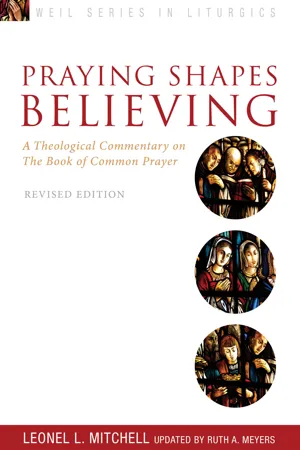
2015 marks the 30th anniversary of Lee Mitchell's great standard work on the 1979 Book of Common Prayer. As his student, protégée, and colleague, Ruth Meyers takes this classic work and updates it for the Church in its current era and for the future.
eBook - ePub
Praying Shapes Believing
A Theological Commentary on the Book of Common Prayer, Revised Edition
- 432 pages
- English
- ePUB (mobile friendly)
- Available on iOS & Android
eBook - ePub
Praying Shapes Believing
A Theological Commentary on the Book of Common Prayer, Revised Edition
About this book
Information
Topic
Theology & ReligionSubtopic
Christian Rituals & PracticeCHAPTER 1
The Service of
the Church
the Church
THE CHURCH IS FIRST AND foremost a worshiping community. It is the synaxis, the gathering together of the people of God for corporate worship, which is the heart and soul of the church’s life. We say this in a great many ways. Massey Shepherd, writing in the original Church’s Teaching Series in 1952, quoted the acts of the fourth-century martyrs:
As if a Christian could exist without the Eucharist, or the Eucharist be celebrated without a Christian! Don’t you know that a Christian is constituted by the Eucharist and the Eucharist by a Christian?1
Associated Parishes, an organization of the Episcopal Church dedicated to liturgical renewal, said it this way:
Jesus Christ is the Lord of all creation and is the Head of the human race. Through Him, in the unity of the Holy Spirit, the Christian Church is called to worship God the Father, to await His kingdom, and to serve in His world. . . . The Holy Eucharist is the characteristic and representative action of the Church in the fulfillment of this vocation. . . . From the altar, God’s redeeming and renewing power reaches out into every phase of life; to the altar every aspect of our existence is to be gathered up and offered to God through Christ in the fellowship of His Holy Spirit.2
The Second Vatican Council of the Roman Catholic Church, in the second paragraph of the Constitution on the Sacred Liturgy, put it like this:
It is the liturgy through which, especially in the divine sacrifice of the Eucharist, “the work of our redemption is accomplished,” and it is through the liturgy, especially, that the faithful are enabled to express in their lives and manifest to others the mystery of Christ and the real nature of the true Church.3
We should not be surprised, then, to find the prayer book sounding this same note at its very beginning, in the section entitled “Concerning the Service of the Church”: “The Holy Eucharist, the principal act of Christian worship on the Lord’s Day and other major Feasts, and Daily Morning and Evening Prayer, as set forth in this Book, are the regular services appointed for public worship in this Church” (BCP, 13). We might follow this up with the statements of the catechism, “An Outline of the Faith”:
The Eucharist, the Church’s sacrifice of praise and thanksgiving, is the way by which the sacrifice of Christ is made present, and in which he unites us to his one offering of himself. . . .The benefits we receive are the forgiveness of our sins, the strengthening of our union with Christ and one another, and the foretaste of the banquet which is our nourishment in eternal life. (BCP, 859–60)
The prayer book lays out at its beginning the traditional Christian and catholic format of the life of the church. At its center is the Lord’s service, the Holy Eucharist, celebrated by the Lord’s people on the Lord’s Day, Sunday. The Holy Eucharist is our common gathering as the people of God, united with one another in Christ our head to celebrate his death and resurrection until he comes again. But the Sunday Eucharist does not stand in isolation. Daily Morning and Evening Prayer provide the supporting framework of corporate and personal prayer for the Sunday liturgy.
This is the ongoing structure of the liturgical life of the church which is the focus of the new life in Christ. It does not sit alone and isolated from the day-to-day business of living, but permeates it and offers it all—joys, sorrows, successes, failures, frustrations, anger, and love—to God. The psalmist sings not only “Have mercy upon us, O LORD” (Ps. 123:4) and “Hallelujah! Praise the LORD from the heavens” (Ps. 148:1), but also “Greatly have they oppressed me since my youth” (Ps. 129:1), and “Happy the one who pays you back for what you have done to us!” (Ps. 137:8). The prayer of God’s children offers up all of life to God.
The Context of Liturgical Life
This ongoing life in Christ is set in the traditional context not only of the day, with Morning and Evening Prayer, and of the week, with the Sunday Eucharist, but also in the context of the whole year as a liturgical expression of the work of our redemption. The liturgical year has its roots in the early centuries of the church’s life and turns the mystery of life in Christ like a fine jewel so that we see it reflected and refracted through different windows as we pass from Advent through Christmas to Epiphany and then from Lent through Holy Week to Easter and Pentecost and the season following. It is in this traditional year, and especially in the celebration of the Maundy Thursday–Good Friday–Easter sequence, that the work of our redemption is proclaimed and celebrated.
The initiation of new Christians has been the central act of this sequence since at least the fourth century. The Great Vigil of Easter was intended to be the clearest and fullest expression of the meaning of our faith and life, and this vigil has been restored to a central position in our prayer book. This restoration, in turn, also restores focus to the church year and gives a context to the sacraments of Christian initiation.
Finally, the prayer book provides appropriate rituals for the important personal occasions of life—births, weddings, sickness, death—and for the ordering of the Christian community with rites for ordinations, consecrating churches, and beginning ministries. All of these are related to the central celebration of the Eucharist and are ways of bringing the specific occasions of individual and communal life into the eucharistic assembly.
Liturgical Roles
The prayer book not only provides a framework for the liturgical life of the church; it also states clearly that “the entire Christian assembly participates” in all services as set forth in the rubrical directions for each service (BCP, 13). The rubrics of the individual services provide the specific directions for participation, but the principle of common participation by the entire assembly, a principle which stands at the very center of the grassroots liturgical movement of the twentieth century, is there established. This is certainly not a novel idea for Episcopalians. It seems to be both a logical extension of the insistence of the sixteenth-century reformers that people should be able to understand the worship they attend and a restoration of some of the most ancient practices of the church.
This participation is not to be without order. The assembly participates “in such a way that the members of each order within the Church, lay persons, bishops, priests, and deacons, fulfill the functions proper to their respective orders” (BCP, 13). In this rubric, the prayer book uses the term “order” in a unique way. Historically, the church has understood “orders” to be specific ministries of church leadership for which individuals are ordained with laying on of hands and prayer. The ecumenical document Baptism, Eucharist and Ministry distinguishes between “ministry,” “the service to which the whole people of God is called,” and “ordained ministry,” “persons who have received a charism [gifts bestowed by the Holy Spirit] and whom the church appoints for service by ordination through the invocation of the Spirit and the laying on of hands.”4
The extension of “orders” to include laypersons as well as bishops, priests, and deacons reflects a desire to emphasize the baptismal foundation of all ministry. In an introduction to the prayer book authorized by the Standing Liturgical Commission, Charles Price explained, “Leadership in the liturgy should be widely shared. The emphasis on the liturgical ministry of the laity is strong in these services. [The Standing Liturgical Commission] intends this liturgical ministry to express the central role of the ministry of the laity in the world, but not to be a substitute for it.”5 Most other churches in the Anglican Communion as well churches in other traditions have not followed the Episcopal Church in identifying laypersons as an “order” of ministry, although many churches are recovering an understanding of baptism as the foundation of all ministry, lay and ordained.6
The general rubrics at the beginning of individual services and the ordination rites describe the different functions of laypersons, bishops, priests, and deacons in more detail, but the important point being made here is that lay and ordained ministers have proper liturgical functions and should be permitted to fill them. At one level this has to do with the ordering of rites and making clear ritually the different roles of different ministers, but there is also a theological dimension. If the church’s theology of ministry is not manifested in the liturgical actions of the ministers, then some ministers may eventually be seen as irrelevant to the actual worship of the congregation, and the theology of ministry which is expressed in the liturgy will eventually supplant the official theology in the minds of worshipers. It is difficult, for instance, to explain the theological importance of the diaconate in a parish in which the deacon’s liturgical role is always filled by a priest, or to explain the role of the laity in the body of Christ at worship if all liturgical ministries are performed by ordained persons.
The prayer book speaks of “exceptional circumstances, when the services of a priest cannot be obtained” (BCP, 13) and permits the authorization of deacons to preside at other rites. It also allows laypersons to preside at the liturgy of the Word in the Eucharist (BCP, 407) and to preside at a funeral (BCP, 468, 490) in the absence of a priest.7 These, however, are exceptional circumstances, and their effect is to subordinate the liturgical functioning of the ordained ministers to the needs of the assembly of the people of God. Generally speaking, Episcopalians have not been willing to carry this principle to the extent of permitting laypersons or deacons to preside at the Eucharist. We have traditionally seen a necessary theological connection between priestly ordination and eucharistic presidency. In the same way, we have seen a necessary connection between episcopal presidency and ordination. Other Christians have not always seen these liturgical roles as being required theologically, and they have been willing to authorize lay presidency of the Eucharist or ordination effected by priests or presbyters. The examination of the ordination rites will give us an opportunity to explore this more fully, but the Episcopal Church is clearly in the tradition of both Anglicanism and the church catholic in these practices.
The prayer book uses the term “celebrant” for the bishop or priest who presides at baptism, Eucharist, and other sacramental rites, whereas earlier prayer books had used “priest” or “minister.” However, many have come to recognize that using the term “celebrant” to identify the ordained leader of worship suggests that the priest is the primary agent of worship, while laypeople observe, an understanding that contradicts the prayer book teaching that the entire assembly participates (BCP, 13). Some congregations are now using “presider” to identify the leader who oversees the assembly’s worship, a term that Justin Martyr used in his second-century description of the Sunday Eucharist in Rome.8 Louis Weil explains, “The reclaiming of this term in our liturgical vocabulary is the result of the renewed emphasis on the significance of baptism shared by laity and clergy alike.”9
Liturgical Continuity
One further theological reflection regarding the material in this opening section of the prayer book concerns continuity with the liturgy of the past. The classic expression of this continuity can been found in the preface to the prayer book of 1789, which has been printed as the preface of every succeeding American prayer book: “This Church is far from intending to depart from the Church of England in any essential point of doctrine, discipline, or worship; or further than local circumstances require” (BCP, 11).
In 1789, this was a clear description of the doctrinal and liturgical position of the fledgling Episcopal Church. Its prayer book and other formularies could be compared with those of the Church of England and interpreted in their light. Since that time, not only has the Church of England itself engaged in liturgical reform, but the various churches of the Anglican Communion have adopted their own variants of the Book of Common Prayer, taking into account their particular cultural contexts, languages, and histories.10
For the Episcopal Church, continuity with the past is evident in the provisions for the use of “previously authorized liturgical texts” when it is desired to sing music composed for them (BCP, 14). These provisions permit the continued use of classical Anglican liturgical music, as well as the great liturgical music of the Western church which has formed a part of so much Anglican worship. But there is more involved here than music. The provisions recognize that the worship of the 1979 prayer book is continuous with that of the earlier liturgical tradition, and they affirm that the services in the prayer book are the legitimate descendants of those in the earlier books.
The same point could also be made from the inclusion of the Rite One services in the prayer book, using the Elizabethan English of older prayer books, and the provision that other services may be conformed to the older language (BCP, 14).11 The continued use of the music and the texts from previous books and the continuity of title ensure that this liturgy is related to that previously used and has, in fact, developed from it and its collateral relatives.
CHAPTER 2
The Calendar, Times, and Seasons
THE FIRST MAJOR SECTION OF the prayer book, following its general introductory rubrics, “Concerning the Service of the Church” (BCP, 13–14), is the calendar (BCP, 15–33). Closely related to it are the collects (BCP, 159–261), the Proper Liturgies for Special Days (BCP, 263–95), and the various tables and lectionaries (BCP, 881–1001). Together they make up a substantial portion of the prayer book. We must therefore recognize that a concern with liturgical time, festival, and season is an important part of our religious heritage, as it has been traditionally in Christianity and in most other religions. The establishment of a calendar of festivals has been an...
Table of contents
- Cover Page
- Title Page
- Copyright
- Contents
- Acknowledgments
- Introduction to the Revised Edition
- Introduction to the First Edition: The Religion of the Prayer Book
- CHAPTER 1 The Service of the Church
- CHAPTER 2 The Calendar, Times, and Seasons
- CHAPTER 3 The Daily Office
- CHAPTER 4 Proper Liturgies for Special Days: Three Holy Days
- CHAPTER 5 Christian Initiation
- CHAPTER 6 The Holy Eucharist
- CHAPTER 7 The Pastoral Offices
- CHAPTER 8 Ordination Rites
- CHAPTER 9 The Theology of the Prayer Book
- Concluding Postscript
- Selected Bibliography
- Notes
Trusted by 375,005 students
Access to over 1.5 million titles for a fair monthly price.
Study more efficiently using our study tools.
Frequently asked questions
Yes, you can cancel anytime from the Subscription tab in your account settings on the Perlego website. Your subscription will stay active until the end of your current billing period. Learn how to cancel your subscription
No, books cannot be downloaded as external files, such as PDFs, for use outside of Perlego. However, you can download books within the Perlego app for offline reading on mobile or tablet. Learn how to download books offline
Perlego offers two plans: Essential and Complete
- Essential is ideal for learners and professionals who enjoy exploring a wide range of subjects. Access the Essential Library with 800,000+ trusted titles and best-sellers across business, personal growth, and the humanities. Includes unlimited reading time and Standard Read Aloud voice.
- Complete: Perfect for advanced learners and researchers needing full, unrestricted access. Unlock 1.5M+ books across hundreds of subjects, including academic and specialized titles. The Complete Plan also includes advanced features like Premium Read Aloud and Research Assistant.
We are an online textbook subscription service, where you can get access to an entire online library for less than the price of a single book per month. With over 1.5 million books across 990+ topics, we’ve got you covered! Learn about our mission
Look out for the read-aloud symbol on your next book to see if you can listen to it. The read-aloud tool reads text aloud for you, highlighting the text as it is being read. You can pause it, speed it up and slow it down. Learn more about Read Aloud
Yes! You can use the Perlego app on both iOS and Android devices to read anytime, anywhere — even offline. Perfect for commutes or when you’re on the go.
Please note we cannot support devices running on iOS 13 and Android 7 or earlier. Learn more about using the app
Please note we cannot support devices running on iOS 13 and Android 7 or earlier. Learn more about using the app
Yes, you can access Praying Shapes Believing by Ruth A. Meyers,Leonel L. Mitchell, Ruth A. Meyers in PDF and/or ePUB format, as well as other popular books in Theology & Religion & Christian Rituals & Practice. We have over 1.5 million books available in our catalogue for you to explore.