A straightforward treatment of the only existential issue that matters from the Christian perspective.
In What Happens When We Die? Tom Long provides information about the promises and convictions of the Christian gospel concerning death and life after death. He surveys in simple terms the major themes surrounding death, dying, and hope for an afterlife.
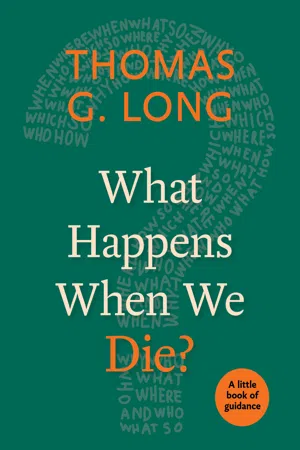
- 64 pages
- English
- ePUB (mobile friendly)
- Available on iOS & Android
eBook - ePub
What Happens When We Die?
About this book
Information
On the Other Side of Death’s Curtain
Possible Answers to the Question “What Happens after Death?”
Since the very beginning of human history, people have wondered and dreamed about what happens to us after death. Because the dead no longer communicate with the living, we are left to guess what happened to them, and what will happen to us. Do the dead continue to exist? If so, what is that existence like?
In all of our human wondering about life after death, human beings have arrived at five basic answers to the question, what happens after death?
1. Nothing. Some believe that human beings share a common fate with all other living things. Like insects and oak trees and like sparrows and sea coral, humans live out their life spans and then simply cease to be. We are part of a biological life cycle. Our bodies decay like the grass of the field. We become dust and are blended into the humus, the soil out of which other living things spring forth and grow.
2. Immortality of the Soul. Others believe that, while our bodies die, there is something about a human being, namely the soul, that is immortal. When we die, the soul, this spark of the divine, is reunited with its source: God. In previous centuries, people imagined the soul to be a physical entity, and some scientists would conduct experiments where they would weigh a person just before and just after death, trying to calculate the weight of a soul. However, most people today who have a view of the immortality of the soul think of the soul not as a body part, with shape and mass, but as a kind of life force or energy.
3. Reincarnation. This is the idea that the soul, or the cumulative force of one’s previous lives, continues to live on, but in another body. Often connected to the concept of reincarnation is the belief that the migration of the soul from body to body offers the chance for the soul’s purification. For some ancient Greek philosophers (such as Plato), souls were originally with God and were pure, but souls fell from this state of perfection (they “lost their wings”) and descended into corrupt fleshly bodies. Reincarnation, therefore, is the gradual escape of the soul from all embodiment and a step-by-step restoration of the soul as pure and finally disembodied. In Hinduism, writes religion scholar Lisa Miller, the cycle of reincarnation “is affected by karma, a system of cause and effect that we are used to thinking about as rewards, or consequences. Good deeds now will have a salutary bearing on a soul’s next life.”17
4. Resurrection of the Soul. This view of life after death acknowledges that human beings die, and that there is nothing immortal about a human being that survives the experience of death. However, in the power of God, the soul is given new life and brought into a heavenly relationship with God and the souls of the saints. Sometimes, the New Testament Book of Hebrews, with its vision of the heavenly city and “spirits of the righteous made perfect,” is seen to support this view of the resurrection of the soul:
You have not come to something that can be touched . . . But you have come to Mount Zion and to the city of the living God, the heavenly Jerusalem, and to innumerable angels in festal gathering, and to the assembly of the firstborn who are enrolled in heaven, and to God the judge of all, and to the spirits of the righteous made perfect, and to Jesus, the mediator of a new covenant, and to the sprinkled blood that speaks a better word than the blood of Abel. (Heb. 12:18–24)
5. Resurrection of the Body. In the main, Christian theology does not subscribe to any of the four views above but instead to the promise of the resurrection of the body. In this view, expressed in the ancient Apostles’ Creed (“I believe in . . . the resurrection of the body, and the life everlasting”), human beings are created by the living God and have life only as a gift from God. The book of Genesis pictures this act of creation in this way: “Then the Lord God formed man from the dust of the ground, and breathed into his nostrils the breath of life; and the man became a living being” (Gen. 2:7). Therefore, humans are not immortal souls trapped in fleshly bodies. Rather, humans are made from dust and given the life-giving breath of God. Humans don’t have bodies; we are embodied. When we die, everything about us dies, and if there is to be any life after death, it will come only if God raises us from the dead—raises the whole embodied human being.
This central Christian claim of the resurrection of the body taxes the credulity of many people today, including many Christians. Lisa Miller writes,
Resurrection is, on the face of it, impossible, the stuff of science-fiction horror stories. It means, literally, to rise again, the revivification of dead flesh, yet this Frankenstein scenario is the bedrock of the Christian story, the defining test of faith. Without it, Jesus would have been another Jewish rebel crucified for his insubordination to the Roman regime.18
Actually, Miller doesn’t have it quite right. The notion of dead bodies getting up from their graves and walking around, zombie-like, is not what Christians affirm about resurrection, but Miller does recognize that the very idea of the resurrection of the body raises serious questions that need responses. In thinking through these questions, Christian rely on more than just speculation. Christians believe that they can point to the one experience of encountering one who was dead and then raised, namely, Jesus himself.
Looking at Death through the Lens of the Resurrection
The story of Easter and the accounts of the risen Christ encountering his followers, therefore, are the best guides we have to understanding what the resurrection of the body means. Let us pose some of those key questions:
What happens to us at the time of death?—About three o’clock in the afternoon of the day he was crucified, Jesus “breathed his last” (Matt. 27:50). Jesus was dead, completely dead. He was not secretly alive, pretending to be dead. He was not hiding behind a bush in heaven, just waiting for Easter morning so that he could appear again. He was dead and buried, dead as a doornail. And so will it be for all human beings. At some point, we will stop breathing, our hearts will cease beating, all brain activity will end, our bodies will become still and cold, and we will be irretrievably dead. No medicine or magic will be able to revive us.
When Jesus was dead, however, his crumpled and brutalized body was not simply discarded as if it no longer had any worth. In fact, a man named Joseph, who was from the town of Arimathea, about twenty miles from Jerusalem, saw to it that Jesus’s body was treated properly and with respect. Matthew says ...
Table of contents
- Cover Page
- Title Page
- Copyright
- Contents
- Introduction
- In the Hour of Our Death
- On the Other Side of Death’s Curtain
- Notes
Trusted by 375,005 students
Access to over 1.5 million titles for a fair monthly price.
Study more efficiently using our study tools.
Frequently asked questions
Yes, you can cancel anytime from the Subscription tab in your account settings on the Perlego website. Your subscription will stay active until the end of your current billing period. Learn how to cancel your subscription
No, books cannot be downloaded as external files, such as PDFs, for use outside of Perlego. However, you can download books within the Perlego app for offline reading on mobile or tablet. Learn how to download books offline
Perlego offers two plans: Essential and Complete
- Essential is ideal for learners and professionals who enjoy exploring a wide range of subjects. Access the Essential Library with 800,000+ trusted titles and best-sellers across business, personal growth, and the humanities. Includes unlimited reading time and Standard Read Aloud voice.
- Complete: Perfect for advanced learners and researchers needing full, unrestricted access. Unlock 1.5M+ books across hundreds of subjects, including academic and specialized titles. The Complete Plan also includes advanced features like Premium Read Aloud and Research Assistant.
We are an online textbook subscription service, where you can get access to an entire online library for less than the price of a single book per month. With over 1.5 million books across 990+ topics, we’ve got you covered! Learn about our mission
Look out for the read-aloud symbol on your next book to see if you can listen to it. The read-aloud tool reads text aloud for you, highlighting the text as it is being read. You can pause it, speed it up and slow it down. Learn more about Read Aloud
Yes! You can use the Perlego app on both iOS and Android devices to read anytime, anywhere — even offline. Perfect for commutes or when you’re on the go.
Please note we cannot support devices running on iOS 13 and Android 7 or earlier. Learn more about using the app
Please note we cannot support devices running on iOS 13 and Android 7 or earlier. Learn more about using the app
Yes, you can access What Happens When We Die? by Thomas G. Long in PDF and/or ePUB format, as well as other popular books in Theology & Religion & Religion. We have over 1.5 million books available in our catalogue for you to explore.