Designed to help parishes of all sizes establish good financial management processes and policies.
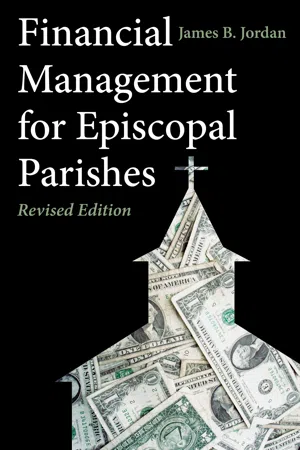
Experience shows that open and transparent churches engender a greater feeling of trust and willingness on the part of the donor. The policies and processes in Financial Management for Episcopal Parishes, which can be implemented by any size church, allow clergy, vestry, and parishioners to establish and document procedures that enable a financially transparent organization. The book defines the roles of the clergy, staff, vestry, and congregation and outlines what needs to be done by them to design and implement a system of checks and balances for financial oversight and stewardship, in order to protect donations and assets. Throughout the book, real-life examples of processes and procedures that did not work (and why) make for enjoyable reading of an otherwise business-like subject. Every reader will recognize some of them in their own church life.
- 304 pages
- English
- ePUB (mobile friendly)
- Available on iOS & Android
eBook - ePub
About this book
Information
CHAPTER
1
The Gospels and Money
Jesus did not despise money, nor did he love money. Jesus had no problem with money. His interest in money was how we, you and I, regard money. Do we love money as the Israelites loved and worshipped the golden calf? Has money taken a place in our hearts as well as our heads? Is money a tool or an instrument by which we accomplish good, or is it a means to an end for power, purchased obedience, and admiration? Are our decisions in life based on money or matters of the heart?
Money has been much maligned by the church. But money is not bad in itself. Jesus had no more problems with money than he had with sandals. To illustrate, we should examine what the gospels and New Testament have to say regarding money. It is vital to have an understanding and agreement of the legitimacy of money in the life of the church. We look to Jesus himself concerning how money should be regarded in our lives—spiritually and secularly.
When I teach courses on parish finances, we begin with the gospel witness. One cleric in the course could not remember having preached a sermon about money based on the appointed lectionary readings. That may be a choice, but the lectionary does contain many opportunities to preach about money.
While there are exceptions with individual parishes, by and large Episcopalians avoid discussing money. Some people think it is a private matter— between them and God. Some people are embarrassed for others to know their involvement in the church financially. Some wear their gifts on their sleeve like a badge of honor. Others regard it as a matter of the heart, like the widow in the parable of the widow’s mites in Luke 21:1–4.
Most people have heard that “money is the root of all evil” and claim it comes from the Bible. The correct quotation is, “For the love of money is a root of all kinds of evil, and in their eagerness to be rich some have wandered away from the faith and pierced themselves with many pains” (1 Tim. 6:10). With the proper inclusion of “the love of money,” the passage takes on a different meaning. The entire subject of the sentence changes from money to the love of money.
Money has been maligned, but should no longer be considered a scapegoat. It is our human emotion and intent that are judged on the last day, not the amount we gave. We are the culprits, not the dollars themselves, with whom the Bible takes issue when schooling us about money. The thirty pieces of silver that Judas got for betraying Jesus is not as important as the intent of his heart and the actions he took to gain reward.
When Jesus launched into his tirade at the temple, it was not about the money itself.
In the temple he found people selling cattle, sheep, and doves, and the money changers seated at their tables. Making a whip of cords, he drove all of them out of the temple, both the sheep and the cattle. He also poured out the coins of the money changers and overturned their tables. He told those who were selling the doves, “Take these things out of here! Stop making my Father’s house a marketplace! (John 2:14–16)
While I do not blame him for wanting livestock and birds out of the temple, it sounds like Jesus was angry with the people and their love of money, not the money itself.
Another observation is the use of them, which is more clearly defined by the use of the word both. Jesus drove out both the cattle and the sheep. It does not say he drove out the people selling the cattle and the sheep. He told the sellers of the doves to take them out of his Father’s house. He did not drive out the sellers. Is it because Jesus perceived the love of money in their hearts, but loved them as he loves all of us, each with our individual sins?
The Jewish temple required taxes and offerings be given in Hebrew shekels, but Roman money—denarii—was the currency of conducting business transactions outside of the synagogue and Jewish community. This is much like the difference between the U.S. dollar, an internationally recognized currency used and accepted in international business transactions, and the baht of Thailand, used only in that country. The money changers extracted a plentiful fee for their services from those paying taxes to the temple and from the temple priests who then had shekels from the taxes and needed Roman money for other transactions. This policy of “get you going and coming” made the money changers rich while preventing a sizable amount of money from reaching the priests for use in the synagogue.
I believe it was this love of money in the hearts of the money changers that drove Jesus to react the way he did, not the fact that money was present in the temple. Had there been no money changers, the money would still be present on the Temple Mount to pay the temple its taxes and offerings. By overturning the tables of the money changers, Jesus ruined the possibility of an exchange rate. With the money strewn about, the money changers would not know how much was their initial investment and how much was their profit, as they kept those in stacks on the tables. Interestingly, the English word bank comes from the Greek word used in the Scripture trapeza (Τράπεζα) that today is still used interchangeably in modern Greek to mean both table and bank.
Money was a large part of daily life during the life of Christ. It was, and is, how we humans exchange things in an orderly fashion. Taxes were necessary and rendering unto Caesar what was Caesar’s was as desirable as rendering unto God that which is God’s.
As we read in Matthew’s gospel:
When they reached Capernaum, the collectors of the temple tax came to Peter and said, “Does your teacher not pay the temple tax?” He said, “Yes, he does.” And when he came home, Jesus spoke of it first, asking, “What do you think, Simon? From whom do kings of the earth take toll or tribute? From their children or from others?” When Peter said, “From others,” Jesus said to him, “Then the children are free. However, so that we do not give offense to them, go to the sea and cast a hook; take the first fish that comes up; and when you open its mouth, you will find a coin; take that and give it to them for you and me.” (Matt. 17:24–27)
Jesus made sure he paid his taxes to the temple. There was no fanfare about it. It was a matter-of-fact reference that paying temple taxes was what Jews did. Interestingly, Jesus was exact in his choice of words. The Greek word used for the coin that was in the fish’s mouth is stater (στατήρα), which means two didrachma, or the exact amount of tax for two people at the time—Peter and Jesus.
Is this beginning to sound like how we deal with money today in our secular lives, too? We earn it, save it wisely, invest it, take to heart how we spend it, and pay taxes. So did the Jews at the time of Christ. Then why be surprised that the gospels deal with these events involving money in our lives?
We have created an entire vocabulary in the church that allows us as clergy, vestry, volunteers, and parishioners to avoid acknowledging that money is what enables the church’s activities. It is both necessary and desirable, not for our personal gain but as a tool for compassion and good. We have created a vocabulary unique to the church that is used in sermons, vestry meetings, and coffee gatherings to avoid having to say the word money. Needs of the parish, parish life, and outreach are examples of terms we all know involve money. We employ them to imply the need for, and the use of, money without having to discuss the topic of money or use the word itself. We speak of budgets as if they are something for which we have no personal concern or knowledge.
Money is the tool used by the church to pay the utility bill, buy flowers, repair the building, or put gas in the church bus. Money is used to pay the priest, reimburse parishioners for Wednesday night supper purchases, or buy formation supplies. It is money that is used to outfit the church with pews, an altar, prayer books, and hymnals. And it is money that buys the music and robes for the choir, candles for service, and the envelopes for tithing.
Think about your parish. From the moment you step onto the church grounds, everything you see has been purchased with money at some point. True, some of the items were donated, but someone purchased them originally. When articles made by hand, such as kneelers at the altar or baptismal font, are donated to the church, we record the donation and include the value of the raw materials that were purchased. If the person were in the business of making fonts, kneelers, whatever was donated, we probably include the value of their time as well.
The Bible is full of hundreds, even thousands, of references to money. Jesus spoke a lot about money: gold, silver, mites, drachmas, shekels, treasure, taxes, and the like. He recognized that money was necessary for life in the world, but not of value in heaven. He alluded to the difference between treasures stored in the bank versus the treasure in the heart that is stored in heaven. Matthew 19:21, Mark 10:21, and Luke 12:33 all refer to “treasure in heaven,” while Matthew 25:27 and Luke 19:23 refer to the investing of money in a bank. Jesus wanted us to understand that it is what we do with our money, how we treat each other concerning the use of money, and the intentions of the heart regarding money that determine whether we are acceptable in the sight of God.
Jesus wants us to use wisely the money we have. In the parable of the talents (Matt. 25:14–30), we are given instructions regarding how to deal with the secular side of money. Investing what is entrusted, even if only earning interest in a bank, is the right thing to do. While the servant with the one talent did protect it, he did not provide for its oversight for which he was held accountable. Oversight and accountability are concepts we will examine a number of times in later chapters.
The point is that talk of money should not be ignored in the church. Money is not the “thing that shall not be named.” However, there is one verse of Scripture that I have never heard discussed openly in the church. In John 12, there is the confrontation by Judas about the cost of the nard that Mary Magdalene used to anoint Jesus and provide fragrance to Jesus’ feet.
Nard is made from the root of a plant found in India. Because of its enormous value, it was transported by camel in caravan for protection. The route was a long one because the camels had to get to Jerusalem and Galilee by going the long way around the mountain trails of Lebanon, making it about an eight months’ journey. Once a sealed jar of nard was opened, it lost its fragrance and usefulness quickly. The entire contents of the jar had to be used or the remaining amount would quickly be of no value.
“But Judas Iscariot, one of his disciples (the one who was about to betray him), said, ‘Why was this perfume not sold for three hundred denarii and the money given to the poor?’” (John 12:4–5). Mary used about a pint of nard to anoint Jesus. The value is about $35,000 in today’s currency. “(He said this not because he cared about the poor, but because he was a thief; he kept the common purse and used to steal what was put into it.)” (John 12:6).
Wow. Not only did Judas betray Jesus to the Romans for money, he loved money itself. Judas committed fraud. He helped himself to the funds of Jesus and the disciples for his own use. Was Judas concerned about selling the nard to get the cash to put in the money bag just so he could help himself to some of that $35,000, too?
Judas was one of the twelve called by Jesus. He was their accountant, in a similar position of access to the funds as a parish bookkeeper today. Yet, he took money from the band of disciples much as those who steal money from the church do today—through willfulness and deceit. If Judas stole from the inner circle—in the vicinity and presence of Christ—then why are we surprised when we discover fraud in our own parishes? Returning to the parable about taking care of the money by investing, depositing, and spending wisely, we see that neither Judas nor we are excused for mismanagement, lack of accountability, and lack of oversight.
There is another Scripture reference regarding Judas and the money: “Some thought that, because Judas had the common purse, Jesus was telling him, ‘Buy what we need for the festival’; or, that he should give something to the poor” (John 13:29). This further confirms that Judas was the keeper of the money and bookkeeper for the twelve and Jesus.
The Old and New Testaments contain many more references to money. What we have in the gospels is the clear indication that money is a part of life. We are responsible for tending to the church’s needs for money to operate just as each of us needs money to operate our own households.
Jesus did not condemn money. He did identify that matters of the heart and matters of the wallet intersect, and there will be treasure in heaven created, or not, based on our heart’s approach to and use of money. In Matthew 19:24, Jesus said that it was easier for a camel to pass through the eye of a needle than for a rich man to enter the kingdom of heaven. This is not meant literally, but rather for understanding that it is hard for a person who treats money as an idol for their affection to see the real value of God.
CHAPTER
2
Church Canons and Financial Matters
We have seen in the last chapter that money is biblically established as a component of our lives with which we must deal like any other. Jesus legitimized money in the church and our lives through his examples and teaching. We now turn our attention to the church and the legitimate authority and responsibilities given to us by the church itself in the handling of money in our parishes.
The Episcopal Church (TEC) is a member of the Anglican Communion. This Anglican Communion has no oversight or great influence in the workings of TEC. Until the Revolutionary War, the colonies’ churches were a part of the Church of England. After the Revolutionary War, the churches were autonomous and formed their own organizational structure. Drawing upon their roots, they formed their own rules and regulations known as canons. Canons, or canonical laws, are what guide the operations of the church in most instances.
There is one canon in particular—Title I, Canon 7—that must be carefully examined if we are to understand the financial requirements of dioceses and parishes. We will also look at other canons, but this is the primary one. To help us in our discussion, I have reproduced Title I, Canon 7 as of the 76th Convention (2009) below.
Title I, Canon 7:
Of Business Methods in Church Affairs
Sec. 1. In every Province, Diocese, Parish, Mission and Institution connected with this Church, the following standard business methods shall be observed:
(a) All accounts of Provinces shall be audited annually by an independent certified public accountant, or independent licensed accountant or such audit committee as shall be authorized by the Provincial Council. The Audit Report shall be filed with the Provincial Council not later than September 1 of each year, covering the preceding calendar year.
(b) Funds held in trust, endowment and other permanent funds, and securities represented by physical evidence of ownership or indebtedness, shall be deposited with a National or State Bank, or a Diocesan Corporation, or with some other agency approved in writing by the Finance Committee or the Department of Finance of the Diocese, under a deed of trust, agency or other depository agreement providing for at least two signatures on any order of withdrawal of such funds or securities. But this paragraph shall not apply to funds and securities refused by the depositories named as being too small for acceptance. Such small funds and securities shall be under the care of the persons or corporations properly responsible for them. This paragraph shall not be deemed to prohibit investments in securities issued in book entry form or other manner that dispenses with the delivery ...
Table of contents
- Cover Page
- Title Page
- Copyright
- Contents
- Preface to the Second Edition
- Introduction
- Chapter 1 The Gospels and Money
- Chapter 2 Church Canons and Financial Matters
- Chapter 3 Roles and Responsibilities
- Chapter 4 Parish Monies
- Chapter 5 How to Read Church Financial Statements
- Chapter 6 Audits
- Chapter 7 Fraud
- Chapter 8 Introduction to Internal Control
- Chapter 9 Support Internal Control
- Chapter 10 Disbursements Internal Control
- Chapter 11 Taxes
- Chapter 12 Budgets
- Chapter 13 Other Items
Trusted by 375,005 students
Access to over 1.5 million titles for a fair monthly price.
Study more efficiently using our study tools.
Frequently asked questions
Yes, you can cancel anytime from the Subscription tab in your account settings on the Perlego website. Your subscription will stay active until the end of your current billing period. Learn how to cancel your subscription
No, books cannot be downloaded as external files, such as PDFs, for use outside of Perlego. However, you can download books within the Perlego app for offline reading on mobile or tablet. Learn how to download books offline
Perlego offers two plans: Essential and Complete
- Essential is ideal for learners and professionals who enjoy exploring a wide range of subjects. Access the Essential Library with 800,000+ trusted titles and best-sellers across business, personal growth, and the humanities. Includes unlimited reading time and Standard Read Aloud voice.
- Complete: Perfect for advanced learners and researchers needing full, unrestricted access. Unlock 1.5M+ books across hundreds of subjects, including academic and specialized titles. The Complete Plan also includes advanced features like Premium Read Aloud and Research Assistant.
We are an online textbook subscription service, where you can get access to an entire online library for less than the price of a single book per month. With over 1.5 million books across 990+ topics, we’ve got you covered! Learn about our mission
Look out for the read-aloud symbol on your next book to see if you can listen to it. The read-aloud tool reads text aloud for you, highlighting the text as it is being read. You can pause it, speed it up and slow it down. Learn more about Read Aloud
Yes! You can use the Perlego app on both iOS and Android devices to read anytime, anywhere — even offline. Perfect for commutes or when you’re on the go.
Please note we cannot support devices running on iOS 13 and Android 7 or earlier. Learn more about using the app
Please note we cannot support devices running on iOS 13 and Android 7 or earlier. Learn more about using the app
Yes, you can access Financial Management for Episcopal Parishes by James B. Jordan in PDF and/or ePUB format, as well as other popular books in Theology & Religion & Christian Church. We have over 1.5 million books available in our catalogue for you to explore.