Esteemed former leader of the Anglican Communion distills the essence of the Christian faith.
With clarity and insight, the former Archbishop of Canterbury takes the reader to the heart of what Christianity means for those who practice it and the hope it offers to the world at large. A book for all who wonder what the Christian faith is all about, and what difference it really makes.
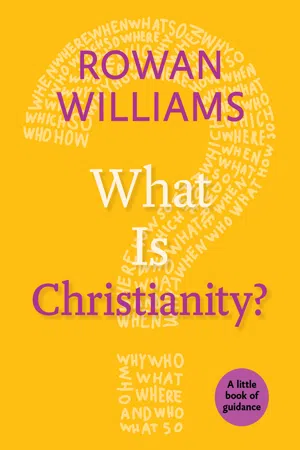
- 64 pages
- English
- ePUB (mobile friendly)
- Available on iOS & Android
eBook - ePub
What Is Christianity?
About this book
Information
1
What is Christianity all about?
Imagine someone watching, over a period of about one year, the things that happen in a Christian church. They would be aware that one day of the week has special significance. Particularly if they are observing what happens in a historically Christian country, they would notice that Sunday is seen as important for meeting and praying. They would see that Christians meet to sing and speak to a God whom they describe as the maker of all things and the judge of all things, and that they kneel or bow in the presence of this God, thanking him and acknowledging their failures and sinfulness. They would see that extracts from a holy book are read in public and that instruction is given by leaders of the congregation in how to understand this book. They would perhaps notice that most of the prayers end with words referring to someone called Jesus Christ, and describing him as ‘Lord’.
They would see that at different seasons Christians celebrate the birth of Jesus and also commemorate his death and his miraculous return from death. Sometimes they would hear prayers and blessings mentioning ‘the Father, the Son and the Holy Spirit’. And finally, they would see that new members are brought into the community by a ceremony of pouring water on them or immersing them in water, and that the most regular action performed by communities of different kinds is the blessing and sharing of bread and wine. They would notice, perhaps with bewilderment or even shock, that this sharing of bread and wine is described as sharing the body and blood of Jesus.
In this little book, I am trying to think what questions might arise for someone looking at Christians from the outside in the way I have just imagined. These may or may not be the questions you have. But perhaps the attempt to answer these questions will help bring other questions more clearly into focus.
God: Father, Son and Holy Spirit
Let me begin with the most obvious features of Christian prayer. We pray ‘through Jesus Christ our Lord’. And the best known of all Christian prayers begins with the words ‘Our Father in heaven’. These belong together. Probably the most important Christian belief is that we are given the right to speak to God in exactly the same way that Jesus did, because the life, the power, the Spirit that filled Jesus is given to us also.
We believe that Jesus, son of Mary, is fully a human being. But we believe more than that. Because of the divine authority that he shows in his power to teach and to forgive, as our Gospels describe it, we say also that the whole of his human life is the direct effect of God’s action working in him at every moment. The image used by some Christian thinkers is that his human life is like iron that has been heated in the fire until it has the same power to burn as the fire does.
We call him the Son of God. But we do not mean by this that God is physically his father, or that he is made to be another God alongside the one God. We say rather that the one God is alive and real in three eternal and distinct ways. God is first the source of everything, the life from which everything flows out. But then we say that this one God is also living and real in that ‘flowing-out’. The life that comes from him is not something different from him. It reflects all that he is. It shows his glory and beauty and communicates them. Christians say that God has a perfect and eternal ‘image’ of his glory, sometimes called his ‘wisdom’, sometimes called his ‘Word’, sometimes called his ‘Son’, though this is never to be understood in a physical and literal way. And we say that the one God, who is both source and outward-flowing life, who is both ‘Father’ and ‘Son’, is also active as the power that draws everything back to God, leading and guiding human beings – and indeed the whole universe – towards unity with the wisdom and goodness of God. This is the power we call ‘Holy Spirit’.
So when we speak of ‘the Father, the Son and the Holy Spirit’, we do not at all mean to say that there are three gods – as if there were three divine people in heaven, like three human people in a room. Certainly we believe that the three ways in which God eternally exists and acts are distinct from one another – but not in the way that things in the world or even persons in the world are distinct. This is important in the context of dialogue with other faiths, not least with Islam: when Christians read in the Qur’an the strong condemnation of ‘associating’ with God other beings that are not God, they will agree wholeheartedly.
If we then return to what Christians believe about Jesus, perhaps we can see why they say that he is ‘Son of God’. Because the eternal Word and wisdom of God completely occupies his human mind and body, we say that in him this Word and wisdom has ‘become flesh’, has been ‘incarnated’. Just as the Word and wisdom eternally reflects God’s glory and beauty, so in our human world, in human history, Jesus reflects this glory and beauty, showing us both the splendour of divine love and the true dignity and glory of humanity as God intends it to be. Because the Word and wisdom of God is sometimes described in the Jewish Scriptures of the Old Testament as a ‘child’ of God – and also because these Scriptures often call the kings of God’s people who rule according to wisdom the ‘sons of God’ – we come to say that Jesus, who embodies God’s wisdom and is anointed as ruler of God’s people, is God’s Son. And, as we have seen, from the very first, Christian thinkers have said that this language must not be thought of in any physical way.
When Jesus himself prays to God in his own human voice, he calls him ‘Father’. And what we must now add to what we have said so far is that this title expresses not only the acknowledgement on the part of Jesus that his whole being comes directly from God, but also the trust and complete confidence that he enjoys with God. As the Gospel of St John ...
Table of contents
- Cover Page
- Title Page
- Copyright
- Contents
- 1 What is Christianity all about?
- 2 What is faith?
- 3 What difference does it make?
- Further reading
Trusted by 375,005 students
Access to over 1.5 million titles for a fair monthly price.
Study more efficiently using our study tools.
Frequently asked questions
Yes, you can cancel anytime from the Subscription tab in your account settings on the Perlego website. Your subscription will stay active until the end of your current billing period. Learn how to cancel your subscription
No, books cannot be downloaded as external files, such as PDFs, for use outside of Perlego. However, you can download books within the Perlego app for offline reading on mobile or tablet. Learn how to download books offline
Perlego offers two plans: Essential and Complete
- Essential is ideal for learners and professionals who enjoy exploring a wide range of subjects. Access the Essential Library with 800,000+ trusted titles and best-sellers across business, personal growth, and the humanities. Includes unlimited reading time and Standard Read Aloud voice.
- Complete: Perfect for advanced learners and researchers needing full, unrestricted access. Unlock 1.5M+ books across hundreds of subjects, including academic and specialized titles. The Complete Plan also includes advanced features like Premium Read Aloud and Research Assistant.
We are an online textbook subscription service, where you can get access to an entire online library for less than the price of a single book per month. With over 1.5 million books across 990+ topics, we’ve got you covered! Learn about our mission
Look out for the read-aloud symbol on your next book to see if you can listen to it. The read-aloud tool reads text aloud for you, highlighting the text as it is being read. You can pause it, speed it up and slow it down. Learn more about Read Aloud
Yes! You can use the Perlego app on both iOS and Android devices to read anytime, anywhere — even offline. Perfect for commutes or when you’re on the go.
Please note we cannot support devices running on iOS 13 and Android 7 or earlier. Learn more about using the app
Please note we cannot support devices running on iOS 13 and Android 7 or earlier. Learn more about using the app
Yes, you can access What Is Christianity? by Rowan Williams in PDF and/or ePUB format, as well as other popular books in Theology & Religion & Religion. We have over 1.5 million books available in our catalogue for you to explore.