Following up on the popularity of the groundbreaking anthology Embodied Spirits: Stories of Spiritual Directors of Color, this book continues the work of filling a void in the world of contemplative spirituality in stories of the contemplative spiritual journeys of people of color. Like the first book, Ain't Gonna Let Nobody Turn Me Around incorporates stories from members of their encounters with 'othering' and disparaging treatment across issues and their understandings of contemplative practice and the call to action that follows. This volume seeks to give voice to these issues from those whom have lived with them and to seek peace and healing for the unresolved trauma that continues to separate us.
In a world or resurgent racism and bias against those whose skin color, nationality, religion, gender, or sexuality are seen as "other," these are voices that need to be heard.
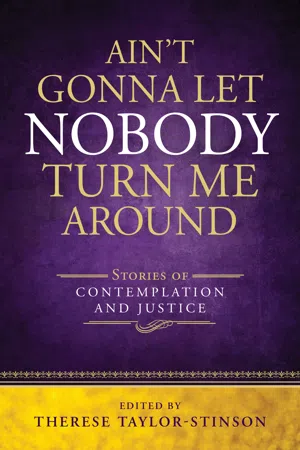
eBook - ePub
Ain't Gonna Let Nobody Turn Me Around
Stories of Contemplation and Justice
- 192 pages
- English
- ePUB (mobile friendly)
- Available on iOS & Android
eBook - ePub
About this book
Information
1
Prayer and Social Justice
I come to the garden alone, while the dew is still on the roses,
and the voice I hear falling on my ear the Son of God discloses.
and the voice I hear falling on my ear the Son of God discloses.
And he walks with me and he talks with me and he tells me I am his own,
and the joy we share as we tarry there none other has ever known.
He speaks and the sound of his voice is so sweet the birds hush their singing,
and the melody that he gave to me within my heart is ringing.
—“In the Garden” by Charles A. Miles
Isn’t that a beautiful song?
I serve annually as extended staff at a contemplative retreat. Known to be an extemporaneous singer, I was asked one year to sing a song, any song, and the song the Spirit put on my heart was “In the Garden.” Many expressed gratitude that I had selected this song to sing because it had been “their mother’s or grandmother’s favorite song.” They also shared how much they missed this song that had been banished from their churches.
You see, a few decades ago, many pastors and religious leaders began to reject this song because of its focus on the self vs. the other or community. It has been said that songs like “In the Garden” are shallow and thus produced shallow people incapable of facing the challenges of the world . . . incapable of doing the just work of Jesus Christ. It is my hope that you will embrace “the garden” not only as a prerequisite to doing justice and the work of Christ, but also as a tool for spiritual growth and sustainability.
My understanding of God’s demand for justice, the importance of authentic prayer and contemplation, and the significance of listening to God is largely rooted in the Hebrew Bible book of Zechariah.
Then the word of the Lord Almighty came to me: “Ask all the people of the land and the priests, ‘When you fasted and mourned in the fifth and seventh months for the past seventy years, was it really for me that you fasted? And when you were eating and drinking, were you not just feasting for yourselves? Are these not the words the Lord proclaimed through the earlier prophets when Jerusalem and its surrounding towns were at rest and prosperous, and the Negev and the western foothills were settled?’ ”
And the word of the Lord came again to Zechariah: “This is what the Lord Almighty says: ‘Administer true justice; show mercy and compassion to one another. Do not oppress the widow or the fatherless, the foreigner or the poor. Do not plot evil against each other.’
“But they refused to pay attention; stubbornly they turned their backs and covered their ears. They made their hearts as hard as flint and would not listen to the law or to the words that the Lord Almighty had sent by his Spirit through the earlier prophets. So the Lord Almighty was very angry.
“When I called, they did not listen; so when they called, I would not listen, says the Lord Almighty.” (Zech. 7:4–13, niV)
Zechariah had a message for his people—and it wasn’t a pleasant one. He needed the people to understand that simply keeping the rituals of the faith was of no value. It meant nothing to God because it meant nothing to the people. It was not helping anyone. They weren’t doing these acts out of love and devotion for God.1
As a spiritual director, I am frequently asked, “How can I know for sure that I am doing God’s will?” One way to test whether you are doing God’s will is to ask yourself if anyone (any of God’s creation) other than yourself (your company, your people, etc.) is benefitting from the act or work. Remember that we are to make disciples of ALL nations, love our neighbor, and show mercy and compassion to everyone.
One of my mentors in the ministry, the Rev. Dr. Kirk Byron Jones, frequently writes and speaks of being still in knowing that God is. He says that spiritual stillness is often unintentionally blocked by religious practices that can obstruct as much as they can enhance prayer, experienced as mere monologue toward God, which can be a form of avoiding God. We often end up talking ourselves out of God’s presence. “We can also dodge God under the guise of devotion by reading and singing, without leaving openings for stillness and silence. We may go from song to song, and Scripture to Scripture, without ever taking time to absorb, to sit, to wait, to question, or even to doubt.”2 It is not enough that we should read about prayer, hear and sing worship songs, or listen to other people pray and worship. We must pray authentically, contemplate God’s response and worship God with a heart full of love. It is in personal prayer times that an intimate relationship with God develops. Prayer is multifaceted. The intent of authentic deep prayer is not only to communicate, be in relationship with, and experience God but, moreover, to effect transformation in our lives and in the lives of others.
Being still before the Lord in contemplation is a form of prayer; worship is a form of prayer; singing can be a form of prayer; prayer can be communal or corporate; it can consist of petition or inter-cession; or prayer can be entering the garden alone to walk and talk with Jesus. Yes, there are many different ways to pray.
International prayer warrior Stormie O’Martian says, “If you are ever worshipping God by yourself and you don’t sense His intimate presence, continue to praise and worship Him until you do.”3 By praise and worship, I mean giving God credit where credit is due. Rather than simply exclaiming that you praise God, tell the world the ways in which he has guided you and provided for you, the way she has protected and sheltered you. It’s not that you have to try hard to get God to be close to you. He has chosen to dwell in the midst of your praise. But you do have to give her time to break down the barriers within your soul and penetrate the walls of your heart so that he can pour himself into you.
Scripture documents that a time of silence and contemplation was part of Jesus’s regular routine, a method of spiritual care. After stories of Jesus ministering to crowds and healing people, Luke 5:16 tells us that Jesus often withdrew to lonely places and prayed. In the following chapter, Luke 6:12, just prior to selecting the twelve apostles, the Gospel tells us that Jesus went out to a mountainside and spent the night praying to God. Later in chapter nine, Luke tells us that Jesus prayed in private even when his disciples were with him and that he took Peter, John, and James with him up onto a mountain to pray. It was on this occasion that the three disciples would see Jesus in his full glory. Prayer is a time to experience wholeness from the inside out, a time to receive the love, grace, and peace that we then offer to others to God’s glory.
Similarly, in the Gospel according to Mark, we understand that very early in the morning, while it was still dark, Jesus got up, left the house, and went off to a solitary place where he prayed (1:35). He did this just prior to expanding his ministry to go and preach in nearby villages. The Bible also tells us that after Jesus fed the five thousand and sent his disciples ahead of him to Bethsaida, he dismissed the crowd and went up on a mountainside by himself to pray (Mark 6:46).
These examples don’t tell us expressly how Jesus prayed. I wonder if it was extemporaneous and kataphatic, or silent, centering, apophatic prayer. Maybe he audibly and/or physically praised God through song and adoration, or maybe it was contemplative and reflective prayer. What we do know is that Jesus regularly took time apart from his ministry for renewal and centering, for discernment and preparation.
In speaking on the history of contemplative traditions, scholar and theologian Barbara A. Holmes explains that “in Eurocentric contexts contemplation and silence were presumed to be synonymous. Unfortunately, the pervasiveness of this presumption helps to shroud the emergence of contemplative practices within the vibrant and ecstatic Africana traditions.”4 To be clear, in my faith tradition, intentional acts of contemplation must not always be silent or still, but can also be embodied in dance, song, and shout! A contemplative act is an act of deliberate consideration with the intent of seeing or experiencing God. Whatever act, gesture, thought, song, or word that reflects or brings us into the tangible presence of the Holy Spirit is an act of contemplation. For instance:
• In my faith tradition, we sometimes have devotions or begin a sermon with a “call and response” in the form of a long-metered hymn. In the deep, extended moans of the long-metered hymn there rests a space for contemplation.
• There is a faithful member of my home congregation who regularly but gently and ever so intentionally stands and lifts his hands into the air pumping them up and down at seemingly random times during the worship service and sermons. I submit that this is an act of contemplation.
• Jesus’s journeys into the mountain to pray were acts of contemplation.
• When Jesus hushed the elements, saying “Peace, be still”— that was an act of contemplation.
• When Mahalia Jackson proclaims, “There Is a Balm in Gilead”—that’s a contemplative act. I, too, have sung this soul-stirring hymn and to do so authentically requires nothing less than deliberate consideration with the intent of seeing or experiencing God.
• Dr. Martin Luther King Jr. and thousands of others marched nonviolently for freedom and civil rights; when we march today to combat violence, hate, terrorism, oppression, human trafficking, and other injustices in the world, we are most often performing acts born out of contemplation, acts seeking holy presence and intervention.
• I’ve been told that my style of preaching presents as a contemplative act. My hope is that each time I stand before a congregation, through the words that I speak, both preacher and congregation, together, will see and experience God.
Although he was fully God, Jesus was also fully human. In order for Jesus to have the strength to minister continually, he had to make prayer and contemplation a priority. When painful things happened, Jesus handled them by spending time alone with God. For instance, when Jesus heard about the death of John the Baptist, he withdrew by boat privately to a solitary place (Matt. 14:13).
There are numerous matters of concern in our society. Gangs and drugs continue to plague our urban areas and inner cities, only to be overshadowed by hundreds of targeted mass killings each year throughout the country.5 Wars with other nations are a constant threat. There is a prevalence of both foreign and domestic terror, hate, and evil. We pray and cry out to God and observe all the outward rituals of religion, but we don’t place a high priority in our lives on justice and compassion for our neighbor. It is important for us to not only be still, go into the garden, and cry out to God, but also to do what God says. To do that, we must listen to his Word and hear his call. We do this through prayer and contemplation. Matters of social justice must not be separate from our prayer lives.
I am a practical theologian. This means that I want to see theology in practice, in action! It is one thing to talk about good news, and another to be and do good news. This is reflective of my conviction that spirituality and justice go hand-in-hand. During the course of my ministerial internship at the Allen Temple Baptist Church (ATBC), one of our pastoral leaders, noticing my focus on Christian Spirituality, asked of my spiritual motivation for helping ATBC to challenge the institutional injustice of the Alameda County (AC) Transit’s Bus Rapid Transit (BRT) proposal for East Oakland. I responded that my spiritual motivation lies in the understanding that spirituality and justice cannot be separated. There is no such thing as private spirituality. So it was quite natural that I was spiritually motivated to help prevent the impending institutional injustice threatened by the proposed BRT project. God gifts each of us with our own set of unique skills and abilities so that God can use us in the manifestation of his will in this world. God’s will is gleaned most clearly in his greatest command: to love God and to love your neighbor. First John 3:16 explains how to know what love is: “[Jesus Christ] laid down his life for us—and we ought to lay down our lives for one another.” Jesus tells us in the Gospel of Luke who our neighbor is in the parable of the Good Samaritan along the Jericho Road. Jesus affirms that the one who showed mercy to the contaminated, marginalized, disinherited stranger was indeed the neighbour, and that we must go and do likewise. When God shows us mercy, God does so in spite of ourselves, our situations, and even our sins. The Christian must intentionally put him- or herself out so that the wounds of the broken [or would-be broken] might be healed.6 So my call to help others to experience spiritual freedom is likewise a call to help others experience justice.
After we go into the garden, walk and talk and listen with Jesus, we must go out...
Table of contents
- Cover Page
- Title Page
- Copyright
- Contents
- Foreword: Keep the Fire Burning
- Acknowledgments
- Introduction
- Chapter 1: Prayer and Social Justice
- Chapter 2: Compassion
- Chapter 3: Home/Loss and Gains
- Chapter 4: “Breathe on Me, Lord; I Can’t Breathe”
- Chapter 5: Love and Kenosis: Contemplative Foundations of Social Justice
- Chapter 6: “Pray for Yourself”
- Chapter 7: Howard Thurman: Contemplative and Social Activist
- Chapter 8: A Reflection on Contemplation and Social Justice in a Global Era
- Chapter 9: Religious Intolerance and Gender Inequality
- Chapter 10: Multifaith Conversation as a Tool Spiritual Empowerment
- Chapter 11: Spend Time with Others: Prepare Your Heart for Social Justice
- Chapter 12: A Sankofa Moment: Exploring a Genealogy of Justice
- Epilogue: Contemplation in Action
- About the Authors
Trusted by 375,005 students
Access to over 1.5 million titles for a fair monthly price.
Study more efficiently using our study tools.
Frequently asked questions
Yes, you can cancel anytime from the Subscription tab in your account settings on the Perlego website. Your subscription will stay active until the end of your current billing period. Learn how to cancel your subscription
No, books cannot be downloaded as external files, such as PDFs, for use outside of Perlego. However, you can download books within the Perlego app for offline reading on mobile or tablet. Learn how to download books offline
Perlego offers two plans: Essential and Complete
- Essential is ideal for learners and professionals who enjoy exploring a wide range of subjects. Access the Essential Library with 800,000+ trusted titles and best-sellers across business, personal growth, and the humanities. Includes unlimited reading time and Standard Read Aloud voice.
- Complete: Perfect for advanced learners and researchers needing full, unrestricted access. Unlock 1.5M+ books across hundreds of subjects, including academic and specialized titles. The Complete Plan also includes advanced features like Premium Read Aloud and Research Assistant.
We are an online textbook subscription service, where you can get access to an entire online library for less than the price of a single book per month. With over 1.5 million books across 990+ topics, we’ve got you covered! Learn about our mission
Look out for the read-aloud symbol on your next book to see if you can listen to it. The read-aloud tool reads text aloud for you, highlighting the text as it is being read. You can pause it, speed it up and slow it down. Learn more about Read Aloud
Yes! You can use the Perlego app on both iOS and Android devices to read anytime, anywhere — even offline. Perfect for commutes or when you’re on the go.
Please note we cannot support devices running on iOS 13 and Android 7 or earlier. Learn more about using the app
Please note we cannot support devices running on iOS 13 and Android 7 or earlier. Learn more about using the app
Yes, you can access Ain't Gonna Let Nobody Turn Me Around by Therese Taylor-Stinson in PDF and/or ePUB format, as well as other popular books in Theology & Religion & Christian Ministry. We have over 1.5 million books available in our catalogue for you to explore.