Well-known and well-loved bishop of the Episcopal Church and Anglican Communion
This official biography tells the compelling story of the Rt. Rev. Mark Dyer: Irish Catholic boy from New Hampshire, U.S. Navy vet, Roman Catholic then Episcopal priest, bishop, and seminary professor—and one of the most influential, beloved leaders of the American Episcopal Church and the worldwide Anglican Communion. Following a dispute with ecclesiastical authorities, Dyer left the Roman Church for the Anglican Church of Canada. Later received as priest in the Episcopal Church, his gifts as teacher, preacher, and pastor were recognized with election as Bishop of Bethlehem, Pennsylvania. There, he established a new model of leadership, delegating administrative duties to concentrate on spiritual direction, pastoral care, and creating mission projects at every church in his diocese. Also renowned as a story-teller, many of his favorite stories appear here, told in his own voice. Called by leadership of the Anglican Communion to a variety of roles, for more than 20 years Bishop Dyer was on the front lines of the most contentious issues facing the church throughout the world, including ordination of women and gay people. He also was co-chair of the ecumenical dialogue between the Anglican and Eastern Orthodox Churches, which produced a landmark agreement after 17 years of meetings.
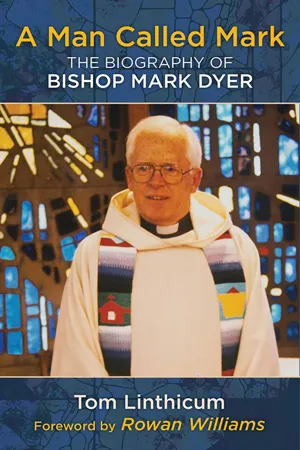
- 224 pages
- English
- ePUB (mobile friendly)
- Available on iOS & Android
eBook - ePub
About this book
Information
Topic
Theology & ReligionSubtopic
Religious BiographiesCHAPTER 1
“You Are Irish Catholic”
As I look at my faith and the oppression our family had to go through during the Herbert Hoover days and what the church did, that was very moving to me.1 —Mark Dyer
Times were tough—very tough indeed—when James Michael Dyer Jr. entered the world on June 7, 1930, in Manchester, New Hampshire.
It was the first year of the Great Depression. The stock market had crashed the previous October, and the country was reeling from the hammer blows of an imploding economy. Unemployment lines stretched endlessly, banks were failing, savings were decimated. Manchester, a mill town founded in 1846 on the banks of the Merrimack River fifty miles north of Boston, was hit especially hard. Its decline had begun in the 1920s as its mills, which once included the largest cotton textile mill complex in the world, began to falter.
The world as Manchester had known it ended on Christmas Eve, 1935, when the last mill closed and filed for bankruptcy. At one time its owner had employed seventeen thousand people and was the chief source of income for half of Manchester’s families.2 Stunned by their city’s economic collapse, Manchester’s nearly seventy-seven thousand residents did whatever they could to get by.
In the household of the Dyer family, an Irish clan rooted in the Roman Catholic Church, traditional values of family, faith, and work reigned supreme. That included the illegal making and selling of whiskey since Prohibition was the law of the land. Everyone pitched in, even the new baby. It was a story—confirmed by his younger sister, Pat Cashin—that Dyer always took great relish in telling. “My grandfather made it in the cellar,” he said, referring to the forbidden brew. “Then he would make the deliveries in the baby carriage, which he had modified with a place for the bottles underneath, and I was the baby in that carriage.”3 And so the carriage bounced along the streets of Manchester, with the youngest Dyer nestled atop the bottles, providing a very legitimate cover for a very illegitimate operation. The first stop was always the residence of the monsignor, who would get a complimentary bottle. There was also a free bottle for the cop on the beat—a good Irishman, of course.
As Dyer grew up during these times of great hardship, he saw firsthand how the Catholic Church ministered to its parishioners not just on Sundays but every day, helping people survive and giving them hope. “The monsignor always knew who was working and who wasn’t, which families were struggling the most, and he would send over money or food when it was most needed,” Dyer recalled many years later. “It was a social welfare system, it was run by the church, and it worked.”4
It was a lesson Dyer never forgot. It provided the foundation for his lifelong commitment to social justice and his belief in the church’s calling to serve the poor. For Jimmy Dyer, as he was called by his family (Mark was the name he would later take as a young monk), life in Manchester, even in times of deprivation, was a rich tapestry of family, church, and the Irish community.
His father, James M. Dyer, worked as a baker by day and made bread at St. Patrick’s Orphanage for Girls at night. “On Friday night he would make what the children would like on Saturday morning, and he would bake cookies,” said Pat. “He would make all kinds of cakes for people, and he never asked for any money. He was a good man.”5
Anna Mahoney Dyer raised Jimmy and Pat, cared for her husband’s ailing parents, and took in sewing work to help meet expenses. The four Dyers, along with James Dyer’s parents, Anna’s mother, and other family members, shared a rambling, three-story house at 352 Cedar Street, in the Irish and Greek quarter of the inner city’s east side. “There was no money but there were good times,” said Pat. “Grandfather Dyer went to church every morning at 7, and Grandmother was in her rocking chair, saying her rosary. At 6:30, [Jimmy and I] would fire up the oil furnace. Then we would have oatmeal, toast, and orange juice, and leave for school.
“For fun after dinner, sometimes we would sit on the front steps. Other times, we would listen to jazz and do the jitterbug. On weekends, if we were lucky, we would go to the movies and watch cowboy movies on Saturday afternoons but never on Sunday. Sunday was Mass at 9 or 10:30 and then breakfast and a big dinner—roast beef, fried chicken, mashed potatoes, and vegetables—at 1.”6
Every year when the circus came to town, nobody in Manchester was more excited than Jimmy Dyer. He would jump out of bed between 3 and 4 in the morning to watch the elephants lumber from their railroad cars to the circus venue; he was convinced that this was the greatest form of free entertainment known to man.
No matter how tight things were, Agnes Mahoney (Anna’s mother) managed to scrape together enough money every year to rent a cottage for a two-week family vacation at Hampton Beach, located on southeast New Hampshire’s eighteen-mile sliver of craggy Atlantic coastline. Those memorable trips kindled Dyer’s lifelong love affair with the sea.
The family’s Irish roots ran deep. Grandparents on both sides were born in Ireland. Years later while he was studying in Belgium, Dyer would visit the family farm in the village of Farranfore, near Killarney in County Kerry, before it became an airport. Anna Dyer treasured her Irish heritage so much that when she died in 1995, the local funeral home flew the Irish flag in her honor.
The Irish-American Club, a tired, one-room affair with a bar, some worn chairs, and a sagging floor, was not far from the home on Cedar Street. Dyer’s father would go there regularly on Fridays and Saturdays, and as Jimmy grew older, he would meet his friends there as well.
Although Jimmy developed a taste for beer when he came of age, Anna Dyer was a confirmed teetotaler and a member of the Pioneer Total Abstinence Association of the Sacred Heart, founded in Dublin in 1898. Dyer told a friend years later that on one occasion, fearful that an Irish wake in her home was getting out of hand, his mother emptied all of the whiskey bottles into the sink, bringing the gathering to an abrupt halt.
The Catholic Church was also a defining influence in Dyer’s life. “Grandmother would say to us, ‘You are Irish Catholic,’” Pat recalled, as if the two were woven seamlessly together. During Dyer’s early years, they were.7 His family attended St. Anne’s Church, a bastion of Irish Catholicism, where he was baptized on June 21, 1930. The Dyers attended church every Sunday, and young Jimmy became an altar boy and attended Catholic schools.
Tragedy struck the Dyer family when Jimmy was fifteen. Born with only one kidney, his father was stricken at home one evening in January 1946 with a terrible stomachache. He was taken to the hospital, where doctors discovered a virulent infection in his remaining kidney that they were powerless to stop. He died that night at the age of thirty-nine.
More than half a century later, Mark told his wife, Amy, whom he married in 2004, about his memories from that traumatic time: “I learned so much about my father that I didn’t know as I wandered from room to room at the wake. The women were in the kitchen, saying how kind and caring my father had been, telling about his care for the nuns and doing their baking after he finished his work. The men were in the parlor telling funny stories about him, always with a good Irish punch line. One story stayed with me, about how my grandmother would always call my father downstairs to break up fights between my uncles and how he was the one who looked after my Uncle Matthew when he’d had too much to drink. I learned a lot about my father that night.”8
His father’s death was a crushing blow to Jimmy Dyer. Always a good student, his grades plummeted and his mother had to intercede with his teachers. In time, Dyer regained his emotional equilibrium and his grades returned to normal. But the life he had known was over. Young Jimmy Dyer was now the man of the house.
Despite the Catholic Church’s central role in Dyer’s life, there was never any talk in those years of his becoming a priest. Many years later, he said that if he had given much thought to a future vocation at that point in his life, he probably would have said he wanted to be a firefighter or a policeman because that’s what most Irishmen did in Manchester.
“[Our mother] didn’t want him to be a priest and she didn’t want me to be a nun,” said Pat. “She thought he would have to go far away.”9
It turned out that he did go far away, but it wasn’t the church that took him there. It was the church that brought him back.
CHAPTER 2
War and Monasteries
When I was on shore in Greece, I was taking my turn as an MP, watching out for the guys who had a bit too much to drink. This one kid started a fight and the local police picked him up. Some of the guys he was with came to get me and tell me that he was at the police station, so I went up there, not really knowing what to do. When I got there, they were, of course, speaking Greek. I knew enough Greek from the guys I grew up with in Manchester that I could tell this kid was in big trouble. So I just started to chat with them in what street Greek I knew. The cops looked at me and said, “You Greek? Get this guy out of here!” We took off quickly before they changed their minds.1 —Mark Dyer
The nation was still catching its breath from World War II when a new conflict broke out on the other side of the world from Manchester. It was the Korean War, and it would radically change Jimmy Dyer’s life.
Too young to serve in World War II—he was fifteen when it ended—Dyer graduated from St. Joseph’s Cathedral High School in 1948 and worked various jobs in Manchester, delivering newspapers and driving a truck for the city. Still living at home, he contributed his income to help support the household and enjoyed the postwar rhythms of life with family and friends.
But things began to change on June 25, 1950, when North Korean soldiers poured across the 38th parallel into South Korea. The United States was soon drawn into the war. More soldiers, sailors, and airmen were needed, and volunteers and draftees would fill the ranks.
Dyer wanted to choose his branch of service, so on January 17, 1951, he went to Boston and enlisted in the navy.2 This offered him a four-year, all-expenses-paid tour of exotic ports of call and more money than he was making in Manchester—most of which he would send home to his mother.
With all hell breaking loose on the rugged Korean Peninsula, Dyer found himself at the Naval Training Center in Newport, Rhode Island,3 with its yacht-filled harbor and Gilded Age mansions. He and his naval aviation unit prepared for combat in a remote locale that he, like most Americans, knew virtually nothing about.
On May 10, 1952, Dyer’s Fighter Squadron 71 (VF-71) flew to San Francisco, where it was assigned to the aircraft carrier USS Bon Homme Richard, namesake of the famous warship commanded by John Paul Jones in the Revolutionary War. Ten days later, the “Bonnie Dick,” as it was known to its crew, left port to join the U.S. 7th Fleet in the Sea of Japan.4
The monthlong voyage gave Dyer plenty of time to acclimate to his new world. Far from the familiar streets of Manchester and his cadre of family and friends, he found himself in a waterborne city of twenty-six hundred souls, all strangers to him. There was no Irish-American Club, no St. Anne’s Parish, no band of lifelong chums.
So he kept his head down, did his work, and set about making new friends. And he went to Mass.
There was also training and plenty of it. As a petty officer third class, Dyer was in charge of the weapons on the navy’s first carrier-based jets: the Grumman F9F Panthers. The single-engine combat aircraft, the navy’s workhorse during the war, carried four 20mm cannons in its nose and rockets and bombs under its wings.5
The ship arrived in Japan on June 22,6 and for the next six months, its planes pounded targets across North Korea, including four major rail centers close to the Soviet and Manchurian borders in the largest air raid of the war at that point,7 and several hydroelectric power plants near the Chosin Reservoir.8 The attacks were often met with heavy anti-aircraft fire, and some of Dyer’s friends were killed.
But even as he prepped his planes for combat, making sure their ordinance was at its most lethal efficiency, Dye...
Table of contents
- Cover Page
- Title Page
- Copyright
- Contents
- Foreword by Rowan Williams
- Prologue
- Chapter 1: “You Are Irish Catholic”
- Chapter 2: War and Monasteries
- Chapter 3: Set Up by God
- Chapter 4: Breaking Away
- Chapter 5: Charting a New Course
- Chapter 6: Matthew
- Chapter 7: Rector
- Chapter 8: Bishop
- Chapter 9: A Yankee in the Archbishop of Canterbury’s Court
- Chapter 10: Of Women Priests and Bishops
- Chapter 11: The Wars of Windsor
- Chapter 12: A Monk in the World
- Chapter 13: Teacher, Mentor, Pastor
- Chapter 14: Tragedy
- Chapter 15: New Life
- Chapter 16: Journey’s End
- Chapter 17: Legacy
- Acknowledgments
- Notes
- Bibliography
- Index
Trusted by 375,005 students
Access to over 1.5 million titles for a fair monthly price.
Study more efficiently using our study tools.
Frequently asked questions
Yes, you can cancel anytime from the Subscription tab in your account settings on the Perlego website. Your subscription will stay active until the end of your current billing period. Learn how to cancel your subscription
No, books cannot be downloaded as external files, such as PDFs, for use outside of Perlego. However, you can download books within the Perlego app for offline reading on mobile or tablet. Learn how to download books offline
Perlego offers two plans: Essential and Complete
- Essential is ideal for learners and professionals who enjoy exploring a wide range of subjects. Access the Essential Library with 800,000+ trusted titles and best-sellers across business, personal growth, and the humanities. Includes unlimited reading time and Standard Read Aloud voice.
- Complete: Perfect for advanced learners and researchers needing full, unrestricted access. Unlock 1.5M+ books across hundreds of subjects, including academic and specialized titles. The Complete Plan also includes advanced features like Premium Read Aloud and Research Assistant.
We are an online textbook subscription service, where you can get access to an entire online library for less than the price of a single book per month. With over 1.5 million books across 990+ topics, we’ve got you covered! Learn about our mission
Look out for the read-aloud symbol on your next book to see if you can listen to it. The read-aloud tool reads text aloud for you, highlighting the text as it is being read. You can pause it, speed it up and slow it down. Learn more about Read Aloud
Yes! You can use the Perlego app on both iOS and Android devices to read anytime, anywhere — even offline. Perfect for commutes or when you’re on the go.
Please note we cannot support devices running on iOS 13 and Android 7 or earlier. Learn more about using the app
Please note we cannot support devices running on iOS 13 and Android 7 or earlier. Learn more about using the app
Yes, you can access A Man Called Mark by Tom Linthicum in PDF and/or ePUB format, as well as other popular books in Theology & Religion & Religious Biographies. We have over 1.5 million books available in our catalogue for you to explore.