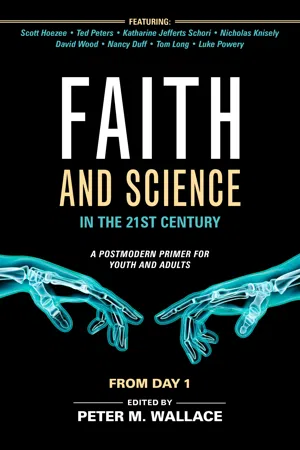
With contributions from eight noted theologians, this book builds on popular videos from the Day 1 radio.
Science or faith? The battle rages, from millennials and GenXers questioning the relevance of religion to older adults who doubt the validity of science (and vice versa), but these two are not mutually exclusive. They can, in fact, be mutually enriching and complimentary, once their proper domains are understood and respected. The Episcopal Church, with its tradition of the "via media," offers an ideal setting for conversations seeking to bridge the often antagonistic perspectives on both sides. Faith and Science in the 21st Century presents a way to start that conversation.
Built on existing videos produced by the popular Day 1 program with assistance from a John Templeton Foundation grant, this series features notable faith leaders across the denominational spectrum in 3 to 5 minute video presentations on scientific topics in which they are experts. Intended for use in a variety of settings, including congregations, schools, and campus ministries, it can be presented as an eight-session series of studies, but each session can also stand on its own for a one-time formation offering. A single video download will offer all video presentations. This Leader Guide enables facilitators to foster fruitful discussions of each session topic. It includes an introduction about the program and how it can be used, and eight detailed session plans to utilize with a downloadable video sold separately on the Day 1 website.
eBook - ePub
Faith and Science in the 21st Century
A Postmodern Primer for Youth and Adults
- 112 pages
- English
- ePUB (mobile friendly)
- Available on iOS & Android
eBook - ePub
About this book
Information
Topic
Theology & ReligionSubtopic
Christian Denominations
Can Science and Faith
Inform Each Other?
Inform Each Other?
Does the universe make any sense? Does the cosmos have purpose? And what about us human beings? Do we matter? Is there any way to know? Listen to some people these days, including some vocal scientists, and you will hear the answer loud and clear: “No, not really. We don’t matter. We’re too small. The universe is pretty much pointless.”
—The Rev. Scott Hoezee

The quarrel between religion and science has ancient roots. The first philosophers in Greece—such as Heraclitus and Parmenides—actively pursued what we would call scientific questions, thereby challenging the roles of the gods in their culture. They asked questions about the character of human nature, the role of nature in shaping human life, the beginning of human life, and the shape of life after death. Their answers to such questions didn’t involve the presence of supernatural forces; they focused instead on the natural world to provide explanations for the way humans interact with each other and the world.
By the end of the nineteenth century, the ongoing conversation between religion and science took on new dimensions with Charles Darwin’s writings about evolution. When many people of faith read his books—or heard about them from their pastors—they rejected the idea that human life developed randomly without the involvement of a divine Creator providing and sustaining human life. As the twentieth century brought new scientific advances, such as quantum physics and developments in medicine that could prolong life and intervene in the process of death, even more questions arose for people of faith.
The major questions with which people of faith often grapple—and that are raised by the various speakers in this Day1 Faith and Science series—involve the compatibility of faith and science. For example, can we reconcile creation and evolution? How do new medical technologies alter our understandings of life and death? What about the purpose of life? Do scientists and people of faith have anything meaningful to say to each other?
In this first session, Scott Hoezee, author of Proclaim the Wonder: Engaging Science on Sunday, encourages us to think about these questions, focusing on Paul’s approach to nature and God in Colossians.
Participants may like to come to the session having reflected on the issues to be discussed. The following questions invite participants to engage rationally and spiritually with the topic, so share them in advance announcements of the group study. Encourage participants to jot down notes, questions, and reflections.
- How does God reveal Godself to you through nature? Through the Bible? Through Jesus? Through the teachings of the Church? Through some other means?
- What does God reveal to you through nature? Can you have faith in a God who is solely revealed through nature?
- Is it possible for science and faith to be compatible? If so, how? If not, why not?
- What views do the biblical writers—the psalmists or Paul, for example—have of the natural world and our place in it?
WELCOME those attending and if necessary have everyone introduce themselves briefly. Explain the purpose of this series. Open with prayer if you choose.
READ Colossians 1:15–23 (2 minutes)
Have a volunteer read it, read it together, or play Audio File 1-4 to hear Scott Hoezee read it. If possible, read the passage in different translations.
He is the image of the invisible God, the firstborn of all creation; for in him all things in heaven and on earth were created, things visible and invisible, whether thrones or dominions or rulers or powers—all things have been created through him and for him. He himself is before all things, and in him all things hold together. He is the head of the body, the church; he is the beginning, the firstborn from the dead, so that he might come to have first place in everything. For in him all the fullness of God was pleased to dwell, and through him God was pleased to reconcile to himself all things, whether on earth or in heaven, by making peace through the blood of his cross.
And you who were once estranged and hostile in mind, doing evil deeds, he has now reconciled in his fleshly body through death, so as to present you holy and blameless and irreproachable before him—provided that you continue securely established and steadfast in the faith, without shifting from the hope promised by the gospel that you heard, which has been proclaimed to every creature under heaven. I, Paul, became a servant of this gospel.
WATCH Video 1 (4 minutes)
REFLECT (10 minutes)
Ponder the passage and Hoezee’s comments by considering together some or all of these questions:
• Is this a biblical text that comes to mind immediately when you think about the relationship between faith and science?
• What messages in the passage do you hear about the relationship between faith and science?
• What is Paul’s attitude toward creation and all things created?
• What is the purpose of the cosmos?
• What role do creatures play in creation?
• What can we know about God from this passage?
• How can we relate to God and to a scientific view of the world after reading this passage?
• What are Paul’s final words in the passage, and how do they relate to the questions about faith and science?
LISTEN Audio File 1-1 (5 minutes)
In his opening interview with Day1 host Peter Wallace, Scott Hoezee shares some of his goals in teaching his class on faith and science. He tries to introduce students to the current state of science and to areas of science with which they might be unfamiliar.
DISCUSS (5 minutes)
Talk about some of the newest developments in science with which you are familiar. What are some ways that you think religion and science can inform each other in light of new developments in science?
Optional Discussion
Hoezee also talks about revelation and our response to it in this interview:
Particularly in my Reformed tradition, we’ve long had this theology of revelation of two books. There’s the book of nature, the creation of God, and of course scripture; and of course we believe that due to our sinfulness we can’t read the book of nature correctly without—as John Calvin said—putting on the spectacles or the eyeglasses of scripture. But we’re always interpreting both books and we can make mistakes on both sides. . . . But there are sometimes conflicts, apparent conflicts, and the question becomes, where does the mistake lie? Is it in the interpretation of what we’re seeing through science, or is the mistake what we thought the Bible was saying all along? . . . We’re never going to achieve perfect harmony and shouldn’t expect to, I suppose, but come as close as we can to getting both right and then seeing where are the convergences and where are the questions we still have to work out.
Take a few minutes to consider these questions:
• Do we in the church have views of science that are outdated or that need updating?
• Do we have views of the Bible that might be left over from earlier in our lives and that need reconsideration?
• What does reconsideration of our views about science and about the Bible reveal about the relationship of the two?
LISTEN Audio File 1-2 (13 minutes)
In his sermon, entitled “Every Creature,” Hoezee raises several questions that relate to science and religion. In one section he discusses purpose and meaning—of human life and of the universe—and he probes the ways that we as people of faith might feel after scientific discoveries that question our role in the universe.
THINK AND SHARE (10 minutes)
Divide into small groups of two or three. Discuss the following questions based on what Hoezee said:
Oh, once upon a time before we knew anything much about how big the universe is, how many billions o...
Table of contents
- Cover Page
- Title Page
- Copyright
- Contents
- How to Use This Resource
- SESSION 1 How Can Science and Faith Inform Each Other?
- SESSION 2 God and Cosmos
- SESSION 3 Creation and Evolution
- SESSION 4 Quantum Physics and Eternity
- SESSION 5 Science and the Image of God
- SESSION 6 The Bible and Genetics
- SESSION 7 Life and Death
- SESSION 8 Continuing the Conversation in the Churches
- For Further Reading
- Meet the Speakers
Trusted by 375,005 students
Access to over 1.5 million titles for a fair monthly price.
Study more efficiently using our study tools.
Frequently asked questions
Yes, you can cancel anytime from the Subscription tab in your account settings on the Perlego website. Your subscription will stay active until the end of your current billing period. Learn how to cancel your subscription
No, books cannot be downloaded as external files, such as PDFs, for use outside of Perlego. However, you can download books within the Perlego app for offline reading on mobile or tablet. Learn how to download books offline
Perlego offers two plans: Essential and Complete
- Essential is ideal for learners and professionals who enjoy exploring a wide range of subjects. Access the Essential Library with 800,000+ trusted titles and best-sellers across business, personal growth, and the humanities. Includes unlimited reading time and Standard Read Aloud voice.
- Complete: Perfect for advanced learners and researchers needing full, unrestricted access. Unlock 1.5M+ books across hundreds of subjects, including academic and specialized titles. The Complete Plan also includes advanced features like Premium Read Aloud and Research Assistant.
We are an online textbook subscription service, where you can get access to an entire online library for less than the price of a single book per month. With over 1.5 million books across 990+ topics, we’ve got you covered! Learn about our mission
Look out for the read-aloud symbol on your next book to see if you can listen to it. The read-aloud tool reads text aloud for you, highlighting the text as it is being read. You can pause it, speed it up and slow it down. Learn more about Read Aloud
Yes! You can use the Perlego app on both iOS and Android devices to read anytime, anywhere — even offline. Perfect for commutes or when you’re on the go.
Please note we cannot support devices running on iOS 13 and Android 7 or earlier. Learn more about using the app
Please note we cannot support devices running on iOS 13 and Android 7 or earlier. Learn more about using the app
Yes, you can access Faith and Science in the 21st Century by Peter M. Wallace in PDF and/or ePUB format, as well as other popular books in Theology & Religion & Christian Denominations. We have over 1.5 million books available in our catalogue for you to explore.