Distinguished Anglican theologian Jane Shaw presents four of the early 20th century Anglican innovators in spirituality and assesses how they might help us develop a renewed Anglican spirituality for our own “spiritual but not religious” age. These four Anglicans—Percy Deamer, Evelyn Underhill, Somerset Ward, and Rose Macaulay—are people who revived spirituality at a time, like our own, when people were questioning institutional religion.
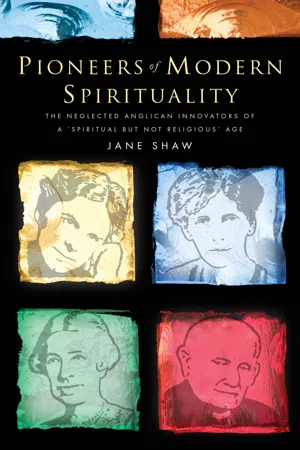
eBook - ePub
Pioneers of Modern Spirituality
The Neglected Anglican Innovators of a "Spiritual but Not Religious" Age
- 136 pages
- English
- ePUB (mobile friendly)
- Available on iOS & Android
eBook - ePub
Pioneers of Modern Spirituality
The Neglected Anglican Innovators of a "Spiritual but Not Religious" Age
About this book
Information
Subtopic
Ministère chrétienChapter 1
Evelyn Underhill
Seeking
Evelyn Underhill was a seeker for much of her life. The early twentieth century was a moment when the seeker emerged as a significant figure, inside, outside and on the margins of the churches, questing after an authentic spirituality. Those familiar with Underhill’s work may think of her primarily as a devout Anglican, leader of retreats, Christian writer and a prominent laywoman, called upon to serve on multiple church committees. However, only in 1921 when she was in her mid-forties, did she embrace Anglicanism fully, so it was only in the last two decades of her life, in the 1920s and 30s, before she died aged 65 in 1941, that she was the devout and fully-committed Anglican that we remember.
A decade before Underhill made her definitive turn to the Church of England, her lengthy book, Mysticism, was published (1911). Through that publication and a series of shorter books that followed, Underhill brought mysticism to a broad audience in the early part of the twentieth century. Her work was part of a broad revival of interest in mysticism in the early twentieth century, kick-started by W. R. Inge’s Bampton Lectures in Oxford in 1899, published that year as Christian Mysticism.1 Underhill’s distinctive contribution to this revival was her suggestion that mysticism was practical and could be learnt by anyone. Through her publications and her work as a spiritual director, she guided many people towards a life of prayer, and through the leading of many retreats she was at the forefront of a rapid growth in retreat-taking in the first half of the twentieth century.
The revival of interest in mysticism relates to the ways in which spirituality began to flourish in these years of the early twentieth century, just as institutional religion began to decline. Religion’s traditional authority was shaken by science and historical biblical criticism, especially after the 1860s (Darwin’s Origin of Species was published in 1859). In that context, W. R. Inge turned to mysticism because he asked: on what authority might faith now rest? It was no longer ‘the old seats of authority, the infallible Church and the infallible book’ which had been fiercely assailed. Rather the seat of authority was now ‘a life or experience.’2 Mysticism was appealing because it apparently transcended religious institutions and sacred texts; as Inge put it: ‘For what has mysticism to do with past and future, with history and prophecy? It is a vision of timeless reality, which is neither born nor dies, being raised above the changes and chances of this mortal life.’3
Underhill’s Search
It was in that context of questioning that Underhill’s own spiritual search occurred. Born in 1875, Underhill was brought up in a well-to-do middle-class family (her father was a barrister) that was nominally Anglican, but which paid little attention to faith. She was educated at home, and briefly at a girls’ school in Folkstone (where she was confirmed Anglican), before going to King’s College, London, to study first botany and then history and philosophy. She was a deeply practical person, being a good book binder, for example, and she was also an expert sailor, a passion she shared with her husband, whom she had known since childhood as a family friend. She was also artistic, and quite early on she began writing: short stories (published in the Horlicks Magazine), poetry, and novels that explored the metaphysical and supernatural - in ways that Charles Williams would later in his novels.
She loved to travel and it was when visiting Italy and many of its churches for the first time in 1898 that a spiritual longing began to stir in her. When she was 29, in 1904, she had a spiritual awakening – a religious experience – but did not formally return to the church for another seventeen years. She was, for a brief while, a member of the esoteric occult group, the Order of the Golden Dawn, and it was through her exploration of Christian hermeticism, which she studied in that group, that she came to the Christian mystical tradition. Her search took her to Roman Catholicism and her intellect took her to the modernist end of Roman Catholicism. She got to the point of almost converting to Roman Catholicism, but two things happened that stopped her. First, she told her husband-to-be, Hubert, and he was appalled – not least because he feared the intimate details of their marriage would be shared in the confessional with a celibate, Roman Catholic priest. Secondly, her thoughts of becoming a Roman Catholic occurred at just the moment that modernists like the priest George Tyrell were excommunicated, and her conscience would not allow her to go further. As she wrote to a friend in 1911, the year that Mysticism was published, ‘being myself Modernist on many points, I can’t quite get in without suppressions or evasions to which I can’t quite bring myself. But I can’t accept Anglicanism instead: it seems an integrally different thing. So here I am, going to Mass, and so on of course, but entirely deprived of sacraments.’4 She remained on the margins of the churches for another decade. This means that when she wrote her big book Mysticism and began to take on her own spiritual directees, she was still an outsider, questing and seeking.
Mysticism is a book that draws deeply on a wide range of scholarship and texts, contemporary psychological literature on the subject of religious experience, as well as the Christian mystical tradition – with a particular focus on the medieval mystics of the West. But what was mysticism for Underhill? She was a learned woman, but, in the end, mysticism was for her primarily about love. ‘In mysticism that love of truth which we saw as the beginning of all philosophy leaves the merely intellectual sphere and takes on the assured aspect of a personal passion.’ Mysticism was for her the essence of religion, and in her book Mysticism she defined it as ‘the expression of the innate tendency of the human spirit towards complete harmony with the transcendental order.’5 In an essay written much later, in 1936, she used more distinctly Christian, theological language, and defined mysticism as ‘the passionate longing of the soul for God, the unseen Reality, loved, sought, and adored in Himself for Himself alone.’ She quoted here the Roman Catholic layman, who by that time had influenced her so much, Baron von Hügel, who described this longing as a ‘metaphysical thirst’. And so, she said, ‘A mystic is not a person who practices unusual forms of prayer, but a person who is ruled by this thirst. He feels and responds to the overwhelming attraction of God, is sensitive to that attraction; perhaps a little in the same way as the artist is sensitive to the mysterious attraction of visible beauty, and the musician to the mysterious attraction of harmonized sound.’ She quoted Augustine’s great saying – ‘Thou hast made us for thyself, and our hearts shall find no rest save in thee’ – as the best explanation for this thirst and thus the appeal of the path of mysticism.
Underhill always wanted to make mysticism available to anybody and everybody who had that thirst, and especially to provide a practical form of mysticism for others who were, like her, on a spiritual quest. She wanted to train them how, through ‘that loving and devoted attention which we call contemplation,’ they could come ‘to know a spiritual reality to which we are [otherwise] deaf and blind.’ She therefore focused on practice: the mystic way, a path of prayer, contemplation and action rooted in love, which anyone could learn. Indeed, she believed that mysticism was really ‘the science of the love of God’. It is through that love that we come to knowledge of God – neither emotion nor pure intellect, but love. 6
After the success of Mysticism, she wrote two much shorter books for seekers like herself, The Mystic Way in 1913 and Practical Mysticism in 1914. The latter attempted to show that mysticism was not an esoteric pastime for the few, but something that was open to all. ‘It is to a practical mysticism that the practical man is here invited: to a training of his latent faculties, a bracing and brightening of his languid consciousness, an emancipation from the fetters of appearance, a turning of his attention to new levels of the world.’ This was possible for anyone: ‘mystical perception – this “ordinary contemplation” as specialists call it – is … a natural human activity, no more involving the great powers and sublime experiences of the mystical saints and philosophers than the ordinary enjoyment of music involves the special creative powers of the great musicians.’ How would this happen? – ‘through an educative process; a drill’. If a person could learn how to practice the law or be good at business, so they could learn the mystic way. ‘The education of the mystical self lies in self-simplification.’7
The mystic way, as she expounded it in the books she wrote in these years before she definitively returned to the Church of England, was largely an individual endeavour. This practical mysticism is a solo activity, and nowhere in the book does she mention churchgoing or corporate worship. In 1924, she wrote that she regarded the book as ‘incomplete’ because of its inattention to ‘Institutional and Social spirituality’.8 To one of her correspondents, she wrote that she was ‘apt to be disagreeable on the Church question. I stood out against it myself for so long and have been so thoroughly convinced of my own error that I do not want other people to waste time in the same way … I do not mean that perpetual churchgoing and sermons are necessary, but some participation in the common religious life and sacramental life.’9
Nevertheless, we should not underestimate the influence that the little book Practical Mysticism – for all its failings, which she pointed out – had on people. James Lumsden Barkway, a Presbyterian who converted to Anglicanism and was Bishop of Bedford and then Bishop of St Andrew’s, wrote of the impact that book had on him when he was given a copy in 1914 when it was published.
I had been prepared for its message by many years of searching without finding and it spoke straight to the heart of my condition … I had previously read Evelyn Underhill’s two longer books, Mysticism and The Mystic Way, and had been greatly interested. But the intimate appeal of the smaller volume, with its characteristically homely illustrations, spoke to me … directly … Evelyn Underhill threw open a door before which I had been standing all my life, longing to get through. She encouraged me to make the experiment which the previous guides of my university and theological college days … had said was beyond human capacity; and she assured me that direct and first-hand knowledge of God was not only desirable but possible.
For Lumsden Barkway, Underhill wrote in a way that was ‘pertinent and relevant to the life of to-day.’ She did this by practical common sense, and being unafraid to appeal to her own experience in prayer. This made her a very approachable spiritual director, as we shall explore later in this chapter.10
Responding to Seekers
Underhill always wanted to appeal to those who were searching, like the young Lumsden Barkway, and she recognized that there were increasing numbers of people who were alienated by and from institutional religion. In my Introduction to this book I quoted from her 1921 Upton Lectures, delivered in Oxford and written just after she had returned to the Anglican fold: ‘I think we may now say without exaggeration that the general modern judgment – not, of course, the clerical or orthodox judgment – is adverse to institutionalism; at least as it now exists.’ In those lectures, she explored what institutional religion can provide (as she had just embraced the Church of England this is perhaps not surprising): group-consciousness, religious union, discipline, and culture. And she wrote that as far as ‘the freelance’ (as she called those outside the body of the church) gets any of those things, it is, ultimately, ‘indirectly from some institutional sources.’ But, she continued, ‘the institution, since it represents the element of stability in life, does not give, and must not be expected to give, direct, spiritual experience; or any onward push towards novelty, freshness of discovery and interpretation in the spiritual sphere.’ She was also clear-eyed about the potential ‘dangers and limitations’ of institutional religion. It would ge...
Table of contents
- Cover Page
- Title Page
- Copyright
- Dedication
- Contents
- Acknowledgments
- Introduction
- Chapter 1 Evelyn Underhill: Seeking
- Chapter 2 Reginald Somerset Ward: Prayer
- Chapter 3 Percy Dearmer: Beauty
- Chapter 4 Rose Macaulay: Second Chances
- Chapter 5 Spirituality and the Church today
- Select Bibliography
- Index
Trusted by 375,005 students
Access to over 1.5 million titles for a fair monthly price.
Study more efficiently using our study tools.
Frequently asked questions
Yes, you can cancel anytime from the Subscription tab in your account settings on the Perlego website. Your subscription will stay active until the end of your current billing period. Learn how to cancel your subscription
No, books cannot be downloaded as external files, such as PDFs, for use outside of Perlego. However, you can download books within the Perlego app for offline reading on mobile or tablet. Learn how to download books offline
Perlego offers two plans: Essential and Complete
- Essential is ideal for learners and professionals who enjoy exploring a wide range of subjects. Access the Essential Library with 800,000+ trusted titles and best-sellers across business, personal growth, and the humanities. Includes unlimited reading time and Standard Read Aloud voice.
- Complete: Perfect for advanced learners and researchers needing full, unrestricted access. Unlock 1.5M+ books across hundreds of subjects, including academic and specialized titles. The Complete Plan also includes advanced features like Premium Read Aloud and Research Assistant.
We are an online textbook subscription service, where you can get access to an entire online library for less than the price of a single book per month. With over 1.5 million books across 990+ topics, we’ve got you covered! Learn about our mission
Look out for the read-aloud symbol on your next book to see if you can listen to it. The read-aloud tool reads text aloud for you, highlighting the text as it is being read. You can pause it, speed it up and slow it down. Learn more about Read Aloud
Yes! You can use the Perlego app on both iOS and Android devices to read anytime, anywhere — even offline. Perfect for commutes or when you’re on the go.
Please note we cannot support devices running on iOS 13 and Android 7 or earlier. Learn more about using the app
Please note we cannot support devices running on iOS 13 and Android 7 or earlier. Learn more about using the app
Yes, you can access Pioneers of Modern Spirituality by Jane Shaw in PDF and/or ePUB format, as well as other popular books in Théologie et religion & Ministère chrétien. We have over 1.5 million books available in our catalogue for you to explore.