Engages in how we should now live into this time of climate change crisis
It is hard to be hopeful in the face of climate crisis. The problem is on a scale difficult for us to understand. Actions needed to address the crisis require a radical change in way of life. Does the Church have anything unique to offer? Is there something in our life of community, worship, and prayer that suggests a different way through this time? Church, Creation, and the Common Good is a program resource offering a hopeful answer to these challenges. Through scripture, tradition, and Christian practice, it guides church communities into deeper understanding of their role as the Church in the world and how they might be communities for the common good in this time. This curricular resource is sure to foster rich conversations and provide a path toward love of all creation and our particular places as we face the climate crisis together.
eBook - ePub
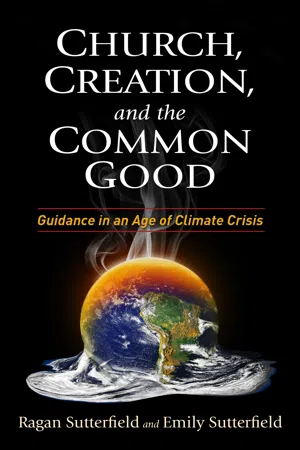
Church, Creation, and the Common Good
Guidance in an Age of Climate Crisis
- 80 pages
- English
- ePUB (mobile friendly)
- Available on iOS & Android
eBook - ePub
Church, Creation, and the Common Good
Guidance in an Age of Climate Crisis
About this book
Information
Topic
Theology & ReligionSubtopic
ReligionSESSION 1
Ecclesia, Part 1
Objectives
• To gain a clear perspective on what the Church should be
• To reflect on the Church as a Truth-Telling Community
• To explore the Church as an Agent of God’s Work
• To deepen our understanding of the Church as a Vision of the Future
Materials
- Flip chart
- Markers
- Pens
- Images and key words, each cut out separately in advance from magazines and newspapers that remind you of possible ways to define the Church. (You may choose to have magazines, newspapers, and scissors available for participants to find their own as an extended activity.)
- Blank sheets of paper
- One copy of Church, Creation, and the Common Good for each participant
Reminders for the Facilitator
• Organize and set up the room with all materials ahead of time.
• Pray for all the participants before each session.
• Keep the conversation flowing, making room for all to share.
• Be open to listening more than sharing.
• Let the process unfold organically for each participant.
| Welcome and Opening Prayer | (5 minutes) |
Welcome to the first session of the class Church, Creation, and the Common Good. Make sure everyone has a seat where they can be seen and heard. Let them know that this will be a time of prayerful discernment together. You are there as a facilitator who is open to learn and grow with them.
During this first class, if there is adequate time, give each participant a chance to introduce themselves. Let them know who you are as well. If it is appropriate, share a bit about why you felt called to lead this class and invite everyone to share why they are interested in the topic.
Explain that during each session, we will open with a time of prayer. Read aloud the following prayer or allow a volunteer to read it aloud for the group.
Keep, O Lord, your household the Church in your steadfast faith and love, that through your grace we may proclaim your truth with boldness, and minister your justice with compassion; for the sake of our Savior Jesus Christ, who lives and reigns with you and the Holy Spirit, one God, now and forever. Amen.2
| Session Overview | (15 minutes) |
Share:
In our first two sessions, we will be exploring what it means to be the Church. We are talking about Church in capital letters—not just about the one particular church we may be part of (though our particular church is a local representation of the Church at large). We sometimes refer to the Christian Church as Ecclesia.
Questions to Ponder:
• Thinking back to the prayer we just read, we are reminded that we are called to be “the Church” in faith and love. What does that mean?
• What is “the Church”?
• How do we define “the Church”?
After a few moments of silence, scatter the cut-out images and words on the floor in the middle of your circle.
• Choose a word or image that speaks to you when thinking of how you define “the Church.”
• Have blank paper as well. If you choose, you can draw your own image or write in your own word as well.
Go around the group and have everyone share their images or words with the group. Each participant can briefly explain why they chose their particular word or image. No one needs to share if they are not comfortable.
As specific thoughts are shared, write them on a flip chart.
| Focus for the Day | (5 minutes) |
Thank the group for sharing their thoughts. Explain in your own words that we all have many different ways of understanding the Church and it is indeed many things. The Church is a community, a people, an Agent of God’s mission in the world. The Church can mean different things to different people at different seasons of their lives. All of this is important to be aware of and to respect.
The Church can also be very powerful. Therefore, we must continually reflect on what it should be through prayer and humility, and through study and conversation. How can we go deeper together to understand the Church?
To explore the meaning of “Church” more deeply, let us start by going to prayer and scripture. Prayers help us define our theology. Scripture serves as the authoritative guide for our lives. Lex orandi, lex credendi: It is prayer that leads to belief and it is liturgy that leads to theology.
We will use these two sources of prayer and scripture to help us better understand what the Church is supposed to be.
Break into pairs or smaller groups. Each team can have a different prayer and scripture to explore together. The facilitator should float between groups to help them stay on track in their conversations. (See Appendix A, pages 47–50.)
| Group Reflection | (20 minutes) |
Give the small groups plenty of time to discuss their prayers and scriptures. Encourage them to take notes and to be ready to share their key findings with the larger group.
Optional: Each group can come up with one image and word to define the Church together. Based on their particular scriptures or prayers, they can select from the leftover images and words of the first activity.
After time for reflection, gather everyone back together. Give each group time to briefly share their prayers and scriptures, summarizing what they discovered in their exploration of the prayers and scriptures.
Optional: If they choose a word and image, they can share and post these on blank chart paper. Each group can add to the same page, creating one large poster together.
After everyone has had a chance to share, take time to sum up the key points.
| Key Points and Next Steps | (10 minutes) |
From our readings and discussion, we have hopefully deepened our understanding of what the Church is about. Sometimes it is good to clear our perspectives and focus on key points.
Based on our readings, three important points stand out (write each heading on a flip chart sheet to use in later sessions):
- Truth-Telling Community God has called the Church to be a community that tells the Truth to each other and to the world. Throughout the week, think of what that means to be a Truth-Telling Community.
- Agents of God’s Work God has called the Church to be an Agent of God’s Work for renewing the world and restoring the common good. Throughout the week, think of what it means to be Agents of God’s work.
- Vision of Hope for the Future God has called the Church to be a community that lives in the now but is guided by what God is working for in the future. Throughout the week, think of what it means to be a Vision of Hope for the Future.
In preparation for the next session:
• Look around for examples of people or groups that are living into our call to be the Church.
• Where in our community do you see people living into Truth?
• Where in the wo...
Table of contents
- Cover Page
- Title Page
- Copyright
- Contents
- Preface
- Introduction
- Session 1: Ecclesia, Part 1
- Session 2: Ecclesia, Part 2
- Session 3: Ecology, Part 1
- Session 4: Ecology, Part 2
- Session 5: Economy, Part 1
- Session 6: Economy, Part 2
- Appendix A: Scripture and Prayer
- Appendix B: Prayers of the People
- Appendix C: Case Studies
- Appendix D: Key Facts About Climate Change
- Appendix E: Climate Change Resources
Trusted by 375,005 students
Access to over 1.5 million titles for a fair monthly price.
Study more efficiently using our study tools.
Frequently asked questions
Yes, you can cancel anytime from the Subscription tab in your account settings on the Perlego website. Your subscription will stay active until the end of your current billing period. Learn how to cancel your subscription
No, books cannot be downloaded as external files, such as PDFs, for use outside of Perlego. However, you can download books within the Perlego app for offline reading on mobile or tablet. Learn how to download books offline
Perlego offers two plans: Essential and Complete
- Essential is ideal for learners and professionals who enjoy exploring a wide range of subjects. Access the Essential Library with 800,000+ trusted titles and best-sellers across business, personal growth, and the humanities. Includes unlimited reading time and Standard Read Aloud voice.
- Complete: Perfect for advanced learners and researchers needing full, unrestricted access. Unlock 1.5M+ books across hundreds of subjects, including academic and specialized titles. The Complete Plan also includes advanced features like Premium Read Aloud and Research Assistant.
We are an online textbook subscription service, where you can get access to an entire online library for less than the price of a single book per month. With over 1.5 million books across 990+ topics, we’ve got you covered! Learn about our mission
Look out for the read-aloud symbol on your next book to see if you can listen to it. The read-aloud tool reads text aloud for you, highlighting the text as it is being read. You can pause it, speed it up and slow it down. Learn more about Read Aloud
Yes! You can use the Perlego app on both iOS and Android devices to read anytime, anywhere — even offline. Perfect for commutes or when you’re on the go.
Please note we cannot support devices running on iOS 13 and Android 7 or earlier. Learn more about using the app
Please note we cannot support devices running on iOS 13 and Android 7 or earlier. Learn more about using the app
Yes, you can access Church, Creation, and the Common Good by Ragan Sutterfield,Emily Sutterfield in PDF and/or ePUB format, as well as other popular books in Theology & Religion & Religion. We have over 1.5 million books available in our catalogue for you to explore.