Dementia: a specter that haunts many, either as a fear for the future or as lived reality with a loved one. It has been called the "theological disease" because it affects so much of how we define our humanity: language, long-term memory, and ability to plan the future. The church has a role in bringing hope and shepherding the spiritual journeys of people with dementia and their families. Beginning with current theological models of personhood, concepts about the self and spirituality are explored through the latest research in medicine and neuroscience as well as from work on spirituality and aging. The final chapter focuses on narratives of successful programs in churches and retirement communities designed to minister to people with dementia alongside their families and caregivers.
- 160 pages
- English
- ePUB (mobile friendly)
- Available on iOS & Android
eBook - ePub
About this book
Information
Topic
Theology & ReligionSubtopic
Christian MinistryCHAPTER 1
The Healthy Brain
The body is very important in our story. Christians believe in the Incarnation, that the second person of the Trinity assumed human form in the person of Jesus Christ. We are embodied, too. This chapter begins our discussion about the physical body, and in particular, the healthy brain.
Brain and Mind
Many today believe that it is the human brain that makes us different from other forms of life. It is immense and more complex in comparison to that of other species, giving rise to an unprecedented human consciousness with abilities such as self-awareness, intelligence, language, self-control, extensive planning, emotion, the ability to cooperate, and other attributes observed only to a lesser degree, if at all, in the species closest to us. Rather than believing in the traditional concept of the soul, some theologians believe that it is consciousness,1 or the “information pattern,”2 that survives after death. (See chapter 3 for more information on this topic.)
Those holding to the scientific-secular model for what makes us human would say that it was the surging size of the brain about two hundred thousand years ago that marked the transition from human ancestors to human beings that were largely like us.3 Because the brain is affected by dementia, those characteristics that some believe make us human can also be affected. This is why theologian David Keck referred to Alzheimer’s disease as the “theological disease,” because it calls into question beliefs about what makes us human.4
Another layer of the theological and scientific discussion is about the subtle differences between brain and mind. For the purposes of our discussion, brain is the physical organ made of brain cells (neurons), fed by circulating fluids and chemicals, full of energy, which as a system generates electrochemical signals. The brain is an object you could hold in your hand. The mind includes intangibles such as thoughts, processing, perceptions, emotions, spirituality, and even relationships. The mind is like the software, yielding laws and theories, yes, but also changing in time and difficult to categorize.
Jeannette Norden articulates the common belief among neuroscientists that “the brain is the biological substrate [substance] of the mind.”5 To complicate matters, it has been discovered that the human heart has forty thousand neurons, and the gut has a billion neurons,6 so even the physical organ “brain” may not be as contained (just in our heads) as we once thought.
Basics about the Brain and Neurons
The 3-pound human brain is much more complex than previously thought. It consists of 100 billion neurons—brain cells—packed together in a consistency like that of firm tofu. The human brain uses a very large amount (20 percent) of your body’s energy when you are at rest. The brain has two hemispheres and all but one of the substructures are paired left and right. The figure on the next page shows a slice through the brain from the forehead to the back of the head, revealing one hemisphere.
There are three major parts of the brain. The brain stem includes the spinal cord, cerebellum (which controls balance and rote motions), and medulla oblongata (which controls heart rate, blood pressure, and breathing, among other activities). It is called the stem because it connects to the rest of our body, as if the brain were the fruit. The brain stem is evolutionarily the oldest part that we share in common with animals. In addition to the functions already named, it is also responsible for digestion, reflexes, sleeping, and arousal. It is the first to develop in a fetus, and the last to be affected by Alzheimer’s.
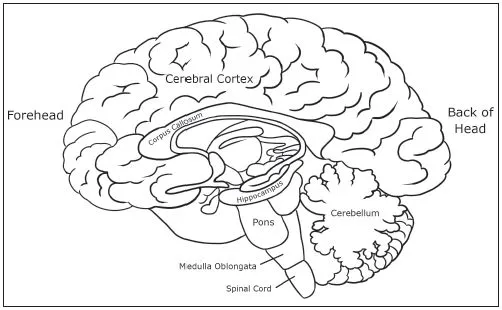
Diagram of slice through the brain from forehead (left) to back of head (right) revealing one hemisphere.
The second part, the midbrain, is the emotional brain, regulating sex hormones, sleep cycle, hunger, emotions, and addictions. The midbrain also contains the pleasure center that makes us feel good, and the amygdala, which is responsible for the fight-or-flight impulse, anger, and fear. The hippocampus—the name in Greek means “seahorse” because it was imagined to resemble such an animal—is thought to consolidate short-term memory into long-term memory and enable spatial memory. The hippocampus is the first place that is affected by Alzheimer’s, which is why the first symptoms of this disease are usually loss of short-term memory, difficulty forming new memories, and disorientation in space.
The third part of the brain is the wrinkly, folded exterior, the cerebral cortex (or cerebrum), which is the thinking brain. It is evolutionarily the newest part, and in humans its size is massive compared to in other animals. Whereas a mouse brain is 40 percent cerebral cortex, a human brain is 80 percent.7 Here is the seat of our thoughts, reasoning, language, planning, and imagination. Parts of the cerebral cortex also process our senses, temperature, movement, reading, music, and mathematics. It is affected in the middle and late stages of dementia.
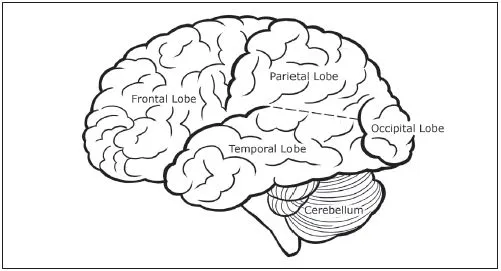
Lobes of the cerebral cortex (or cerebrum).
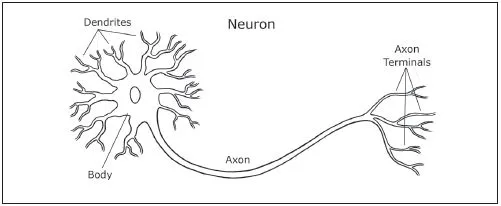
Diagram of a brain cell (neuron), usually microscopic in size (the size of the cross section of a human hair).
The cerebral cortex is divided into four lobes. The frontal lobe is responsible for executive functions such as concentration, planning, and problem-solving. The parietal lobe is associated with understanding speech and using words. The temporal lobe interprets sensory stimuli and contains memory of visual and auditory patterns. The occipital lobe interprets visual information and recognizes visual images.
Of the 100 billion neurons making up the brain, there are thousands of different kinds: multipolar, unipolar, bipolar, pyramidal, and so on. Most have a microscopic cell body, a long projection (or fiber) called the axon, and dendritic terminals, like tree branches, that connect with nearby neurons. Axons are usually microscopic but can be as long as several feet, reaching down the spinal cord to activate muscles, for example.
The cell bodies gather to form substructures, called gray matter because of their gray coloring. The axons join to form adjoining layers called white matter, so named because the axons are coated with a waxy protective substance called myelin, which appears white. There are an astounding 100,000 miles of axonal fibers in one human brain, enough to circle the Earth four times.8
A method called diffusion spectrum imaging, invented only in the past few years, produced the image shown in the figure below, which reveals a grid-like order of the fibers that astounded even most neuroscientists. Most expected a more tangled anatomy.
In addition to neurons, the brain also has as many glial cells that provide support for neurons, such as cleaning their environments. We will see later on how this is an important process during sleep and is possibly a point of deficiency in illnesses causing dementia.
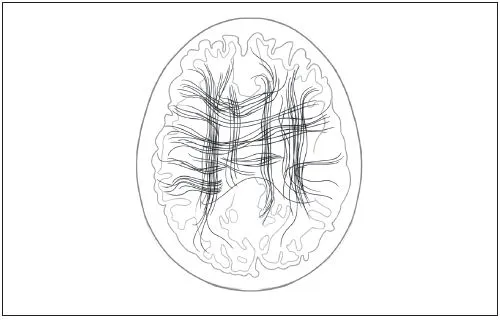
Drawing of the fiber pathways of a living female human brain, mapped noninvasively with diffusion spectrum imaging. The image shows a view from above (front of the brain is at the top of the picture). The fibers of white matter (axons of brain cells) are arranged in major grid-like pathways.9
The Brain as an Electrochemical System
Feelings, thoughts, sensations, and muscle actions all are thought to result from particular neural pathways involving neurons and chemical changes. Neurons communicate by sending electrical pulses that travel down their axons. The rate of the pulses—faster or slower—and the intensity of the pulses—strong or weak—contain the information the brain is trying to transfer. The pulses stimulate the release of chemicals (neurotransmitters), which travel a short distance from one cell to the next across synapses, passing the signal and wiring the two cells together. It’s been said that “neurons that fire together, wire together.”10 This concept of networking among cells is thought to be important in memory as well as in many other brain processes.
The neurotransmitters released at the synapses have various effects. Some, for example, are excitatory—triggering wakefulness, attentiveness, anger, aggression, etc.—while others are inhibitory—calming anxiety, inducing sleep, etc.
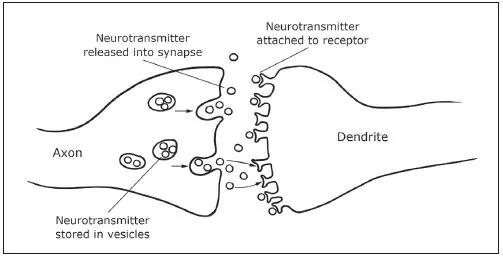
Diagram of a neuronal synapse showing neurotransmitters (dots) leaving the end of the neuron on the left as the result of an electrical pulse that came down the axon, and becoming attached to receptors on the dendrite of the neuron on the right, creating the pulses in that neuron to pass on the information.
With electrical signals traveling all of the possible synapses in the many neurons and the many chemicals involved, the agility of the brain is enormous. The brain has potentially forty quadrillion synaptic connections, making one human brain potentially more powerful than the entire Internet (that is, a storage potential of one petabyte.)11
Neurotransmitter receptors are not just restricted to the brain, but rather are found throughout the body. Neuropsycho-immunologists Candace Pert and Michael Ruff termed this “a network of communication between brain and body”12 or, colloquially, “liquid brain.” This fact, together with the knowledge that the heart and gut have neurons of their own, shows that the information system in our body extends beyond the boundaries of what we traditionally call the brain.
| Neurotransmitter | Functions |
| Acetylcholine | excites cells activates muscles wakefulness |
| Glutamate | helps learning assists memory |
| GABA | slows down and regulates anxiety |
| Endorphins | reduce pain increase pleasure |
| Dopamine | provides motivation gives pleasure |
| Epinephrine (adrenaline) | maintains alertness energizes |
| Serotonin | regulates body temperature, memory, emotion, sleep, appetite, and mood |
| Oxytocin (found during labor and in breast milk) | elicits “motherly” love elicits romantic love increases trust |
A few of the major types of neurotransmitters in the brain and their functions.
The interaction of the mind and body has been a philosophical quandary at least since Ancient Greece. Pert’s contemporary neuroscientific description of “liquid brain” recalls Gregory of Nys...
Table of contents
- Cover Page
- Title Page
- Copyright
- Contents
- Acknowledgments
- Preface
- Introduction
- Chapter 1 The Healthy Brain
- Chapter 2 The Brain Affected by Dementia
- Chapter 3 Theology of the Human Person
- Chapter 4 Theology of Dementia
- Chapter 5 Aging and Spirituality
- Chapter 6 Embracing People Who Have Dementia
- Chapter 7 Serving with People Who Have Dementia
- Conclusion Finding God in the Midst of Dementia
- Further Reading
Trusted by 375,005 students
Access to over 1.5 million titles for a fair monthly price.
Study more efficiently using our study tools.
Frequently asked questions
Yes, you can cancel anytime from the Subscription tab in your account settings on the Perlego website. Your subscription will stay active until the end of your current billing period. Learn how to cancel your subscription
No, books cannot be downloaded as external files, such as PDFs, for use outside of Perlego. However, you can download books within the Perlego app for offline reading on mobile or tablet. Learn how to download books offline
Perlego offers two plans: Essential and Complete
- Essential is ideal for learners and professionals who enjoy exploring a wide range of subjects. Access the Essential Library with 800,000+ trusted titles and best-sellers across business, personal growth, and the humanities. Includes unlimited reading time and Standard Read Aloud voice.
- Complete: Perfect for advanced learners and researchers needing full, unrestricted access. Unlock 1.5M+ books across hundreds of subjects, including academic and specialized titles. The Complete Plan also includes advanced features like Premium Read Aloud and Research Assistant.
We are an online textbook subscription service, where you can get access to an entire online library for less than the price of a single book per month. With over 1.5 million books across 990+ topics, we’ve got you covered! Learn about our mission
Look out for the read-aloud symbol on your next book to see if you can listen to it. The read-aloud tool reads text aloud for you, highlighting the text as it is being read. You can pause it, speed it up and slow it down. Learn more about Read Aloud
Yes! You can use the Perlego app on both iOS and Android devices to read anytime, anywhere — even offline. Perfect for commutes or when you’re on the go.
Please note we cannot support devices running on iOS 13 and Android 7 or earlier. Learn more about using the app
Please note we cannot support devices running on iOS 13 and Android 7 or earlier. Learn more about using the app
Yes, you can access Redeeming Dementia by Dorothy Linthicum,Janice Hicks in PDF and/or ePUB format, as well as other popular books in Theology & Religion & Christian Ministry. We have over 1.5 million books available in our catalogue for you to explore.