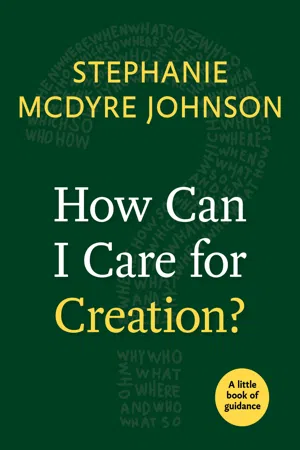
Be inspired and empowered to make care of God's earth central to your life.
From Earth Day in the 1970s to the present day, the Church has been a moral and ethical voice in encouraging a deep relationship between love of God and love of the earth. As climate change becomes an even more pressing issue and localized environmental injustices increase, the Church stands at the forefront of this conversation. Stephanie Johnson provides readers with tools to be inspired and empowered to make care of God's earth central to their lives.
Trusted by 375,005 students
Access to over 1.5 million titles for a fair monthly price.
Since ancient times, people understood that human connection to the land, creatures, plants, water, and sky was central to their relationship with God. Scripture taught that God was the Creator and that the abundance of God’s creation was to be celebrated, preserved, and protected for mutual flourishing. In the past few centuries, the idea of mutuality has been lost as humans have placed themselves in the center of creation by controlling, managing, and destroying natural resources for their own good.
Here we will explore the connection between all creation and God in the Hebrew Scripture and New Testament. Through this very brief review of some key biblical passages, we can better appreciate that harmony with and care of creation is not a new theological trend, but rather a core understanding of our faith tradition.
God as Creator
Most civilizations have a creation story. These stories help give a sense of a divine presence in the activity of creation, explaining the reason for human existence and the natural world. While countless books and academic papers have explored the biblical understanding of creation and humankind, space does not permit a deep review of this issue. However, as an introduction, a closer read of Genesis is important from an eco-theology perspective.
The story of creation in the Book of Genesis is a reminder that God created out of nothingness. Over the course of the six days of God’s time, creation exploded into being with sky, water, air, land, and all sorts of animals including creepy-crawly things and birds in the sky. This imagery recognizes a powerful sense of how God’s presence stood at the center of creation.
Recall that humans were made in the image of God on the sixth day of creation, directed to subdue the earth, and given dominion over all creation. For most ancient peoples , the idea of humans subduing and having dominion over nature was never seen as a possibility. The reality was, for most of human existence, that people were at the total mercy of nature. Droughts or floods could mean total devastation for communities totally reliant on small or family agriculture. Humans in biblical time strived to live in harmony with the natural world and recognized that in many ways they were at the leniency of nature and God’s mercy. To kill animals for survival was understood; however, the ability to subdue and completely destroy creation or the land itself was never an ancient understanding.
From an eco-theology reading, biblical scholars suggest that dominion can be seen as if a benevolent royal oversees a kingdom. To ensure that the entire kingdom or community flourishes, each part of creation should also flourish, rather than be destroyed or abused.
Equally important is that on each day that God created, God saw that everything was good. All creatures were equally blessed in God’s plan. Humankind was invited to be stewards and caretakers of all the bounty of God’s creation, not the center of it, which time and technology has changed.
The second creation story begins in Genesis 2–4a: After God created the heavens and the earth, God created man out of dust from the ground. Humankind has its very origin from the land, as the work of creation continued with the Creator as the gardener in Genesis 2:8–9:
And the Lord God planted a garden in Eden, in the east; and there he put the man whom he had formed. Out of the ground the Lord God made to grow every tree that is pleasant to the sight and good for food, the tree of life also in the midst of the garden, and the tree of the knowledge of good and evil.
We read that God intends man “to till . . . and keep” the land (Genesis 2:15). Humans are meant to cultivate the land by God’s direction. Interestingly, the word “keep” in Hebrew is shamar, which can also mean guard. Humans are responsible for ensuring that the land is protected for its purpose as a source of abundance for all creatures. Flourishing, thriving land will provide goodness and crops for humans while equally ensuring that the land too prospers for God’s purpose.
Psalm 104 further elaborates God’s role as Creator. Beginning at the first and repeated at the last verse, God is celebrated and thanked for the very act of creation:
Bless the Lord, O my soul.
O Lord my God, you are very great.
From there, echoing the creation themes in Genesis, the psalmist reveals God stretches out the heavens like a tent (v. 2), setting the earth on its foundation (v. 5) and giving boundaries to the flowing of the waters. We are then reminded that God created the day and night and the seasons:
You have made the moon to mark the seasons;
the sun knows its time for setting.
You make darkness, and it is night,
when all the animals of the forest come creeping out.
The young lions roar for their prey,
seeking their food from God (v. 19–21)
As a reminder of the power of God’s creative forces in the Book of Job, God appears to Job to question whether he really appreciates the majesty and strength of God as creator. After all the wondering and struggles Job faces in fear, uncertainty, sickness, and loss, God appears to Job to remind him about how Job is but a small part of God’s vast and immeasurable creation. God reminds Job that in his limited human understanding he can barely appreciate the immensity of God’s creative efforts:
Then the Lord answered Job out of the whirlwind: Who is this that darkens counsel by words without knowledge? Gird up your loins like a man, I will question you, and you shall declare to me. Where were you when I laid the foundation of the earth? Tell me, if you have understanding. Who determined its measurements—surely you know! Or who stretched the line upon it? On what were its bases sunk, or who laid its cornerstone when the morning stars sang together . . . ? —Job 38:1–7
Throughout the Hebrew Scripture, there are numerous references that the land itself is deserving of respect, for it is from God. Leviticus 25:4 states:
. . . but in the seventh year there shall be a sabbath of complete rest for the land, a sabbath for the Lord; you shall not sow your field or prune your vineyard.
The practical reason for resting the land is that it will be more productive. However, when placed in the context of the Lord’s sabbath it is a sign that all creation is to be treated with value and respect as part of God’s creation.
Creation Celebrates and Mourns
Through Hebrew Scripture we also learn that human attributes, such as the ability to praise and to mourn, are shared by other parts of creation. Creation is seen as having equality with humans with the similar capacity to recognize the Creator. The prophet Jeremiah reminds us that the land itself will grieve when it and humankind are mistreated, and when the land is unwell other parts of creation suffer also.
How long will the land mourn, and the grass of every field wither? —Jeremiah 12:4
The prophet Hosea reminds the Israelites that separation from God and God’s expectations will cause not only the land but also the rest of creation to grieve. Again, we are reminded that the relationships between land, nature, and people are deeply intertwined. When one aspect of the creation is degraded, another part suffers.
Therefore the land mourns, and all who live in it languish; together with the wild animals and the birds of the air, even the fish of the sea are perishing. —Hosea 4:3
Scripture tells us that while not only can the land mourn, all creation can be in harmony rejoicing in God’s abundance as an interconnected, dependent community. When all is well with nature and balance is achieved with the blessing of God, nature responds like humankind with joy, happiness, and even singing:
The pastures of the wilderness overflow,
the hills gird themselves with joy,
the meadows clothe themselves with flocks,
the valleys deck themselves with grain,
they shout and sing together for joy.
—Psalm 65:12–13
Not only does the land rejoice but the entire cosmos celebrates God:
Let the heavens be glad, and let the earth rejoice;
let the sea roar, and all that fills it;
let the field exult, and everything in it.
Then shall all the trees of the forest sing for joy . . . .
—Psalm 96:11–12
The New Testament
The New Testament is steeped in reminders of the centrality of nature from agricultural references to reminders that Jesus’ ministry was set in various landscapes. In fact the backdrop of many of the gospel stories include numerous stories of Jesus outside in nature. Remember, the very first introduction of Jesus is his birth in a manger, presumably surrounded by animals. The first people to greet Jesus were shepherds who lived out under the sky (Luke 2:8–20).
As Jesus grows into adulthood, we can almost imagine him walking down through the grass and brush alongside the riverbed, wading into the Jordan River as he is immersed in the life-giving water when baptized by John. Looking up to the blue skies, the clouds open up to reveal God. All of nature is present for the baptism of Jesus.
His disciples, all who came to hear him preach and sought healing, met him in fields, mountains, or near the sea. We can almost see Jesus strolling on dusty trails to give the sermon on the plain or, walking beside the vastness of the Sea of Galilee, inviting his disciples to give up their work of fishing to follow him. He rested in the mountains, meeting people at water wells and street corners as he journeyed through villages and towns. Jesus’ disciples were in the fields picking grain on the sabbath.
However, the gospel writers not only placed Jesus ministering outside, they also equated Jesus and his ministry with nature. In the imagery of John’s gospel, the reader is invited to consider that Jesus is actually part of nature.
I am the vine, you are the branches. Those who abide in me and I in them bear much fruit, because apart from me you can do nothing. —John 15:5
Jesus is compared to a vine, part of a growing living tree or bush that stretches and bends as it thrives with sun and water. Humans are described as part of the branches that come out from nature, an imaginative sign of our connection to Jesus and to nature.
The parables of Jesus are full of references to nature, farming, vineyards, water, and the land. The intention is clear that the first listeners of the gospel stories understood the relationship humans have with nature. As farmers and fishermen, they knew the cycles of life were dependent on nature. While some lived in urban settings, they still lived close enough to the land to be reliant on good weather for food. Consider the parable of the sower who plants seeds in the field with mixed results; birds take the seeds when they are not buried, rocks prevent some of the soil from being fertile (Luke 8:4–8). In Matthew 13:8 are the seeds used to full fruition:
Other seeds fell on good soil and brought forth grain, some a hundredfold, some sixty, some thirty.
It’s not only the parables that accent the relationship between Christian faith and the natural world. Particularly important from an eco-theological perspective, Jesus urges the disciples to “Go into all the world and proclaim the good news to the whole creation” (Mark 16:15). From these words, we are reminded that the early followers of Jesus understood that the promise of redemption and new life in the gospel message was not only about human renewal, but also about the flourishing and re-creation of all that God creates. In our time, we should also hear this as the promise of the Good News is for all creation, not just humans.
Exploring further in the New Testament, Romans 8:22–23 is often read from an eco-theological perspective:
We know that the whole creation has been groanin...
Table of contents
Cover Page
Title Page
Copyright
Dedication
Contents
Introduction
1. What Does the Bible Say?
2. Our Separation from God, Nature, and Each Other
3. A Short Primer on Eco-Theology
4. The Episcopal Church in Caring for Creation
5. What Can One Person Do?
6. How Can I Green My Congregation?
A Few Final Thoughts
A Mini-Retreat for Eco-Ministry
Notes
Resources for Creation Care
Frequently asked questions
Yes, you can cancel anytime from the Subscription tab in your account settings on the Perlego website. Your subscription will stay active until the end of your current billing period. Learn how to cancel your subscription
No, books cannot be downloaded as external files, such as PDFs, for use outside of Perlego. However, you can download books within the Perlego app for offline reading on mobile or tablet. Learn how to download books offline
Perlego offers two plans: Essential and Complete
Essential is ideal for learners and professionals who enjoy exploring a wide range of subjects. Access the Essential Library with 800,000+ trusted titles and best-sellers across business, personal growth, and the humanities. Includes unlimited reading time and Standard Read Aloud voice.
Complete: Perfect for advanced learners and researchers needing full, unrestricted access. Unlock 1.5M+ books across hundreds of subjects, including academic and specialized titles. The Complete Plan also includes advanced features like Premium Read Aloud and Research Assistant.
Both plans are available with monthly, semester, or annual billing cycles.
We are an online textbook subscription service, where you can get access to an entire online library for less than the price of a single book per month. With over 1.5 million books across 990+ topics, we’ve got you covered! Learn about our mission
Look out for the read-aloud symbol on your next book to see if you can listen to it. The read-aloud tool reads text aloud for you, highlighting the text as it is being read. You can pause it, speed it up and slow it down. Learn more about Read Aloud
Yes! You can use the Perlego app on both iOS and Android devices to read anytime, anywhere — even offline. Perfect for commutes or when you’re on the go. Please note we cannot support devices running on iOS 13 and Android 7 or earlier. Learn more about using the app
Yes, you can access How Can I Care for Creation? by Stephanie McDyre Johnson in PDF and/or ePUB format, as well as other popular books in Theology & Religion & Christian Denominations. We have over 1.5 million books available in our catalogue for you to explore.