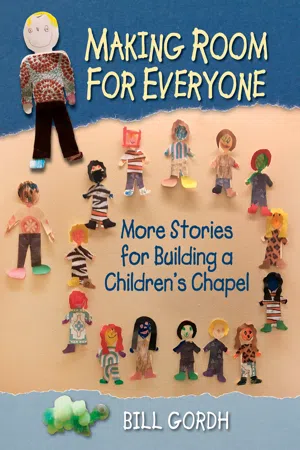
Making Room for Everyone
eBook - ePub

Making Room for Everyone

More Stories for Building a Children's Chapel

  1. 256 pages
  2. English
  3. ePUB (mobile friendly)
  4. Available on iOS & Android
eBook - ePub

Making Room for Everyone

More Stories for Building a Children's Chapel

About this book

This volume shows that stories can reflect and represent the students that hear them.

Working with the same overall themes of his first book, Building a Children's Chapel: One Story at a Time, Bill Gordh presents a wide range of folktales from around the world, stories from different faith traditions, and some updates of the original volume. The stories are presented to be told aloud, complete with storytelling tips and musical suggestions for each. Thirty-five curated folktales and stories from Christian, Jewish, Buddhist, Muslim, African, Asian, Scandinavian, and Native American traditions support the values that many desire to instill in children. As an award-winning storyteller, banjoist, author, and educator, Bill Gordh offers a storytelling approach that honors both the source material and the children who listen.

Those who are engaged with the spiritual growth of children will find this book invaluable.

Age range: 3 - 8 years old, Grade Level: Preschool to 5th Grade

Frequently asked questions

Yes, you can cancel anytime from the Subscription tab in your account settings on the Perlego website. Your subscription will stay active until the end of your current billing period. Learn how to cancel your subscription.
At the moment all of our mobile-responsive ePub books are available to download via the app. Most of our PDFs are also available to download and we're working on making the final remaining ones downloadable now. Learn more here.
Perlego offers two plans: Essential and Complete
  • Essential is ideal for learners and professionals who enjoy exploring a wide range of subjects. Access the Essential Library with 800,000+ trusted titles and best-sellers across business, personal growth, and the humanities. Includes unlimited reading time and Standard Read Aloud voice.
  • Complete: Perfect for advanced learners and researchers needing full, unrestricted access. Unlock 1.4M+ books across hundreds of subjects, including academic and specialized titles. The Complete Plan also includes advanced features like Premium Read Aloud and Research Assistant.
Both plans are available with monthly, semester, or annual billing cycles.
We are an online textbook subscription service, where you can get access to an entire online library for less than the price of a single book per month. With over 1 million books across 1000+ topics, we’ve got you covered! Learn more here.
Look out for the read-aloud symbol on your next book to see if you can listen to it. The read-aloud tool reads text aloud for you, highlighting the text as it is being read. You can pause it, speed it up and slow it down. Learn more here.
Yes! You can use the Perlego app on both iOS or Android devices to read anytime, anywhere — even offline. Perfect for commutes or when you’re on the go.
Please note we cannot support devices running on iOS 13 and Android 7 or earlier. Learn more about using the app.
Yes, you can access Making Room for Everyone by Bill Gordh in PDF and/or ePUB format. We have over one million books available in our catalogue for you to explore.

Information

part 1
CREATING THE FRAMEWORK
FOR STORYTELLING
chapter 1
SETTING UP CHAPEL
Where Shall We Gather?
Keep it simple! The space we use for chapel is a carpeted room in the basement of the school. At one end are a simple altar, a piano, an easel with felt board, and a few stools for musicians and a song leader. Behind the altar is a large woven wall hanging created years ago by school parents that has simple images from Bible stories. There are no chairs in the room. Everyone sits on the carpet facing the altar. Of course we have folding chairs nearby for someone (an elderly person or pregnant mom) who needs a chair. The back half of the room’s walls house books on shelves for the library. Our school is in New York City and though many parents are on their way to work, they happily join the others in their work clothes (generally business suits) with children in their laps sitting together on the rug. The room is simple and handled simply, and it serves us well.
Some schools use the sanctuary of the church. Others use an auditorium, a gymnasium, or a classroom. Each situation creates its own benefits and challenges. Wherever you gather, the size of the space and the size of the children should be taken into consideration. What might at first glance look perfect to an adult may not be the right circumstance for a young child. For example, sitting in pews can make children feel isolated from the others in their class. Many schools solve this by having everyone gather in the chancel, or by having the children gather in the chancel while parents sit in the pews. Some schools use the sanctuary without considering whether another available space in the building might actually serve their purposes better. What at first might seem like a terrible choice (like a carpeted room in a basement) might actually offer just what you need—a simple space to gather with children.
Choosing a setting with few visual or sound distractions (or smells for that matter) will help the children stay focused on the story, the songs, and being together. When there are fewer potential distractions, there will be less need for rules to control behavior. The children become engaged in the story and “follow the rules” without being told. A simple setting is a good place to start.
Who Will Attend?
The immediate answer to this question is simple: children. Of course the chapels are for children and therefore children will attend, but how many and when? How about parents? If the school has a pre-school, kindergarten, and lower grades, do all the students attend together? The answer to all these questions is: It depends. It depends on your particular circumstances.
Our school is devoted to early childhood with over two hundred preschoolers attending. The youngest begin at two-plus and the oldest are five when they leave. We have decided that our chapels will not include our youngest children. The behavioral expectations would not be fair and the stories are too complex. This is not to say that there are no stories in this book appropriate for such young children. Some are and can be shared with the youngest children—with care and a very small group. At our school the children begin chapel in the fall when they are three. We have morning and afternoon sessions, so there are chapels for both. We have three classes of three-year-olds and three classes of four-year-olds in each session, so there is a discreet chapel for each. On Wednesday, we have chapel for fours and on Thursday for threes. The children get to share the experience with two other classes of children as well as their parents. This provides them a larger group experience and makes them more aware of being part of the whole school. Thursday chapel is for the younger group because it gives the children several days in school each week before the chapel gathering with a large group. Additionally, we have told the story already for the Wednesday fours’ group so the story can more easily be tailored for the younger listeners.
The size of many early childhood (including kindergarten) schools make one chapel for the whole group the right choice. In a school with Pre-K through elementary, you probably will want to group the Pre-K and kindergarten (and possibly first grade) together, with a separate chapel program for second through fifth grades. For special occasions, if you have the space, it’s nice to have the whole school gather together.
img1
INVOLVING PARENTS
We invite the parents to bring their children and stay for chapel each week. In fact, it is assumed (and expected) that at least one parent will attend every chapel. This is our community time together and by the end of the year, the parents have spent the majority of their time at school attending chapel with their children. Many parents remark that at first they were not keen on coming to chapel but soon grew to enjoy it. When their children have moved onto another school, numerous parents let us know how they miss the weekly gatherings. The fact that the parents attend chapel dictates when they are held—at the beginning of the session (in our case 8:30 a.m. and 12:30 p.m.). The parents sit with their children on the floor in the chapel. On occasion a parent is unable to attend. When this happens, a grandparent, relative, adult family friend, or caregiver is welcomed.
At many gatherings with children and parents present, I have seen the children sitting together at the front with the parents gathered in the back. The reasoning behind this is that the event is really for children and this seating arrangement makes them the focus. Additionally, it keeps the seated grown-ups from blocking the sight lines for the children. These seem like very good reasons. However, what often happens is this: because the parents are gathered in the back with the focus on the children, they forget that they are still in the same space and often talk with each other. With the added noise from the back, the children are less attentive. However, the most important reason for seating parents with their children is so that parent and child are sharing the chapel experience. Watching your child listening to a story is very different from listening to the story with your child. I have come to believe that each gains from the other’s presence. The parent is able to hear the story through their child and gain an understanding of the story with the child; the child receives support in understanding the story and the spiritual experience itself thorough the parent. It is profound. Singing together and hearing a story that can later be discussed is a shared experience very, very different from one where the children and grown-ups are seated separately (especially in early childhood).
Some parents bring a younger sibling with the child who is attending chapel. The younger child is welcomed as long as the chapel remains relatively peaceful. On occasion, a parent might leave the room with a crying baby. We wait patiently when this occurs. Sometimes the parent chooses to leave the younger one home with a caregiver. The youngest siblings are generally engaged by these stories and the warmth of sitting with family. They look forward to the time when they will attend our school and each can say “my” chapel.
Many childhood chapel programs do not include the parents. Clearly it is not imperative, but it is central to our gatherings. If your chapels do not include the parents, before revamping your whole program or rejecting the entire idea, consider trying out family chapels on several occasions during the year. At the end of the year, you will have a clearer idea what direction you wish to follow.
At chapel we have chapel. We don’t talk about the “What do I do if . . . ” situations. We don’t discuss cell phones. The time is exclusively for singing and stories—experiencing and thinking about them. So how do parents know what to do? To us, it seems like second nature, but that is not how it is. Often parents feel that if their children are engaged, it doesn’t matter what they are doing. They forget that they are being a model for their children. It is not unusual to see a parent lean over and chat with a friend and then tell their own child to stop talking with one of their friends. I consult with a number of congregations about family gatherings/services, and the talking parent is one of the more common problems to tackle. So what do you do? At the beginning of the school year our school holds parent orientations about the upcoming year. As part of this gathering, I have been invited to directly address the parents about chapel and this is a very helpful way to address this issue.
I feel it is very important not to let this opportunity turn into offering a laundry list of do’s and don’ts. That might be the simplest but it does a disfavor to the chapel, the parents, and the children; the behavior asked for is not just about following rules. We know from many years of leading chapels that if parent and child are sitting together, singing, and listening, a profound experience occurs. It is felt in hearts and minds, and parents will want to help enable this to happen. Their modeling behavior for their children makes the shared experience even more personal. This powerful experience is a cumulative one and so is not generally noticed at any one chapel gathering. Guests to our chapel are consistently amazed that such young children are attentive for the entire half hour, but it is not really surprising when you acknowledge the depth of children’s hearts and provide a circumstance for them to feel it too.
During this relative brief chat, I speak of why we sing together, how the songbook is organized, how the parent can support the child by singing themselves, and joining in on any of the gestures that accompany the songs. I point out how the songbook is organized for the non-reading children so that they can choose their songs and the parents can read the words; even with the songbook we are concerned with early literacy and supporting its growth in their child. Then I speak of the stories that we will share and how they have been selected and retold in a way that honors the minds and spirits of the children. These are not simplistic stories because children are more than that; the stories are told simply, using long held early childhood/childhood pedagogy of rhymes, rhythm, and repetition. I talk about some of the Bible stories being repeated each year and how the child hearing a story again (often a year later) helps them realize that they have grown in size and understanding. They may pick up on a different aspect of the story than the year before. I talk about the inclusion of folktales to point out to everyone that we learn from many cultures and that we acknowledge and celebrate these cultures by including stories in our chapel. Using the folktales also implicitly welcomes the children in your midst who are from a variety of places in the world. I also mention that with so many Bible stories featuring men, it is nice to have a lot of stories as well that present a woman (or female) as the lead character. I mention to the parents why I tell stories instead of reading them and how I adjust the telling of the tales according to the age and attention of the listeners.
When the parents become aware of how much goes into each chapel, they more fully understand their own place in its success. They want to help make the experience as engaging as possible for their children. At this point, they are ready to hear and to implement:
  • Sit with your child.
  • Sing! If they see you singing, they will sing too.
  • Join in on the song gestures. They help the children (and adults) remember the sequence of the song.
  • Refrain from talking to adult friends during chapel time—if you do, what is your child going to do?
  • Before entering the chapel space, make a point of turning off your cell phone in front of your child. This says to them, “This is important time and it’s time just for us.” Your child will hold that feeling close.
  • If your child is being disruptive, escort them out of the chapel until they are ready to settle down. You are welcome back.
I am now accustomed to, but still moved by, parents with tears in their eyes on the closing chapel of the year when their child will be going off to the next school. They realize what they have been part of. I have had parents tell me that they changed business meetings in order not to miss chapel with their child. I had a parent who often took an all-night flight, picked up his son, and came to chapel to sing and listen to the stories, but most of all to be part of his child’s spiritual community.
I believe that it is a privilege to lead these chapels and they deserve to be as meaningful as we can make them.
How Often Should We Have Chapel?
We have chapel once a week for the school year. This seems just right as the children grow accustomed to and excited about the weekly gathering. The children come to chapel with their parents at the beginning of the session. In this way it is similar to the child’s experience of the other days, that is, entering school with a parent but with a bonus. The parent gets to stay for a half hour with the child. Following chapel the parent walks the child to the classroom and says “goodbye” at the classroom door like the other days.
img1
HOW LONG?
We have found that a half hour program is perfect. Our time is divided between singing together and listening to a story. Generally we sing for ten or fifteen minutes at the beginning of the chapel. The vast majority arrive for the first sing-along song but this setup allows for children with a parent to arrive during the singing and join right in. At the close of the sing-along, there is a song we sing each time that says “Now it’s time for our story.” We then tell the story. Depending on the story, this segment lasts from five to fifteen minutes, though most of the stories presented in this book can be told in about eight to twelve minutes. You will note there are a number of shorter stories. Sometimes it is fun to share two stories (companion tales) in one session that explore one idea in a couple of ways. We close with a theme-related sing-along. Half an hour is a good length of time for chapel through second grade.
img1
HOW WILL CHILDREN COME AND GO?
At many schools where the parents are not a part of the equation, the children come to chapel with their classes, sit with their group, and leave with their teachers. This allows for the chapel to be held at a convenient time for all the classes.
Having parents at chapel has many benefits, but with young children, saying goodbye is a bit more of a challenge. These children have gotten used to saying goodbye to their parents at the classroom door and getting on with their school day. For a child to have a parent sit and sing and listen to a story at school with them is very special, so separating after chapel can be difficult. At our school, for years the parents said “goodbye” to the children in the chapel space and the young children gathered with their teachers to return to the classroom. This often resulted in at least one crying child while another is still clinging to a parent’s leg. This will happen on occasion no matter what you do. However we have found that...

Table of contents

  1. Cover Page
  2. Title Page
  3. Copyright
  4. Dedication
  5. Contents
  6. Foreword
  7. Introduction
  8. Part One: Creating the Framework for Storytelling
  9. Part Two: Stories of Self
  10. Part Three: Stories of Family and Friends
  11. Part Four: Stories of Faith, New Life, and Celebration
  12. Part Five: Stories of the Value of All Living Things
  13. Part Six: Stories of Giving and Forgiving
  14. Part Seven: The Songbook
  15. Acknowledgments