In an era of digital revolution, artificial intelligence, big data and augmented reality, technology has shifted from being a tool of communication to a primary medium of experience and sociality. Some of the most basic human capacities are increasingly being outsourced to machines and we increasingly experience and interpret the world through digital interfaces, with machines becoming ever more 'social' beings. Social interaction and human perception are being reshaped in unprecedented ways. This book explores this technologisation of the social and the attendant penetration of permanent liminality into those aspects of the lifeworld where individuals had previously sought some kind of stability and meaning. Through a historical and anthropological examination of this phenomenon, it problematises the underlying logic of limitless technological expansion and our increasing inability to imagine either ourselves or our world in other than technological terms. Drawing on a variety of concepts from political anthropology, including liminality, the trickster, imitation, schismogenesis, participation, and the void, it interrogates the contemporary technological revolution in a manner that will be of interest to sociologists, social and anthropological theorists and scholars of science and technology studies with interests in the digital transformation of social life.
eBook - ePub
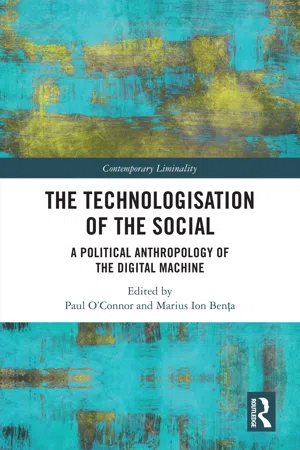
The Technologisation of the Social
A Political Anthropology of the Digital Machine
- 224 pages
- English
- ePUB (mobile friendly)
- Available on iOS & Android
eBook - ePub
The Technologisation of the Social
A Political Anthropology of the Digital Machine
About this book
Information
1 Communication as theatricalisation
Self-presentation in the digital age
Arpad Szakolczai
DOI: 10.4324/9781003052678-2
man’s ultimate rational creations are as far removed from his humanity as the primordial roots of his blood and of his corporeal being, both prohibited realms, both of them dizzying and leading to fakery, touching each other in that which is most unholy, murderous out of the idolatry of blood, murderous out of the idolatry of technology, both one and the same […]: only in the center of our being is there holiness.Hermann Bloch [1886–1951] The Spell [1935]: 294)
We hyper-moderns like to fancy technology as the height of progress, advancement and enlightenment, but – as the motto shows – technology should better be considered as the schismogenic double of the most atavistic and murderous performances of magic, of which primary examples are rituals of sacrifice. The idea is further supported by realising that such rituals are highly theatrical, and that theatricality is a twin double (and hidden secret) of modern rationalism and the public sphere – it is enough to evoke, following Michel Serres (1995), the theatricality of Descartes’s public description of his thinking process in the stove-heated room; or consider the non-attention paid to the theatrical aspects of the public sphere by Jürgen Habermas, the paramount neo-Kantian thinker of our time. This chapter explores the mutation of the theatricalisation of social life, discussed in a series of previous works,1 in the current, hyper-modern digital age. It addresses a general question that seems very simple but that becomes more and more complicated the more we try to explore its meaning: how did communication change with the increasing ‘progress’ of technological digitalisation?
Communication
Problems start with this most basic, and apparently very simple term, ‘communication’. This is because, while for Habermas and similarly minded neo-Kantian thinkers, it is evident that communication is one of the most important – if not the most important – feature of us humans, it is necessary to dissent from this position as, while we certainly do exist, communication simply does not exist.
One must be very precise here, to avoid sophistic implications. Not only do we exist as human beings, as is evident, pace Descartes, but language exists, words exist, speaking exists – this is when we humans, as existing beings, use the words of language that exist and say something which generates sound waves which again exist. But ‘communication’ does not exist. It is a generalising ‘overcoat’ word which is applied in English, in various different ways, bringing together different activities, but which already in Italian, as comunicazione, means something different, and which in Hungarian, for example, is almost impossible to translate. In Hungarian ‘communication’ is usually translated as közlés, but this implies a one-way act, an utterance with a public intention, close to the meaning of a ‘communiqué’,2 and it simply cannot be applied for a mutual activity like a conversation, which for Habermas seems to be a form of ‘communication’ par excellence.
This is not just an issue of translation, or a concern with the peculiarities of language, but reveals the simple truth, with which this chapter started, that ‘communication’ simply does not exist. We speak, we talk, we are engaged in a conversation or make gestures, behave in order to render something evident or transparent, but do not ‘communicate’. ‘Communication’ is a generalised in-between category, but the in-between simply does not exist, as Agnes Horvath (2021) argues in her recent work. We exist, and language exists, and we can use the words of language to say something or engage in various activities to get in touch with others, but we cannot start from this generalised in-between, rather from us as concrete beings.
This brings us to the central starting word, presence.
Presence
Presence is very close to existence, almost the same thing, except that it means existence in the here and now.3 Presence alludes to the many things that exist for those that are part of the world that can be immediately perceived.4 Such presence is necessary to become engaged in one or other of the activities that are usually presumed with the English word ‘communication’: we can only talk to somebody who is present, as otherwise that person would not hear us and could not respond.
The presence of another living being, especially a human being, however, is a very complex issue, as it alters our experience of the world; it transforms, but also simply forms it. The modern Cartesian vision is seriously misleading, as it starts with the isolated individual; however, ‘isolation’ itself is not just a mental operation but is a very real activity of separation, which indeed starts with our birth. We come into being, into the light, by being born, which is a real separation from our mother, but this means that until that moment, for about nine months, we already ‘exist’, inside our mother’s womb, so are in its – and in her – presence, and vice versa. Such presence does not disappear even after, as any new-born, unless asleep, requires such direct presence – of the mother, the father or other relatives, at any rate people with whom he/she is familiar, and familiar because they are frequently present, a kind of circularity that is the stuff of life. Otherwise, if nobody is present, a baby does not ‘communicate’, but simply cries. Through such presence, and only through such presence, a baby learns to look attentively, notice, laugh, utter various voices and eventually talk. Without such human presence, as is known through the various ‘wild child’ stories, after a time a human child simply loses the possibility of speaking.
Such a foundational character of presence, going back to the mother’s womb, a genuine matrix (again in the sense of Agnes Horvath), thus in a way implying the historicity of every human being, makes it evident that the Cartesian starting point is simply meaningless: the reality of our existence can be validated through the presence of others, and at any rate without the presence of others one could never arrive at posing the – quite stupid, as meaningless, sophisticated only in the sense of being literally sophistic – question of whether we really exist or not.5 So not simply ‘presence’ as an abstract term, again, but the concrete and persistent presence of some people, the ones we know and love, is constitutive of us as human beings; but a new and so far unknown presence constitutes a difficulty, puzzle, problem. Behaving, doing things in the presence of our loved ones does not present a problem, is not even perceived consciously, but if something, especially a human being, appears that we have not yet seen, it is a serious matter. It disturbs one’s behaviour, which stops being ‘normal’; one becomes apprehensive, anxious. It is due to such interference6 with our behaving, even being, that something like a ‘communication’ (in the general sense)7 starts to appear.
Difficulties need to be eased, or solved, and in the case of such a new presence this is done through an activity that is called ‘introduction’, whether this refers to a parent, relative or another familiar authority figure who is letting the child know who that person is – so that he could be reassured; or whether it is the more formal introduction of a new person in the company or ‘in society’. It is the act by which somebody who came into the presence of a person moves into the circle of those people whom one ‘knows’ or with whom one is ‘familiar’ or ‘acquainted’.8 Then one’s behaviour can be again ‘natural’, as it is with one’s loved ones.
This simple example makes it evident that, apart from rendering problematic, as non-existent, ‘communication’ as such, we should do the same with ‘behaviour’, in the sense of a kind of conscious or even self-conscious way of acting. In the presence of familiar people, or of our loved ones, we do not ‘behave’, we simply are, and do things in the most self-evident and natural way possible; the way we are. We start to ‘behave’, and to ‘communicate’, if there is a new, unprecedented, problematic presence; and especially so if we are new to the presence of other people, if we are outsiders to a group of people who know each other, but where we are new, unfamiliar. Safe and stable connections can only be established through regular and durable presence.
We can now approach a radically new phenomenon, that can be called, in the analogy of Latour’s (and Weber’s) ‘action at a distance’ as ‘communication at a distance’.
Communication at a distance
How can we talk to somebody who is not present? The answer, of course, is that we cannot, it is simply not possible. However, there are two possibilities, again moving towards the meaning of communication: we can leave signs or marks – and here we turn to the origins of language, and of image-making, which – through ‘cave art’ – leads us back to the Palaeolithic era, and which we obviously cannot bring in now; or, a crucial second possibility, we might bring the absent into presence, and this brings us into another enormous and even more impossible theme, the ‘communication’ with the dead, or with spirits. Here, however, let us restrict our attention to a simple issue, the more or less direct replacement of a personal talk between two persons, which is the writing of letters. Until the invention of electronic means of communication this was practically the only ‘normal’ means by which two persons who became separated and distanced could keep in contact.
Here we start by noticing that, given the importance of distance communication in our world, and that for a long time, writing letters was the almost unique mode for doing so, there is surprisingly little reflection on this activity in thinking. Many philosophers, back to Seneca and even Plato, wrote letters, and their letters are quite famous, but very little effort went into writing on such modality of writing. Foucault’s (1997) work on letter-writing is a quite rare and precious exception to this general practice, and his work makes it clear that, in contrast to the standard, taken-for-granted ‘utilitarian’ perspective according to which a letter transmits information, and that what matters is to whom it is addressed, writing a letter is fundamentally a technique of self; it is a way to first of all place oneself into a certain, ‘conscious’, ‘reflexive’ position. I would only add, through familiarity with the term trickster, that this ‘constructed’ position, as we’ll see in detail, is the position of the outsider. We write a letter, ostensibly and often genuinely, in order to address somebody else, and to let them know something, but still, such an activity first of all requires a work on oneself, a self-behaving and most importantly, a genuine ‘alienation from oneself’: it stimulates self-consciousness, and every self-conscious act is alienating. Writing a letter is done to bridge a distance; yet, while it can do so, it also, and perhaps even more so, creates a further distance: it renders us distant, alien, outsider, not only from the person we address, but first of all from ourselves.
This aspect of writing letters is elaborated in further and revealing detail by Kafka. Here we should note that Kafka is a novelist, and novelists have an even more privileged access to letter-writing than philosophers, as to a large extent the modern novel grew out of letter-writing. Several of the most famous ‘first novels’ in the history of the modern novel (but going back again to Hellenistic precedents) were written in the form of letters; it is enough to evoke Goethe’s Young Werther, or Richardson’s Pamela here – indeed, Goethe’s model. Kafka in fact was a keen letter writer, and in this light it is particularly intriguing that his opinion on letter-writing was extremely negative. Kafka was engaged in an exhaustive and interminable exchange of letters with all his main female companions, leading to claims that evidently the most erotic act conceivable for Kafka was the writing of a letter (Citati, 2007: 255–6). For Kafka, writing letters was indeed a surrogate for human relationships, just as writing during the night was a substitute for real life. As he would admit, writing letters was a very peculiar activity: ‘how could the idea have emerged that human beings can get in touch with each other by writing letters?’ (as in Citati, 2007: 255). Letter-writing was a way to multiply misunderstandings; even worse, it was a way to establish contact with phantasms:
one’s own phantasm, who is apparently sitting at the desk, the phantasm of the addressee who is waiting for who knows what words from us – and all the other ghosts who populate the world, before whom we render ourselves naked, and who wait for the letters brought by the postman at the threshold.(Citati, 2007: 255)
Kafka’s case was particularly grave, as all his love life was conducted through letters, where he even invited his partners to get involved with this game with ghosts, only as a joke, though with weighty consequences:
All the misfortune of my life – I don’t wish to complain, but to make a generally instructive remark – derives, one could say, from letters or from the possibility of writing letters. People have hardly ever deceived me, but letters always.(Kafka, 1953: 229)
Yet, he persisted; just as we persist in writing emails, thinking that this is the most natural and efficient way (it isn’t; how can one have such a crazy idea?! One can write volumes about the systematic misunderstandings generated by emailing, not to mention ‘texting’), and moving, in our professional as well as private lives, from one blunder to the other. Why is it so? And how could the situation be remedied?
Electronic ‘communication’: email message vs letter
So, what difference is there between a letter and an email message? From the standard, technological-utilitarian perspective, which is strangely so dominant in every aspect concerning communication and mediation, an activity so central for Hegel, it only concerns speed: a letter takes at least a day to arrive – and often much more; an email, however, most of the time arrives instantaneously. It is quicker, more efficient, so better – full stop, case closed, let’s not waste more time on the matter. Unfortunately, and as always with technological ‘efficiency’, we beg to differ, as we must.
A...
Table of contents
- Cover
- Half-Title
- Series
- Title
- Copyright
- Contents
- List of contributors
- Introduction: The technologisation of the social: A 21st-century megamachine?
- 1 Communication as theatricalisation: Self-presentation in the digital age
- 2 Parasites of the social: Digital disruptions of the labour market
- 3 Possessed by technology: The metastasis of absence
- 4 Technologisation of the social: Symbiosis, parasitism or predation?
- 5 J’accuse zéro: The technology of zero and the making of a personal void
- 6 Digital affordances and the liminal
- 7 The smart womb: Digital technologies and the maze of trickster politics
- 8 Brave new industry?: The dark side of dematerialisation and Industry 4.0
- 9 ‘What have you caught?’: Nannycams and hidden cameras as normalised surveillance of the intimate
- 10 Coercive visibility: Discipline in the digital public arena
- Conclusion: Is there a way out of the technologisation of the social?
- Index
Trusted by 375,005 students
Access to over 1.5 million titles for a fair monthly price.
Study more efficiently using our study tools.
Frequently asked questions
Yes, you can cancel anytime from the Subscription tab in your account settings on the Perlego website. Your subscription will stay active until the end of your current billing period. Learn how to cancel your subscription
No, books cannot be downloaded as external files, such as PDFs, for use outside of Perlego. However, you can download books within the Perlego app for offline reading on mobile or tablet. Learn how to download books offline
Perlego offers two plans: Essential and Complete
- Essential is ideal for learners and professionals who enjoy exploring a wide range of subjects. Access the Essential Library with 800,000+ trusted titles and best-sellers across business, personal growth, and the humanities. Includes unlimited reading time and Standard Read Aloud voice.
- Complete: Perfect for advanced learners and researchers needing full, unrestricted access. Unlock 1.5M+ books across hundreds of subjects, including academic and specialized titles. The Complete Plan also includes advanced features like Premium Read Aloud and Research Assistant.
We are an online textbook subscription service, where you can get access to an entire online library for less than the price of a single book per month. With over 1.5 million books across 990+ topics, we’ve got you covered! Learn about our mission
Look out for the read-aloud symbol on your next book to see if you can listen to it. The read-aloud tool reads text aloud for you, highlighting the text as it is being read. You can pause it, speed it up and slow it down. Learn more about Read Aloud
Yes! You can use the Perlego app on both iOS and Android devices to read anytime, anywhere — even offline. Perfect for commutes or when you’re on the go.
Please note we cannot support devices running on iOS 13 and Android 7 or earlier. Learn more about using the app
Please note we cannot support devices running on iOS 13 and Android 7 or earlier. Learn more about using the app
Yes, you can access The Technologisation of the Social by Paul O'Connor, Marius Ion Benţa, Paul O'Connor,Marius Ion Benţa in PDF and/or ePUB format, as well as other popular books in Social Sciences & Sociology. We have over 1.5 million books available in our catalogue for you to explore.