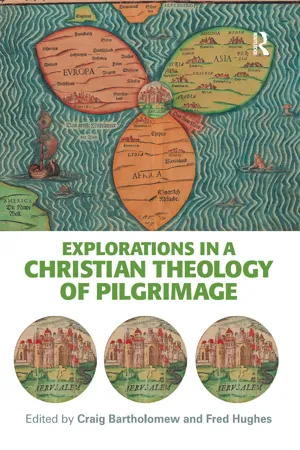
eBook - ePub
Explorations in a Christian Theology of Pilgrimage
- 238 pages
- English
- ePUB (mobile friendly)
- Available on iOS & Android
eBook - ePub
Explorations in a Christian Theology of Pilgrimage
About this book
Many Christians go on pilgrimage, whether to Jerusalem, Rome, Santiago, or some other destination, but few think hard about it from the perspective of their faith. This book fills that gap, looking at the biblical and theological elements in pilgrimage and asking how we could do pilgrimage differently. Exploring the current resurgence of pilgrimage from a Christian viewpoint, this book seeks to articulate a theology of pilgrimage for today. Examination of pilgrimage in the Old and New Testaments provides a grounding for thinking through pilgrimage theologically. Literary, missiological and sociological perspectives are explored, and the book concludes by examining how such a theology could change our practice of pilgrimage today, raising such questions as how tourism to the Holy Land should reflect the situation in the region today. Pilgrims, students and all interested in contemporary pilgrimage will find this accessible book a valuable articulation of the different elements in a Christian theology of pilgrimage.
Information
CHAPTER 1
Jesus, Jerusalem and Pilgrimage Today
I
That ‘bowels move pilgrims’ must sound in our ears as the oddest thing that John Bunyan ever said, but in the parlance of the 17th century ‘bowels’ were the seat of the heart’s affections, the inner springs of emotion and feeling. The contemporary versions of the New Testament (Tyndale and Coverdale) used it to translate Paul’s splagchna in writing to the Colossians and Philemon. These did not mean unhappy digestions responding to travelling ills in foreign climes.1 In truth, ‘the road to Jerusalem is in the heart’ – an old saying with a nice ambiguity. For having it there argues no need to travel, yet will inspire every urge to do so. That paradox is at the core of the entire theme of Jerusalem in Christian mind and conscience.
As with electricity, the current has to ‘go to earth’. Hence the earthing wires and the lightning conductors high on towers and steeples. Or, in the different idiom of time and place, meanings call for memories to be visited, if their ‘when and where’ remain accessible. For these are important for the ‘what and why’ within those happenings. If we use the word ‘point’ in its double sense, then ‘the point of the event’ – in this case the Christ-event – can be grasped (in some measure) at ‘the point’ of its eventuation. Or, as Augustine had it in a sermon (not preached in Galilee or Jerusalem): ‘Christians worship in the place where Christ’s feet trod.’ He could only have meant that the Lord’s ‘feet-treading’ was always imaginatively His people’s territory and sanctuary, even in Milan, Rome or Thagaste. English William Blake, in his elusive way, may have had the same idea in picturing, if only with interrogation, ‘those feet in ancient time … on England’s mountains green’.
What, with pilgrimage in mind, has been well called ‘the sacrament of geography’ always has this quality of validity and dispensability. It invites and ministers to faith but it will also sift how that faith relates itself to the locale of its convictions. That ‘sifting’ might be illustrated by the familiar notion of barakah, or acquirable ‘virtue’ latent in holy places, people and shrines. The idea is prominent in folklorist and popular Islam and in many superstitions. The ‘mothers of Salem’, for example, in the Gospel narrative, ‘brought their children to Jesus that He might touch them’ (Mark 10:13, Luke 18:15). The disciples seem to have felt that this naïveté was no part of ‘the kingdom of heaven’, or was distracting. But the mothers, and many others in situ, had the instinctive conviction that there was ‘benison’ to be had and that ‘touching’ was vital to receiving it. Unlike the disciples, Jesus met them on the ground of their own simplicity, while not approving it (cf. Matthew 9:20–22, ‘thy faith … saved thee’).
In the crudest way, this theme of ‘blessing by proximity’ and ‘access by contact’ could arguably be the rationale of pilgrimage, depending on how the place is perceived as the locale of what is sought, of how what is found is conceived to avail from the place. Certainly in various forms and theories, barakah is understood to accrue from pilgrimage, thanks to the journey that contrives the association and the sojourn that prolongs the ‘touching’. To seek, by this analogy, what Christian pilgrimage to ‘the holy land’ is, and is not, requires some prior study of the Judaic theme of ‘the place of the Name’.
II
The Biblical juncture of ‘place’ and ‘Name’ is clearly a pivotal theme, the ‘Name’ being, of course, no mere label but where the reality, we may even say the identity, of God is known for its truth via some event – and therefore some place (since all events are physically and historically ‘situated’) – where it is believed to be intrinsically given, by God, into human knowledge, where the divine, we might say, was dependably credentialized. Such an event-in-place for the Judaic tradition was certainly the Exodus. When, in his experience at the burning bush, Moses understands himself commissioned to lead his people out of Egypt, he knows how timidly incredulous they will be.2 He visualises them saying to him about this summoning Lord: ‘What is His Name?’ and adds his own question: ‘What shall I say to them?’
Then comes that enigmatic ‘playing on the verb “to be”’, and so the Name ‘Yahweh’: ‘I am who I am’, which, in context, should surely read ‘I will be there as there whom I will be.’ A riddle like ‘I am that I am’ would never motivate a slave people. The point, surely, is that only in exodus can the God of exodus be known. The ‘guarantee’ about the risk, which is what querying ‘the Name’ is seeking, is not to be had in advance. Trust must proceed3 and only in the going will ‘the Name’ be proven. ‘Experience will decide’ its content. Only in and through exodus will the God who presides over it be known for ‘who He is’.
The historic Exodus was, thus, for Jewry the first ‘place of the Name’. Their Lord had been there, as whom there He had been. The knowing assured them of being ‘His people’ and the event had sanctioned their ‘chosen peoplehood’. ‘All our fathers passed through the sea’ and Passover ritualized in abiding memory the event-cum-sacrament of their identity as Jewry, ‘the tribes of Israel’.
Exodus, however, was prospective to entry. ‘He brought them out that He might bring them in.’ Through the wilderness, beyond Moses to Joshua, they held themselves destined for a territory and a territory destined uniquely for themselves (albeit pre-occupied and needing to be conquered). Their ultimate access to it and appropriation of it changed ‘the place of the Name’ from history to geography, from a journey to a tenancy. The barakah of the first had been meant to inaugurate the barakah of the second, with both as tokens of the divine ‘election’.
It is evident that, within the land once fully possessed, there were several local shrines and foci of worship, like Bethel and Shiloh and ‘seats of the tabernacle’, that symbol of divine Presence during nomadism. However, with David’s acquisition of Jerusalem (which Joshua never possessed) and the aura of the Davidic/Solomonic monarchy and the Temple building, Jerusalem became the focal point both of worship and of the land. Hence the repeated plea of Solomon at the inauguration of the Temple: ‘When we pray towards this place of which Thou hast said, My Name shall be there, then hearken’ (I Kings 8:29, 30, 35). Subsequently the ‘place and Name’ theme runs through the language of psalmody and prophethood. Isaiah 60:13, ‘The place of my feet … the place of my sanctuary’ and Psalm 26:8, ‘the place where thy honour dwells’ are typical. Or, as Rabbi Abraham Heschel used to love to say: ‘Yahweh has an address on earth.’
III
The flag of the modern state of Israel has two equilateral triangles set across each other to yield a six-pointed star. It may be read as telling the material truth of a tri-unison of people, place and past which embodies the triple theme of the spirit, namely how Yahweh bestowed the land on the people, that in the land they might glorify the Lord. The Temples, David’s and Herod’s alike, as it were consummated the holiness of the whole territory. Indeed the latter was for the Temple’s sake as the apex of its hallowing, the theme song of its destiny.
It is at once evident, however, that this triunity of place, folk and story is a universal shape of human life. Witness the constant interplay of names of places and people (Finns and Finland, Caribs and the Caribbean, Nepal and the Nepalese), with habitats and tribes identifying each other. For all nations have ancestors, land and history. Who we are, where we dwell and whence we came are universal denominators of humanity. All cherish histories, live by generational sequence and know where they belong territorially. Hence, on every count, the pain of exile, of old Mother Joad crying, in forced migration: ‘How shall we know it’s us without our past?’4 Ezekiel’s ‘in thy blood thou shalt live’ (16:6) is true of all birthing, parenting and genealogy.
It was the intensity Judaic tradition gave to these common denominators that made their sense of ‘chosen peoplehood’ so insistent ‘from generation to generation’.5 But it must be clear from any doctrine of divine creation that God – if not Yahweh – has only ‘chosen peoples’, in that habitats sustain all, memories belong to all and ancestors prepossess all. Anthropological studies have familiarized us with the number of land/people amalgams which are believed divinely donated and ordained.6 Climates and terrains vary endlessly and vitally condition their peoples. Wordsworth would never have written The Prelude in the Sahara. ‘Providence’ has its mysteries but the Biblical (and Qur’anic) doctrine of creation argues a given destiny for all habitats and habitands. The Noahid ‘covenant’ of ‘possess and multiply, dwell and manage’ is indifferently a human charter. Emotionally it can have something of an equal tenacity of attachment. The point was well made by Kipling:
God gave all men earth to love,
But since man’s heart is small,
Ordained that each one spot should prove
Beloved over all, that as He watched creation’s birth
So we, in God-like mood,
Might of our love create our earth
And see that it is good.7
It would clearly be a travesty of any faith in divine creation to think of unilateral ‘covenant’ attaching to earth tenancy, folk awareness and historic memory.
That logic is contradicted by the urge, in some quarters of Biblical exegesis, to argue that the Bible really begins at Genesis 12 with the call of Abraham and that for this ‘history’ creation was merely setting the stage. The exceptionality that ensues in ‘redemptive history’, via Abraham, Jacob, Joseph, Moses and their sequential story, can only well belong with, and in, the inclusive reality of ‘all nations of one blood’ housed and environed in a universally ‘gifted earth’. Certainly modern space awareness and planetary globalism, if not Biblical sanity, have required us to know it so.
It follows that ‘a holy land’ is a sounder usage than ‘the holy land’. For unless all lands are hallowed none could be. The exceptionality will arise from history and tenancy, not from locale itself, if it is to arise at all. Nature-wise it will be fair to sing:
Where’er we seek Thee, Thou art found
And every place is hallowed ground.
That it did arise from history and tenancy – with these read as a pre-ordained destiny – was the Jewish truth of ‘the land of Israel’. Hence that threefold awareness of who, where and whence, of tribe, terrain and time–story which, albeit humanly in common, reached in Israel a distinctive and ‘peculiar’ reality, whereby Jewry constituted ‘an elect people’ where Yahweh was ‘known’ as nowhere else (Psalm:16.1). They saw themselves, because of where they dwelt, as ‘a people dwelling alone’ (Numbers 23:9) though surrounded, interpenetrated and affected by ‘other nations’ on whom their apartheid reacted both ways. They were, through their whole history, we must say, an ethnicized, territorialized people with their own mother language. Even in the tragedy of exile the burden of their special category persisted, if not in the irony of foreign sojourn, then in the yearning for repatriation. The command to them, ‘You shall have no other gods but Me’ was somehow assured to them by the pledge: ‘I will have no other people but you.’ The land was to be exclusively theirs and they were to be exclusively the land’s. Its barakah would enshrine their worship, authenticate their history and enwomb their generations. History knows no more tenacious, no more tremendous land–people equation than ‘this Israel of Israel’.8
IV
The point, in this context of a study of Christian pilgrimage, of a summary review of Hebraic land awareness is simply to say that in the New Testament each dimension is radically neutralized. For good or ill, the Church emerged there as de-ethnicized, deterritorialized and capable of being multilingual. It neither needed nor possessed a sacred space, nor a sacred ethnos, nor a sacred tongue – or, rather, it received these in the meaning of faith in the Christ-event, so that its great locative was ‘in Christ’,9 their folk heritage and their ‘citizenship’.
Thus Jerusalem became a focal point of missionary diaspora. By the apostolic understanding of the ministry and the passion of Jesus there came ‘the Christ of faith’. That Christhood was perceived as having an inherent worldwideness as its logic and its nature. From the sort of Messiah that ‘Jesus as the Christ’ had been, only the world of sundry races, many tongues and scattered lands could properly contain it. This view of its perceived Christ antecedents has often been disputed by those who have preferred to conclude that there was only properly a ‘Jesus of history’, a maverick rabbi, an itinerant charismatic like Hanina Ben Dosa, who should never have been read in any other (inflated) terms. The whole issue is too massive to call for detailed attention here.10 We are proceeding on the de facto apostolic sequence to Jesus in which alone the Church lived and from which its Scriptures derived. The issue is no realm for guaranteed proof/disproof. It would not then be a matter of faith. But despite all Geza Vermes-style disavowal of the Church’s ‘Christ-event’,11 faith’s theme is eminently trustworthy as appropriate to faith’s proper quality.12
The sequence from Jesus to Christ to apostolicity to the world might be captured in T.S. Eliot’s ‘Time future contained in time past’ and ‘home is where one starts from’. ‘The words’ (and the deeds qua Jesus) ‘sufficed to compel the recognition they preceded.’13 That recognition, it is urgent to note, was an interior Jewish decision. ‘Gentile’ participation in the openness that followed was consequent on, not contributory to, the crucial verdict about their due inclusion in a new ‘people of God’. The story is not one of ‘Gentile’ conspiracy to invade and corrupt a Jewish perquisite and violate its exclusivity but rather of a logic, perceived by Jews themselves, that ‘Messiah according to Jesus’ had an inclusive, multi-ethnic quality. No ‘Gentiles’ attended the Council in Jerusalem of Acts 15 to influence its decision on the issue of circumcision.
The thrust in it, however, stemmed from the way Jesus, in their perception, had been ‘the Christ’, namely in the crucified terms of the love that suffers. And ‘the love that suffers’ is the only power from which redemption results. If the Cross was enacted as, and by, ‘the sin of the world’, then ‘the sin of the world’ had been there forgiven, veritably in the words and wounds of Jesus suffering in those love terms, as ‘the cup his Father willed’.
Any other pattern of Messiahship – Zealot, Ess...
Table of contents
- Cover
- Half Title
- Title Page
- Copyright Page
- Table of Contents
- Preface
- Abbreviations
- Contributors
- Introduction
- 1 Jesus, Jerusalem and Pilgrimage Today
- Part I Biblical Perspectives on Pilgrimage
- Part II Historical Perspectives on Pilgrimage
- Part III Theological Perspectives on Pilgrimage
- Index
Trusted by 375,005 students
Access to over 1.5 million titles for a fair monthly price.
Study more efficiently using our study tools.
Frequently asked questions
Yes, you can cancel anytime from the Subscription tab in your account settings on the Perlego website. Your subscription will stay active until the end of your current billing period. Learn how to cancel your subscription
No, books cannot be downloaded as external files, such as PDFs, for use outside of Perlego. However, you can download books within the Perlego app for offline reading on mobile or tablet. Learn how to download books offline
Perlego offers two plans: Essential and Complete
- Essential is ideal for learners and professionals who enjoy exploring a wide range of subjects. Access the Essential Library with 800,000+ trusted titles and best-sellers across business, personal growth, and the humanities. Includes unlimited reading time and Standard Read Aloud voice.
- Complete: Perfect for advanced learners and researchers needing full, unrestricted access. Unlock 1.5M+ books across hundreds of subjects, including academic and specialized titles. The Complete Plan also includes advanced features like Premium Read Aloud and Research Assistant.
We are an online textbook subscription service, where you can get access to an entire online library for less than the price of a single book per month. With over 1.5 million books across 990+ topics, we’ve got you covered! Learn about our mission
Look out for the read-aloud symbol on your next book to see if you can listen to it. The read-aloud tool reads text aloud for you, highlighting the text as it is being read. You can pause it, speed it up and slow it down. Learn more about Read Aloud
Yes! You can use the Perlego app on both iOS and Android devices to read anytime, anywhere — even offline. Perfect for commutes or when you’re on the go.
Please note we cannot support devices running on iOS 13 and Android 7 or earlier. Learn more about using the app
Please note we cannot support devices running on iOS 13 and Android 7 or earlier. Learn more about using the app
Yes, you can access Explorations in a Christian Theology of Pilgrimage by Craig Bartholomew, Fred Hughes, Craig Bartholomew,Fred Hughes in PDF and/or ePUB format, as well as other popular books in Theology & Religion & Biblical Studies. We have over 1.5 million books available in our catalogue for you to explore.