- 140 pages
- English
- ePUB (mobile friendly)
- Available on iOS & Android
eBook - ePub
About this book
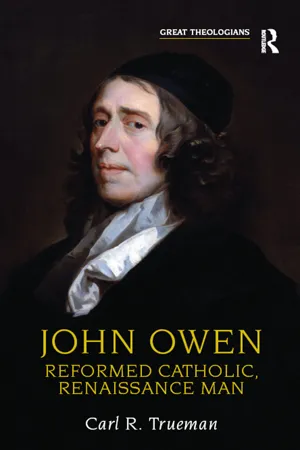
John Owen is considered one of the sharpest theological minds of the seventeenth century and a significant theologian in his own right, particularly in terms of his contributions to pneumatology, christology, and ecclesiology. Carl Trueman presents a major study of the key elements of John Owen's writings and his theology. Presenting his theology in its historical context, Trueman explores the significance of Owen's work in ongoing debates on seventeenth century theology, and examines the contexts within which Owen's theology was formulated and the shape of his mind in relation to the intellectual culture of his day - particularly in contemporary philosophy, literature and theology. Examining Owen's theology from pneumatological, political and eschatological perspectives, Trueman highlights the trinitarian structure of his theology and how his theological work informed his understanding of practical Christianity. With the current resurgence of interest in seventeenth century Reformed theology amongst intellectual historians, and the burgeoning research in systematic theology, this book presents an invaluable study of a leading mind in the Reformation and the historical underpinnings for new systematic theology.
Information
Chapter 1
John Owen: Reformed Catholic, Renaissance Man
Introduction
The name of John Owen (1616–1683) is little known today even in theological circles outside of very conservative evangelical churches and the narrow and highly specialized field of early modern intellectual history.1 This is unfortunate, for Owen was without doubt the most significant theological intellect in England in the third quarter of the seventeenth century, and one of the two or three most impressive Protestant theologians in Europe at the time. It was his misfortune, however, to be on the losing side: for Owen was a Puritan and allied to the Independent party in the struggles which tore England apart in the 1640s and 1650s; as such, he was one of history’s losers; and, as history is generally written by those who win, Owen was swiftly and decisively written out of the intellectual history of England in the aftermath of the Great Ejection of 1662 when non-conformists were not simply expelled from the Church of England, but excluded from the establishment, political, cultural, and intellectual, with all of the later impotence with regard to influence and the writing of history which that implies. At the same time, and as if to add insult to injury, the whole of western European university culture was undergoing cataclysmic change as the curriculum and basic patterns of thought which had stood pretty much since the twelfth century were being reshaped and revised in light of new ways of thinking about the world. Again, Owen was on the losing side: as a champion of Reformed Orthodoxy, his thinking was in large part shaped by the traditional curriculum and patterns of thought it embodied; and as this world passed away, so did the contribution of the great John Owen.
That Owen was on the losing side should not however be taken as indicative of any intrinsic mediocrity in his own thinking. By the standards of his age he was profoundly learned, at ease with both the wider theological tradition of Western catholic thought (in the broadest sense), the trajectories of classical philosophy as mediated through the medieval schools and the Renaissance, and contemporary theological literature, Protestant, Catholic and heretical. Indeed, if one wishes to understand either the nature of Reformed Orthodoxy in the seventeenth century or the kind of theological thought which helped to shape aspects of the Cromwellian project and the identity of non-conformity in Restoration England, then there are few if any better candidates for study than John Owen.
His Life
John Owen was born in Stadhampton, near Oxford, in 1616, the son of local vicar, Henry Owen, a man of Puritan sympathies.2 After education at a local grammar school, he matriculated at Queen’s College, Oxford, in 1631, graduating BA in 1632. His time at Oxford was apparently marked by extreme acts of self-discipline, survival on only four hours of sleep a night to allow more time for study, and a growing reputation as a flautist, a long jumper, and a javelin thrower.
Following his BA, he graduated MA in 1635, was ordained deacon and then proceeded to study the seven-year course for a BD.3 During this time, his tutor was a man named Thomas Barlow who was both a vigorous opponent of Arminian theology and an acute metaphysician. His influence on Owen, both theological and metaphysical, was profound; and by all accounts they became good friends, despite significant differences on the matter of conformity. Indeed, Owen helped Barlow at Oxford during the 1650s, when he was Vice-Chancellor, and Barlow himself later interceded for Owen when he was in trouble for preaching in his own home.4
With the increasing power of the Laudian party in the Church of England, Owen felt it necessary to leave Oxford and stay at the home of John, Lord Lovelace, in Berkshire, though, with the outbreak of war in 1642, Owen moved to London, his patron’s Royalism no doubt making further stay somewhat impractical.
It was around this time that Owen went to Aldermanbury Chapel to hear the famous Puritan divine, Edmund Calamy, preach. On the day in question, however, Calamy was absent and a substitute preacher, whose name Owen was later unable to recall, preached a sermon Mt. 8:26. Owen’s disappointment at the absence of Calamy soon gave way to elation when he experienced some form of conversion as a result of the unknown preacher’s message. It would appear that it was at this point that Owen’s commitment to anti-Laudian church policies was combined with the not-untypical experiential piety which marked out many Puritans.
In 1642, Owen published his first work, A Display of Arminianism. It would appear that he had already privately circulated a Latin text on the priesthood of Christ in opposition to the teaching of papists, Arminians and Socinians, but A Display was his first published (and, indeed, his earliest extant) piece of work. We will examine many of its themes and arguments in more detail in subsequent chapters, but it is worth noting at this point that the work was marked by a clear grasp of the philosophical and metaphysical issues at stake in the debate with Arminianism, and by the positive use of medieval and contemporary Catholic sources to establish many of his points, indicating the broad and eclectic nature of theology which he is formulating.
The book, while in retrospect clearly the work of a theologian at the start of his career, brought him instant fame, and the Parliamentary Committee on Religion conferred upon him the living of Fordham in Essex, the parish where he met and married his first wife, one Mary Rooke, who was to bear him 11 children, all of whom predeceased him with only one living to adulthood. Owen was to stay in Fordham until 1646, when the right to appoint the minister reverted to the local patron and he was forced to move on. However, in the same year Owen received his first invitation to preach before Parliament and thus began a new and highly influential stage in his career.
Having obtained a new living at St Peter’s in Coggeshall, Owen read a little book by the Puritan emigrant to the New World, John Cotton: The Keys of the Kingdom. He was to credit this book with altering his opinion of church governement from a broadly Presbyterian ecclesiology, where ultimate power in the church lay in the higher courts and assemblies which operated at a supra-congregational level, to that of Independency, where power was restricted to the individual congregation, albeit one with a strong eldership and not an egalitarian democracy. The shift in Owen’s thinking was to be highly significant. In the short term, he decided to gather a congregational church at one and the same time as being the local Anglican minister. This decision clearly indicates that Owen was no separatist and that his commitment to Independency was not the equivalent of a narrow sectarianism. Then, in the medium term, it was to facilitate an alliance between the young clergyman and the rising political cause of Independency, particularly as that cause found its champion in Oliver Cromwell, the political leader of the Independents par excellence. Finally, in the long term, it was almost certainly a factor in his formulation of notions of religious tolerance both under Cromwell and, more significantly, in the world of non-conformity after 1662.
Owen’s greatest moment in the political drama of 1640s England came on 31 January 1649, the day after Charles had been executed. On this day, it was Owen who was chosen to preach the sermon to parliament, a sermon which proved so popular that he returned to the capital on 19 April to preach before the House of Commons. On that occasion, he was heard by Oliver Cromwell who subsequently met him while they were both waiting to pay their respects to General Fairfax. The results of this meeting for Owen were spectacular: he first acted as Cromwell’s chaplain on the latter’s infamous expedition to Ireland, and was then appointed Dean of Christ Church and Vice-Chancellor of the University of Oxford, a post he held from 1651 to 1657.
During all of this time, Owen had gained an increasingly impressive reputation as a theologian and controversialist. For example, in 1647 he published one of the most thorough defences of the classic understanding of particular redemption, The Death of Death in the Death of Christ, as a result of which he found himself engaged in controversy with another rising theological star, Richard Baxter, particularly on the issue of the relationship of atonement to justification. Then, in 1654 he was commissioned by the government to write a major critique of Socinianism which he published in 1655 as Vindiciae Evangelicae, a work which was essentially a blow-by-blow refutation of the two catechisms of John Biddle and the major Polish work, the Racovian Catechism. Both The Death of Death and the Vindiciae Evangelicae indicate that Owen’s thinking was becoming more and more sophisticated both in terms of his biblical exegesis and also in terms of his grasp of the Christian tradition and the ease with which he was able to deploy sophisticated concepts in laying out his position.
With the publication of Vindiciae Evangelicae, Owen probably reached the high-water mark of his political career, for in 1657 his strong republican sympathies led to a serious breach with his former patron, Oliver Cromwell when the latter spent some time considering whether he should have himself crowned king or not. Owen resigned the Vice-Chancellorship and thus bowed out of public life: a year later, when Cromwell died, he was to have no role to play in the funeral of his once close friend. His activity on behalf of Independency, however, continued, and it was in this same year that he helped his colleagues, Thomas Goodwin and others, to draft the Savoy Declaration, essentially a mild modification of the Westminster Confession along more strictly Independent lines.
With the return of the king in 1660 and the brutal repression of Puritanism under the Clarendon Code of the 1660s, Owen found himself definitively excluded from the establishment. In 1662, with the passing of the Act of Uniformity, he was forced out of the Church of England once and for all and became, along with his old adversary, Richard Baxter, one of the leading lights of English non-conformist church life and thought. Indeed, he and Baxter even put aside their differences for a very short while in an (ultimately unsuccessful) effort to produce a non-conformist consensus in the face of persecution. Yet, while he was excluded from Anglican orders, Owen himself did not suffer as others such as Baxter and John Bunyan did, and enjoyed a certain amount of favour at court – remarkable considering his previous connections to one of the major regicides. In addition, with time on his hands, he engaged in producing a series of massive theological tomes, including a major Latin work of covenant theology, Theologoumena Pantodapa, 1661, a series of treatises on the work of the Holy Spirit (1674–93, the latter treatises appearing posthumously) and a commentary on Hebrews (1667–84, final volume posthumous) which is quite possibly the most elaborate and important precritical commentary ever written on the book. He also spent time reflecting upon the nature of religious toleration and in a number of shorter works clearly pointed forward towards the kind of settlement embodied in the legislation of 1689. His own death in 1683, however, meant that he never saw the realization of this particular vision.
Owen: Puritan or Reformed?
Before addressing the shape of Owen’s theology proper, some preliminary comments need to be made upon the heuristic categories appropriate for understanding his thinking. Perhaps the most obvious of such would be that of Puritanism. As a leader of the Independents, and one who clearly identified with the likes of Edmund Calamy and Thomas Goodwin, it would appear obvious that Owen is without doubt a Puritan theologian. While I do not wish to deny this, I remain unpersuaded that this is, in general, a helpful historical category for understanding Owen’s theology.5 First, as noted above, there is little consensus on exactly what constitutes a Puritan, let alone the reification of that elusive essence in the phenomenon known as Puritanism. Second, whatever else Puritanism is, it is fairly minimalist in terms of its theological content – if John Milton, the quasi-Arian counts as a Puritan, for example, we can scarcely include even that most basic of Christian distinctives, the doctrine of the Trinity, in our definition.6 Third, Puritanism has, on the whole, far too parochial a range to allow us to see the full context of Owen’s thinking. I have already argued elsewhere at some length that Owen needs to be understood in terms of the wider ongoing Western tradition of theological and philosophical thought, that even his contemporary intellectual context needs to be seen as European and not primarily English or even British. Thus, the use of a category like ‘Puritanism,’ which brings with it all manner of narrowly parochial connotations, really needs to be deployed very carefully and in very specific contexts if it is to be at all helpful in our understanding of his thought.7
In light of the above, the category which I will use as best facilitating the exploration of Owen’s thought in context is that of Reformed Orthodoxy, on the grounds that this is at once both more easily defined and less limiting than the category of Puritanism. The term Reformed Orthodoxy refers to the tradition of Protestant thought which found its creedal expression on the continent in such documents as, among others, the Belgic Confession, the Heidelberg Catechism and the Canons of Dordt, and in Britain in the Westminster Assembly’s Confession of Faith and Larger and Shorter Catechisms. Historically speaking, the immediate roots of this tradition are to be found in the work of Reformers such as Huldrych Zwingli, Johannes Oecolampadius, Martin Bucer and, a generation later, such men as John Calvin, Heinrich Bullinger, Peter Martyr and Pierre Viret.8
In analyzing the development of this tradition, Richard Muller has divided the history into four broad periods. Now, while such periodisation of time is inevitably somewhat anachronistic, when applied loosely to the development of Reformed Orthodoxy it can nevertheless fulfill a useful heuristic purpose and is therefore worth noting very briefly. The first period runs from 1523 to 1563 (from Zwingli’s Articles to the Heidelberg Catechism) and is marked by the basic statement of the general Reformed position. The second period, that of early orthodoxy, from 1563 to c. 1640, represents the time during which Reformed theology began to establish itself in the universities, work out and elaborate the basic positions established by the earlier generations, and consequently to develop a methodological sophistication and self-awareness which led to the more obvious appropriation of the traditional language and methods of medieval scholasticism as well as more innovative approaches such as that offered by Peter Ramus. The increasingly complex polemical environment, with the arrival of highly sophisticated Catholic apologists such as the Jesuit, Robert Bellarmine, the rise of a parallel orthodoxy in Lutheranism, and the fracturing of Reformed Protestantism with the advent of Armini...
Table of contents
- Cover
- Half Title
- Title Page
- Copyright Page
- Table of Contents
- Preface
- Dedication
- 1 John Owen: Reformed Catholic, Renaissance Man
- 2 The Knowledge of the Trinitarian God
- 3 Divine Covenants and Catholic Christology
- 4 The Article by Which the Church Stands or Falls
- Conclusion
- Index
Trusted by 375,005 students
Access to over 1.5 million titles for a fair monthly price.
Study more efficiently using our study tools.
Frequently asked questions
Yes, you can cancel anytime from the Subscription tab in your account settings on the Perlego website. Your subscription will stay active until the end of your current billing period. Learn how to cancel your subscription
No, books cannot be downloaded as external files, such as PDFs, for use outside of Perlego. However, you can download books within the Perlego app for offline reading on mobile or tablet. Learn how to download books offline
Perlego offers two plans: Essential and Complete
- Essential is ideal for learners and professionals who enjoy exploring a wide range of subjects. Access the Essential Library with 800,000+ trusted titles and best-sellers across business, personal growth, and the humanities. Includes unlimited reading time and Standard Read Aloud voice.
- Complete: Perfect for advanced learners and researchers needing full, unrestricted access. Unlock 1.5M+ books across hundreds of subjects, including academic and specialized titles. The Complete Plan also includes advanced features like Premium Read Aloud and Research Assistant.
We are an online textbook subscription service, where you can get access to an entire online library for less than the price of a single book per month. With over 1.5 million books across 990+ topics, we’ve got you covered! Learn about our mission
Look out for the read-aloud symbol on your next book to see if you can listen to it. The read-aloud tool reads text aloud for you, highlighting the text as it is being read. You can pause it, speed it up and slow it down. Learn more about Read Aloud
Yes! You can use the Perlego app on both iOS and Android devices to read anytime, anywhere — even offline. Perfect for commutes or when you’re on the go.
Please note we cannot support devices running on iOS 13 and Android 7 or earlier. Learn more about using the app
Please note we cannot support devices running on iOS 13 and Android 7 or earlier. Learn more about using the app
Yes, you can access John Owen by Carl R. Trueman in PDF and/or ePUB format, as well as other popular books in Teología y religión & Teología cristiana. We have over 1.5 million books available in our catalogue for you to explore.