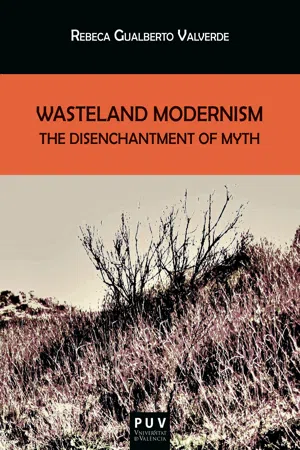
This book proposes a renewed myth-critical approach to the so-called 'wasteland modernism' of the 1920s to reassess certain key texts of the American modernist canon from a critical prism that offers new perspectives of analysis and interpretation. Myth-criticism and, more specifically, the critical survey of myth as an aesthetic and ideological strategy fundamental for the comprehension of modernist literature, leads to an engaging discussion about the disenchantment of myth in modernist literary texts. This process of mythical disenchantment, inextricable from the cultural and historical circumstances that define the modernist zeitgeist, offers a possibility for revising from a contemporary standpoint a set of classic texts that are crucial to our understanding of the modern literary tradition in the United States. This study carries out an exhaustive and updated myth-critical examination of works by T.S. Eliot, John Dos Passos, F. Scott Fitzgerald, Ernest Hemingway, John Steinbeck and Djuna Barnes to broaden the scope of familiar themes and archetypes, enclosing the textual analysis of these works in a wider exploration about the purpose and functioning of myth in literature, particularly in times of crisis and transformation.
- 174 pages
- English
- ePUB (mobile friendly)
- Available on iOS & Android
eBook - ePub
About this book
Information
CHAPTER 1
“Shall I at least set my lands in order?”:
Post-War Mythopoeia in T.S. Eliot’s The Waste Land
“Shall I at least set my lands in order?”:
Post-War Mythopoeia in T.S. Eliot’s The Waste Land
I
When attempting a myth-critical analysis of T.S. Eliot’s The Waste Land, “the most famous use of anthropology in modernist literature” (Manganaro 79), it seems practical to follow the author’s advice and go back to the critical sources that he identifies as fundamental references for understanding how myth operates in the poem. These are Jessie L. Weston’s book on the Grail legend From Ritual to Romance (1920) and James George Frazer’s wide-ranging anthropological study The Golden Bough (1890) (Eliot TWL 21).1 Of course, critics have agreed over the decades that the influence of Weston’s book was somewhat limited in the actual composition of the poem.2 Yet, it is reasonable to argue that the choice of the ‘waste land’ as governing metaphor in the poem may have been influenced by Weston after all, serving as “a structural or guiding model for [the] poem” and not as a clue to “reveal a hidden meaning” (Ullyot 48). Significantly, as Ullyot explains, Weston implicitly argues that “the very wholeness of medieval romance is the symptom of the loss of (…) ritual” (49), which is a fundamental topic in Eliot’s poem. Simultaneously, as also noted by Ullyot, Weston suggests that “scholars must focus on the story of the Waste Land and the wounded Fisher King in the Grail romances rather than on the story of the hero’s quest” (49), for it is the terre gaste that holds the core meaning of the Grail myth.3
As Arthurian experts Lupack and Lupack note, Eliot probably recalled this centrality of the wasteland and of its need for restoration as a unifying motif of the Grail legend (114-15). This may explain the “structural and methodological” indebtedness to Weston (Ullyot 48) of a poem in which references to the Waste Land myth, shaped in different ways, provide a discontinuous rhythm to a great complexity of mythical, religious, historical, and literary allusions. Notoriously, F. R. Leavis once claimed that “a poem that is to contain all myths cannot construct itself upon one” (92). Indeed, The Waste Land is not construed solely upon a single myth, but it does juxtapose unsettlingly “clipped fragments” (Longenbach “Radical” 452) that do not feel coherent due to narrative continuity or dramatic situation, but “because of a swiftly established certainty of tone” (452) that is eloquently expressed in the guiding elements that make up the Waste Land myth: the theme of illness, the topics of sterility and sexual impotence, the narrative structure of the quest, the trope of the king’s sacrificial death, the cyclical movement of the seasons, and the communal longing for regeneration. Moreover, Weston’s myth-ritualist perspective offers a representational advantage since the claim that every rite of sacrifice inheres to the later myth allows for a presentation of ritual as an embodiment of myth.4 In effect, this reverses the loss of ritual that produced medieval romance, which in effect constitutes a remaking of pre-modern myth much in line with modernist mythopoeia.
A distinguishable feature in the representation of the myth of the Waste Land in Eliot’s poem are the various Maimed-King figures that often take the shape of several incarnations of the divine king who, according to Weston, “hovers in the shadowy background” of our history (62). The Fisher King is “a romantic version” of this “divine or semi-divine ruler, at once god and King, upon whose life, and unimpaired vitality, the existence of his land and people directly depends” (62). He is not an archetype for every character in the poem, nor does he articulates, as an individual self, the many voices in the poem.5 He is, however, a paradigmatic model for a high number of characters. The Waste Land is, after all, the consequence of the Fisher King’s injury, and thus he must be either healed or successfully succeeded after a sacrificial death so that the Waste Land can be restored.6 Both scenarios are repeatedly represented in the poem, and both are portrayed as ultimately futile. Perhaps, since succession stories are better established throughout tradition, scenes of sacrificial killings are also more numerous in The Waste Land. Victims such as the Phoenician sailor in “Death by Water,” Jesus Christ in “What the Thunder Said,” or Stetson’s corpse in “The Burial of the Dead” are only the most well-known among several examples of “the same mythic impulse toward insuring the fertility of the earth by ritualistically killing heroes and kings” (Brooker and Bentley 67). The impulse is, however, entirely moot.
The myth, reshaped and rewritten, is transformed from a myth of regeneration to a myth of degeneration. Such degenerative reinterpretation is carried out mostly by a multiplication of symbols that are progressively more and more ambivalent and unreliable. Segal claims that, while “myth is commonly taken to be words, often in the form of a story,” myth-ritualism remakes it so it “does not stand by itself but is tied to ritual” (Myth 61). Myth becomes an action, necessarily transcendent; it encodes the magical meaning to warrant the survival of the community. It has a social purpose. It supplies “a structure of values” (Litz 6). It holds the community together and ensures its proper functioning. Yet, if the myth of regeneration that secures communal survival is transformed, rewritten as a myth of degeneration, its magical meaning is upended: the myth will no longer redeem the community but enact its dissolution.
II
In The Waste Land, “the thematics and imagery of the war underlie the poem at many levels, beginning with its memorial opening and encompassing its burning cities, soldier songs, shell-shocked London citizenry, ubiquitous dead, burial phobias, even the rats” (Cole 66). The possibility of regeneration seems farfetched, even when the land is physically reborn. Whereas in the medieval sources, the physical renewal of the land’s fertility brought along the restoration of peace and social welfare, the earth coming back to life in spring is an act of cruelty in the modern Waste Land. The undertone is apocalyptic: the earth regenerates and will continue to do so for the rest of eternity, but eternal life is the utmost form of cruelty for the war-ravaged, wasted world that remains:
April is the cruellest month, breeding
Lilacs out of the dead land, mixing
Memory and desire, stirring
Dull roots with spring rain.
Winter kept us warm, covering
Earth in forgetful snow, feeding
A little life with dried tubers. (1-7)
In her fundamental study on violence and modernism, Sarah Cole finds in these iconic lines “multiple valences on the way death and land conjure one another, including the vegetative structure of resurrection” (71). She writes that “the lines invoke the parched earth which nevertheless will breed, the land impregnated by dead bodies (no-man’s-land made general), and the cruel discomfort and pain of bringing blossoms out of such a soil” (71). As she claims, the beginning of the poem ties the loss and death of the Great War to the inevitable cycling of the seasons, which is poignant as far as the horror of war cannot in this way be altered or avoided (71).
For Cole, the beginning of the poem ironizes “the truism that the violence of war can be germinative” (72), which clearly undercuts the magical potency of the alleged ritual of resurrection that underscores the use of myth in the poem. In his famous 1923 review of James Joyce’s Ulysses, Eliot seemed to clearly advocate for the benefit of myth as a strategy to give order and meaning to the chaos of the contemporary world,7 and, as some critics have argued, the use of myth in the poem may provide some sense of order—or at least the illusion of order.8 But, in any case, the argument that primitive myth can restore order and meaning in a world wracked by chaos disregards the fact that to complete such purpose, myth has to be reshaped. It is the case in The Waste Land, a poem that “treats myth, history, art and religion as subject to the same fragmentation, appropriation, and degradation as modern life” (Davidson 123). Eliot himself critiqued Stravinsky’s Le Sacré du Printemps (1913) because it remained “a pageant of primitive culture” in which, in everything except in the music, “one missed the sense of the present” (qt. in Litz 19). The words reveal that, for Eliot, the contemporary recreation of myth requires myth to be updated and transformed to give a good account of the present.
Langbaum has argued that all the characters in The Waste Land have in common “a sense of loss and a neural itch, a restless, inchoate desire to recover what has been lost” (“Walking” 231). For Faulk, the poem makes “desperate efforts to reestablish cultural hierarchy out of anarchy by means of a perspective achieved through a poetic arrangement of disparate ‘fragments’” (36). It is the particular arrangement of the fragments that expresses the futility of such a desire for recovery, that “very minimum of restless aliveness” that propels the characters to repeat the archetypal pattern of the Grail quest (Langbaum “Walking” 231). By the time the speaker reaches the Chapel Perilous, the place is empty and poses no threat: “There is the empty chapel, only the wind’s home, / It has no windows, and the door swings, / Dry bones can harm no one” (Eliot TWL 388-90). As Lupack and Lupack explain, “with the Chapel divested of its dangers and trials, there is no chance for a hero to prove his courage and virtue, and thus to prove himself worthy of achieving the Grail—if there were a hero, that is” (117). The fragments are barely recognizable, even when the visit to the Chapel is followed by “the dry sterile thunder” (342) finally bringing down the much-awaited rain.
A different sound accompanies the rain. It is a single syllable, DA. Interpreted by the gods as meaning “damyatta” (control), by the men as “Datta” (give), and by the demons as “dayadhvam”(pity), the voice of the thunder as heard in the Upanishad, the sacred books of Hinduism, may suggest a form of redemptive knowledge acquired by the Grail Knight at the end of the quest.9 But such knowledge, if it exists at all, is necessarily polysemic and ambivalent. It raises the problem of interpretation, what Coyle terms “overdetermination,” “liminality,” and “doubleness” (160), in his view the main characteristics of a poem that “inhabits both sides of an opposition” (160).
“What the Thunder Said” begins with the description of a desert—“Here is no water but only rock / Rock and water and the sandy road / The road winding among the mountains above / Which are mountains of rock without water” (Eliot TWL 331-4)—that is finally relieved by the rain. The hopes for regeneration seem corroborated by the presence of resurrected Christ in this fifth canto, in a vignette that recalls the story of the two men on the road to Emmaus:
Who is the third who walks always beside you?
When I count, there are only you and I together
But when I look ahead up the white road
There is always another one walking beside you
Gliding wrapt in a brown mantle, hooded
I do not know whether a man or a woman
—But who is that on the other side of you? (359-365)
These lines apparently resolve the first lines of the section, which seem to recreate the Passion,10 poeticizing a transition from death to resurrection. Yet, as Eliot explains in a note, the lines that retell an episode from the Gospel were inspired by the narrative of an Antarctic expedition in which “it was related that the party of explorers, at the extremity of their strength, had the constant delusion that there was one more member that could actually be counted” (25).11 Both references simultaneously embody a manifest Providence but, while Shackleton claims that they “had seen God in his caramel raptures, [and] heard the text that Nature renders [and] (…) reached the naked soul of man” (226), Eliot characterizes such apparition as “a constant delusion,” doubling the meaning of a reference that simultaneously signifies redemption and exhaustion. In this regard, the debilitated stream of consciousness of the speaker before the apparition is highly eloquent:
If there was water
And not rock
If there were rock
And also water
And water
A spring
To pool among the rock
If there were the sound of water only
Not the cicada
And dry grass signing. (Eliot TWL 346-54)
The faltering rhythm of these short lines, the inconsistent discourse, and the frequent repetitions recall a nearly-exhausted state of consciousness, which resignifies the apparition of Christ into a hallucination suffered by the dehydrated explorers who wander the Waste Land. The doubled image points towards the inevitable failure of heroic action in The Waste Land,12 and at the same time, negates the possibility of resurrection. If Christ’s redemptive sacrifice is a hallucination, the ritual meaning underneath the myth is emptied out of meaning. The killing of the divine king can no longer resurrect the Waste Land because, as Brooker and Bentley note, “Christ, all the heroes of fertility myth, the tradition of revering such figures, and mythic consciousness itself seem to be dead in the reverberation of spring thunder over distant mountains” (174).
This is the fate of ritual and transcendence in the poem, and it is the effect of these ‘doubleness’ of references. As Coyle argues, “both interpretations need to be there, each destabilizing even as it implies the other” (160). Tarot is another example. Weston discussed, its original use had been “to predict the rise and fall of the waters which brought fertility to the land” (80). In Weston’s hypothesis, the four suits of Tarot—Cup, Lance, Sword, and Pentangle (Dish)—correspond with the Grail myth’s central symbols, that is, the Cup, the Lance, the Dish, and the Sword (79). These symbols conform “a group of ‘Fertility’ symbols, connected with a very ancient ritual, of which fragmentary survivals alone have been preserved to us” (80). Those fragments of ritual are collected in The Waste Land, and presented as dramatizing the conflict between modern trivialization and ancient mysticism (Brooks 209). If in Antiquity, the Tarot was used to predict the water rising in springtime, in Eliot’s poem, the fortune-teller Madame Sosostris also heralds the coming of the waters. But in the contemporary, death-ridden world of The Waste Land, the rising waters do not bring along the land’s fertilization but a catastrophic flood. Madame Sosostris cautions the reader to “fear death by water” (55), transforming the announcement of regeneration into an admonition for danger. Brooks argued that “the ‘fortune-telling’ which is taken ironically by a twentieth-century audience becomes true as the poem develops” (207). This is explained by the cards that Madame Sosostris reveals in the first canto:
…Here, said she,
Is your card, the drowned Phoenician Sailor,
(Those are pearls that were his eyes, Look!)
Here is Belladonna, the Lady of the Rocks,
The lady of situations,
Here is the man with three staves, and here the Wheel,
And there is the one-eyed merchant, and this card,
Which is blank, is something he carries on his back,
Which I am forbidden to see. I do not find
The Hanged Man. Fear death by water. (46-54)
The cards are not real Tarot cards, a sign that the ritual has lost the power of ancient mysticism. And yet, the seemingly ludicrous set effectively predicts the characters and events that the reader will find along the poem. Eliot explains in a note:
I am not familiar with t...
Table of contents
- Cover
- Halftitle
- Title Page
- Copyright
- Contents
- Introduction
- CHAPTER 1: “Shall I at least set my lands in order?”: Post-war Mythopoeia in T. S. Eliot’s The Waste Land
- CHAPTER 2: “If I could git more into the center of things…”: The End of Life in John Dos Passos’s Manhattan Transfer
- CHAPTER 3: “For a transitory enchanted moment”: The Disillusion of Romance in Francis Scott Fitzgerald’s The Great Gatsby
- CHAPTER 4: “A Spectacle with unexplained horrors”: Disenchanted Ritual in Ernest Hemingway’s The Sun Also Rises
- CHAPTER 5: “The cycle is too cruel”: The Ambivalence of Myth in John Steinbeck’s To a God Unknown
- CHAPTER 6: “Godamercy, they have shot the Holy Grail!”: Mythical Wreckage in Djuna Barnes’s Nightwood
- Conclusion
- Works Cited
Trusted by 375,005 students
Access to over 1.5 million titles for a fair monthly price.
Study more efficiently using our study tools.
Frequently asked questions
Yes, you can cancel anytime from the Subscription tab in your account settings on the Perlego website. Your subscription will stay active until the end of your current billing period. Learn how to cancel your subscription
No, books cannot be downloaded as external files, such as PDFs, for use outside of Perlego. However, you can download books within the Perlego app for offline reading on mobile or tablet. Learn how to download books offline
Perlego offers two plans: Essential and Complete
- Essential is ideal for learners and professionals who enjoy exploring a wide range of subjects. Access the Essential Library with 800,000+ trusted titles and best-sellers across business, personal growth, and the humanities. Includes unlimited reading time and Standard Read Aloud voice.
- Complete: Perfect for advanced learners and researchers needing full, unrestricted access. Unlock 1.5M+ books across hundreds of subjects, including academic and specialized titles. The Complete Plan also includes advanced features like Premium Read Aloud and Research Assistant.
We are an online textbook subscription service, where you can get access to an entire online library for less than the price of a single book per month. With over 1.5 million books across 990+ topics, we’ve got you covered! Learn about our mission
Look out for the read-aloud symbol on your next book to see if you can listen to it. The read-aloud tool reads text aloud for you, highlighting the text as it is being read. You can pause it, speed it up and slow it down. Learn more about Read Aloud
Yes! You can use the Perlego app on both iOS and Android devices to read anytime, anywhere — even offline. Perfect for commutes or when you’re on the go.
Please note we cannot support devices running on iOS 13 and Android 7 or earlier. Learn more about using the app
Please note we cannot support devices running on iOS 13 and Android 7 or earlier. Learn more about using the app
Yes, you can access Wasteland Modernism by Rebeca Gualberto Valverde in PDF and/or ePUB format, as well as other popular books in Literatur & Literarische Essays. We have over 1.5 million books available in our catalogue for you to explore.