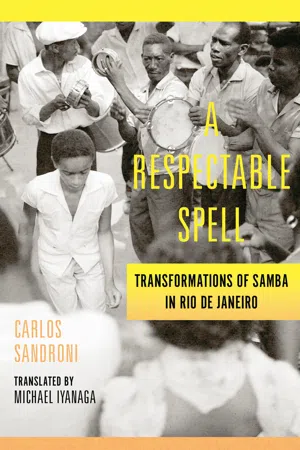
Incisive and comprehensive, A Respectable Spell tells the compelling story of an iconic Brazilian musical genre.
- English
- ePUB (mobile friendly)
- Available on iOS & Android
eBook - ePub
About this book
A landmark in Brazilian music scholarship, A Respectable Spell introduces English-speaking readers to the rich history of samba from its nineteenth century origins to its emergence as a distinctive genre in the 1930s. Merging storytelling with theory, Carlos Sandroni profiles performers, composers, and others while analyzing the complex ideologies their music can communicate in their lyrics and rhythms, and how the meaning of songs and musical genres can vary depending on social and historical context. He also delves into lundu, modinha, maxixe, and many other genres of Brazilian music; presents the little-heard voices and perspectives of marginalized Brazilians like the African-descended sambistas; and presents a study in step with the types of decolonial approaches to ethnomusicology that have since emerged, treating the people being studied not only as makers of music but also of knowledge.
Information
Publisher
University of Illinois PressYear
2021Print ISBN
9780252086083
9780252044021
eBook ISBN
9780252052965
Subtopic
EthnomusicologyPART ONE
FROM LUNDU TO SAMBA
CHAPTER
1
“Sweet Lundus, for Massa to Dream”
The word lundu, also sometimes written as londu, lundum, landum, and other variations, has designated different things at different times, but all of them are generally considered to be interconnected. It was the name of some of the Black and mestiço dances at the turn of the nineteenth century, of a nineteenth-century genre of salon music for piano and voice, and of an early twentieth-century repertoire of commercially recorded songs. I will deal primarily with the salon lundu to which we have access via the sheet music published in Brazil during the second half of the nineteenth century; other aspects of lundu will be addressed more briefly over the course of the exposition. As I will later explain, this chapter also dedicates space to modinha, a Luso-Brazilian genre of romantic song historically associated with lundu.
The oldest known reference to a dance called lundu comes from 1780, in a letter written by the count of Povolide,1 a Portuguese aristocrat who had been governor of Pernambuco. In the letter the count defended some of the enslaved Black celebrants’ dances against accusations made by the Tribunal of the Inquisition:
The blacks … dance and spin like harlequins, and others dance with diverse body movements, which even if not the most innocent, are like the fandangos of Castile, and fofas of Portugal, and the lundus of whites and pardos [people of mixed race] of that country [Portugal].2
Lundu is also mentioned around 1780 in verses penned by the Portuguese poet Nicolau Tolentino.3 In two popular Portuguese entremeses4 from 1784 and 1787, which included Black characters, José Ramos Tinhorão has found mentions of a baile (dance) called lundu.5 In Brazil, also in the late eighteenth century, the poet Tomás Antônio Gonzaga mentions this dance in his Cartas chilenas (Chilean Letters).6
The African origin of the lundu dance was accepted as fact by researchers in the twentieth century. According to the Dicionário musical brasileiro (DMB, Brazilian Musical Dictionary), it is a “dance of black-African origin, brought by Bantu slaves from the regions of Angola and the Congo.”7 Mário de Andrade speaks of lundu as “a characteristic form of Negro folklore, perhaps the most characteristic of the time [that is, the late eighteenth century], and certainly the most widespread.”8 And Araújo writes that “the lundu …, a direct descendent of the African batuque, was the valve of emotional balance utilized by slaves to temper the hardships of exile and the pains of slavery.”9
Put in this way, however, these statements are debatable, for the eighteenth and early nineteenth-century documentation does not mention lundu as either an African dance or as a dance characteristic of enslaved Africans. The letter from the count of Povolide, cited above, speaks of lundu as being “of whites and pardos of that country [Portugal].” In the aforementioned Cartas chilenas, the person who dances lundu is a “mulata” (mixed-race woman).10 And in the entremeses cited by Tinhorão, which were sung popular theater plays, Black characters are the ones who dance “lundum” during scenes set in the homes of the white masters, who also participate. However, these characters were portrayed by white actors for an audience that was also white and frequented the theaters of Lisbon and other Portuguese cities. Furthermore, the descriptions of the lundu choreography we have from the beginning of the nineteenth century inhibit us from attributing it exclusively to Black people, for in the lundu dance, notwithstanding the bodily movements attributed to Africans (such as the umbigada [belly bounce], which we will discuss later), we also see a strong Iberian influence, as Tinhorão and others have noted.11
In sum, lundu dancing was, as Tinhorão affirms for the turn of the nineteenth century, “more cultivated by whites and mestiços than by blacks.”12 The “mestiço” lundu was, however, proposed as a representation, direct or veiled—and as we will see, nearly always humorous—of aspects of the era’s Afro-Brazilian context.
From the 1830s on, when the printing of music began in Brazil, the word lundu also starts to be used to designate a genre of music independent of any dance: a genre of printed music for piano and voice. Lundu as a genre of song, however, is indissolubly linked to modinha, a word whose musical usage began in Lisbon also during the late eighteenth century. In his important study of modinha, Mário de Andrade writes the following: “the fact is that modinha and lundum were completely entangled.”13 And Bruno Kiefer: “In the previous century [the nineteenth,] confusing modinha and lundu was not uncommon.”14 The classic book on the topic, by Mozart de Araújo, is in fact titled A modinha e o lundu no século XVIII (Modinha and Lundu in the Eighteenth Century); later musicologists, such as Edilson Lima and Paulo Castagna, have also connected the two genres in the titles of their texts. The conjoined scholarly treatment of the genres reflects what Araújo calls their “historical connections.”15 Because of such connections, despite the fact that my main point of interest here is lundu, I will also discuss modinha.
Modinha is, first of all, the diminutive of moda, a word that in the eighteenth century, in both Portugal and Brazil, was widely used to designate popular songs. We see, for example, in a traveler’s account published in the early eighteenth century, a reference to the existence, in Bahia, of a “famous musician and performer of these profane modas” (in which modas means “songs” or “tunes”), without further elaboration.16
As Luiz Heitor Corrêa de Azevedo notes in his entry on modinha for the Dicionário do folclore brasileiro (DFB, Dictionary of Brazilian Folklore), “it is in the nature of the [Portuguese] language and in the tradition of the composers such use of the diminutive; the same thing happens with fado and fadinho, polca and polquinha, tango and tanguinho, choro and chorinho, etc.”17 In this case, however, the use of the diminutive spread at precisely the moment during which its meaning was changing. While the word moda continued to be used as a generic term for “song,”18 modinha began to be used, in Lisbon, during the 1780s, no longer as a diminutive but rather as a designation for a specific type of song.19 These were urban songs, novamente compostas (newly composed), as they would say. That is, these songs were presented as “novelties” and in many cases signed by their authors, who signed and published them commercially as sheet music with their respective lyrics in print. Modinha was, starting in the late eighteenth century, the Portuguese name for these songs, which were produced and consumed in an urban context, anticipating in part what came to be called, in the twentieth century, a “popular” or “pop” song, in contrast to a “traditional” or “folk” song.
We see this new use of the word modinha in the Jornal de Modinhas, published in Lisbon between 1792 and 1796 by French publishers Milcent and Maréchal. This was the first Portuguese musical periodical, routinely publishing two modinhas per month, one on the first of the month, another on the fifteenth.20 As Marcos Magalhães notes, one of the most striking aspects of the way in which the periodical presented the modinhas is the “emphasis given to the issue of novelty.”21 Of the 104 modinhas published by the periodical, no fewer than twenty-nine had the word “new” or the expression “newly composed” (meaning recently composed) in their very titles.22
Some late eighteenth-century documents associate these new modinhas with a musical influence arriving in the Portuguese metropolis from what was then an immense overseas colony, Brazil. While never mentioning modinhas, the German botanist Heinrich Friedrich Link, who spent some time in Portugal during his youth (1797–1799), bears witness to these musical influences in his book of travels. The scene takes place at the mansion of a wealthy family in a small city near Serra da Estrela, in northeastern Portugal:
We were daily in company with the principal people of this little town, where the young but half speechless girls, and the young but cheerful married women, passed their time in a pleasant manner without play. … General conversation prevailed, and they joined in a general chorus. We heard a number of soft plaintive Portuguese songs, generally on the pains of love, and frequently on some charming shepherdess (linda pastora). Among these the Brasileros [sic], or brasil [sic] songs, were distinguished by their great variety, gaiety and wit, like the nation from which they spring.23
But the most well-known account of the era, which does explicitly mention modinhas of Brazilian origin, is that of the Engl...
Table of contents
- Cover
- Title
- Copyright
- Contents
- Translator’s Foreword: The Decolonial Spark of a Translated Spell
- Acknowledgments
- Introduction to the English Translation
- Original Introduction
- Musical Premises
- Part One: From Lundu to Samba
- Part Two: From One Samba to the Other
- Conclusion
- Glossary
- Notes
- Works Cited
- Index
- Back Cover
Trusted by 375,005 students
Access to over 1.5 million titles for a fair monthly price.
Study more efficiently using our study tools.
Frequently asked questions
Yes, you can cancel anytime from the Subscription tab in your account settings on the Perlego website. Your subscription will stay active until the end of your current billing period. Learn how to cancel your subscription
No, books cannot be downloaded as external files, such as PDFs, for use outside of Perlego. However, you can download books within the Perlego app for offline reading on mobile or tablet. Learn how to download books offline
Perlego offers two plans: Essential and Complete
- Essential is ideal for learners and professionals who enjoy exploring a wide range of subjects. Access the Essential Library with 800,000+ trusted titles and best-sellers across business, personal growth, and the humanities. Includes unlimited reading time and Standard Read Aloud voice.
- Complete: Perfect for advanced learners and researchers needing full, unrestricted access. Unlock 1.5M+ books across hundreds of subjects, including academic and specialized titles. The Complete Plan also includes advanced features like Premium Read Aloud and Research Assistant.
We are an online textbook subscription service, where you can get access to an entire online library for less than the price of a single book per month. With over 1.5 million books across 990+ topics, we’ve got you covered! Learn about our mission
Look out for the read-aloud symbol on your next book to see if you can listen to it. The read-aloud tool reads text aloud for you, highlighting the text as it is being read. You can pause it, speed it up and slow it down. Learn more about Read Aloud
Yes! You can use the Perlego app on both iOS and Android devices to read anytime, anywhere — even offline. Perfect for commutes or when you’re on the go.
Please note we cannot support devices running on iOS 13 and Android 7 or earlier. Learn more about using the app
Please note we cannot support devices running on iOS 13 and Android 7 or earlier. Learn more about using the app
Yes, you can access A Respectable Spell by Carlos Sandroni in PDF and/or ePUB format, as well as other popular books in Media & Performing Arts & Ethnomusicology. We have over 1.5 million books available in our catalogue for you to explore.