Kuhn contended that the Bible derived its origins from other Pagan religions and that much of Christian history was pre-extant as Egyptian mythology. He also proposed that the Bible was symbolic and did not depict real events, and argued that the leaders of the church started to misinterpret the bible at the end of the third century. These controversial ideas outside of mainstream history and theology are rejected by most pre-eminent scholars, but many including Tom Harpur and John G. Jackson were influenced by the works of Kuhn. Harpur even dedicated his best-selling 2004 book, "The Pagan Christ" to Kuhn, calling him "a man of immense learning and even greater courage" and "one of the single greatest geniuses of the twentieth century" [who] "towers above all others of recent memory in intellect and his understanding of the world's religions."
- English
- ePUB (mobile friendly)
- Available on iOS & Android
eBook - ePub
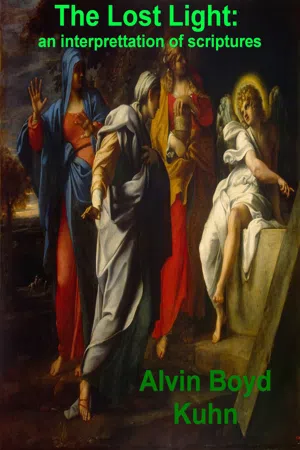
The Lost Light: An Interpretation of Ancient Scriptures
About this book
Information
Topic
Theology & ReligionSubtopic
Comparative Religion 86
From the general thesis that their national history reflected God’s plan for the world, it was an easy step to the more explicit assumption that their national life embodied the divine plan. They threw about themselves the aureole of divinely constituted agency to fulfill the cosmic plan. They therefore arrogated to themselves the title of "God’s chosen people," and took the names allotted only to the spiritualized humans, the men evolved to divinity! This tack will not appear either unlikely or outlandish when we ponder the disposition of nations in our own day to put forth blatant claims to be the chosen agents of Providence for the cultural rulership of the world.
Even if there seems to be veridical history in the Bible, it can be viewed properly as a setting for the spiritual dramatization, or as the clothing in which the drama was garbled. At times, perhaps, the writers appear to have utilized the data of actual history to stage the symbolic figurations. To this task the religious poets dedicated their ingenuity.
It becomes evident on this thesis that the historical element of the scriptures is of far less significance than has been supposed. It is the philosophy of history and not the data of history that is of foremost concern. As exhibiting providential design in world life it becomes of epic moment. The Hebrew race has exploited this phase of the old methodology to its highest possibility, only, however, as Egypt had done before it; and has been so successful that it has left the impression of a unique and exalted hierarchical status for the Jewish race. The outcome of our correction of vision will be that we shall for the first time properly regard the Old Testament books as, in the main, the universal drama of the spiritual life masquerading in the disguise of Hebrew history subtly woven into the great cosmic epic! The Biblical title Israelites is a spiritual designation purely, and is wrongly taken in the sense of the name of an ethnic group. "My people of Israel" or "the children of Israel" of the Hebrew deity are just the divinized humans, mortals who have put on the immortal spiritual nature, men graduated into Christhood, a spiritual group in the early Mysteries. Gentiles were those who were not yet spiritually reborn. The word comes from the Latin and Greek roots, "gen," "gent," meaning simply "to be born." They were those born as the first or natural man, but not yet reborn as the spiritual Christ. It can be given no ethnic reference. The name "Israelite" is obviously compounded of "Is," abbreviation of Isis, or Eve’s original name, Issa (See Josephus); "Ra," the great Egyptian
87
solar god, male and spiritual; and the Hebrew "El," God. It would then read, Father-Mother-God, making his "children" the sons of God, i.e., Christs. Likewise the name "Hebrews" means "those beyond" (the merely human state), and therefore is practically identical with "Israelites." Finally the term "Jews" (from the plural of the Egyptian IU--Latin JU) refers to the "male-female divinities," a title given in the Mysteries to men made gods and thus restored to androgyne, or male-female, condition. The national Jews thus adopted for their historical name all three of the exalted spiritual designations conferred in the Mysteries on the Epoptae or completely divinized candidates.
It was hardly expected that any positive documentary evidence could be found in support of the evident fact that these names had simply been appropriated by the race using them as illustrious titles abstracted from the uranograph. But a direct statement to that precise effect was found in the Hebrew Grammar of Gesenius, a learned German scholar, (on p. 6):
"Of the names Hebrews . . . and Israelites . . . the latter was more a national name of honor and was applied by the people to themselves with a patriotic reference to their descent from illustrious ancestors; . . ."
This is of vast significance as affecting the historical view of the Bible, with possible extremely severe repercussions on world history of the present.
The fourth consideration found essential to a grasp of archaic meaning is the knowledge that religion was an outgrowth from a specific situation involving the human race at its beginning. Religion is commonly assigned to a category under the head of psychology. It is a matter of mind and emotion.
But the roots of religion are found to go deeper than any mere inclination of the psyche. Eventually religion took psychological forms of expression, but it was originally not mere psychology. It was an outgrowth of anthropology. It took its rise out of the racial or evolutionary beginnings and bore an immediate relation thereto. Every feature of it was engendered out of the interrelation of the several elements entering into the compound of man’s constitution.
Human nature was composed of more than one element. There were the physical, the emotional, the mental and the spiritual. More
88
compactly viewed, there are the human-animal and the divine. Religion is just the play of the factors of the interrelationship subsisting between these several natures in man. Or it is the relation between man and his god, the latter being universally existent primarily within him, secondarily without. It details the history of the soul or divine spark of spirit in its cyclical incorporation in human bodies. Its central fact is the incarnation, the relation of soul to body, God to man, man to God.
According to Plato’s Timaeus and other archaic documents a group of twelve legions of "junior gods," who were sparks of the eternal Flame of cosmic mind, were ordered, as their assignment in the cooperative work of creation with Deity, to descend to earth and elevate the races of the highest animal development by linking their own mental capacity with the organisms thus far developed by the evolution of form. They were to lift the animals across the gulf between the summit of instinct and the beginnings of reason. These angels were devas, "bright" or "shining" emanations of divine intelligence, but were not exempt from the "cycle of necessity," or periodical immersion in forms of physical embodiment on a planet for purposes of their own further self-evolution. It subserved both the interests of their own progress and that of the animals they were to uplift, that the two races, the one germinally conscious and immortal, the other dumbly brutish and mortal, should be periodically joined together, the higher to be the king and ruler of the lower. The procedure thus adopted by life gave to the animal the possibility of evolving a mind through association with a mental nature, and to the intelligent spirits the physical bodies that were their particular requirement for contacting the type of experience they were destined to undergo. If this seems bizarre, it must be remembered that all living entities are the result of the linkage of a spiritual nucleus with a material organism. No creature lives but what is compounded of "soul" and body.
In conformity with evolutionary law these legions of devas or angels, we are told, descended to earth, took lodgment in the bodies of higher animals and began their career of redeeming the lower creatures to mental status. In the Timaeus these "junior gods" are addressed by the Demiurgus (the creative Logos, Jupiter) and are told to descend and "convert yourselves according to your natures to the fabrication of animals," the gist of their mission being summed up in the command
89
to "weave together mortal and immortal natures." This is one of the most important utterances of ancient scripture, because it announces the character of our constitution and sets forth plainly our evolutionary commission. It tells us that we are both animal-human and divine at once, animal as to our bodies, divine as to our intellects. For Plato says: "According to body it is an animal, but according to intellect a god." Our earthly task, according to St. Paul, is to link together the two natures in "one new man," bringing to an end in a final "reconciliation" "the battle of Armageddon," the aeonial warfare between the "carnal mind" of the animal and the spiritual mind of the god. This warfare is also Plato’s strife between noësis, the spiritual intelligence, and doxa, the motions of the sense nature. The soul is here in body to discipline the latter by the inculcation of habits of rectitude until the animal learns to use the powers of mind. Tutoring the animal, the soul at the same time achieved its own higher schooling in deific unfoldment. This interlocking of the two grades of life in one organism must be constantly kept in view if the proper study of religion is to be made. No organic evolution can proceed from one kingdom to another without the deploying of the mental resources of a superior kingdom in aid of the level below it. And each kingdom profits by the act of brotherhood. The god achieves his own further apotheosis by reaching down to raise the animal to human estate.
It must be noted that when the intelligence of the god is joined to the life of the animal, it communicates but a fragment of its power to the organism, remaining for the larger part of its conscious being hidden on its own spiritual plane. It thus becomes an invisible guardian, or what the ancients called the "daimon." Lurking in the background of consciousness, it is what modern psychology has lately discovered and named the "collective unconscious." From behind the curtain, as it were, it directs the animal with only a tentacle of its power. It can not incorporate in the animal a greater measure of its capacity than the latter can suitably accommodate and carry. It will push down into expression more and more of itself as the refinement of the coarse body goes on apace. Like a radio, the mechanism must be tuned up higher to register finer vibrations. In the Greek theosophy it is stated that "the gods distribute divinity" to the grades of beings below them, which "participate according to their capacity."
In briefest summary (to be amplified to greater elaboration in the
90
sequel) this is the basic cosmological and racial datum of every old religion. Together with its implications it is the basis of every religious interpretation ever made or to be made. Every problem of ethics, devotion, discipline and intellect receives its full complement of value and meaning only in reference to this fundamentum. Religion is far more than a posture of mystic feeling; it was in origin a series of codes, principles and practices given by the demi-gods to early mankind to awaken the torpid genius of our actual divinity. In a true sense it was designed to wield a semi-magical influence to transform animal man into the divinized human! Its rites were formulated with a view to bestirring man’s memory of his essential deific character. It was in no sense merely worship. It was the most intensely practical and utilitarian culture the world has ever known. It was designed to prevent the utter loss of purpose and failure of effort in the cosmical task to which man, as a celestial intelligent spirit, had pledged himself under the Old Testament covenant and "the broad oaths fast sealed" of Greek theology. In coming to earth to help turn the tide of evolution past one of its most critical passages, he bound himself to do the work and return without sinking into the mire of animal sensuality. We must henceforth approach religion with the realization that it is the psychic instrumentality designed for the use of humanity in charting its way through the shoals of the particular racial and evolutionary crisis in which it was involved. All the stupendous knowledge relating to the entire cosmic chapter was once available, given by the gods to the sages. We have nearly lost it beyond recovery because the ignorance of an early age closed the Academies and crushed every attempt to revive the teaching. The prodigious folly of the modern essay to vitalize religion through piety alone will be more fully seen as the ancient picture takes form in the delineation. Our present business is to struggle to regain that lost paradise of intelligence. We must work again to the recognition of our high cosmic mission, and revivify the decadent forms of a once potent religious practique, based on knowledge. For spiritual cultism was once vitally related to our evolutionary security, which stands jeopardized by present religious desuetude.
The nature of the material to be presented in volume will enforce by the sheer illuminative power of the interpretation itself the necessity for this extended introduction. It was quite impossible to undertake the exegesis of recondite scriptures long misinterpreted or never
91
interpreted at all, without providing a rationale of ancient literary methodology and setting up a background of philosophical light. The erection of this background was made all the more necessary by the inveterate recalcitrancy of modern scholarship to recognize the applica...
Table of contents
- Start
Trusted by 375,005 students
Access to over 1.5 million titles for a fair monthly price.
Study more efficiently using our study tools.
Frequently asked questions
Yes, you can cancel anytime from the Subscription tab in your account settings on the Perlego website. Your subscription will stay active until the end of your current billing period. Learn how to cancel your subscription
No, books cannot be downloaded as external files, such as PDFs, for use outside of Perlego. However, you can download books within the Perlego app for offline reading on mobile or tablet. Learn how to download books offline
Perlego offers two plans: Essential and Complete
- Essential is ideal for learners and professionals who enjoy exploring a wide range of subjects. Access the Essential Library with 800,000+ trusted titles and best-sellers across business, personal growth, and the humanities. Includes unlimited reading time and Standard Read Aloud voice.
- Complete: Perfect for advanced learners and researchers needing full, unrestricted access. Unlock 1.5M+ books across hundreds of subjects, including academic and specialized titles. The Complete Plan also includes advanced features like Premium Read Aloud and Research Assistant.
We are an online textbook subscription service, where you can get access to an entire online library for less than the price of a single book per month. With over 1.5 million books across 990+ topics, we’ve got you covered! Learn about our mission
Look out for the read-aloud symbol on your next book to see if you can listen to it. The read-aloud tool reads text aloud for you, highlighting the text as it is being read. You can pause it, speed it up and slow it down. Learn more about Read Aloud
Yes! You can use the Perlego app on both iOS and Android devices to read anytime, anywhere — even offline. Perfect for commutes or when you’re on the go.
Please note we cannot support devices running on iOS 13 and Android 7 or earlier. Learn more about using the app
Please note we cannot support devices running on iOS 13 and Android 7 or earlier. Learn more about using the app
Yes, you can access The Lost Light: An Interpretation of Ancient Scriptures by Alvin Boyd Kuhn in PDF and/or ePUB format, as well as other popular books in Theology & Religion & Comparative Religion. We have over 1.5 million books available in our catalogue for you to explore.