eBook - ePub
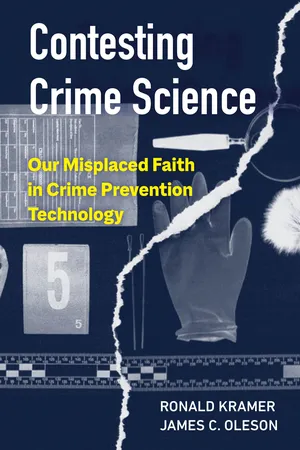
Contesting Crime Science
Our Misplaced Faith in Crime Prevention Technology
- 270 pages
- English
- ePUB (mobile friendly)
- Available on iOS & Android
eBook - ePub
Contesting Crime Science
Our Misplaced Faith in Crime Prevention Technology
About this book
In this eye-opening critique, Ronald Kramer and James C. Oleson interrogate the promises of crime science and target our misplaced faith in technology as the solution to criminality. This book deconstructs crime science's most prominent manifestations—biological, actuarial, security, and environmental sciences. Rather than holding the technological keys to crime's resolution, crime sciences inscribe criminality on particular bodies and constitute a primary resource for the conceptualization of crime that many societies take for granted. Crime science may strive to reduce crime, but in doing so, it reproduces power asymmetries, creates profit motives, undermines important legal concepts, instantiates questionable practices, and forces open new vistas of deviant activity.
Information
Publisher
University of California PressYear
2022Print ISBN
9780520299597
Edition
1eBook ISBN
9780520971264
CHAPTER 1
A Brief Sketch of Crime Science and Its Limits
This chapter fulfills two important functions in this book. First, it outlines the epistemological stance that informs the argument and analysis that is explored throughout the text. In our view, crime science needs to be approached as a discourse. That is, it amounts to a set of statements about “crime,” “criminality,” and, among other categories, “punishment.” These statements, however, do not simply map or correspond to an external, pure reality, but actively construct the objects of which they speak.1
To embrace the idea of discourse as constitutive of reality casts doubt on the view that reality exists independently of its mediation via language. Many agree that discourse is an important concept within critical thought, but the implications of the concept have generated intense debate. We chart several intellectual positions among those who recognize the critical utility of discourse and the constructivist logic it entails in order to indicate the sense in which it is deployed here.
The work of Michel Foucault is an obvious, if not inevitable, starting point for any exploration of discourse.2 After a brief discussion of Foucault, we offer some reflections on radical constructivism, successor sciences, situated knowledges, and constitutive criminology.3 Whereas radical constructivism pushes discourse in a relativist direction, successor sciences, situated knowledges, and constitutive criminology suggest that “partial” or “new” truths are possible. If radical constructivism strives to reject any possibility of objective accounts, the latter positions reinstate the possibility of adjudicating between “better” and “worse” accounts of reality. We posit that attempting to push discourse in either direction—that is, relativism or a “reworked objectivity”—invites as many problems as it resolves. As such, we note the possibility of a “suspended constructivism,” which operates from within the zones of commonality where most constructivist approaches appear to overlap.
A schematic summary of crime science as a discourse is offered in the second part of the chapter. Descending from sea level, we trace the underside of the crime science archipelago by examining Cesare Beccaria’s On Crimes and Punishments and Cesare Lombroso’s Criminal Man.4 This approach may seem odd given that Beccaria and Lombroso are often construed as providing distinct frameworks for making sense of crime and punishment. There are certainly differences between the two figures, but despite such tensions, their works contain many points of contact. It is these overlaps that effectively provide crime science with its fundamental logic, or what one may describe as the perimeter that bounds crime science.
This initial discussion of crime science focuses on four of its elements. First, it explores crime science’s ontology, epistemology, and fundamental categories. Crime science is a “modernist” discourse, one that accepts the distinction between reality (ontology) and knowledge (epistemology). In accepting this distinction, crime science believes itself capable of producing knowledge that reflects reality with fidelity. Its central categories include human nature, crime, criminality, and punishment, each of which is thought to be objectively knowable and thus liable to manipulation. Second, we explore the technology fetishism that suffuses crime science. Technological strategies figure as the primary mode of intervention or manipulation that will, so the story goes, control crime and “protect” the social. Third, some of the practical effects or manifestations within the domains of law and criminal justice are summarized. Crime science may be discursive, but this does not mean it is incapable of shaping practice.5 Finally, the ways in which crime science is complicit with state authority, and its related tendency to naturalize and protect the fundamental axes of power by which social relations are hierarchically organized, are explored.
CRIME SCIENCE AS A DISCOURSE
The purpose of this book is to interrogate contemporary crime sciences, which we regard as a particular discourse. Engaging in this kind of critique requires that the epistemological position and theoretical ideas by which it is informed are outlined in some detail. Our approach is broadly consistent with constructivist logic, in which the concept of discourse occupies center stage. In such an approach, discourse cannot be understood as a mirror that simply reflects some external world. Rather, it needs to be understood as constitutive of the world that it purports to map.
Arguably, discourse has emerged as one of the central categories for critical approaches within criminology (and a range of other social sciences), especially those associated with postmodern thought. The most obvious starting point for elaborating upon discourse is the work of Michel Foucault. In Foucault’s work, a discourse is constituted by a set of statements that cohere to form the objects of which they speak. At any given time, a variety of discourses are available for speaking about the same topic. As such, the discursive realm is fragmented into competing “regimes of truth,” with specific regimes securing dominance while others remain subjugated.6
One can draw out the distinctiveness of this approach by contrasting it with Karl Marx’s notion of ideology. Marx used ideology to refer to knowledge claims that distorted the underlying realities of capitalism, thereby preserving or naturalizing capitalist social relations. Ideology, in other words, deliberately misled people into erroneous ways of perceiving the world and thus failing to interrogate its organization, inequalities, and power asymmetries. Given this, the task of the critical scholar became one of recovering “reality,” articulating the “truth” of social relations, thereby freeing the working classes from their ensnarement within ideology.7
For Foucault, “truth” in this sense does not exist (or perhaps one should say, the notion of truth cannot be reduced to the sense in which Marx tended to use it). There is no such thing as a reality “out there” that, if revealed, will ensure freedom, liberty, and so on. Instead, we are inevitably confined to a realm of competing discourses that strive to pass for the truthful account of reality. Insofar as a particular discourse becomes dominant and thus functions as if it were true, it profoundly shapes practices, behaviors, subject positions, and mental frameworks. In this sense, social practices are oriented in light of dominant discourses, as “subjects” we enter into relationships with available discourses, and it is these relationships that infuse who we are and what we do.
The notion of discourse, however, has generated intense debates within critical scholarship, and it has opened up avenues that lead to disparate epistemological standpoints. Some say that the concept of discourse has not been pushed far enough, thereby robbing critical thought of any chance to marshal a profound critique of dominant knowledges. Against this, others argue that if the notion of discourse is pushed to its limits—or if it is taken “too far”—we will quickly slide into an untenable relativism. The former view is embedded within “radical constructivism,” whereas the latter is discernible in “successor sciences,” “situated knowledges,” and “constitutive criminology.”
Given that our critique is premised upon treating crime science as a discourse, it is important to trace some of the major fault lines in the debate among these competing positions. Our discussion revolves around the epistemological positions of these different approaches and how such positions translate (or do not translate) into critical practice. By exploring such issues, we can specify the epistemological space that animates the arguments and interpretations that appear throughout the following chapters. We trace the basic parameters of radical constructivism through the work of Nicolas Carrier (and some colleagues), successor sciences and situated knowledges through Sandra Harding and Donna Haraway, respectively, and constitutive criminology via Stuart Henry and Dragan Milovanoviv.
Radical Constructivism
Like successor sciences, situated knowledges, and constitutive criminology, radical constructivism rejects logical positivism. Rejecting logical positivism entails the refusal to accept that there is an external reality that, via value-free or objective observations and methods, resurfaces in scientific accounts in some “pure” or unmediated form. Rather, knowledge is always partial, stemming from an arbitrary conflation of concepts with that which has been observed. As it is inevitable that particular concepts will be selected to summarize the observable, it follows that other concepts could have been chosen. The fundamental mistake of logical positivism is to accept the fallacy that “the world as it is” can be distinguished from “the world as it is observed.”8
For the radical constructivist, positing that there is no reality outside of discourse, that there is no such thing as an “atextual reality,” entails several logical corollaries.9 First, it follows that any given knowledge claim cannot be afforded authority or privileged over others. An “equality of positions” is inevitable. Second, speaking in “representational” terms, or assuming that the discourse one produces maps an already extant reality, is no longer viable. Third, the idea that science entails the “discovering” of laws, which enable us to develop intervening strategies or organize institutional practices in a rational manner, must be abandoned. The world cannot be understood as consisting of “variables” and causal laws that operate independently of the subject’s capacity to observe. As Carrier notes, we need to “resist dreaming of a society (and of a penal apparatus) governed by God or Reason.”10 In Nietzschean parlance, such knowledges do not follow from the “will to truth,” but from the “will to power.”11 To “intervene” or suggest alternative courses of action, therefore, is an effort to exercise power.
In our view, this epistemological stance is logically coherent and thus not easily dismissed as a “god trick,” as Donna Haraway has claimed. Haraway used the notion of “god trick” to characterize logical positivism and radical constructivist approaches as presuming to be able to see everything while standing nowhere.12 While the former can be said to depend upon the “god trick,” it is harder to frame the latter in the same way. If it is accepted that the distinction between reality and discourse is untenable, and that different languages or “distinctions” could be used to frame an observable regularity, it does seem to follow that there is no way to determine why specific discourses should be selected—inevitably at the expense of others—to symbolically apprehend the phenomenal. Smoking marijuana can be construed as “criminal behavior,” or “pleasurable activity,” or a “necessity in this day and age.”13 Of course, one may disagree that all reality is inevitably textual, but once “textual reality” is accepted, the slide into relativism seems a logical corollary.
While radical constructivism might be able to defend against accusations of functioning via the “god trick,” other challenges can be raised. We argue that the problem with radical constructivism is that it cannot be translated into critical practice (knowledge production/critique) without repressing the logical coherence of the epistemological position it espouses. Alternatively, it could be said that radical constructivism can only honor its epistemological coherence by restricting itself to an endless rearticulation of its epistemology. And yet radical constructivists routinely proceed to engage in critical practice, offering a variety of deconstructive readings, critiques of various concepts and frameworks, specifying the effects that follow when certain categories of thought are readily accepted, and so on.
The tension in radical constructivism is evident in several of its writings. Nicolas Carrier and Kevin Walby’s “Ptolemizing Lombroso,” for example, offers a critique of biosocial criminology.14 As they point out, proponents of biosocial criminology claim that this “new” approach amounts to a revolutionizing of criminological thought, one that demands all competing paradigms concede defeat. According to biosocial criminologists, various techniques for observing the body—such as brain scans, personality tests, and genetic markers—reveal that those who engage in criminalized behavior possess distinct biological markers, which allow the criminologist to sort those with a “disposition” for “crime” from those who do not harbor any such disposition. Biosocial criminology insists that tendencies toward crime reside within the body, but that criminal behavior is a product of biological and environmental interactions. As Carrier and Walby put it, this can be formulated as the principle of “nature via nurture.”15 From this postulate, biosocial criminology is adamant that it amounts to a radically new way of understanding the causes of crime, one that rejects biological determinism yet promises to control criminal behavior by manipulating the environmental conditions that supposedly allow biological tendencies to find their expression. If only other criminological discourses, especially those indebted to sociology, would let go of their ideological worldviews—thereby recognizing the inevitable conclusions that follow from a sober analysis of the data upon which biosocial criminology rests—the discipline of criminology could finally recognize itself as a science, one replete with a compelling theory concerning the etiology of crime.16
Carrier and Walby take the notion of Ptolemization from Slavoj Žižek, who suggests it is a process in which “attempts are made to change or supplement [a discipline’s] theses within the terms of its basic framework.” Ptolemization is contrasted with a “true ‘Copernican’ revolution”: only the latter amounts to introducing a radically distinct framework.17 With Ptolemization, Carrier and Walby are able to show how biosocial criminology...
Table of contents
- Title Page
- Copyright
- Contents
- List of Illustrations
- Acknowledgments
- Introduction
- 1. A Brief Sketch of Crime Science and Its Limits
- 2. Biological Crime Science: Identification and Biosocial Criminology
- 3. Actuarial Science: Crime Control as a Risky Business
- 4. Security Science: Cartographies of Crime, States of Exception, and the Twilight of Liberty
- 5. Environmental Crime Science: Missing the Forest for the Acronyms
- Conclusion
- Notes
- Bibliography
- Index
Trusted by 375,005 students
Access to over 1.5 million titles for a fair monthly price.
Study more efficiently using our study tools.
Frequently asked questions
Yes, you can cancel anytime from the Subscription tab in your account settings on the Perlego website. Your subscription will stay active until the end of your current billing period. Learn how to cancel your subscription
No, books cannot be downloaded as external files, such as PDFs, for use outside of Perlego. However, you can download books within the Perlego app for offline reading on mobile or tablet. Learn how to download books offline
Perlego offers two plans: Essential and Complete
- Essential is ideal for learners and professionals who enjoy exploring a wide range of subjects. Access the Essential Library with 800,000+ trusted titles and best-sellers across business, personal growth, and the humanities. Includes unlimited reading time and Standard Read Aloud voice.
- Complete: Perfect for advanced learners and researchers needing full, unrestricted access. Unlock 1.5M+ books across hundreds of subjects, including academic and specialized titles. The Complete Plan also includes advanced features like Premium Read Aloud and Research Assistant.
We are an online textbook subscription service, where you can get access to an entire online library for less than the price of a single book per month. With over 1.5 million books across 990+ topics, we’ve got you covered! Learn about our mission
Look out for the read-aloud symbol on your next book to see if you can listen to it. The read-aloud tool reads text aloud for you, highlighting the text as it is being read. You can pause it, speed it up and slow it down. Learn more about Read Aloud
Yes! You can use the Perlego app on both iOS and Android devices to read anytime, anywhere — even offline. Perfect for commutes or when you’re on the go.
Please note we cannot support devices running on iOS 13 and Android 7 or earlier. Learn more about using the app
Please note we cannot support devices running on iOS 13 and Android 7 or earlier. Learn more about using the app
Yes, you can access Contesting Crime Science by Ronald Kramer,James C. Oleson in PDF and/or ePUB format, as well as other popular books in Social Sciences & Criminology. We have over 1.5 million books available in our catalogue for you to explore.