- 224 pages
- English
- ePUB (mobile friendly)
- Available on iOS & Android
eBook - ePub
About this book
For much of the nineteenth century, women artists laboured under the same restrictions and taboos they had endured for centuries, and it was assumed that marriage and child-bearing were their goals in life. However, by the 1870s female art students of every nation were flocking to Paris in search of instruction in the city's private art schools. With proper training, they now had the confidence to tackle a wider range of subjects and by the century's end they were at last able to study the nude figure. During these breakthrough years, women won the right to work and exhibit alongside men, both in Europe and America, and the advent of art galleries and art dealers opened up new ways of selling their work. This book is full of surprising adventures: young women, still not allowed to visit a museum unchaperoned, travelled thousands of miles in a quest for first-class tuition; several Americans, while still in their twenties, journeyed to Rome to study sculpture; numerous free and independent women joined the artists' colonies that sprang up all over Europe, where they made lasting friendships, painting from dawn to dusk en plein air and enjoying the bohemian life. These trailblazing women rose to the challenges of the century's dramatic development in art styles – from Realism to the Avant-Garde – and triumphantly succeeded in becoming successful professional artists.
Information
Topic
ArtSubtopic
Art GeneralCHAPTER ONE
La Vie de Bohème
In the studio all distinctions disappear; you have neither home nor family; you are no longer the daughter of your mother; you are yourself; you are an individual with art before you – art and nothing else. One feels so happy, so free, so proud!
MARIE BASHKIRTSEFF, OCTOBER, 18771

This jubilant comment appears in the journal of Marie Bashkirtseff, which she maintained from early childhood until her death aged twenty-five. Into this journal she poured her feelings and opinions about everything that touched her brief life: her ambition to become a famous artist; her jealousy of those she thought more gifted or more praised than herself; her frustration at women being barred entry to the École des Beaux-Arts; her lack of freedom to go about alone; and the presumption that a rich, highly educated and beautiful Russian aristocrat could not possibly be serious about studying to become an artist. (Her daily arrival at the Académie Julian, with her dog and servant gave rise to the accusation that she was ‘putting on airs’.) In her journal she constantly railed against these restrictions: ‘Yes, with all my impulses, all my immense fever for life, I am always stopped like a horse by the bit. It foams, it rages and rears but is stopped all the same.’2 However, in 1878, following a peripatetic childhood accompanying her mother (her parents were estranged), Marie Bashkirtseff had the immense good fortune to settle in Paris, then the acknowledged artistic capital of Europe.
The Paris that Bashkirtseff was to occupy for the rest of her short life had recently undergone massive upheavals. In 1852 Napoleon Bonaparte’s nephew was proclaimed Emperor Napoleon III. One of his first acts was to appoint Baron Haussmann as Prefect of the Seine, and together they began the transformation of the medieval city into the most magnificent in Europe. From the maze of stinking alleys gradually emerged the public parks and the broad tree-lined boulevards bordered with apartment buildings, linked one to another by a filigree of wrought-iron balconies, that distinguish the Paris of today. However, after reconstruction came devastation: in 1870 the Franco-Prussian War erupted, the French forces were defeated, Napoleon was forced to abdicate, the city was besieged by the Prussians and the populace was reduced to eating everything from rats to animals in the zoo and the horses that pulled the omnibuses. The last to go were the monkeys. ‘These were kept alive from a vague and Darwinian notion that they are our relatives,’ declared the banker Thomas Bowles, ‘or at least the relatives of some of the members of the Government.’3
No sooner had the government signed an armistice and the siege had been lifted than the city was again plunged into turmoil when its citizens attempted to turn Paris into a self-governing Commune. Frenchman fell upon Frenchman with appalling savagery, thousands were killed, the city centre was engulfed by fire and the Tuileries Palace was reduced to ashes. Napoleon’s Second Empire, with all its frivolity, gaiety and excess, was over. Yet when Henry James visited Paris in 1875, he was astounded by ‘the elasticity of France. Beaten and humiliated on a scale without precedent, despoiled, dishonoured, bled to death financially – all this but yesterday – Paris is today in outward aspect as radiant, as prosperous, as instinct with her own peculiar genius as if her sky had never known a cloud.’4 This radiance was captured on the canvases of the Impressionists, who painted its grands boulevards ablaze with flags, the cafés overflowing, and the life of its great river crowded with people out to enjoy a day in the sun.
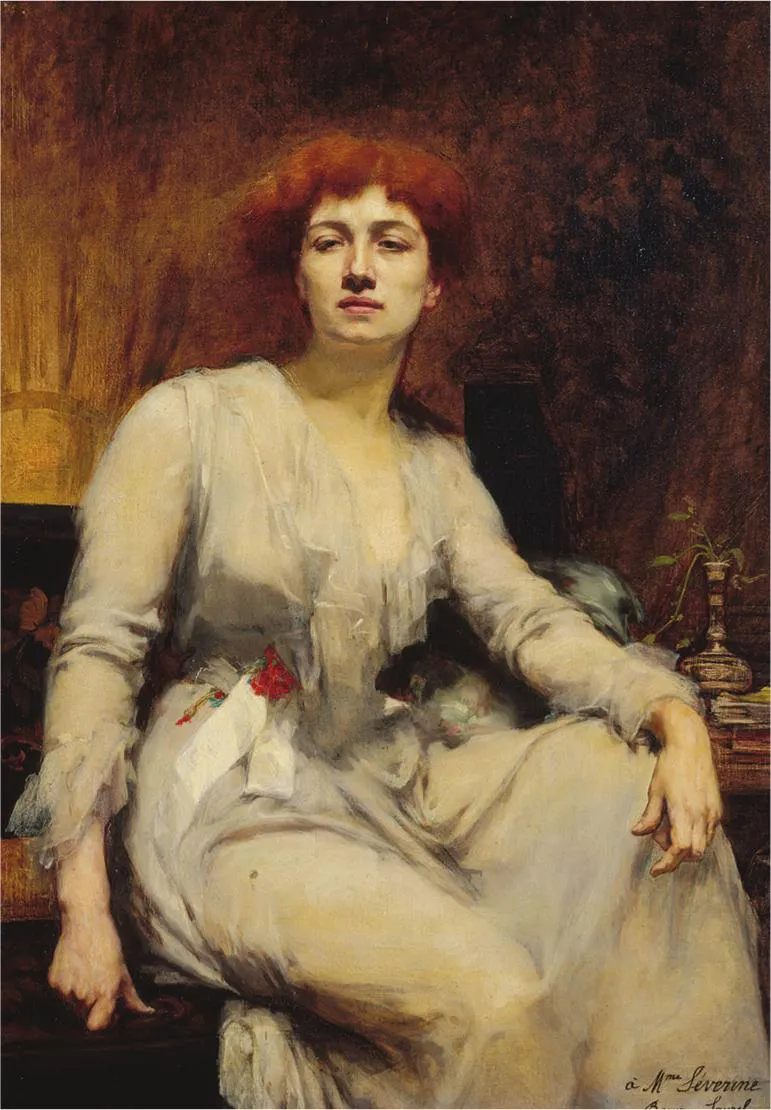
7. Amélie Beaury-Saurel, Portrait of Séverine, 1893
The artist depicts the journalist and militant feminist Séverine looking every inch the glamorous, sophisticated Parisienne. Although Beaury-Saurel had established her reputation as a portraitist, she also taught at the woman’s studio at the Académie Julian and later married the owner, Rodolphe Julian.
The artist depicts the journalist and militant feminist Séverine looking every inch the glamorous, sophisticated Parisienne. Although Beaury-Saurel had established her reputation as a portraitist, she also taught at the woman’s studio at the Académie Julian and later married the owner, Rodolphe Julian.
This was the city to which young artists flocked in the second half of the nineteenth century, bent on obtaining what few of them were able to find in their own countries: serious instruction at one of Paris’s private art academies. They came in their hundreds from America, Britain, Europe, Scandinavia and Finland. These female artists were bold, emancipated, ambitious New Women who no longer saw themselves as ‘Angels in the House’ – women who embodied the Victorian ideal of submissive, domesticated wives or daughters – but energetically espoused the feminist ideal. They came, not chaperoned by their parents, but with their girlfriends or unmarried sisters. They crossed Europe by train, traversed the Atlantic by steamship. In 1870 May Alcott Nieriker (who was immortalised as Amy in Louisa May Alcott’s Little Women) travelled to Paris from Philadelphia and later wrote a guide for American students, Studying Art Abroad and How to Do it Cheaply (1879). She had no qualms about a woman travelling ‘unprotected’ as ‘the railroad regulations and order in Europe are so complete’ that ‘she finds herself the especial charge of the officials, until handed to a cab by a civil porter, with her much-belabelled luggage safely piled on the roof ’.5 Oddly enough, the one thing she does not mention in her guide is the need to speak French and, indeed, many Americans arrived in Paris unable to speak a word of the language, thus making them easy prey for the sly concièrges and light-fingered domestic servants, or bonnes, whom May Alcott Nieriker warned against in her guide.

8. Berthe Morisot, Summer’s Day, 1879
For this scene, Morisot first executed a watercolour sketch and then worked on the oil painting in the studio. She had become increasingly interested in the immediacy and atmospheric effects she could produce in watercolour and evolved a technique whereby she could retain the liveliness and lightness of the medium in oils.
For this scene, Morisot first executed a watercolour sketch and then worked on the oil painting in the studio. She had become increasingly interested in the immediacy and atmospheric effects she could produce in watercolour and evolved a technique whereby she could retain the liveliness and lightness of the medium in oils.
These ambitious young women could not have come to Paris at a more exhilarating time for artists. Change was in the very air they breathed. The power of France’s great art institutions, the Salon and the École des Beaux-Arts, had begun to wane. The highly influential French artist Jules Bastien-Lepage found the tuition at the latter stifling in its commitment to the conventions of the past. ‘You want to paint what exists, and they invite you to paint the Unknown Ideal, that is to say, more or less to imitate the paintings of old.’6
From mid-century, styles of painting succeeded each other with breathtaking speed: the Realism of Jean-François Millet and Gustave Courbet gave way to the Impressionism of Claude Monet and Renoir. In the century’s last two decades the Post-Impressionism of Cézanne, Gauguin and Van Gogh predominated. The Paris Salon, despite its decline, was still the ultimate marketplace for contemporary art, and women could now also exhibit their work at the Salon des Femmes. There were other signs of improvement in the lot of women artists: Rosa Bonheur was awarded the Légion d’honneur for her animal paintings – the first female artist to be given this award – and the Dutch artist Thérèse Schwartze made so much money as a portraitist that she left a fortune at her death.7 It is estimated that in 1883 there were 3,000 French women working as professional artists.8
It is most unlikely that any of these eager young women would have read Henri Murger’s hugely popular Scènes de la vie de Bohème (published in 1845, but not translated into English until 1887), as it would have been thought highly improper for them to learn about the lives of poverty-stricken art students living in chilly attics in the city’s Latin Quarter. (The word ‘bohemian’ is from the French for ‘gypsy’.) They would certainly have been unaware of the...
Table of contents
- Title Page
- Contents
- Introduction
- 1: La Vie de Bohème
- 2: The Great Outdoors
- 3: The Marketplace
- 4: Painters of Contemporary Life
- 5: Women Impressionists
- 6: Painting Themselves
- 7: The Power to Inspire: Artists as Muses
- 8: The White Marmorean Flock
- 9: The Avant-Garde, 1900–14
- Biographies of the principal women artists
- Bibliography
- List of illustrations
- Index
- Acknowledgements
- Copyright
Trusted by 375,005 students
Access to over 1.5 million titles for a fair monthly price.
Study more efficiently using our study tools.
Frequently asked questions
Yes, you can cancel anytime from the Subscription tab in your account settings on the Perlego website. Your subscription will stay active until the end of your current billing period. Learn how to cancel your subscription
No, books cannot be downloaded as external files, such as PDFs, for use outside of Perlego. However, you can download books within the Perlego app for offline reading on mobile or tablet. Learn how to download books offline
Perlego offers two plans: Essential and Complete
- Essential is ideal for learners and professionals who enjoy exploring a wide range of subjects. Access the Essential Library with 800,000+ trusted titles and best-sellers across business, personal growth, and the humanities. Includes unlimited reading time and Standard Read Aloud voice.
- Complete: Perfect for advanced learners and researchers needing full, unrestricted access. Unlock 1.5M+ books across hundreds of subjects, including academic and specialized titles. The Complete Plan also includes advanced features like Premium Read Aloud and Research Assistant.
We are an online textbook subscription service, where you can get access to an entire online library for less than the price of a single book per month. With over 1.5 million books across 990+ topics, we’ve got you covered! Learn about our mission
Look out for the read-aloud symbol on your next book to see if you can listen to it. The read-aloud tool reads text aloud for you, highlighting the text as it is being read. You can pause it, speed it up and slow it down. Learn more about Read Aloud
Yes! You can use the Perlego app on both iOS and Android devices to read anytime, anywhere — even offline. Perfect for commutes or when you’re on the go.
Please note we cannot support devices running on iOS 13 and Android 7 or earlier. Learn more about using the app
Please note we cannot support devices running on iOS 13 and Android 7 or earlier. Learn more about using the app
Yes, you can access Nineteenth-Century Women Artists by Caroline Chapman in PDF and/or ePUB format, as well as other popular books in Art & Art General. We have over 1.5 million books available in our catalogue for you to explore.