- 208 pages
- English
- ePUB (mobile friendly)
- Available on iOS & Android
eBook - ePub
About this book
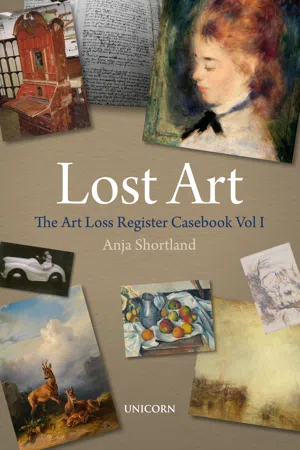
Countless dollars of art are stolen or looted every year, yet governments often consider art theft a luxury problem. With limited public law enforcement, what prevents thieves, looters and organised criminal gangs from flooding the market with stolen art? How can theft victims get justice – even decades after their loss? What happens if the legal definition of a good title is at odds with what is morally right? Enter the Art Loss Register, a private database dedicated to tracking down stolen artworks. Blocking the sale of disputed artworks creates a space for private resolutions – often amicable and sometimes entertainingly adversarial. This book is based on ten cases from the Art Loss Register's archive, showing how restitutions were negotiated, how priceless objects were retrieved from the economic underworld and how thieves and fences end up in court and behind bars. A fascinating guide to the dark side of the global art market.
Information
Topic
ArtSubtopic
Art General7
1
Introduction
There is a common perception that the art market is a new ‘Wild West’: a huge international grey market riddled with fakes and forgeries, stolen and looted objects with very limited law enforcement.1 Yet at the same time, the art market is a highly successful global service industry with a turnover in the region of US$65 billion per annum between 2013 and 2019.2 Sophisticated investors regularly spend millions, or even tens and hundreds of millions of dollars on rare and fashionable artefacts, suggesting the market is as transparent and liquid as other asset markets. If the art market operates largely beyond state control, how do market participants make and enforce rules that maintain consumer confidence and trust? This book examines a private crime control initiative against art theft: the Art Loss Register (henceforth the ALR), whose database on stolen and looted artefacts provides timely information to buyers, dealers and auction houses on whether an artwork is claimed by a previous owner, and offers a service to resolve such claims before the object is sold. But the ALR is much more than a biddable service provider that 8keeps its customers out of trouble. The company is controversial because it challenges entrenched business practices in the market: pushing for greater transparency, demanding respect for (largely unenforced) laws and promoting the interests of victims of crime.
Art theft, artnapping, fakes and forgeries, looting of cultural heritage, money laundering and fraudulent investment schemes are recurrent themes in the media. The massive increase in the prices for ‘passion assets’ since the 1980s has created a multitude of profit opportunities for legal as well as illicit and illegal businesses.3 As the world’s financial elite drive up the cost of fashionable art, antiques, rare cars, watches and antiquities, savvy investors follow suit. Criminals respond to the burgeoning demand for high-status luxury goods by stealing from private and museum art collections, robbing people for jewellery, burgling houses, and looting graves, churches and archaeological sites. Crooks try to pass off brand-new forgeries or old copies and pastiches as authentic works of famous masters. Fraudsters con investors by selling multiple, overlapping financial stakes in desirable artworks. A large service industry stands ready to shelter ill-gotten valuables and counterfeits from law enforcement and (knowingly or unknowingly) sell them on to collectors who do not know how to ask the right questions, or who simply do not care.
The constant threat of art crime raises two fascinating questions. First, how do sellers, dealers and auction houses maintain the trust of buyers in the authenticity and legitimacy of artworks offered for sale? Passionate collectors may have the time, resources and expertise to spot sophisticated scams, verify the authenticity of an artwork and investigate whether there is a former owner somewhere in the world who might try to reclaim the object at some point in the future. Shrewd well-off collectors and investors employ professionals to conduct such investigations. However, most art buyers rely on sellers to exercise due diligence on their 9behalf. Top prices are only paid when buyers are confident the offered works are genuine and unencumbered. What underpins buyers’ trust that artworks are ‘as described’ and that any problems will be rectified with the minimum of fuss and financial loss?
Second, what has brought about the sea change in art buyers’ attitudes over the last thirty years? Until the 1990s, few collectors bothered to make detailed enquiries into an object’s recent provenance. Export restrictions designed to protect countries’ cultural property were commonly flouted. There was a brisk trade in looted antiquities.4 Some auction houses were complicit in smuggling art into London and New York, or determinedly turned a blind eye to their consignors’ inability to provide a credible history of ownership for their pieces.5 Theft victims and families who spotted their ancestors’ Nazi-looted artworks in private collections, public sales or museums had little hope of recovering them.6 Fakes and forgeries could circulate freely once they had been accepted as genuine by a single well-known dealer or connoisseur. Nowadays, artworks that have been smuggled, looted or stolen, or whose origin is dubious, are considered suspect and even distasteful. What explains this massive shift in social norms?
It is highly unlikely that improved policing provides the answer to these questions. If anything, states have become less active in policing the art market over the last twenty years. In most countries, police budgets are stretched to breaking point. Police chiefs face tough decisions about how to divide their limited resources between fighting violent, drug and property crime. In times of financial austerity, property crimes can slip silently down the political priority list. To most voters, art crime looks like a luxury problem. As the Director of the UK Police Foundation put it: ‘My sense is that [art crime] is not prioritised because of everything else the police have to do that is more pressing. 10Acquisitive crime generally is deprioritised with the increased focus on violent and sexual crime, which now make up the overwhelming bulk of investigative work.’7 Moreover, artworks easily cross international borders into jurisdictions that make it deliberately difficult to seize stolen objects and hold criminals to account. Thus, policing the art market is not only expensive and time-consuming, but also success is far from assured. Major international police operations to track down stolen art or antiquities are therefore the exception rather than the rule.
Some jurisdictions – especially New York – have lowered the barriers for former owners to reclaim their property through the civil courts. However, seeking legal redress brings its own problems. Disputes over art are generally highly complex, making court cases both costly and lengthy. Court cases are also conducted in public and frequently attract significant media coverage. The saying ‘nobody looks good in court’ could have been coined for the art market. Even if they know they have a good legal case, many people prefer to avoid resolving the problem under the glare of the media spotlights. Does that make the art market effectively lawless?
When we take a close look at ‘Wild West’ situations and markets, we often find they are surprisingly well-ordered. When states are weak or exercise power only sporadically, individuals, voluntary organisations and private companies step in to fill the gaps. We see private initiatives to protect citizens and their property, gather information, enforce contracts, adjudicate or mediate in disputes, or help the police to enforce the law within their limited budgets. The lack of public law and order therefore does not mean the global art market is anarchic or has been taken over by criminals. It is in the commercial interest of top-end dealers, fair organisers and auction houses to create institutions that maintain the trust of art buyers. 11
Private solutions
Collectors who display their artworks only to close friends and would never dream of parting with their treasures can choose to ignore gaps in their artworks’ provenance. But art investors who frequently flip their assets rely on secure titles. Every public sale is an opportunity for hidden problems to come to light: former owners may spot their possessions being advertised in a catalogue or online and try to reclaim them. Experts attending pre-sale viewings may throw doubt on an artwork’s authenticity. Rich and powerful people may acquire art to demonstrate their wealth and good taste. But showing off artworks in glossy magazine spreads, in social media and at glamorous events similarly comes at the price of public scrutiny and potential exposure. Philanthropists who display their collections in private galleries, lend them to public exhibitions or donate important works to museums must expect them to be examined in minute detail by curators, conservators, provenance researchers and academics. When collectors exhibit their treasures, they seek positive publicity and status gain. They do not want the embarrassment of having been tricked or lawsuits brought by former owners. Thus, anyone who wants to serve the world’s most attractive client base must be seen to take all reasonable precautions against offering counterfeit, stolen, smuggled or looted artworks. In case something slips through the net, reputable dealers and auctioneers prove their good faith by reimbursing their disappointed (VIP) customers. For example, in 2016 Sotheby’s rescinded the 2011 sale of a painting sold as a work by Frans Hals after technical analysis proved it to be a counterfeit and returned the full sale price of £8.5 million to the buyer.8
Offering buy-back guarantees is a high-stakes gamble unless one has confidence in the provenance of every object on sale. Yet, not all legitimately owned artworks, antiques or pieces of 12jewellery have a complete paper trail of consensual sales leading back to the original maker. In fact, relatively few objects have a perfect provenance. Many artefacts just come with some oral history passed down the generations such as ‘your great-great-uncle Luke brought this back from Abyssinia in the 1890s’. Tourists on the Grand Tour in the eighteenth century shipped antique statuary home by the cartload. In the past, gifts were rarely formally documented. Even if they existed, import and export licences and receipts are lost over time: through negligent bookkeeping, during moves, house fires, divorces or floods. Bargain hunters can pick up genuine but unprovenanced treasures at flea markets and car boot (or yard) sales for spare change. Can you tell the difference between an object that has become accidentally detached from its provenance from one that was criminally severed from it?
It is not surprising the art market has developed a commercial solution to this thorny question: to facilitate the trade in legitimately owned art and luxury goods, as well as raising the stakes for criminals trying to infiltrate and contaminate this lucrative market. Enter the Art Loss Register.
Serving the art market
The ALR was founded in 1990 as a joint initiative between insurers, reputable art dealers and the world’s top auction houses to prevent the circulation of stolen artefacts in the market. It is majority-owned by its founder Julian Radcliffe, with Sotheby’s and Christie’s as minority shareholders. The ALR has compiled the world’s most comprehensive database on lost, stolen and at-risk artworks, antique furniture and antiquities. By July 2020 it had registered more than700,000 uniquely identifiable objects, 13gathering data from a wide range of sources. The ALR’s team of researchers started off by recording the historic theft data collated by the International Foundation for Art Research (IFAR). This not-for-profit educational and research organisation in New York had collected and publicised detailed reports on art thefts since 1977.9 The ALR’s innovation was to create a searchable database of lost and stolen artefacts, which is constantly updated by adding information on art thefts reported to Interpol, theft reports from various industry associations and insurance records.
In addition, the ALR database offers a direct service to theft victims who can prove ownership and supply a detailed description of the object, high-quality photographs and evidence of the crime (such as a police report number). Families looking for Nazi-looted artefacts can register their art loss on the database. It is also possible to register assets under legal dispute (e.g. in divorce proceedings), works that are mortgaged and cannot be sold without the lender’s agreement and well-documented archaeological treasures at extreme risk of looting.10 The company provides a similar facility for registering stolen luxury watches – The Watch Register – with a total of over 70,000 entries. Although it is theoretically possible for dealers to independently search some of the ALR’s source files – taking care to look at foreign police data in addition to the subset of crimes recorded on the Interpol database – this is clearly impracticable and uneconomic. It would also be less reliable, as police and insurers eventually remove objects from their databases and information from private subscribers would be missed. Over a period of thirty years the ALR has thus become the most comprehensive and internationally respected provider of timely information on stolen valuables in the art world.
Anyone who can prove a legitimate interest in an artwork can pay for a search to be carried out. In the first stage, ALR 14staff conduct a search based on a description of the artwork’s key attributes to narrow down the list of potential matches. In the second stage, high-resolution photographs of the object are compared with those submitted by the theft victims. When a search results in an all-clear, the provenance does not raise any red flags and the documents are credible, the item can be sold in good faith. If there is a possible match, the ALR may ask the searching party to examine the artwork physically and send additional photographs (including the reverse of the object). This information is compared to that provided by the registrant to determine or rule out a match. If a match is confirmed, the company or individual commissioning the search and the former owners/lenders/co-owners are alerted. If the holder is suspected of smuggling or fencing stolen goods, the police are informed.
Often, however, many years have passed since the crime was committed, and the holder may be abroad or hiding their identity. In these cases, there is little chance of a successful prosecution. Yet, reputable dealers, art fairs and auction houses will still refuse to sell the object until the title issues raised by the ALR are fully resolved. This puts the artefact in a state of limbo as far as a public sale is concerned. The holders can withdraw the disputed item from sale, sell it privately (probably at a significantly lower price) or seek a settlement. If the last option is chosen, the ALR puts the current holders directly in touch with the former owners or helps to broker a settlement between the rival claimants. Depending on the preferred course of action, the ALR then charges either a location fee or a recovery fee, which are a small percentage of the final benefit for the registrant.
Many dealers and auction houses subscribe to this service and check all valuable objects routinely before a sale. These due diligence procedures reassure customers that they can buy in good faith, and protect buyers, dealers and market makers against 15scandal and future lawsuits. An increasing number of art and antiques fairs similarly engage the services of the ALR to check the exhibitors’ offerings and thereby create a visible barrier against art crime. Private individuals can consult the register to investigate the legitimacy of artworks they wish to purchase. They have t...
Table of contents
- Title Page
- Dedication
- Contents
- 1: Introduction
- 2: The Moral Maze: Negotiating the Return of a Multimillion-dollar Cézanne
- 3: The Criminal Lawyer: Finder or Fence?
- 4: The Santamarina Impressionists: A ‘Very Political’ Recovery
- 5: A Find in the Attic: The Missing Minutes of the Royal Society
- 6: Sleeping Beauty: From Grubby Seascape to Saleroom Glory?
- 7: Justice v the Law: Restitution of Holocaust-era Looted Art
- 8: A Convenient Grey Zone: ‘Restoring’ Antique Furniture
- 9: Outfoxed: The Table with the Hairy Hocks
- 10: Illicit Antiquities: Looters v Archaeologists
- 11: Some Like It Hot: Fencing Stolen Watches
- 12: Conclusion: Transforming the Norms of the Art Market
- Notes
- Further Reading
- Acknowledgements
- Index
- Copyright
Trusted by 375,005 students
Access to over 1.5 million titles for a fair monthly price.
Study more efficiently using our study tools.
Frequently asked questions
Yes, you can cancel anytime from the Subscription tab in your account settings on the Perlego website. Your subscription will stay active until the end of your current billing period. Learn how to cancel your subscription
No, books cannot be downloaded as external files, such as PDFs, for use outside of Perlego. However, you can download books within the Perlego app for offline reading on mobile or tablet. Learn how to download books offline
Perlego offers two plans: Essential and Complete
- Essential is ideal for learners and professionals who enjoy exploring a wide range of subjects. Access the Essential Library with 800,000+ trusted titles and best-sellers across business, personal growth, and the humanities. Includes unlimited reading time and Standard Read Aloud voice.
- Complete: Perfect for advanced learners and researchers needing full, unrestricted access. Unlock 1.5M+ books across hundreds of subjects, including academic and specialized titles. The Complete Plan also includes advanced features like Premium Read Aloud and Research Assistant.
We are an online textbook subscription service, where you can get access to an entire online library for less than the price of a single book per month. With over 1.5 million books across 990+ topics, we’ve got you covered! Learn about our mission
Look out for the read-aloud symbol on your next book to see if you can listen to it. The read-aloud tool reads text aloud for you, highlighting the text as it is being read. You can pause it, speed it up and slow it down. Learn more about Read Aloud
Yes! You can use the Perlego app on both iOS and Android devices to read anytime, anywhere — even offline. Perfect for commutes or when you’re on the go.
Please note we cannot support devices running on iOS 13 and Android 7 or earlier. Learn more about using the app
Please note we cannot support devices running on iOS 13 and Android 7 or earlier. Learn more about using the app
Yes, you can access Lost Art by Anja Shortland in PDF and/or ePUB format, as well as other popular books in Art & Art General. We have over 1.5 million books available in our catalogue for you to explore.