eBook - ePub
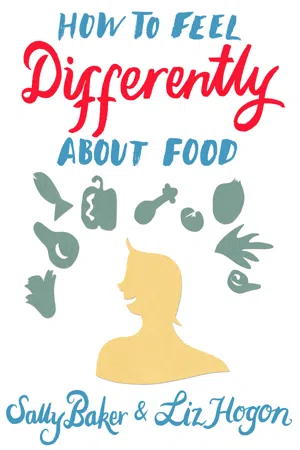
How To Feel Differently About Food
liberation and recovery from emotional eating
- 300 pages
- English
- ePUB (mobile friendly)
- Available on iOS & Android
eBook - ePub
How To Feel Differently About Food
liberation and recovery from emotional eating
About this book
Sally Baker and Liz Hogon, informed by helping thousands of clients achieve a sustained healthy approach to eating, have researched and written How To Feel Differently About Food to break the painful cycle of yo-yo dieting and emotional eating. The book cuts a clear path through the conflicting nutritional information that fills the popular media to reveal the best way to eat for improved health and enhanced mood, boost energy without triggering feelings of hunger and stop wildly fluctuating blood-sugar levels that lead to cravings. They explain how to make informed and appetising food choices and how to implement small but empowering new eating habits from breakfast onwards. Learning new ways of thinking and feeling about food will naturally enable readers to approach food differently. These positive changes are designed to be effortlessly integrated into a busy life with minimum planning and preparation, including how to eat for nourishment, become healthier, lose excess weight if appropriate, and boost mood as well as help to combat anxiety and depression.
Information
Topic
MedicineSubtopic
Nutrition, Dietics & BariatricsCutting through the confusion
Never before in the history of humankind have we faced a situation where increasing numbers of the older generation are predicted to outlive their offspring. Never before has there been a time with such a wealth of information about what we should and should not eat. Messages bombard us from every angle, in all types of media, from the evermore confusing labelling on food packaging through persuasion from celebrity-endorsed brands to government-funded campaigns, proliferating all over the Western world, and yet we still find ourselves in the middle of an increasing and unprecedented obesity epidemic.
So, with all this information and guidance we should be the healthiest, most nutritionally savvy generation ever to live on Earth – yet this just isn’t the case. The ‘standard American diet’ (SAD) leaves increasing numbers of people overfed yet nutritionally undernourished, contributing to poor general health on a massive scale. The effects were once largely found in industrialised countries, but are now obvious in developing nations too, making this a truly global problem.
It is obvious that the healthy eating message has become so confused and contradictory that even the so-called ‘experts’ cannot agree on an effective strategy to improve public health. The information overload ultimately amounts to just so much white noise, and in the end we just zone out and ignore it.
The high percentage of people who are currently struggling with their weight, or labelled obese by the medical community, is the greatest challenge of the 21st century. Much of the problem of excessive weight gain and obesity can be laid at the door of the convenience food manufacturers and the proliferation of 24/7 takeaways, with fast-food outlets on every high street. The popularity of sweet drinks; the habit of constantly grazing; snacking while on the move; the lack of structure around meal times – all of this means no-one is sure any more if they are hungry or can recognise when they are full. This is especially true when so much eating happens when busy doing other things. Eating then becomes a secondary activity that is barely registered by the conscious mind.
The majority of today’s popular processed foods and soft drinks have been developed in laboratories by men and women in white coats (rather than chef’s hats!) with ingredients’ lists that read like advanced chemistry. So many multi-syllable, unpronounceable, unrecognisable ingredients go into making Frankenstein-type concoctions of unhealthy fats, sugars and artificial flavourings in a never-ending variety of high profit margin fake foods. Our taste buds have been assailed for years by an onslaught of synthetic flavours, textures and colours, so that now many people have a hard time knowing what real food should even taste like. These processed foods are so prevalent, and so expertly marketed, it’s no wonder we fall victim to them. So-called ‘low fat’ this, and ‘no added sugar’ that; we buy them thinking that we are doing ourselves good and eating healthily when in fact we are eating nothing short of a packet full of lies and chemicals. These products are so adulterated they shouldn’t even be called ‘food’!
The food industry seems to take a perverse delight in conjuring up calorifically loaded foods, sometimes exceeding an adult’s entire daily calorie allowance in just a single serving. They love to abracadabra into existence these highly addictive combinations of fats, sugars and artificial flavourings that would never exist in a natural form; to formulate irresistibly tempting ‘goop’ with huge calorie loads, and absolutely no nutritional value.
Profit-motivated agribusinesses have been allowed unprecedented free rein, in their ‘state of the art’ laboratories, to genetically modify our crops and adulterate our foods so that many are no longer recognisable from their original, natural state. Much of the research was sanctioned and funded by first world governments with the altruistic aim of ending famine in the third world by developing new strains of crops, more resistant to blight, and to increase yields in poor growing conditions. All of this was done with the best of intentions. However, the ramifications of the unfettered, profit-hungry agribusinesses are only now becoming known and many of these outcomes are not so beneficial. The true effect of these practices is often obscured by profit margins and vested interests.
For instance, these very same agribusinesses have turned natural seasonal eating into whole-year-round availability of every type of fruit and vegetable, flown in from every corner of the globe. Sounds fine in theory perhaps, except the essential micro-nutrients in these once seasonal foods are now hugely reduced due to their being grown with the use of excessive pesticides, or force-grown under plastic, or picked before ripened, so that they can be flown to distribution hubs thousands of miles away.
The food giants manufacture a vast range of cans of carbonated soft drinks, energy drinks and sodas containing excessive sugar, artificial sweeteners, caffeine, phosphorus and carbon acids, all of which can cause harmful effects to the body.
Collectively, the efforts of the food manufacturing giants have normalised a way of eating that would seem alien to our grandmothers’ generation. We often play with the idea of the mythical ‘grandmother’ test to judge if a food or a food process would comply with real food guidelines. The restaurant critic and food writer Jay Rayner (2015) wrote in The Observer Food Magazine, ‘Whenever I hear a pursed-lipped food campaigner announce that we should only eat things our grandmothers would recognise, my first thought is that my grandmother was a lousy cook, and I’d fight to keep her away from the kitchen.’
For our purposes, our grandmothers would really have known their stuff and would have been great scratch cooks, working with real ingredients to create wholesome meals. They would certainly have had no time for the many radical changes in food production and eating habits that have led to a year upon year increase in worldwide obesity rates since the end of the Second World War (Academic Earth, 2015).
While these changes have been taking place, many consumer-focused organisations and spokespeople who are in positions of power and influence, and who should have been on the lookout for the ordinary consumer, have been silent. Instead, they made themselves profitable alliances with the food giants. These alliances have contributed to creating a complex web of conflicts of interest, on an international scale.
It would be absurd and laughable if it wasn’t true. Take for instance the Academy of Nutrition and Dietetics. With over 75,000 members, it is the largest association of food and nutritional professionals in the world. In very recent times their membership has applied pressure for the organisation to relinquish some of its questionable connections to food manufacturing giants that have included Coca-Cola, Kraft Foods, Nestlé, Hershey’s, PepsiCo and McDonald’s. Their current sponsors are listed on their Meet Our Sponsors page and still include PepsiCo (Eat right pro, 2016). They have given approval and allowed these monolithic conglomerates, and many others besides, to provide educational material for their own organisation that, by association, blurs health issues and confuses the public.
When London hosted the Olympic Games in 2012, the International Olympic Committee squandered the opportunity of promoting a positive healthy-eating message by agreeing to sponsorship from fast-food manufacturers McDonald’s along with Coca-Cola and Cadbury’s chocolate.
McDonald’s opened its largest restaurant in the world right inside the Olympic Park, and Coca-Cola expected to serve over 20,000,000 fizzy drinks at the Games, benefiting as it did from its near monopoly at Olympic venues. It is the potential conflicts of interest such as these that obscure clear messages around nutrition and are one of the reasons why people feel so overwhelmed, and confused about what to eat.
Our aim in this book is to show you how you can cut through all the hype, debunk all the myths and confusion, and eat for nutrition, weight loss if appropriate, and optimum mental and physical health.
Kurtay’s kitchen story
My interest in feeling differently about food and improving my eating habits was motivated by my desire to cure myself of multiple sclerosis (MS). I was diagnosed when I was 19 years old and not surprisingly it felt like a devastating blow. I felt overwhelmed and pretty powerless for a long time. Going into therapy and undertaking my own research made me want to be proactive about my own health. My thinking shifted to such an extent that I felt empowered to improve my health. Everything I’ve read and studied over the years always comes back to the importance of nutrition.
I find that eating salads, mainly green leaves, along with grilled fish, such as salmon, sea-bass and fresh tuna, makes me feel more energised. I also find starting the day with a home-made green juice helps me to feel mentally sharper and physically more ready for the day ahead. My favourite recipe is a handful of kale, fresh spinach, stick of celery, a carrot, a small piece of fresh turmeric, a crisp, green apple with fresh lemon or lime all juiced together. I add coconut water until it has the right consistency to drink. It’s delicious.
I have lived with the diagnosis of MS for over 10 years now and my body soon tells me when I am working to help it or hinder it. If I’ve had a few days of not eating well, or eating on the run as I’ve been too busy to prepare the food I know works for me, the contrast in how I feel and how much energy I have is astounding. What I choose to eat has a very tangible effect on my health, and eating real food makes me feel I can play a positive role in managing my condition and one day over-turning this diagnosis.
The one piece of advice I have for anyone considering switching from processed foods to real foods is that only you can help yourself, so stop asking and start acting – your body will thank you for it.
You can follow Kurtay on Twitter: @Kurtaytoros83
Just eat real food
Human beings, supposedly at the top of the food chain, are the only creatures on Earth who are confused about what to eat. Wild animals do not turn to experts, or stress themselves out about what they should or should not eat – they are just focused on getting enough. Nor do they obsess by weighing or measuring everything. They simply eat when they are hungry, stop when they are full, and consume what is available in their environment, appropriate for their bodies.
If further proof is required as to the level of confusion there is around what food choices to make, then ponder this: Eating real food is in itself a movement. It goes by many names too. One of the emergent names for this kind of eating is ‘paleo’ which is shorthand for Paleolithic. This was an era in history dating back some 2.6 million years. There are many definitions of what paleo means. Some people can get very animated about what qualifies as ‘real’ paleo, and what does not. The term has been around for less than a decade yet it has already spawned specific approaches and conf...
Table of contents
- Cover
- Title Page
- Copyright
- Dedication
- Contents
- Preface
- Foreword
- About the authors and how we came to write this book
- Key principles of how to feel differently about food
- Cutting through the confusion
- References
- Bibliography
- Resources
- Index
- Also by Sally Baker and Liz Hogon…
Trusted by 375,005 students
Access to over 1.5 million titles for a fair monthly price.
Study more efficiently using our study tools.
Frequently asked questions
Yes, you can cancel anytime from the Subscription tab in your account settings on the Perlego website. Your subscription will stay active until the end of your current billing period. Learn how to cancel your subscription
No, books cannot be downloaded as external files, such as PDFs, for use outside of Perlego. However, you can download books within the Perlego app for offline reading on mobile or tablet. Learn how to download books offline
Perlego offers two plans: Essential and Complete
- Essential is ideal for learners and professionals who enjoy exploring a wide range of subjects. Access the Essential Library with 800,000+ trusted titles and best-sellers across business, personal growth, and the humanities. Includes unlimited reading time and Standard Read Aloud voice.
- Complete: Perfect for advanced learners and researchers needing full, unrestricted access. Unlock 1.5M+ books across hundreds of subjects, including academic and specialized titles. The Complete Plan also includes advanced features like Premium Read Aloud and Research Assistant.
We are an online textbook subscription service, where you can get access to an entire online library for less than the price of a single book per month. With over 1.5 million books across 990+ topics, we’ve got you covered! Learn about our mission
Look out for the read-aloud symbol on your next book to see if you can listen to it. The read-aloud tool reads text aloud for you, highlighting the text as it is being read. You can pause it, speed it up and slow it down. Learn more about Read Aloud
Yes! You can use the Perlego app on both iOS and Android devices to read anytime, anywhere — even offline. Perfect for commutes or when you’re on the go.
Please note we cannot support devices running on iOS 13 and Android 7 or earlier. Learn more about using the app
Please note we cannot support devices running on iOS 13 and Android 7 or earlier. Learn more about using the app
Yes, you can access How To Feel Differently About Food by Sally Baker,Liz Hogon in PDF and/or ePUB format, as well as other popular books in Medicine & Nutrition, Dietics & Bariatrics. We have over 1.5 million books available in our catalogue for you to explore.