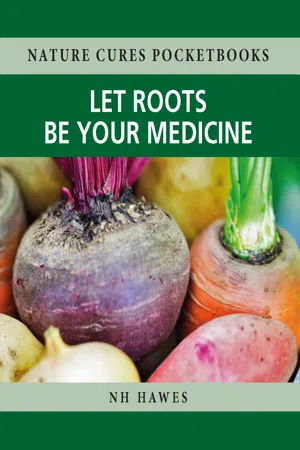
The roots of plants have been used as medicines and nutritious food for thousands of years. Many have astonishing properties which can heal and remedy most human ailments and diseases without the harmful side-effects of powerful medications. They should be an important part of the daily diet but most are often neglected. This A to Z pocket guide of root vegetables includes their nutritional values and which health issues they can help to treat and prevent.
- 300 pages
- English
- ePUB (mobile friendly)
- Available on iOS & Android
eBook - ePub
Let Roots Be Your Medicine
About this book
Trusted by 375,005 students
Access to over 1.5 million titles for a fair monthly price.
Study more efficiently using our study tools.
Information
Introduction
Our ancestors evolved to leave the trees and walk upright approximately 4.4 million years ago. This gave them the evolutionary advantage of access to ground-level foods, such as the nutritious roots of plants, and their teeth evolved in line with this. Chimpanzee diets focused more on fruit whilst gorillas stayed with leaves.
The roots of plants have been consumed by humans as nutritious food and used as natural medicines ever since they evolved. Many have astonishing properties which can heal and treat most human ailments and diseases without the harmful side effects of manufactured drugs, but this has largely been forgotten in recent years due to the availability and ease of use of these modern pharmaceuticals.
Losing this traditional knowledge means we now treat some of nature’s most powerful natural antibiotics as weeds and discard them, or spray them with toxic weed killers, forgetting that they provide an abundance of nutrients our bodies need.
Two prime examples are dandelions (Taraxacum officinale, page 38) and burdock (Arctium lappa, page 26). The roots of both these plants have powerful antibacterial, antifungal and diuretic properties and are protective for the kidneys and liver. It is strange that dandelion and burdock both used to be favourite and very healthy and nutritious beverages in years gone by but have since mysteriously disappeared from our repertoire.
Precisely because the roots of plants grow under the ground they absorb many nutrients from the soil, especially minerals. Many produce tubers which are the storehouses for these nutrients and the sources of buds, from which new plants will grow. However, there is a constant battle with microbes and other organisms in the soil that want to consume these rich stores of nutrients. Plants have evolved in thousands of diverse shapes and structures to find sustenance, reach the sunlight, reproduce and evade the microbes and other organisms that want to feed on them. Their predators have evolved similarly to overcome the obstacles plants place in their way.
Plants have also developed antimicrobial substances to repel or kill off particular invading foragers and parasites. When we consume these substances, they can have a similar effect within and upon the human body. They will destroy the microbes and parasites that also try to feed on us. For instance, garlic and onions produce allicin when damaged, which is a very powerful antioxidant. For the underlying chemical reaction to take place, these roots must be left to stand for 10 minutes after being peeled and chopped, before being cooked or consumed.
Certain roots contain fat-soluble nutrients, such as carotenoids and vitamins A, D, E and K; these nutrients will not be absorbed by humans unless they are consumed at the same time as oily food, such as avocado, butter, oily fish or nut, seed and other plant oils. Vitamins D and E are usually found in foods that already contain oils, such as fish, seeds and nuts. Orange-coloured root vegetables, such as carrots, swede and sweet potatores, are especially rich in the carotenoids that are precursors to vitamin A.
How to prepare roots
Unless the outer skins of roots are completely inedible, as in the case of garlic, onions and tough roots such as swedes, the skins should also be consumed as this is often where many of the nutritional or protective compounds are located. Peeling vegetables such as carrots, parsnips, potatoes and sweet potatoes removes many of these vital nutrients and is unnecessary. The skins should simply be scrubbed well before use.
Most roots need either chopping and cooking or drying and grinding into a powder in order to extract the medicinal properties. Decoctions are the most concentrated and powerful of the following methods, followed by tinctures, then infusions. Unless otherwise stated further on, most of the nutrients and medicinal compounds of the roots mentioned in this pocketbook can be consumed using the methods below.
Baking, steaming and boiling
Raw juicing is a good way to obtain the highest levels of nutrients from vegetables without cooking them and destroying important enzymes. The juices of vegetables such as carrots and beetroot require little digestion, are rich in alkaline elements and provide plentiful, easily absorbed minerals. The juicing process breaks down tough cell walls but it does remove much-needed fibre too. When consumed as a vegetable, some softer roots can be steamed or boiled to break down their tough cell walls. Baking or steaming them retains more of the vitamin and mineral content, which can be lost in the water when they are boiled. On the other hand, using the water they were boiled in, for gravy and soups etc, is one way of consuming those lost nutrients; however, keeping this liquid for later use will degrade the nutritional content and therefore baking or steaming roots is generally a better choice.
Brine pickling
One of the best ways to store and consume many root vegetables is to immerse them in cold water with salt (brine) and allow them to ferment. Brine pickling, also known as lacto-fermentation, is an easy, traditional and the healthiest method of making pickles without using vinegar. Pickles made using this method are alive and rich in probiotics that are needed for a healthy intestinal environment. It is also a very safe way to preserve any excess produce for up to one year. (For information about how to make your own brine pickles see page 114.)
Decoctions
Decoction involves heating in water to produce a concentrated liquor. Roots and barks that are used medicinally are thicker and less permeable than the above-ground parts of plants and need to be boiled to extract their medicinal constituents. The roots should be scrubbed well, then chopped or broken into small pieces. To avoid losing volatile constituents, use a lid over the simmering pan. After cooling down, strain the solid from the liquid and pour the liquid into an air tight container and store in the refrigerator. Decoctions can be taken hot or cold or added to sauces and soups.
Infusions / macerations
Infusions, or teas, are made by infusing plant material in hot water for a short amount of time. Macerations involve the softening and breaking down of plant cell walls using prolonged exposure to a liquid (water or alcohol – the latter makes an ‘alcoholic maceration’, see page 11). Use approximately one to two teaspoons of dried root powder per cup of cold filtered water. For alcoholic macerations the proportions should be 20 parts of alcohol to one part of the plant.
Water-based infusions
- Bring the water to a boil and pour over the root powder.
- Cover the container and allow to steep for 10-20 minutes.
Consume one tablespoon of the mixture three times a day unless otherwise stated. One teaspoon of honey and the freshly squeezed juice of half a lemon may be added to make the infusion more palatable and provide additional healing properties. Infusions may be gently reheated and consumed as a tea with other medicinal herbs and spices.
Infused oils
Pure vegetable oils such as almond, olive, rapeseed and sunflower are easily found at general grocery stores. They have the property of dissolving the active, fat-soluble principles of medicinal plants. This process is called infusion and can be carried out at room temperature or higher. Infusion is a slower process than alcoholic maceration but has the advantage of resulting in an oil-based solution of medicinal constituents that can easily be used to make creams and ointments. Hot infusion is recommended for the harder parts of the plants, such as roots and stems, while cold infusion is more suitable for flowers and leaves.
Juicing and blending
Raw juicing is a good way to obtain the highest levels of nutrients from root vegetables without cooking them and destroying important enzymes. The juices of root vegetables such as carrots and beetroot require little digestion, are rich in alkaline elements and provide plentiful, easily absorbed minerals. The juicing process breaks down tough cell walls but it does remove the much-needed fibre too. A way to keep this fibre is to use a powerful blender instead and these are now available to purchase.
Ointments
Ointments are prepared like hot infused oils, the difference being that herbs are simmered in waxes or fats containing no water. After separating the simmered herbs by squeezing and cooling, the result is a solid mixture of the wax or fat with the medicinal constituents of the plant. Petroleum jelly, soft paraffin wax and bees wax are some common bases used. Ointments form an oily barrier on the surface of injuries and carry the active principles to the affected area.
Tinctures
Most of the volatile components of medicinal roots are soluble in alcohol, while some cannot be extracted by other methods as they are ‘hydrophobic’ (non-polar and repel water). By immersing dried or fresh roots in alcohol, the active principles are easily extracted at concentrations that exceed those that can be achieved by other methods. Furthermore, ethanol (the form of alcohol humans can drink) is easily evaporated under 50-60ºC leaving behind the required components. Highly concentrated solutions, that will last for one to two years, are a convenient way to store and use medicinal plant constituents. Ideally tinctures should be made using pure ethyl (ethanol) alcohol distilled from cereals. However, since this product is not easily available, good quality vodka with at least 45 per cent alcohol can be used. Tinctures are also known as ‘alcoholic macerations.
Method
- Clean and chop up the fresh roots.
- Place them in a clean container (preferably glass).
- Use a vodka that has at least 45 per cent alcohol content (also known as 90 per cent proof).
- Add the alcohol at a two to one ratio (that is, two cups of vodka to one cup of fresh roots).
- If using dried roots, use a five to one ratio instead (that is, five cups of vodka to one cup of dried roots).
- Make sure the roots are entirely submerged in the vodka.
- Let the mixture sit for about two weeks.
- Then strain it and pour it into a dropper bottle with an air-tight lid.
- Tinctures are meant to be used as medicine in very small amounts. Shake well and add a few drops to juices, smoothies, soups, teas, water or directly into the mouth when needed.
- If kept sealed in a cool dry place, tinctures can last for many years before losing their medicinal properties.
Note: Use ethanol only. Never use alcohol that is not meant for human consumption such as isopropyl alcohol, methyl alcohol, methylated spirits or any other kind of unknown spirit to make tinctures.
The A-Z of medicinal roots
Over the centuries of human inhabitation of this planet, the sheer diversity of plants and their powerful properties has caused many to be given multiple names, depending on the location. This has caused much confusion even to the botanists of Kew Gardens, the leading botanical institution in the world. Many were once commonly named as a ‘wort’...
Table of contents
- Cover
- Title Page
- Contents
- About Nature Cures
- 1. Introduction
- 2. How to prepare roots
- 3. The A-Z of medicinal roots
- 4. Prebiotic roots
- 5. How to make brine pickles
- Index
- About the Author
- Copyright
Frequently asked questions
Yes, you can cancel anytime from the Subscription tab in your account settings on the Perlego website. Your subscription will stay active until the end of your current billing period. Learn how to cancel your subscription
No, books cannot be downloaded as external files, such as PDFs, for use outside of Perlego. However, you can download books within the Perlego app for offline reading on mobile or tablet. Learn how to download books offline
Perlego offers two plans: Essential and Complete
- Essential is ideal for learners and professionals who enjoy exploring a wide range of subjects. Access the Essential Library with 800,000+ trusted titles and best-sellers across business, personal growth, and the humanities. Includes unlimited reading time and Standard Read Aloud voice.
- Complete: Perfect for advanced learners and researchers needing full, unrestricted access. Unlock 1.5M+ books across hundreds of subjects, including academic and specialized titles. The Complete Plan also includes advanced features like Premium Read Aloud and Research Assistant.
We are an online textbook subscription service, where you can get access to an entire online library for less than the price of a single book per month. With over 1.5 million books across 990+ topics, we’ve got you covered! Learn about our mission
Look out for the read-aloud symbol on your next book to see if you can listen to it. The read-aloud tool reads text aloud for you, highlighting the text as it is being read. You can pause it, speed it up and slow it down. Learn more about Read Aloud
Yes! You can use the Perlego app on both iOS and Android devices to read anytime, anywhere — even offline. Perfect for commutes or when you’re on the go.
Please note we cannot support devices running on iOS 13 and Android 7 or earlier. Learn more about using the app
Please note we cannot support devices running on iOS 13 and Android 7 or earlier. Learn more about using the app
Yes, you can access Let Roots Be Your Medicine by Nat Hawes in PDF and/or ePUB format, as well as other popular books in Biological Sciences & Nutrition, Dietics & Bariatrics. We have over 1.5 million books available in our catalogue for you to explore.