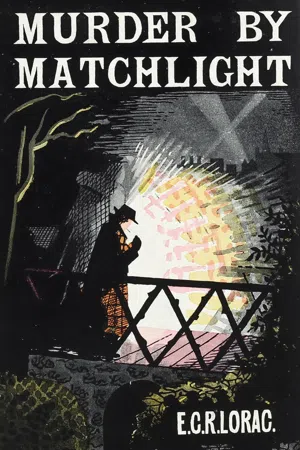
On a damp November evening in wartime London, a young chemist sits on a bench in Regent's Park and watches as an approaching stranger suddenly disappears beneath a footbridge. Seconds later another figure appears on the same overpass, stops to smoke and discard a cigarette, and strikes a match that briefly illuminates a face beyond his own. Through the succeeding darkness come the sounds of a thud and a falling body - then silence.Thus begins this chilling mystery from the Golden Age of Detective Fiction.Murder by Matchlightfeatures Scotland Yard's imperturbable Chief Inspector Robert Macdonald, who is tasked with finding the killer of the man on the bridge. His only evidence: a set of bicycle tracks that come to an abrupt end. His suspects: a colorful cast that includes the shy, soft-spoken witness, a respected London physician, a screenwriter, an unemployed laborer, and a vaudevillian specializing in illusions - a lively group whose questionable activities will keep readers guessing until the final twist and turn of this deftly plotted whodunit.
- English
- ePUB (mobile friendly)
- Available on iOS & Android
eBook - ePub
Murder by Matchlight
About this book
Information
Subtopic
Crime & Mystery LiteratureIndex
LiteratureChapter One
I
“Well, the war’s done one thing at any rate. It’s got rid of those damned awful railings.”
Bruce Mallaig lighted another cigarette and stood still to get his bearings in the dark. The railings to which he had referred were those which had once divided Regent’s Park from the roadway of the Outer Circle. Bruce, who was now thirty years old, had known Regent’s Park all his life, and had often regretted the fact that at sunset, when the wide stretches of the Park seemed so desirable in the misty twilight, the public were sternly driven out into the streets. Standing in the darkness of war-time London on a moonless night, Bruce Mallaig conjured up the shout of the park-keepers in peace-time: “All out! All out!” Ghostly echoes of their call seemed to come to him now from the blackness beyond the lake. It was a very dark night. “If I didn’t know exactly where I was, damn it, I might be anywhere,” he said to himself.
Fortunately, he knew very well where he was. He had turned into the Outer Circle at Clarence Gate, and crossed the road, and he now stood at the approach to the iron bridge which spans the lake. Mallaig was a sentimentalist, though he would not have admitted it. He stood in the searching damp chill of a black November evening just because it gave him pleasure to be reminiscent. As a schoolboy he had learnt to scull and to punt on Regent’s Park lake, and he had learnt to skate there as well. On summer afternoons in the holidays he and Peter and Pat had taken picnic teas to eat in their skiffs under the shady trees of the islands. Now Peter was in the R.A.F. and Pat was in the Waafs. She should have been on leave this evening, and she and Bruce had made a date to dine together at Canuto’s. When Bruce had reached the restaurant he was given a telegram saying that her leave was deferred for twenty-four hours. Too disappointed to eat his dinner in solitude he had had a drink, and had then come out to wander in Regent’s Park.
“Some bloke wrote a book called ‘Outer Circle’,” he said to himself. “I’ll write one one day and call it ‘Inner Circle.’ Jolly good title.”
He set out over the bridge, reflecting that he and Peter used to have sculling races from the boat house at the end of the lake up to the bridge where Pat had waited in a Canadian canoe to judge the result. Once he had taken a header into the water, and had started to swim to the bank, only discovering later that the water was but waist deep. He crossed the bridge and turned to the right along the path by the lake side. To his left were the grounds of Bedford College—their railings still in situ, else he would have walked across to the Botany garden and the tennis courts. The college was evacuated elsewhere now, and strangers roamed the once trim lawns. Pat had been a student at Bedford, and Bruce knew the grounds well.
He walked on briskly towards the small gate at the eastern end of the path; this led into York Gate and the Inner Circle and he determined in a warm glow of sentiment to walk right round the Circle and return to Marylebone Road by York Gate. As he walked he continued to think of Pat. She had said that she would marry him after the war, and Bruce kept on discussing with himself where would be the ideal place to live. A tiny flat in London and a nice cottage in Bucks or Berks—or a not so tiny flat in London and a houseboat on the river somewhere, or even a caravan for week-ends. So immersed was he in this pleasant cogitation that he decided to sit down for awhile and think the thing out. There was a seat beside the path—his torchlight showed it when he switched it on—and he sat down in the darkness feeling that the whole world belonged to him.
He was just beginning to weigh up the advantages of a fair-sized flat in Dolphin Square as against a single-roomed one in Trinity Court when he heard footsteps a few yards away from him. Just before the gateway which led into the York Gate there was a little wooden bridge: beneath this bridge a path in the College gardens led to the lake side. The newcomer had paused on the bridge, and stood there for a few seconds. Then, rather cautiously, he flashed a dim torchlight around. A moment later, much to Bruce’s interest, there came sounds indicating that the newcomer was climbing the wooden railings of the bridge, and this surmise was clinched by the sound of something solid alighting on the ground—some six feet below the bridge.
“Well I’m dashed!” said Bruce Mallaig to himself, wondering what the devil the chap was up to. A spy? a thief? . . . but why on earth should he choose that means of entry to the erstwhile College grounds? There was a gate a little farther along. An assignation? Bruce chuckled, not unsympathetically. The chap who had climbed over the little bridge was keeping tryst, perhaps. Bruce sat still and listened. The man down below had certainly not moved from the spot where he had landed: he must be waiting down there in the darkness. “Ought I to do anything about it?” Bruce asked himself, and sat and listened.
A few minutes later came the sound of further footsteps approaching, this time from the roadway beyond. Another person turned in at the gate and presently stood on the bridge.
“Anyone about?”
The unexpected inquiry nearly made Bruce Mallaig reply “Yes, I’m here. . . .” The voice had been so conversational, so calmly chatty, as though it were the most natural thing in the world for a man to ask such a question in the apparent solitude of a black dripping November evening in Regent’s Park.
Bruce had a lively imagination and the situation intrigued him. Sitting very still, he began to work things out. Number two was obviously expecting a friend. Perhaps he made a habit of meeting here—and number one (now under the bridge) had discovered the trysting place and was going to listen in.
“Dirty dog!” said Bruce to himself. He felt kindly disposed to all lovers to-night. “I’ll stay here until the girl-friend turns up and then put them wise,” he determined.
Meantime number two was humming a little air to himself, quite unconcernedly. Next he struck a match and lighted a cigarette. Bruce had a momentary glimpse of a thin pale face, rather whimsical, under the shadow of a trilby hat. “That chap’s an Irishman,” said Bruce to himself, remembering the voice he had heard—even those two words gave the brogue away. Number one, down on the path below the bridge, was silent and still. The Irishman finished his cigarette and flung the end away, so that the lighted tip made a tiny glowing arc before it fell into the damp grass beyond. A moment later he lighted another match, and Bruce rubbed his eyes, wondering if he were dazed by the bright splutter of light in the intense darkness. It seemed to him that beyond the small bright circle of matchlight there was another face in the darkness—no body, just a sullen dark face. The Irishman had bent his head, his cupped hands were shielding the match flame, and then he shook it to and fro and the light went out. Bruce Mallaig heard a dull thud, and then another sound, as of a heavy body lurching, thumping, falling . . . and then silence again.
II
Mallaig said later that he was so surprised that he must have sat stock still for a few seconds, not believing what his ears had told him. Then he snatched his torch from his pocket and jumped up. Of course he dropped the torch and wasted further seconds fumbling for it. By the time he reached the bridge, a full minute must have elapsed since he heard the dull thud.
The light from his torch showed him two things; first, a man’s body lying on the bridge, and second, another man just astride the rail of the bridge. As Bruce Mallaig sprang forward, the second man tried to get back over the bridge with the obvious intention of reaching the ground below.
“No you don’t!” cried Bruce, and seized the other, dragging him forward with all his might. It was a “catch as catch can” performance, in which Mallaig clawed and tugged, and the other struggled to get free, hitting out and wriggling and heaving in his efforts to get away. Mallaig, who was by no means a powerful fellow, was uncertain of his ability to hold his opponent, and he shouted “Police! police!” while he persisted in the struggle. It was both a grim and a ludicrous performance, because the probability of the police hearing the calls seemed pretty remote. Bruce Mallaig, by sheer determination, succeeded at length in dragging the other fellow over the handrail, and then they both collapsed heavily on the bridge, Mallaig uppermost, kneeling on his panting captive.
It was at this juncture that there came the sound of running footsteps—heavy plodding footsteps of one unaccustomed to making speed, and Mallaig gave another breathless howl of “Police” which sounded as much like a squawk of distress as anything else, and at last a hoarse, breathless, unmistakably constabular voice demanded, “What’s all this?”
Mallaig gave up his efforts to hold his captive and rolled over breathlessly, gasping out, “Cop him! Don’t let him go . . . He bashed that other chap . . .” In the light of his torch, Constable Bull of D. division, proved himself quite equal to an emergency. He collected Mallaig’s captive by tripping him up just as he had regained his feet and was making a dive for freedom, and he stood over him with regulation boots, reinforced by fourteen stone of constabular pressure, holding the overcoat firmly down on the planks of the bridge. He then blew a whistle vigorously, and promptly gripped Mallaig with his free hand.
“All right. I’m not going to beat it,” protested Mallaig. “It was I who yelled for you.”
“We’ll see about that,” said Constable Bull.
It was at this moment that the gleam of another torchlight helped to light up the scene, and a voice said, “Can I help, officer? I’m a doctor—if anybody happens to be hurt.”
The voice was the kind of voice which commanded respect, and Bull, glad enough of the arrival of a responsible-sounding party, replied:
“If you’ll just glance at that man on the ground, sir, I’ll deal with these others till my mate arrives.”
Mallaig stood still, panting from his recent efforts, bemusedly reflecting that this was the craziest scene ever staged in Regent’s Park. The big constable still pinned down the man who Mallaig had in very truth “arrested,” and the down cast light of the bull’s-eye lamp on the constable’s belt fell on the Irishman’s crumpled body, and the bending figure of the newly arrived doctor. The latter, torch in hand, was examining the original victim, and Mallaig could see enough of the latter’s face to feel suddenly sick. Blood had trickled down the pale face, and the dark eyes stared dreadfully as the doctor pulled the crumpled hat away.
The doctor did not spend very long on his examination.
“Nothing I can do here, officer. The man’s dead—his skull is smashed into his brains.”
Constable Bull immediately sounded his whistle again, and as though in strange reply a dog raised his voice close by and howled in piercing notes of melancholy.
III
Half an hour later Bruce Mallaig was asked to make a statement concerning the events of the evening to Inspector Wright at the Regent’s Park Police Station. Wright was a big powerful fellow, but apart from his inches he was quite unlike Mallaig’s notion of what a policeman looked like without his helmet. Wright had a meditative, almost a philosophic air, and his voice was kindly and encouraging. (Mallaig learnt later that this gentle aspect concealed a sceptical mind—Wright was a man who never took any statement at its face value.)
“Bruce Charles Mallaig, age 30, British subject. Address, 31 Marlborough Terrace, N.W.8. Occupation, analytical chemist to the Ministry of Supplies.”
Wright wrote down this information, returned to Mallaig’s identity card and then said: “And now if you would care to make a statement, sir?”
Bruce Mallaig gave a clear, terse description of his evening’s experiences, beginning with the telegram he had received at Canuto’s and ending with his tussle with an unknown man on the little bridge in Regent’s Park. Wright listened and wrote industriously, putting an occasional question, such as, “You just thought you’d like a walk, sir? You had no particular reason for going by that route? It was just as the fancy took you, so to speak?
“You sat down for a rest, as it were . . .? You weren’t expecting to meet anyone?”
Finally, Bruce arrived at the moment when the Irishman struck his second match, and he paused a moment, realising that it was necessary to be very careful. “The matchlight dazzled my eyes a bit, but I had a very strong impression that I saw another face just beyond the first chap’s shoulder . . . I could only see his face, no collar or tie or coat.”
“Did he wear a hat?”
“I don’t know . . . I just don’t remember,” replied Mallaig. “All I can remember is the face—and I should recognise that if I saw it again.”
“Did you hear the footsteps of this third man arriving, sir? You say you had heard the footsteps of the man who climbed over the bridge, and you heard the footsteps of deceased when he arrived.”
“Yes—I heard both of them, but I didn’t hear a single sound of the third chap: that was why I was so surprised when I saw his face. I didn’t hear him walk away, either. I just heard a thud, and then the sound of a body falling. I tried to get my torch out quickly—but I dropped it through being in too much hurry. When I got it switched on, the first chap was astride the bridge—and I went for him so that he shouldn’t do a bolt.”
“You say the first chap, sir—meaning the man who had originally climbed the bridge, I take it—but you hadn’t seen his face until you lighted your own torch after the thud of the falling body?”
“No, that’s quite true,” replied Mallaig. “I saw the dead man’s face by the light of the match he struck, and I saw that other face—a dark flushed heavy-jowled chap—but I didn’t see number one—the bridge man I call him—until I got my own torch on.”
“So you can’t be certain it was the same man who climbed the bridge?”
Bruce took a deep breath. “No, I suppose I can’t—but it’s absurd to suppose that another one joined the party. Dash it all, I should have heard him. . . .”
He broke off, realising that he had already described one face—minus the appendages of a face—and denied hearing the arrival of the feet which presumably belonged to the disembodied face. He began to realise more clearly than ever what his story must sound like to a sceptical hearer.
“Look here, officer,” he broke out. “I realise that you’re probably thinking I’m telling you a tall story. It must sound the most utter drivel, but I’m telling you exactly what happened, and I’m not adding one single thing. I heard the first chap come and I heard him get over the bridge. I didn’t see his face, because although he lighted a torch to examine the bridge, the light—a very feeble one—was thrown downwards. I heard the second chap arrive, and I saw his face in the matchlight and heard him ask ‘Anybody about?’ I did not hear the third chap arrive, but I saw his face, I’ll swear to that. When I heard the thud and realised there was dirty work afoot, I tried to cop the chap on the bridge in the interests of justice, and I yelled for the police to help me. If you think I’m trying to lead you up the garden—well, you’re wrong.”
“That’s all right, sir. Don’t you get worked up,” replied Wright cheerfully. “We’ve got to look into this very carefully, you’ll understand that. Now I shall have to trouble you to step round to the Mortuary with me, just to see if you can recognise deceased.”
“All right, I’ll come—but I don’t know him from Adam,” replied Mallaig.
A few minutes later Bruce Mallaig stood and looked down at the shrouded figure of the Irishman, as he described the dead man to himself. When the sheet was turned back, the stare of the dark eyes in the dead man’s face was horrific at first, but otherwise the face looked very peaceful. The wide thin lips were set in a half smile and the dark brows were whimsical, tilted at the corners. The Irishman might have been any age from thirty-five to fifty: he was lean, black-haired and pale skinned, certainly not a “tough.” Rather the sort of chap one might have opened up to in a theatre buffet or bar, thought Mallaig, a nice looking bloke, humorous and promising. Wright inquired formally:
“Can you identify deceased, sir?”
Mallaig turned to him with a worried look. “No. I can’t tell you who he is, and it’s quite probable I’ve never seen him before—but something about him is familiar. I might have seen him in a bus, or in the tube, or in a pub for that matter. I can’t place him, but I believe I’ve seen his face before somewhere. What’s his name—or don’t you know that yet?”
“According to his Identity Card and some letters we found on him, his name’s John Ward, and he lives in Notting Hill.”
“John Ward.” Mallaig meditated. “It’s a commonplace sort of name—nearly as common as John Smith . . . Anyway it doesn’t convey anything to me. I’ve known several men named Ward—but he’s not one of them. I should have expected him to have an Irish name—O’Connell or O’Brien or something like that.”
Wright replaced the sheet, and as they left the building he said: “I’ll get you to sign that statement, sir, and then I needn’t trouble you any further to-night. We shall need you at the Inquest, I expect—and you’ll probably be asked further questions when the Yard take over. You w...
Table of contents
- Chapter One
- Chapter Two
- Chapter Three
- Chapter Four
- Chapter Five
- Chapter Six
- Chapter Seven
- Chapter Eight
- Chapter Nine
- Chapter Ten
- Chapter Eleven
- Chapter Twelve
- Chapter Thirteen
- Chapter Fourteen
- Chapter Fifteen
- Chapter Sixteen
- Chapter Seventeen
- PERMANENT POLICEMAN
Trusted by 375,005 students
Access to over 1.5 million titles for a fair monthly price.
Study more efficiently using our study tools.
Frequently asked questions
Yes, you can cancel anytime from the Subscription tab in your account settings on the Perlego website. Your subscription will stay active until the end of your current billing period. Learn how to cancel your subscription
No, books cannot be downloaded as external files, such as PDFs, for use outside of Perlego. However, you can download books within the Perlego app for offline reading on mobile or tablet. Learn how to download books offline
Perlego offers two plans: Essential and Complete
- Essential is ideal for learners and professionals who enjoy exploring a wide range of subjects. Access the Essential Library with 800,000+ trusted titles and best-sellers across business, personal growth, and the humanities. Includes unlimited reading time and Standard Read Aloud voice.
- Complete: Perfect for advanced learners and researchers needing full, unrestricted access. Unlock 1.5M+ books across hundreds of subjects, including academic and specialized titles. The Complete Plan also includes advanced features like Premium Read Aloud and Research Assistant.
We are an online textbook subscription service, where you can get access to an entire online library for less than the price of a single book per month. With over 1.5 million books across 990+ topics, we’ve got you covered! Learn about our mission
Look out for the read-aloud symbol on your next book to see if you can listen to it. The read-aloud tool reads text aloud for you, highlighting the text as it is being read. You can pause it, speed it up and slow it down. Learn more about Read Aloud
Yes! You can use the Perlego app on both iOS and Android devices to read anytime, anywhere — even offline. Perfect for commutes or when you’re on the go.
Please note we cannot support devices running on iOS 13 and Android 7 or earlier. Learn more about using the app
Please note we cannot support devices running on iOS 13 and Android 7 or earlier. Learn more about using the app
Yes, you can access Murder by Matchlight by E. C. R. Lorac in PDF and/or ePUB format, as well as other popular books in Literature & Crime & Mystery Literature. We have over 1.5 million books available in our catalogue for you to explore.