"There is not one page of this enchanting book which does not contain something to interest the common reader as well as the serious student. Regarded simply as a history of flowers, it adds to the joys of the country." — B. E. Todd, SpectatorVolume 2 of the fullest, most exact, most useful compilation of herbal material. Gigantic alphabetical encyclopedia, from aconite to zedoary, gives botanical information, medical properties, folklore, economic uses, much else. Indispensable to serious reader. 161 illustrations.
- English
- ePUB (mobile friendly)
- Available on iOS & Android
eBook - ePub
A Modern Herbal (Volume 2)
About this book
Information
Subtopic
HorticultureIndex
Biological SciencesSABADILLA
Veratrum sabadilla
N.O. Liliaceae
Synonyms. Cevadilla. Schcenocaulon officinale. Melanthium sabadilla. Veratrum officinale. Helonias officinalis. Sabadilla officinarum. Asagraea officinalis. Sabadillermer
parts used. Seeds, dried fruit
Habitat. Southern north america, guatemala and venezuela

Two other alkaloids have been isolated: sabadine, which is less sternutatory than veratrine, and sabadinine, which is not sternutatory. Sabadilla yields about 0-3 per cent, of veratrine. The seeds also contain veratric acid, cevadic acid, fat and resin.
SAFFLOWER
Carthamus tinctorius
N.o. Compositae
Synonyms. Dyer’s saffron. American saffron. Fake saffron. Flores carthami. Bastard Saffron
part used. Flowers
This plant is not in any way related to saffron, though the flowers are used similarly.1
The safflower plant, known in india as koosumbha and in china as hoang-tchi, is extensively cultivated in india, china and other parts of asia, also in egypt and southern europe; but its native country is unknown. It grows about 2 to 3 feet high, with a stiff, upright whitish stem, branching near the top; and has oval, spiny, sharp-pointed leaves, their bases half-clasping the stem. Its fruits are about the size of barleycorns, somewhat four-sided, white and shining, like little shells.
Safflower contains two colouring matters, yellow and red, the latter being most valued.
It is chiefly used for dyeing silk, affording various shades of rose and scarlet. Mixed with finely-powdered talc it forms the well-known substance called ‘rouge.’ another common use of safflower is in adulterating saffron. The seeds yield an oil much used in india for burning and for culinary purposes.
SAFFRON
Crocus sativus
N.o. Iridaceae
Synonyms. Crocus. Karcom. Krokos (arabian) zaffer
part used. Flower pistils
The true saffron is a low ornamental plant with grass-like leaves and large lily-shaped flowers, inhabiting the european continent, and frequently cultivated for the sake of the yellow stigmas, which are the part used in medicine, in domestic economy and in the arts.
Saffron is the karcom of the hebrews (song of solomon iv. 14). The plant was also known to the ancient greeks and romans.
In the course of an inquest held in 1921 at Poplar (london, e.), a medical witness testified to the prevalence of a domestic custom of giving saffron ‘tea’ flavoured with brandy in cases of measles.
The Emplastrum oxycroceum of the edinburgh pharmacopœia contained, in olden days, a large proportion of saffron (from which – and vinegar – it derived its name), with the addition of colophony, gum am-moniacum, mastic and vinegar.
Saffron was imported to england from the East many centuries ago, and was once grown extensively round saffron walden, in essex. One smoke-pervaded spot in the heart of london still bears the name of ‘saffron hill.’ it is a somewhat expensive product, the economic value residing in the stigmas of the flower, of which it is said 60,000 are needed to make 1 lb. Of saffron.
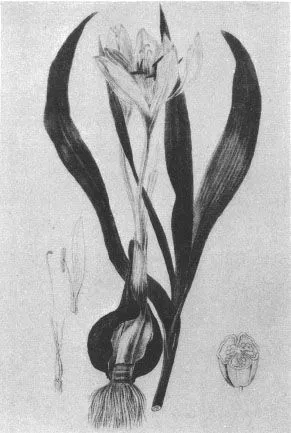
Saffron Crocus Sativus
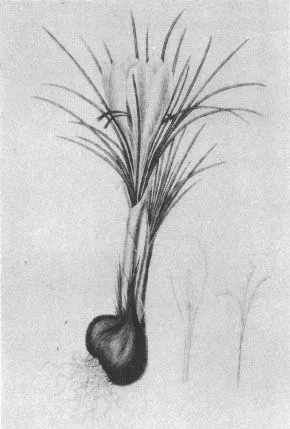
Meadow saffron colchicum autumnale
According to dr. Pereira, a grain of good commercial saffron contains the stigmas and styles of nine flowers, and consequently 4,320 flowers are required to yield 1 oz. Of saffron! English-grown saffron is now very seldom met with in commerce; the best comes from spain, while that imported from france is usually considered of second-rate quality. The quantity imported has been computed at between 5,000 and 20,000 lb. Weight per annum. Saffron has a bitter taste and a penetrating aromatic odour.
Lately, persian saffron has made its appearance in the english market – although of rare occurrence – owing to the high and increasing price of the european article. It has long been known as a wild product of persia, and was formerly sent from that country and kashmir to bombay, -but was driven out of the market by the superior saffrons of europe.
Saffron was cultivated at derbena and ispahan in persia in the tenth century. It differs a little in appearance from european saffron in being rather more slender and in the unbranched part of the style being paler, but the characteristic odour is remarkably strong. On immersion in water it does not seem to give out so much colour as european saffron, and could only compete with it if the price enabled it to be used in sufficient quantity to give a colour equal to that used in europe. The wild persian crocus is the variety hausknechtii, which occurs on the delechani and sangur mountains between kermanshah and hamada in west persia, and at karput in kurdistan, which is the most easterly point where any form of crocus sativus occurs in the wild state.
It may be mentioned that five forms of c. Sativus are known in the wild state. (1) var. Orsiniiy which may be regarded as the italian form and is found at ascoli, the most westerly point from which any wild form of the plant is recorded. It near...
Table of contents
- I
- J
- K
- l
- M
- N
- O
- P
- Q
- R
- S
- T
- U
- V
- W
- Y
- Index of Country Names of Plants
Trusted by 375,005 students
Access to over 1.5 million titles for a fair monthly price.
Study more efficiently using our study tools.
Frequently asked questions
Yes, you can cancel anytime from the Subscription tab in your account settings on the Perlego website. Your subscription will stay active until the end of your current billing period. Learn how to cancel your subscription
No, books cannot be downloaded as external files, such as PDFs, for use outside of Perlego. However, you can download books within the Perlego app for offline reading on mobile or tablet. Learn how to download books offline
Perlego offers two plans: Essential and Complete
- Essential is ideal for learners and professionals who enjoy exploring a wide range of subjects. Access the Essential Library with 800,000+ trusted titles and best-sellers across business, personal growth, and the humanities. Includes unlimited reading time and Standard Read Aloud voice.
- Complete: Perfect for advanced learners and researchers needing full, unrestricted access. Unlock 1.5M+ books across hundreds of subjects, including academic and specialized titles. The Complete Plan also includes advanced features like Premium Read Aloud and Research Assistant.
We are an online textbook subscription service, where you can get access to an entire online library for less than the price of a single book per month. With over 1.5 million books across 990+ topics, we’ve got you covered! Learn about our mission
Look out for the read-aloud symbol on your next book to see if you can listen to it. The read-aloud tool reads text aloud for you, highlighting the text as it is being read. You can pause it, speed it up and slow it down. Learn more about Read Aloud
Yes! You can use the Perlego app on both iOS and Android devices to read anytime, anywhere — even offline. Perfect for commutes or when you’re on the go.
Please note we cannot support devices running on iOS 13 and Android 7 or earlier. Learn more about using the app
Please note we cannot support devices running on iOS 13 and Android 7 or earlier. Learn more about using the app
Yes, you can access A Modern Herbal (Volume 2) by Margaret Grieve in PDF and/or ePUB format, as well as other popular books in Biological Sciences & Horticulture. We have over 1.5 million books available in our catalogue for you to explore.