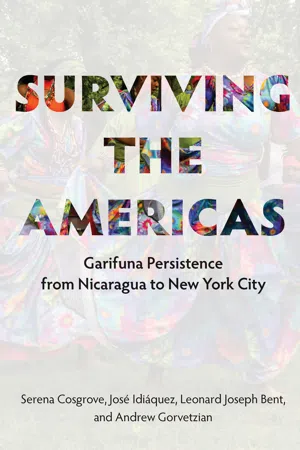
In Surviving the Americas, Serena Cosgrove, José Idiáquez, Leonard Joseph Bent, and Andrew Gorvetzian shed light on what it means to be Garifuna today, particularly in Nicaragua. Their research includes over nine months of fieldwork in Garifuna communities in the Pearl Lagoon on the southern Caribbean coast of Nicaragua and in New York City. The resulting ethnography illustrates the unique social issues of the Nicaraguan Garifuna and how their culture, traditions, and reverence for their ancestors continues to persist.
eBook - ePub
Surviving the Americas
Garifuna Persistence from Nicaragua to New York City
- English
- ePUB (mobile friendly)
- Available on iOS & Android
eBook - ePub
Surviving the Americas
Garifuna Persistence from Nicaragua to New York City
About this book
The Garifuna are a Central American, Afro-Indigenous people descended from shipwrecked West Africans and local Indigenous groups on the Caribbean island of St. Vincent. For over two centuries, the Garifuna have experienced oppression, exile, and continued diaspora that has stretched their communities to Honduras, Belize, and beyond. However, little has been written about the experiences of the Garifuna in Nicaragua, a community of about 5,000 who live primarily on the Caribbean coast of the country.
In Surviving the Americas, Serena Cosgrove, José Idiáquez, Leonard Joseph Bent, and Andrew Gorvetzian shed light on what it means to be Garifuna today, particularly in Nicaragua. Their research includes over nine months of fieldwork in Garifuna communities in the Pearl Lagoon on the southern Caribbean coast of Nicaragua and in New York City. The resulting ethnography illustrates the unique social issues of the Nicaraguan Garifuna and how their culture, traditions, and reverence for their ancestors continues to persist.
In Surviving the Americas, Serena Cosgrove, José Idiáquez, Leonard Joseph Bent, and Andrew Gorvetzian shed light on what it means to be Garifuna today, particularly in Nicaragua. Their research includes over nine months of fieldwork in Garifuna communities in the Pearl Lagoon on the southern Caribbean coast of Nicaragua and in New York City. The resulting ethnography illustrates the unique social issues of the Nicaraguan Garifuna and how their culture, traditions, and reverence for their ancestors continues to persist.
Information
CHAPTER ONE
Persisting: Garifuna Histories
Serena Cosgrove and José Idiáquez
—IRENE WATSON, “Aboriginal Sovereignties: Past, Present and Future (Im)Possibilities”
—JAMES CLIFFORD, Returns: Becoming Indigenous in the Twenty-First Century
Introduction
We’re writing about an impossibility that is a possibility. Groups like the Garifuna of Nicaragua have faced and continue to face a series of obstacles; certainly, the slave trade and the disastrous effects of colonization placed limits on their survival as a people as well as the marginalization and repression of the present-day government of Nicaragua. And yet, they persist. Today, there are five Garifuna villages or communities in Nicaragua—Orinoco, San Vicente, La Fe, Marshall Point, and Brown Bank—around the Pearl Lagoon basin, north of Bluefields, and today as in the past, there is extensive outbound migration seeking employment. It is estimated that the entire Nicaraguan Garifuna population numbers around five to six thousand with most Garifuna living in Bluefields, Managua, and other places in Nicaragua. There are Garifuna communities in Honduras, Guatemala, and Belize; there are 100,000 to 200,000 Garifuna in the United States,3 most of them living in the Bronx and Brooklyn in New York City with Garifuna strongholds also in New Orleans, Houston, and Los Angeles.4
Throughout this book, we refer to the Garifuna as an Afro-Indigenous people—both an Indigenous and an Afro-descendant people—with an attachment to the natural world of Pearl Lagoon where their ancestors are buried. The specific and localized or spatially situated part of their identity is particularly important for the Garifuna in Nicaragua because they have a spiritual and a livelihoods connection to the land and sea—something that is informed by both their Indigenous and Afro-descendant heritage. The term Indigenous is itself informed by a rich debate, and multiple overlapping definitions exist: some created by original peoples themselves (peoples living in places before colonizers arrived) and others by international agencies attempting to protect Indigenous rights. Commonalities between the definitions include a long-term commitment to a place and ways of knowing and being in the world that are different than Western ones. Linda Tuhiwai Smith, a Maori researcher, explains that Indigenous peoples “is a term that internationalizes the experiences, the issues and the struggles of some of the world’s colonized peoples… They share experiences as peoples who have been subjected to colonization of their lands and cultures, and the denial of their sovereignty, by a colonizing society.”5 The plural of people, peoples, is important to the definition precisely because there is such a range of groups who identify as Indigenous: it is not one people we are talking about but many peoples. James Clifford adds that Indigenous peoples “are defined by long attachment to a locale and by violent histories of occupation, expropriation, and marginalization.”6 Key parts of this definition include common experiences of colonization and exclusionary treatment by colonizers.
Afro-descendant means that the people come from the involuntary diaspora of enslavement set in motion by the slave trade of the European colonial powers. “A review of the political economy of the European slave trade reveals that it was an inhuman act, precisely designed to create wealth for Europeans through exploitation of Africans. The slave trade also involved selling Africans as instruments of labor and as capital to finance the industrial revolution in Europe.”7 Between the fifteenth and nineteenth centuries, between 15 to 25 million West and Central African men, women, and children were brought to the Americas as part of the Atlantic slave trade.8 This diaspora—an inhuman and horrific economic project that forcibly moved millions of people from their communities of origin into enslavement—has had global impacts whose effects are still felt today. “In using diaspora as a conceptual tool authors usually denote dispersed groups of African descent, descendants of peoples removed from the African continent who are racially Black.”9 The widespread contributions to Latin America and the Caribbean by peoples of African origin are significant “seeds of ancestral knowledge, philosophy, memory, and tradition, of resistance, and of and for life.”10 Because the Garifuna have their roots in both Afro-descendant and Indigenous cultures, they sometimes emphasize different aspects of their identities over others. For example, “Some evidence indicates that Garifuna have at times emphasized the indigenous component of their ancestry. Other evidence—such as Garifuna participation in Marcus Garvey’s Universal Negro Improvement Association in the 1920s suggests that at different moments they have adopted a Black racial identity.”11 In the case of the Garifuna in Nicaragua, identity as an Afro-Indigenous group is further complicated by the diversity of different ethnicities on the Caribbean coast. This is informed by the history of Indigenous leadership under the Miskitu, the role of the British challenging the Spanish for control over the Nicaraguan Caribbean coast, and the emergence of the ethnic group, the Creoles—descended from the progeny of British colonists and people of African descent. Explained in further detail below, this array of ethnicities is comprised of the following groups who live on the Caribbean coast today: Indigenous groups—Miskitu, Rama, Mayagna (formerly Sumo), and others, the Creoles, mestizos from the Pacific coast, and the Garifuna. Interestingly, the Garifuna share indigeneity with some groups and Afro-descendant identity with others; this, in turn, creates similarities and differences, points of convergence and divergence of identities and interests with all of these groups as we discuss below.
Our unpacking of what it means to be Garifuna today in Nicaragua comes from historical sources and our research participants. Some of our primary research protagonists from Orinoco, Nicaragua, include Mateo, Eric, Rebecca, and Kelsey, to mention a few.12 To appreciate Mateo’s healing powers as a bush doctor, it’s vital to keep in mind that he never got the opportunity to go to school due to poverty and that he came of age during the Counterrevolutionary or Contra war (1980–1990). Mateo’s life has been deeply marked by the Sandinista revolution, contradictory state policies, war, and exclusion. On a personal level, he struggled to find his path before he entered into ritual practices of ancestor worship, which entail daily contact with his ancestors and their guiding knowledge of the natural world and medicinal plants. Today he is a healer and spiritual leader in the community, and yet, he does not have a diploma or formal recognition for his skills. To appreciate Garifuna spirituality, as we learned, it’s important to visit Mateo on the land his family cultivates outside Orinoco.
Similarly, comprehending the realities confronting Garifuna youth—such as Eric and Orson—requires understanding that the only way the elders can live in the community is for the youth to leave the community by “shipping out” on cruise boats, finding employment in call centers in Bluefields or Managua, or working in a hotel at a distant tourist destination—what Clifford calls “indigenous commuting”—to send money home.13 This journeying to and fro, out and back, is an important component of Garifuna persistence. Though it means leaving (and looping back for visits), many have to leave to support those who stay, such as the elders and children.
Through our conversations with women community leaders in Orinoco, we’ve come to see that similar to Garifuna communities in other parts of Central America,14 the Garifuna in Nicaragua also have strong models of women’s leadership. At the family and community level, women form strong bonds to support community survival when male family members are off earning money. Women participate in fishing and farming, frequently heading out of the village on foot or up the river in their dories to check on gardens. There are present-day challenges with gendered effects. Depredatory extractive practices have decimated fish and lobster stock which in turn have taken away Garifuna traditional income-generation activities, leaving some men playing cards on the dock. Garifuna women, on the other hand, take on entrepreneurial activities such as running stores and small hostels, and continue their farming in the bush to sustain their families. This dynamic was described to us by Kelsey, the daughter of a long line of Garifuna sukias (spiritual leaders), owner of a small hotel in Orinoco, and animator of the women’s group that makes and sells traditional Garifuna food. In some cases, the inactivity of men and the attendant loss of income have led to alcoholism or use of other drugs, which can lead to increased levels of gender-based violence; in other cases, unemployment has led to new entrepreneurial developments such as Eric’s drumming school and performances or Miss Rebecca’s guest house.
This book aims to illuminate the Nicaraguan Garifuna journey to the impossible: their cultural persistence in the face of great odds. This chapter provides the reader with the historical context and the analytical framework to understand the “tensions, resonances, transformations, resistances, and complicities”15 that emerge when analyzing the ethnographic data we’ve gathered about Garifuna everyday life, survival, and persistence in the Pearl Lagoon of Nicaragua and beyond.
A History of the Garifuna, a Different History of Nicaragua
For Nicaragua, history is usually told by mestizo (European descendant or mixed race) elites from the Pacific side of the country who have benefited from a dominant ideology that Nicaragua is universally mestizo.16 Today, mestizos on the Pacific side of the country continue to administer and perpetuate a status quo that keeps the poor, Indigenous, and Afro-descendant communities at the margins, many of whom live on the Caribbean side of the country. On the Caribbean coast of Nicaragua, it is common to hear Afro-descendant people or Creoles, Indigenous people, and the Garifuna refer to the mestizos from the Pacific coast as Pañas or Spaniards, a sharp reminder that many on the Caribbean coast see mestizos from the Pacific coast as present-day conquerors and colonizers. In fact, mestizo migration to the Caribbean coast is on the rise throughout Central America: “This internal migration, leading to illegal land occupations in the newly demarcated and titled areas of indigenous and afro-descendant peoples, has created significant tensions and conflicts [on the coast].”17
Today’s tensions have deep historical roots. The Garifuna became a people through the very emergence of the modern world system. Their ethnogenesis—or birth story as a people—is powerful and compelling: they are a hybrid culture from the island of St. Vincent in the Caribbean, born of the Indigenous Carib and Arawak peoples and shipwrecked West Africans intended to be sold as slaves in the Americas. “As early as 1612, European writers noted the appearance of a large number of Africans among the Carib war and trading parties. This population of Africans was progressively augmented by the wreck of one or several slave ships (for which several dates are given—1635, 1675, and 1742) and by the integration of African maroons from neighboring islands.”18 Survivors freed themselves from the wreckage of the ships and swam to shore. Kidnapped Africans destined for Caribbean plantations were abruptly thrown onto the shores and mercy of the Island Caribs of St. Vincent, an island, named but ignored by the Spanish. “Out of this sudden co-presence, an encounter not chosen by either group, a new synthetic ethnicity and religion—what Mary Helms (1969) called a ‘colonial tribe’—was born.”19 People of African descent intermarried with Indigenous Red Caribs and Arawaks on the island and the first Garifuna were born. This co-existence led to intermarriage and children and the Garifuna as a people emerged, speaking Garifuna—a language informed by Indigenous Caribbean languages and by Yoruba in Western Africa, practicing a spirituality informed by the worship of ancestors, honoring the land and sea that had saved them, and demonstrating a fierce commitment to freedom and repudiation of slavery.20
During French and British disputes over St. Vincent, the Garifuna refused to leave their lands that had been taken from the French and given to the British in the Treaty of Paris in 1763.21 This led to Garifuna conflict with the British who forcibly removed them from St. Vincent, first imprisoning them on the nearby, desolate island of Baliceaux, and then exiling them to Roatan off the coast of Honduras “some 1,700 miles to the northwest.”22 Authors Matthei and Smith summarize this period “as an ill-fated armed insurrection against the British colonizers… which resulted in their forced exile to a small island off the coast of Central America.”23 Very relevant to this book about the Garifuna of Nicaragua, the story of the Garifuna as a people or nation contains their most characteristic trait: a people born in movement, a diasporic people who continue their journey as time goes by. A little over two thousand Garifuna—including men, women, and children—arrived to Honduras, though it is believed that the pre-conflict population was between eight and nine thousand.24 Upon arrival on Roatan, the Garifuna soon made their way to the coast of the Honduran mainland seeking fertile land for gardens and crops. Though many stayed in Honduras, the Garifuna continued to seek cultivatable land to grow cassava and access to the sea where they could fish; this led to the eventual dispersal of the Garifuna along much of the Caribbean coast of Central America.25
When the Garifuna refer to the land, rivers, sea, and their ancestors, they do it with reverence and veneration. These are vital elements of their culture that have motivated their persistence and supported their survivance: the land bequeathed to them by watchful ancestors that has given them shelter and sustenance, the rivers and sea that have witnessed their trials and tribulations as well as providing them with sustenance, and their ancestors who watch over them. These phenomena are interconnected. The land holds the remains of the ancestors, and the accompaniment of the ancestors is also manifest through the bounty of land, rivers, and sea.
After Central American independence in the early 1800s, some Garifuna leaders in Honduras clashed with leaders of the Central American federation; thus began the movement of Garifuna to British Honduras, or what is today known as Belize, because the country was still under British rule.26 During different periods of tension with the Honduran state, kin groups of Garifuna would leave for Nicaragua, Guatemala, and Belize: “It is likely that as [they] spread along the coast they moved in extended family groups headed by a ‘captain’ as they had on St. Vincent.”27 In the late nineteenth and early twentieth centuries, the first Garifuna families came to the Pearl Lagoon basin, north of Bluefields, on the Caribbean coast of Nicaragua as recounted by Leonard in the introduction of this book. “From [the] region [of the Caribbean coast of Honduras], sometimes known as Costa Arriba, Juan Sambola (possibly a descendant of the [Garifuna] war leader from St. Vincent) travelled to the...
Table of contents
- Cover Page
- Halftitle Page
- Title Page
- Copyright Page
- Dedication
- Table of Contents
- Garifuna Timeline
- Preface: Welcoming: Garifuna Hospitality
- Introduction: Being Garifuna
- Chapter One: Persisting: Garifuna Histories
- Chapter Two: Framing: Decolonial Intersectionality
- Chapter Three: Rooting: Garifuna Connection to Nature
- Chapter Four: Believing: Garifuna Spirituality
- Chapter Five: Routing: Youth Persistence
- Chapter Six: Rooting, Routing, and Believing: Garifuna Persistence in Nicaragua, Honduras, and New York City
- Chapter Seven: Unlearning/Relearning: Decolonial Methodologies
- Notes
- Bibliography
- Acknowledgments
- Index
- About The Authors
Trusted by 375,005 students
Access to over 1.5 million titles for a fair monthly price.
Study more efficiently using our study tools.
Frequently asked questions
Yes, you can cancel anytime from the Subscription tab in your account settings on the Perlego website. Your subscription will stay active until the end of your current billing period. Learn how to cancel your subscription
No, books cannot be downloaded as external files, such as PDFs, for use outside of Perlego. However, you can download books within the Perlego app for offline reading on mobile or tablet. Learn how to download books offline
Perlego offers two plans: Essential and Complete
- Essential is ideal for learners and professionals who enjoy exploring a wide range of subjects. Access the Essential Library with 800,000+ trusted titles and best-sellers across business, personal growth, and the humanities. Includes unlimited reading time and Standard Read Aloud voice.
- Complete: Perfect for advanced learners and researchers needing full, unrestricted access. Unlock 1.5M+ books across hundreds of subjects, including academic and specialized titles. The Complete Plan also includes advanced features like Premium Read Aloud and Research Assistant.
We are an online textbook subscription service, where you can get access to an entire online library for less than the price of a single book per month. With over 1.5 million books across 990+ topics, we’ve got you covered! Learn about our mission
Look out for the read-aloud symbol on your next book to see if you can listen to it. The read-aloud tool reads text aloud for you, highlighting the text as it is being read. You can pause it, speed it up and slow it down. Learn more about Read Aloud
Yes! You can use the Perlego app on both iOS and Android devices to read anytime, anywhere — even offline. Perfect for commutes or when you’re on the go.
Please note we cannot support devices running on iOS 13 and Android 7 or earlier. Learn more about using the app
Please note we cannot support devices running on iOS 13 and Android 7 or earlier. Learn more about using the app
Yes, you can access Surviving the Americas by Serena Cosgrove,José Idiáquez,Leonard Joseph Bent,Andrew Gorvetzian in PDF and/or ePUB format, as well as other popular books in Social Sciences & Black Studies. We have over 1.5 million books available in our catalogue for you to explore.