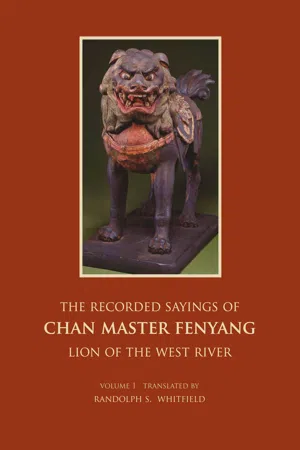
The eminent Song Dynasty Chan Master Fenyang Shanzhao (947-1024 CE) had the distinction of an entry in the canonical Jingde Chuandeng Lu, (Records of the Transmission of the Lamp) whilst still alive. Here the master's sayings, encounters with monks and poetry speak extensively for themselves, as recorded by his Dharma-heir, Shishuang Chuyuan (986-1039 CE). Contained in these first two of three fascicles are some of the earliest gong'an (koans) from the Chan School, as well as the first mention of the famous Five Ranks teachings from the Caodong lineage.the recorded sayings of chan master fenyanglion of the west river Vol: 1translated by randolph s. whitfieldRandolph S. Whitfield studied Classical Guitar and Piano at Trinity College of Music, London and Chinese Language and Literature at Leiden University. He lives in Holland with his wife Mariana.
- 216 pages
- English
- ePUB (mobile friendly)
- Available on iOS & Android
eBook - ePub
The Recorded Sayings of Chan Master Fenyang Wude
About this book
Information
Introduction
During the Song dynasty (Northern Song, capital Kaifeng, 960-1127 CE and Southern Song, capital Hangzhou, 1127–1279 CE) Buddhism was to become thoroughly integrated into the Confucian-Daoist culture. The court engaged their literary elite, civil servants, in inaugurating a new era of textual religion in the service of the state. The textual emphasis was underpinned by the confluence of two events – a new dynasty keen to promote a cultural integration between Confucianism, Daoism and Buddhism as a counterbalance to the ever prevailing need for military vigilance at its northern and north-western borders and, the development of new printing techniques as a facilitator of mass communication, comparable in importance to the development of Gutenberg’s printing press in Europe some four hundred years later.
The Chan school of Buddhism too benefited from this new textual orientation by being given a more definite literary expression, making it more accessible, if not less understandable, to a wider audience. The groundbreaking entrance into the Buddhist canon of the first coherent Chan lineage text in 1011 CE, the Jingde Chuandeng Lu (Records of the Transmission of the Lamp, hereafter CDL, first presented at court in 1004 CE)4 rendered a Chan-without-words into a Chan with not a few words. The enigmatic expressions and often beautiful poetry that emerged in this innovative work became the very embodiment of Chan in China, Korea and Japan for the following thousand years, creating a unique poetic, religious and cultural pan-Asian amalgam, emerging from the midst of a Chinese religious landscape.5
The process of the integration of ancient Chinese poetic practices with literary Chan – the encounter dialogues and poems – was prefigured in the early years of the Northern Song dynasty by the present work, appearing in the same year as the CDL lineage text, 1004 CE, with a preface by the same scholar-official Yang Yi. Master Fenyang of The Recorded Sayings of Chan Master Fenyang Wude (hereafter FWYL)6 had the distinction of an entry in the CDL as a still living master in 1011 CE when the CDL was entered into the Chinese Buddhist canon. The two works, CDL and FWYL, are in fact closely related.7 Shishuang Chuyuan (986-1039 CE), Fenyang’s heir and editor of the FWYL, composes a short preface in the first fascicle of the work to Fenyang’s verses in praise of the CDL that clearly link the two works. Fenyang must have had access to the CDL then, even before its official entry into the Buddhist canon, judging also by his comments on Cases c.1–95 below, many of which have parallel passages in the CDL (recorded in footnotes). And in Cases c. I-XXX we are taken through the whole history of Chan, from its Indian background to the earliest transmission in China, again, following, it would seem, the new redaction of the CDL by Yang Yi.
The literary Chan that emerges in FWYL and recorded by his Dharma-heir Shishuang Chuyuan, embraces references to Buddhist scriptures, quotations from ancient worthies, official history, obscure classical and Confucian-Daoist allusions with much original poetry in different forms. All this underpinned by lively dialogues employed in the service of the one Chan theme running through them, the perennial way of re-linking to one’s inherent ‘Buddha-nature’ through practice and realisation. The ideographic function of the Chinese language as a vehicle for expressing Chan insights is stretched to new linguistic limits by master Fenyang, with Chinese history as the backdrop.
Mundane analysis of such a work as the present one is a veritable minefield for textual scholars. If the literary dialogue is one measure of the rich possibilities for conceptualizing different worlds in different words, in this case the specifically conceived early Song dynasty literary Chan world of the not-yet-awakened over against the realm of awakening, then in this and future Chan ‘encounter dialogue’ texts, for which the FWYL and the CDL are the models, there are a great many dialogues embracing many world views that do not admit of a facile categorisation. Inconsistencies, embellishments, a disjunctive narrative, constant repetition, dislocation, fragmentation and recombination – the bane of textual scholars – preclude a simplistic understanding but are the life-blood of such encounter dialogue texts.
We also have the opposite of dialogue in the FWYL, highly stylised poetry ever canonised in Chinese culture as refined literature. One of the key figures in bringing this richly varied Chan discourse to its first polished literary expression is master Fenyang Shanzhao himself, the fifth generation master from Linji Yixuan († 866 CE), retrospective founder of the Linji school of Chan, a ‘school’ that lent itself to the process of becoming the new Song state orthodoxy. Being a distinguished Dharma-heir of Shoushan Shengnian (932–993 CE), considered one of the renovators of the Linji school in the Song, Fenyang had many influential disciples amongst the Chan community and government literati.
Albert Welter:
‘Shengnian’s students built on the prestige thus far achieved and succeeded in establishing Linji Chan as the new orthodoxy. Their success was predicated on support fro...
Table of contents
- Dedication
- Notes
- Contents
- Preface
- Acknowledgments
- Introduction
- Abbreviations
- Index
- Copyright
Trusted by 375,005 students
Access to over 1.5 million titles for a fair monthly price.
Study more efficiently using our study tools.
Frequently asked questions
Yes, you can cancel anytime from the Subscription tab in your account settings on the Perlego website. Your subscription will stay active until the end of your current billing period. Learn how to cancel your subscription
No, books cannot be downloaded as external files, such as PDFs, for use outside of Perlego. However, you can download books within the Perlego app for offline reading on mobile or tablet. Learn how to download books offline
Perlego offers two plans: Essential and Complete
- Essential is ideal for learners and professionals who enjoy exploring a wide range of subjects. Access the Essential Library with 800,000+ trusted titles and best-sellers across business, personal growth, and the humanities. Includes unlimited reading time and Standard Read Aloud voice.
- Complete: Perfect for advanced learners and researchers needing full, unrestricted access. Unlock 1.5M+ books across hundreds of subjects, including academic and specialized titles. The Complete Plan also includes advanced features like Premium Read Aloud and Research Assistant.
We are an online textbook subscription service, where you can get access to an entire online library for less than the price of a single book per month. With over 1.5 million books across 990+ topics, we’ve got you covered! Learn about our mission
Look out for the read-aloud symbol on your next book to see if you can listen to it. The read-aloud tool reads text aloud for you, highlighting the text as it is being read. You can pause it, speed it up and slow it down. Learn more about Read Aloud
Yes! You can use the Perlego app on both iOS and Android devices to read anytime, anywhere — even offline. Perfect for commutes or when you’re on the go.
Please note we cannot support devices running on iOS 13 and Android 7 or earlier. Learn more about using the app
Please note we cannot support devices running on iOS 13 and Android 7 or earlier. Learn more about using the app
Yes, you can access The Recorded Sayings of Chan Master Fenyang Wude by Randolph S. Whitfield in PDF and/or ePUB format, as well as other popular books in Théologie et religion & Religion. We have over 1.5 million books available in our catalogue for you to explore.