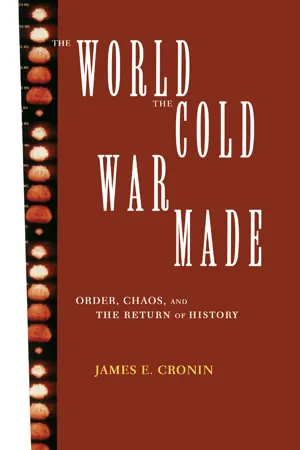
An examination of the Cold War from the creation and structure of the postwar settlement to the eventual coming apart of the post war order in the 1980s and early 1990s.
James Cronin explores the creation and structure of the postwar settlement and the eventual coming apart of the postwar order in the 1980s and early 1990s. Cronin argues that the current state of the world must be understood against the backdrop of the postwar order that until recently governed, prevented or distorted political and economic change.
- 256 pages
- English
- ePUB (mobile friendly)
- Available on iOS & Android
eBook - ePub
About this book
Information
1 The Legacy of Depression and War
Perhaps the crucial decision taken by the Allies during the Second World War was to seek the unconditional surrender of Germany and Japan. There would be no compromise with fascism. Its defeat would be complete and its authoritarian regimes, wherever imposed, would be replaced. The effect was a political vacuum in most of the European continent, Japan, China, and many of the former European colonies in Asia. Change was also in store for significant portions of the Middle East, and the question of the future of Africa loomed. These new, or newly open, political spaces would be filled relatively quickly, but in 1945 the shape and complexion of the successor regimes could not easily be predicted or controlled. Nor could it be foreseen how they would relate to one another and to the rest of the world. Stalin, Churchill, and Roosevelt began early on to try to plan for the postwar period, but because their interests were at odds, little was agreed upon before the end of hostilities—and even that was often reversed in practice.
That the Allies had very different visions of a postwar order was almost inevitable. Histories and interests diverged sharply; more uneven still was the distribution of resources with which each power could make its will prevail.1 The structure of the new United Nations endowed five governments—the United States, Britain, the Soviet Union, France, and China—with the status of great powers by providing them with permanent seats on its Security Council. The decision represented more a geopolitical wish than a recognition of actual clout. Charles de Gaulle may have dominated the parade celebrating the liberation of Paris on August 26, 1944, but the French had contributed little to the defeat of Hitler.2 The Chinese government under Chiang Kai-shek was equally ineffective during the war and even more beleaguered afterward. Chiang could never decide who was his real enemy, the Japanese or the Communists, and the result was that much of the resistance was done by the Communists and the credit went largely to them. The hope was, of course, that France would reemerge as a major power in Europe to balance the defeated, but still much feared, Germans, and that a stable China would help stabilize Asia.
A more realistic assessment of political and economic power would also have undermined Britain’s claim to the status of world power.3 Churchill’s bluster could not disguise the fact that the British war effort, heroic as it was, was utterly dependent on the United States. What made the claim at least credible in 1945 was the British Empire, but relationships within the empire had shifted dramatically. The Commonwealth countries were essentially autonomous; India had been promised independence; British authority was already beginning to recede in the Middle East; and imperial control still had to be reasserted in parts of Asia. But again, there was the hope that a strong Britain linked in some form to its former and remaining imperial possessions could provide a bulwark against anarchy in various potentially unstable areas. This alone seemed to justify the pretense of great-power status.
Only two powers truly merited great-power status: the United States and the Soviet Union. Both had enormous military strength. The Soviets had borne the brunt of the battle with the Nazis and had won decisively. At war’s end, the Red Army was the world’s biggest, and it was well supplied. The cost of victory had been staggering: 20 to 25 million dead, much of the best land laid waste, and industry destroyed. The United States, by contrast, emerged from the war with greatly augmented material strength and few scars. Its losses were real but proportionally much less than those of the Soviets, and the U.S. economy was far stronger than it had been in 1939. The nation had the second-largest armed force and by far the best equipped. U.S. industry had shown itself capable of prodigious wartime feats, and the U.S. arsenal included atomic bombs. Very few such bombs were on hand in 1945, and it would have been hard to justify their use, but their very existence colored international relations nonetheless.
There were, then, no great powers in the nineteenth-century sense but two (or perhaps one and a half) superpowers who, in concert or competition, would decisively influence the emerging postwar system of states. Both, moreover, brought to the task of rebuilding not merely the usual set of geopolitical considerations but ambitious and antithetical conceptions of how other nations should organize themselves. Neither was entirely blinded by ideology: the United States was committed to democratic capitalism but would put up with less than perfect approximations; the Soviets were committed to world revolution but were not averse to putting off its “inevitable” triumph in particular places, for example, in China. And to some extent, the universalist pretensions of U.S. and Soviet policies were but rationalizations of more traditional geopolitical aims. The Soviets were resolved to provide a buffer between themselves and the Germans whatever political and social system prevailed in the countries between; the United States had interests in Latin America and in the Pacific that preceded and transcended immediate political preferences. Still, the ideological competition between the U.S. and the USSR was genuine, and it greatly complicated the coming into being of a stable postwar order.
Ideological differences merged imperceptibly with, and were reinforced by, history, or more precisely, by disparate readings of the recent past. The war was the most proximate experience whose lessons had to be absorbed, but its meaning was filtered through an understanding of the conditions that had produced it. Soviet leaders had little difficulty explaining the war. They had long expected an attack from the West, and fascism, the latest and most degenerate phase of capitalism, had from the beginning been directed at the Bolshevik threat.4 The fascists were merely continuing what had been started by the capitalist democracies. The Soviet Union had been conceived and taken life in the midst of war. The First World War had brought the collapse of tsarist rule in February 1917, and the continuation of Russia’s participation had critically weakened the Provisional Government of Alexander Kerensky. Compelled to accept a humiliating peace settlement with the Germans in early 1918, the Bolsheviks had hoped to regain lost territory in the aftermath of Germany’s surrender in November, but the Allies had intervened in the civil war on the side of the Whites and encouraged the grandiose designs of the new Polish state. By the early 1920s the emerging Soviet state had beaten back the Poles and won the civil war, though at tremendous cost. The experience taught the leaders of the new state to expect nothing but hostility from the West. Throughout the interwar years, Soviet foreign policy was dominated by fears of “capitalist encirclement” and nothing that happened prior to 1939 allayed those fears. With the triumph of fascism in Germany in 1933, the Soviets shifted their stance and instead began to argue for collective security and sought desperately to ally with France or Britain against the German threat. Their efforts were in vain, and in several key confrontations the Western powers chose not to resist Hitler’s demands. With some justice, Soviet leaders concluded that the capitalist democracies preferred appeasement to an alliance with the USSR and that many in the West believed a war in the East that would destroy fascism and communism alike would be the best outcome.
By 1939 the Soviets were desperate. To their west was a militant Nazism whose armaments were growing by the day. To their east was a militant Japan, allied with Germany in the Anti-Comintern Pact, that had successfully occupied Manchuria and now threatened to move north. There were recurring border clashes during 1938 and 1939 along the tense frontier shared by Soviet and Japanese troops and more serious confrontations at Lake Khasan and Khalkin-Gol (Nomonhan).5 The Soviets won important victories in these remote engagements but were nonetheless convinced to make deals with both the Germans and the Japanese. The Nazi-Soviet pact was signed in August 1939; a neutrality pact with Japan, in April 1941. The bargain struck with the Nazis particularly dismayed the Soviets’ sympathizers in the West, but the Soviets showed little hesitation in using the pact to regain control of the Baltic nations and to gobble up the eastern portions of Poland.
For the Soviets, then, the historical memory of prewar diplomacy was dominated by a deep distrust. The war did little to overcome this legacy. The alliance between the Soviet Union and the Western powers was forged by Hitler when in the spring of 1941 he postponed an invasion of Britain in favor of an eastern offensive. By then neither Britain nor France could offer genuine aid to the USSR, and the United States had yet to enter the war. The Soviets were left virtually alone to face the Nazi assault.6 The Americans began to ship supplies to the embattled Soviet forces in 1942, but few had arrived by the time of the Battle of Stalingrad (November 1942-February 1943), regarded as the turning point in the war. It took a very long while, moreover, for the Allies to open a second front against the Germans, which meant that the Soviets continued to bear the brunt of the fighting until at least the summer of 1944. Allied landings in North Africa diverted few German troops from the eastern front, and the slow Allied progress through Italy took away only a few more. Not until the landings at Normandy in June 1944 did the Allies make what Stalin considered a serious military contribution. By that time the Red Army had largely succeeded in pushing the Germans back across Eastern Europe.
It was not likely, in the circumstances, that the Soviets would retreat voluntarily from the lands that they saw themselves as having liberated. The Soviet Union had suffered terrible losses at the hands of the Nazis.7 The countries of Eastern Europe, by contrast, had offered little resistance to Hitler’s advance, and some had actually assisted it. A not insignificant number of Eastern Europeans had also been tempted by ancient and not so ancient hatreds and resentments into collaborating with the Nazis in the extermination of Jews and other racial, political, or religious enemies. The war, then, had not diminished Soviet fears, and as the U.S. diplomat W. Averell Harriman explained in January 1945, “The overriding consideration in Soviet foreign policy is the preoccupation with ‘security,’ as Moscow sees it.”8 As the war drew to a close, Soviet and Western leaders met at Yalta, Teheran, and Potsdam, where they proclaimed a desire to work together to shape the new world. Not far beneath the facade of cooperation, however, was a store of resentment and suspicion that quickly surfaced.9
U.S. leaders shared the general Western hostility to the Soviet Union, but it was far from being their central preoccupation. The United States had joined with Britain and France just after the First World War in the ill-fated effort to bring down the new Bolshevik regime, but had done so halfheartedly. U.S. attention was subsequently focused elsewhere and on other issues, especially the question of naval supremacy vis-à-vis Britain and Japan. The United States had had little to do with the diplomatic maneuverings provoked by the resurgence of German power under the Nazis, and during the war its opinion makers were firmly behind the alliance with the Soviets. In 1945 most Americans supported continued cooperation, but their main concern was the nation’s economic prospects.10 The depression of the 1930s had shattered cherished beliefs about U.S. economic prowess; had wrought the most dramatic realignment in politics since the Civil War; and had initiated a thorough transformation in the relationship between state and society and in the philosophy of government.11 Its impacts ensured that policy makers would carry into the deliberations about the postwar order a desire to avoid a recurrence of the slump.
Prescriptions for the future inevitably grew from diagnoses of past errors. To most U.S. leaders it seemed obvious that governments had failed to respond properly to the Great Depression, and that failure had prolonged and deepened the crisis. They were particularly critical of the retreat into autarchy and neomercantilism undertaken by almost all governments in the early 1930s. British decisions—first to go off gold in 1931 and then to construct a wall of tariffs and preferences around the empire (the Ottawa Accords of 1932)—were seen as especially shortsighted, for they served mainly to reduce the scope of world trade and thus worsen the prospects of recovery. Similar moves by the French, the Germans, the Japanese, and even the United States had, in this view, threatened to replace the open world market with a set of relatively closed trading blocs—sterling, gold, dollar, and yen blocs, and the system of managed bilateral trade erected by Germany and its neighbors in eastern and central Europe.12 Overall, it has been argued, “the actions…by individual countries to protect their economies and to defend their shares of international trade had the inevitable effect of shrinking the total quantity of international trade.”13
The retreat into economic nationalism also affected international relations. As U.S. Secretary of State Cordell Hull put it, “Unhampered trade dovetailed with peace; high tariffs, trade barriers, and unfair competition with war.”14 More practically, Americans came to believe that the U.S. economy was too large to function in anything but a global, or nearly global, environment. No regional or even hemispheric bloc could provide the “grand area” supposedly required for prosperity.15 U.S. policy makers thus concluded from the experience of the depression and from the all-too-easy slide from the depression into war that the key to prosperity and peace was an open system of world trade. Their commitment to what scholars have rather inelegantly called “liberal multilateralism” would be the overriding objective of U.S. policy in the negotiations that began with the signing of the Atlantic Charter in August 1941 and continued through the Bretton Woods Agreement in 1944, the creation of the International Monetary Fund and the World Bank, the British loan in 1946, the Marshall Plan, and the bargaining over trade that issued ultimately in the General Agreement on Tariffs and Trade (GATT). It was a simplistic vision of what it would take to rebuild the international economy, but it provided clear guidance to politicians and planners as they designed the institutional framework of the postwar world economy.
The U.S. vision was not the only vision offered, nor was it uncontested. The British held rather different views, and there was also disagreement among policy makers, economists, and officials within the U.S. government. The major alternatives to the projected program of growth through trade all derived in some measure from the same source. In The General Theory (1936), John Maynard Keynes had persuasively argued for the view that demand left to its devices will not always match supply and that the market economy can reach equilibrium at less than full employment.16 Keynes had for some time advocated government measures to increase demand; he now presented what seemed an irrefutable defense of such action. Keynesian thinking seemed also to be confirmed by practice. The stimuli applied by Roosevelt during the early years of the New Deal appeared by 1935–1936 to have had a positive impact on employment; so, too, did Swedish public spending programs. The rearmament undertaken by Hitler also served to reduce unemployment in Germany, although not many outsiders took comfort from that apparent success. But spending on armaments also began to work its magic in Britain and the United States: unemployment virtually disappeared during the war. Many concluded from this that public spending did in fact create jobs, and that if it was prudently done, inflation would not inevitably result.
Keynesian theory, particularly when combined with the full employment created by war mobilization, offered an alternative model of postwar economic policy that placed less emphasis upon trade than did the vision of many U.S. officials. The Keynesians did not oppose trade but tended to doubt its ability to generate the level of employment that Western publics were likely to insist upon after the war. Efforts to open up world markets, therefore, would have to be coupled with policies that allowed leaders to stimulate demand domestically by utilizing the fiscal and monetary tools at the disposal of national governments. In addition, Keynes and those who thought as he did believed that the disruptions caused by the war and by the legacies of prewar policies would mean that re-creating an open world market would take some time. Keynes had, after all, made his reputation by criticizing the unrealistic expectations of world leaders on precisely this issue after the First World War.17 As Alvin Hansen explained in 1945, policy makers had sought after the First World War to “reconstitute as rapidly as possible the automatic forces in economic life. The drive all around was a return, in the broad essentials, to laissez-faire.”18 The eagerness of politicians and officials to bring about an idealized version of the pre-1914 world economic order, Keynes postulated, had caused them to overlook or minimize the enormous cost in lost output and employment that would have to be paid. He worried openly during the 1940s that U.S. plans for an open world economy were likewise unrealistic and would lead to renewed suffering.
Before 1939 Keynes’s influence among policy makers had been marginal.19 His eminence among economists had had little effect upon those who set economic policy in Britain or elsewhere. With the coming of war, however, his views received a retrospective vindication and he was brought into the Treasury to advise the Churchill government on war finance and, more important, postwar planning. From that position Keynes sought to shape the institutional and policy framework of the postwar world: he participated in most of the principal discussions on international finance and trade with U.S. representatives, and he took the lead in negotiating the U.S. loan essential to Britain’s transition from a wartime to a peace-time economy. Ironically, Keynes had more impact outside Britain than within. The coalition government under Churchill was reluctant to commit itself wholeheartedly to the employment goals advocated by Keynes, and the Treasury was not eager to adopt the new policies and carry out the associated responsibilities. By contrast, British foreign economic policy at the end of the war was esssentially Keynesian. Keynes’s belief that employment should not be sacrificed to a wistful pursuit of balanced budgets, a favorable balance of payments, and the confidence of international bankers would have appalled earlier generations o...
Table of contents
- Cover
- Half Title
- Title Page
- Copyright Page
- Dedication
- Table of Contents
- Preface
- Introduction: The Cold War As Structure and History
- 1 The Legacy of Depression and War
- 2 Nations, Boundaries, and Cold War Realities
- 3 American Power, American Dreams
- 4 Economic Miracles, East and West
- 5 The Cold War and the “Socialist Project”
- 6 Liberalism Eclipsed: Politics and Economics in the Advanced Industrial Nations, 1968–1989
- 7 Communism’s Endings
- 8 The World after the Cold War
- Notes
- Index
Trusted by 375,005 students
Access to over 1.5 million titles for a fair monthly price.
Study more efficiently using our study tools.
Frequently asked questions
Yes, you can cancel anytime from the Subscription tab in your account settings on the Perlego website. Your subscription will stay active until the end of your current billing period. Learn how to cancel your subscription
No, books cannot be downloaded as external files, such as PDFs, for use outside of Perlego. However, you can download books within the Perlego app for offline reading on mobile or tablet. Learn how to download books offline
Perlego offers two plans: Essential and Complete
- Essential is ideal for learners and professionals who enjoy exploring a wide range of subjects. Access the Essential Library with 800,000+ trusted titles and best-sellers across business, personal growth, and the humanities. Includes unlimited reading time and Standard Read Aloud voice.
- Complete: Perfect for advanced learners and researchers needing full, unrestricted access. Unlock 1.5M+ books across hundreds of subjects, including academic and specialized titles. The Complete Plan also includes advanced features like Premium Read Aloud and Research Assistant.
We are an online textbook subscription service, where you can get access to an entire online library for less than the price of a single book per month. With over 1.5 million books across 990+ topics, we’ve got you covered! Learn about our mission
Look out for the read-aloud symbol on your next book to see if you can listen to it. The read-aloud tool reads text aloud for you, highlighting the text as it is being read. You can pause it, speed it up and slow it down. Learn more about Read Aloud
Yes! You can use the Perlego app on both iOS and Android devices to read anytime, anywhere — even offline. Perfect for commutes or when you’re on the go.
Please note we cannot support devices running on iOS 13 and Android 7 or earlier. Learn more about using the app
Please note we cannot support devices running on iOS 13 and Android 7 or earlier. Learn more about using the app
Yes, you can access The World the Cold War Made by James E. Cronin in PDF and/or ePUB format, as well as other popular books in Historia & Historia del mundo. We have over 1.5 million books available in our catalogue for you to explore.