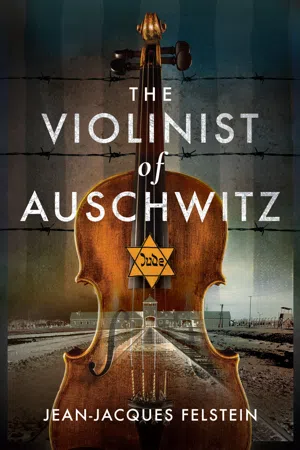
A son chronicles his Jewish mother's real-life efforts to save as many young women as possible from the Auschwitz gas chambers during World War II.
Arrested in 1943 and deported to Auschwitz, Elsa survived because she had the "opportunity" to join the women's orchestra. But Elsa kept her story a secret, even from her own family. Indeed, her son would only discover what had happened to his mother many years later, after gradually unearthing her unbelievable story following her premature death, without ever having revealed her secret to anyone . . .
Jean-Jacques Felstein was determined to reconstruct Elsa's life in Birkenau, and would go in search of other orchestra survivors in Germany, Belgium, Poland, Israel, and the United States. The recollections of Hélène, first violin, Violette, third violin, Anita, a cellist, and other musicians, allowed him to rediscover his twenty-year-old mother, lost in the heart of hell.
The story unfolds in two intersecting stages: one, contemporary, is that of the investigation, the other is that of Auschwitz and its unimaginable daily life, as told by the musicians. They describe the recitals on which their very survival depended, the incessant rehearsals, the departure in the mornings for the forced labourers to the rhythm of the instruments, the Sunday concerts, and how Mengele pointed out the pieces in the repertoire he wished to listen to in between "selections."
In this remarkable book, Jean-Jacques Felstein follows in his mother's footsteps and by telling her story, attempts to free her, and himself, from the pain that had been hidden in their family for so long.
- 208 pages
- English
- ePUB (mobile friendly)
- Available on iOS & Android
eBook - ePub
The Violinist of Auschwitz
About this book
Information
Topic
Theology & ReligionSubtopic
Historical BiographiesChapter 1
Hélène and Violette

The women’s orchestra (artist unknown).
Paris, February 1995
Once again, everything has completely fallen apart for me. Ruth has sent me a book from Cologne which she obtained through complicated channels. Published in Belgium, it focusses on a character who has become a legend: a young woman deported to Birkenau, Mala Zinetbaum. Deported from Belgium, Mala was soon appointed as a Läuferin (messenger) in Birkenau, then as an interpreter. Testimonies about her make her out to be a particularly endearing character, one of those figures that we can’t forget. As an interpreter, she had access to a number of facilities in the camp, including food and clothing, and was extraordinarily dedicated to helping as many inmates as possible, Belgians in particular, but not just by giving them a piece of bread, or a transfer to a less exhausting Kommando, a better fitting pair of shoes, or simply a smile or a compassionate word: something that could, at the right time, prevent someone from letting go, from letting themselves die.
With the help of her counterpart in the men’s camp, Edek Galinski, she escaped Birkenau. However, they were captured after weeks of a Nazi manhunt across Europe. During the ‘ceremony’ of his execution by hanging, Mala had violently rebelled against Edek’s tormentors: slapping one, the foul Tauber, she then slashed her veins with a razor blade. These “ceremonies” were used by the Nazis to set an example – there was no escaping a Lager – and all the detainees would have been there to witness Mala’s execution and therefore witnessed her revolt as well.
This book about Mala is made up of memories and statements from a number of survivors. One of them, Hélène, recalls her arrival in Auschwitz and her meeting with a young girl she described as ‘neat, with a kerchief on her head, and laced boots’. Her name was Elsa Miller: you, my mother. She recounted how you had taken her out of the mass of deportees in quarantine, to shelter her a little, by coming to fetch her to join the orchestra.
I had already met Hélène during a visit that we, Elsa and I, had paid her in Hasselt in 1961. I remember that her daughter, Danielle, had played Bach’s Prelude in C on the piano, the one which makes up the harmonic base of Gounod’s Ave Maria.
The relative balance that I had found, the feeling that this part of your life I had put into the attic of my own mind, was upset again by these few lines.
What Hélène said meant more to me than the family regurgitations I had suffered since your death thirty years before. They had the character of a memory, precious and vague at the same time. But they didn’t proceed from a desire to appropriate what you represent, a feeling of theft constantly renewed and actualized by each evocation – or summons – of you in front of me in our family. Reading you described as “neat” made me see you again, in the morning, when you were getting ready to leave for work, when you were doing your makeup, always neat and tidy, and it gave me back the precision of your gestures, that little mascot who bravely returns to combat every day. It was your presence in my memory, transposed onto the backdrop of Birkenau, concrete, precise and without the trappings of passing time, which I was hit with head on.
It was easy for me to reconnect with Hélène through the editors of the book. One failed act, however, nearly ruined everything. Instead of giving the intermediaries my personal telephone number, I gave my work number … as if to prevent her from finding me.
A whole stream of images haunts me again. Watchtowers, electrified barbed wire, blocks seen from an airplane, lined up like a giant Lego set. A procession of shadows that crawl around, dressed in striped uniforms, and you, standing out against this background, with a few rare locks of hair carefully hidden by your white scarf. I imagine your appearance in what I see as an enclosure, where the new arrivals are huddled together in quarantine. It’s a waking nightmare that takes shape. But a nightmare lived by Hélène and you. Yet for the first time, I had found someone who had seen you in this context, who had lived with you through those two almost unspeakable years, someone who loved you, too.
Completely contradictory thoughts flood through me, right at the same time as I’m on the telephone with Hélène. Will it hurt her to tell me about you? The time that was stolen from you there, those sensations, those feelings, those events that you couldn’t, didn’t know how, or didn’t want to share with me, will Hélène be able to transmit them to me without too much damage to herself?
But I’d also just been hit in the stomach by the need to pass on the history of your group so that it didn’t become lost. The story of the women’s orchestra at Birkenau is so extraordinary that it almost takes hold of me physically. Meeting Hélène and talking about it, these two desires overlapping and intertwining. But would Hélène grant me the right to know your secrets, something that was always forbidden to me during your lifetime? Is it almost a rape, a taboo, that I’m asking her to condone?
I don’t need to display feats of eloquence: Hélène seems to understand my request without saying. She points me in the direction of one of her friends in Paris, Violette Zylberstein, who was with the two of you in the orchestra and has a particularly keen memory.
When I think about these first contacts, I realize how much I really am my mother’s son. My request concerning you had to be presented in this convoluted form; I was interested in your life back in those days – how strange! how easy to say! – but impossible to proceed other than by articulating it in an incomparably complex project, in which my quest for you can succeed. Nothing less than the story of a group of forty-five women, of which you were one of the most secretive. Will I be old enough, one day, to allow myself to look for you, first and foremost you, simply for myself?
Paris, March 1995
This is my first meeting with Violette. We greet each other formally, but she also gives me a kiss to welcome me. Small, lively, and energetic, she smokes like a chimney. Her voice is a bit hoarse, veiled, and the sometimes surprising images she constructs, the flowery if not very PC language she uses, make me appreciate her immediately. She is a “little old lady” who isn’t afraid to say what she wants. She immediately considered me to be a valid interlocutor with whom she could talk about all this, directly, without any false modesty, whereas it took me more than forty years of my life for the same thing to happen to me with my relatives, my family, and even then it was watered down.
I thought I needed to bring her some pictures of you, as a youngster. After all, fifty years later she may have forgotten you. But Violette immediately gives me a gift. Looking at me, I who have lost the image of my mother, she recognizes you instantly. My forehead and the shape of my eyes, no doubt.
I tell her a lot about our life. Violette already knew some elements of it from Hélène and Fanny, with whom she had never completely lost contact. She knew the main episodes, marriage, birth, divorce, remarriage, one more birth, death, living far away on the edge of the United States. I explain to her in detail the feelings that have worked away at me with a chisel for so long, that of having spent my childhood with a quasi-absent mother, someone three-quarters destroyed by her experience. Violette amazes me when she talks about you out loud: your gentleness, your kindness, of course, which everyone in my family always spoke about with devotion. Still, I think, you could also be sour, unfair, and surly. But Violette confirms it: you were gentle, good and serene. Even in Birkenau!
Inside, in the warmth, we spend several hours talking: me about my relationship with you, and my regret at having passed you by, and Violette about her return from deportation. She tries to explain to me how, at the end of the war and with the all daily hardships, many “normal” people, as in those who hadn’t been through Birkenau, very quickly wanted to turn over the page, or even just ignore it altogether. To make me understand the silence, she tells me about a surprise party she was invited to, sometime after her return. Someone hearing her talk about her story squealed and asked her to be quiet: it was too depressing. ‘At that point, I decided to shut my mouth’, she tells me. But in the silence that was expected of her, she describes how it also gave her a kick up the backside, by forcing her not to drown in her memories and to look as resolutely as possible towards the future: the incomprehension of others in light of what couldn’t be spoken, constituted a paradox for her of an unbearable injustice and the impetus to move forward.
I can’t help it: when I tell her of my frustration, my sadness, my emptiness, it’s with vehemence and almost anger. It’s as if, through her, I was speaking to you and, in a way, to everyone around you.
Without any shame, I confide in Violette, who went through what you went through, how I resigned myself very early on to protect you, and not to ask for more than what you could grant me. I also confide in her that I very quickly gave up on you telling me something about this time, and how hard that resignation still is for me.
I now understand. You who had known extreme hunger, the kind people die from, who knew fear, suffering, and horror, could you, so soon afterwards, identify with my cries for “normal” hunger, or the fear of being alone in the dark, or waking up after a nightmare? No doubt you couldn’t bear to anymore.
Reluctantly, I pity you. I pity us, and I’m ashamed of this pity.
Lille, 1 July 1943
Violette has been living in the suburbs of Lille for a few months. She first left Le Havre with her parents who, in order to escape the bombings of 1940, had moved to Paris where they were confronted with the first discriminatory measures against the Jews. She still has her mother’s identity card, issued by the Pétainist authorities, a green card with the word “Jew” stamped in diagonally in red, as if to bar any particular sign of height, weight or hair colour. On the advice of an uncle, they had then secretly come to seek refuge in the Lille region. Without registering at the prefecture, they must use forged food stamps. There’s also no possibility of her parents finding work and no opportunity for Violette to enrol in high school. They manage to live by drawing on their savings, then by reselling the clothing coupons that her father had brought with him from his store in Le Havre.
On 1 July, she returns home to rue Cabanis, in Fives, after going to the cinema to see Le Lit à colones (The Four-poster), a film with Jean Marais, Fernand Ledoux and Odette Joyeux. Fifty years later, she still remembers it with amusement: the character played by Jean Marais is a musician in prison, whose work is stolen by the prison director. By the time the screening ends, it’s 4 o’clock in the afternoon.
She comes back by tram. Arriving near her home, she sees the curtains of the neighbouring house moving, and a slight concern hits her, which then turns into panic. She rings the doorbell and two men in black leather coats and trilby hats come out of her house. She knows what this means and starts to run: her mother has also gone to the cinema in Fives, and is due to return soon. Violette understands that she mustn’t fall into the trap. She wishes she could fly away, but she isn’t fast enough and is quickly caught by the Gestapo. They are used to the chase.
Cornered by the bull mastiffs, she is brought home and watches helplessly as her mother is captured. At the Gestapo headquarters in Lille they find an aunt, who for a time had been seeing a rather suspicious man known to be a petty trafficker and collaborator. It’s clear to Violette that the simultaneous arrests can mean only one thing: they have been betrayed.
A long time later, and without any particular remorse, Violette admits that the fierce desire to discover their whistle blower and kill him was part of what supported her throughout her deportation. ‘When I’m in prison, bring me apples, not oranges’, she often said to her friends, seeing herself as quite the rebel. But the individual in question would later be executed by the FFI (Forces françaises de l’Intérieur).3
Father, mother and daughter are all locked in individual cells at a prison in Loos. What Violette doesn’t know is that this is the last time she will have a space to herself for two years. The food is foul, the isolation scary. One absurd detail is that every day a newspaper is slipped under the door, just as if they were in a grand hotel. She reads it from the first to the last line, even the classifieds. Eight days later, the family is escorted to Saint-Gilles prison, Brussels. The food there is better and they can wave to each other during their daily walk. A dozen or so days later, they are all taken to Mechelen transit camp, the penultimate stage of a journey that will take them to the borders of Europe, to a place where, without them knowing it, a destination has already been planned and organized for them by the Nazis. Auschwitz.
Although French, and only deported from Belgium by some bureaucratic accident, many years later Violette will have the unpleasant surprise of seeing her name inscribed on the monument to the Belgian dead of those deported from Mechelen.
They are deported on 31 July 1943 in convoy number twenty-one, which arrives at Auschwitz in the mid-morning of 2 August. They travel in a sealed wagon car: it’s hot, and the unhygienic conditions and overcrowding are unbearable. The only toilet bucket allocated to the people in the wagon will, naturally, quickly overflow. Trying to retain some form of dignity and, perhaps, while also beginning to adapt her body to the unimaginable conditions, throughout the journey she doesn’t need to crouch in the mire.
Upon arrival, the designation of those who will be killed immediately takes place on the station platform. In a reflex that she herself describes as “boy scout”, Violette doesn’t climb into the waiting truck, believing instead that the older people or those more strained by the journey will need it instead. First she is separated from her father, then watches as her mother gets into the truck. This sorting operation between those deemed ‘fit’ or ‘unfit’ to live takes place in a cacophony of howls, the barking of guard dogs, and seemingly contradictory orders. Yet if someone approaches the truck and expresses the desire to climb on board to be with a loved one, none of the SS guards says anything, or shows any sign of wanting to stop them.
Along with the other women designated to enter the camp, she passes through the gate and walks the approximately 1.3 kilometres of Lagerstrasse, the road which crosses the camp, to arrive at the “sauna” of Camp B. Here, they are all entered in the camp’s records, shaved, ‘disinfected’, and are, finally, entitled to a shower. They are then taken to be tattooed and are given items of clothing: breeches, a shirt, a dress with a large slash of red paint on the back, shoes in their (approximate) size, and a bowl.
Violette doesn’t understand the purpose of the truck. W...
Table of contents
- Cover
- Title
- Copyright
- Contents
- Prologue
- Chapter 1: Hélène and Violette
- Chapter 2: An Anniversary
- Chapter 3: The Chaconne
- Chapter 4: The Weight of Words
- Chapter 5: The Orchestra
- Chapter 6: Alma
- Chapter 7: Hairdresser and Beauty Salon: “Paris-Beauté”
- Chapter 8: Second Violin
- Chapter 9: Tochter aus Elysium
- Chapter 10: Polonaises
- Chapter 11: The Dying Swan
- Chapter 12: Sylvia
- Epilogue
- Members of the Women’s Orchestra of Auschwitz
- A Selection of Works from the Repertoire
Trusted by 375,005 students
Access to over 1.5 million titles for a fair monthly price.
Study more efficiently using our study tools.
Frequently asked questions
Yes, you can cancel anytime from the Subscription tab in your account settings on the Perlego website. Your subscription will stay active until the end of your current billing period. Learn how to cancel your subscription
No, books cannot be downloaded as external files, such as PDFs, for use outside of Perlego. However, you can download books within the Perlego app for offline reading on mobile or tablet. Learn how to download books offline
We are an online textbook subscription service, where you can get access to an entire online library for less than the price of a single book per month. With over 1.5 million books across 990+ topics, we’ve got you covered! Learn about our mission
Look out for the read-aloud symbol on your next book to see if you can listen to it. The read-aloud tool reads text aloud for you, highlighting the text as it is being read. You can pause it, speed it up and slow it down. Learn more about Read Aloud
Yes! You can use the Perlego app on both iOS and Android devices to read anytime, anywhere — even offline. Perfect for commutes or when you’re on the go.
Please note we cannot support devices running on iOS 13 and Android 7 or earlier. Learn more about using the app
Please note we cannot support devices running on iOS 13 and Android 7 or earlier. Learn more about using the app
Yes, you can access The Violinist of Auschwitz by Jean-Jacques Felstein in PDF and/or ePUB format, as well as other popular books in Theology & Religion & Historical Biographies. We have over 1.5 million books available in our catalogue for you to explore.