eBook - ePub
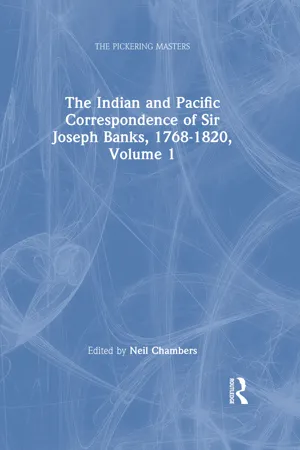
The Indian and Pacific Correspondence of Sir Joseph Banks, 1768-1820, Volume 1
- 464 pages
- English
- ePUB (mobile friendly)
- Available on iOS & Android
eBook - ePub
The Indian and Pacific Correspondence of Sir Joseph Banks, 1768-1820, Volume 1
About this book
After James Cook's voyage in HMS Endeavour, Banks developed a network of scientists and explorers. Banks's correspondence is one of the great primary sources for studying the Pacific region during this important period of exploration and colonial expansion.
From John Sneyd
DOI: 10.4324/9781003113119-1
[1]
Glanville Street
Saty Morng., [1768]
Dear Banks
The Crowd was so great last night at Ranelagh that I could not once get a glimps of you, or wanted much to have given you a parting good wish, & shake by the hand, & likewise to have spoke a word for my Wife & another for myself wch. I fear you will think unreasonable after the many Civilities we have rec'd from you during our short Acquaintance.
That from my Wife is to enlarge her Commission from 5 Guineas to ten in /China/ Goods such as Japan China Muslin Calico /&c/ in short whatever yr. own Taste dictates. The Petition from myself I only offer on condition that you honestly tell me whether you have /or have not/ any Reasons for not granting it. It is to entrust me wth. yr Specimens of English Plants during yr absence from Eng. It would be a charming School for me, & be in some measure a Representative of yourself; & you may depend on the greatest care being taken of them. In case you can grant me this favor, please to send the Cabinet down to me by Clark & Mallet (whose Care I can depend on) from the Castle & Falcon Aldersgate Street.1 The Ladies all join in ev'ry good Wish for Health Amusement & Instruction till we meet again wth
- my Dear Banks
- Yt affecte. & sincere Friend
- J: Sneyd.
[Addressed: New Burlington Street.]
1. In the event, Banks did lend his herbarium to his friend, the naturalist John Sneyd (1734-1809) of Bishton in Derbyshire, where it was used by William Withering (1741-99), FRS 24 November 1785, during the course of the preparation of his Botanical Arrangement of all the Vegetables Naturally Growing in Great Britain (London, 1776). However, the commission by Sneyd's wife to acquire fabrics on the forthcoming Pacific voyage was not undertaken. See Penelope Sneyd (d. 1776) to Banks, 21 May 1768, Kew BC125 (JBK/1/2).
From the President, Council and Fellows of the Royal Society to George III
[2]
[Crane Court]
February 1768
To the King's most excellent Majesty The Memorial of the President, Council and Fellows of the Royal Society of London for Improving Natural Knowledge.1
Humbly Sheweth
That the passage of the Planet Venus over the Disc of the Sun,2 which will happen on the 3d of June in the year of 1769, is a Phenomenon that must, if the same be accurately observed in proper places, contribute greatly to the improvement of Astronomy, on which Navigation so much depends.
That several of the great Powers in Europe, particularly the French, Spaniards, Danes & Swedes, are making the proper dispositions for the observation thereof; and the Empress of Russia has given directions for having the same Observed in many different places of her extensive Dominions.
That the like appearance after the 3d of June 1769 will not happen for more than 100 years.
That, as far as appears from the History of Astronomy, Mr- Jeremiah Horrox (an Englishman)3 seems to have been the first person since the Creation of the World, who calculated the passage of that Planet over the Sun's Disc, and observed the same at the Village of Hool, 15 miles northward from Liverpoole, on the 24th of November O.S. in the year 1639.
That the British Nation have been justly celebrated in the learned world for their knowledge of Astronomy, in which they are inferior to no Nation upon Earth, Ancient or Modern; and it would cast dishonour upon them should they neglect to have correct observations made of this important Phenomenon.
That by neglecting to take the necessary precautions in due time, the passage of the Planet in the year 1761 was not observed in some places from whence the greatest advantages might have redounded to the improvement of Astronomy.
The Memorialists are humbly of opinion that Spitzbergen, or the North Cape, in the higher northern latitudes: Fort Churchill in Hudsons Bay; and anyplace not exceeding 30 degrees of Southern latitude, and between the 140th and 180th degrees of longitude, West from your Majesty's Royal Observatory in Greenwich Park, would be proper Stations of observing the ensuing Transit, to each of which places two Observers ought to be sent.
That a correct Set of Observations made in a southern latitude, would be of greater importance than many of those made in the northern. But it would be necessary that the Observers who are to pass the Line, should take their departure from England early in this Spring; because it might be some time before they could fix upon a proper place for making the Observation within the limits required.
That the Expence of having the Observations properly made in the places above specified, including a reasonable gratification to the persons employed, and furnishing them with such Instruments as are still wanting, would amount to about 4000 pounds, exclusive of the expence of the Ships which must convey and return the Observers that are to be sent to the southward of the Equinoctial line, and to the North Cape.
That the Royal Society are in no condition to defray this Expence, their annual income being scarcely sufficient to carry on the necessary business of the Society.
The Memorialists, attentive to the true end for which they were founded by your Majesty's Royal Predecessor, The Improvement of Natural Knowledge, concieve it to be their duty to lay their sentiments before your Majesty with all humility, and submit the same to your Majesty's Royal consideration.
1. Prior to the memorial printed above, the Royal Society had sponsored earlier missions to observe a transit of Venus (see notes 2 and 3 below) that took place on 6 June 1761. This was part of what was in effect an international programme of observations conducted at around sixty locations all over the world, but one being undertaken in the second half of the Seven Years War, 1756-63, and somewhat disrupted by that conflict. The Royal Society arranged for Rev. Nevil Maskelyne (1732-1811) to sail for St Helena to make observations, while Charles Mason (1728-86) and Jeremiah Dixon (1733-79) were chosen to go to Sumatra. However, poor weather at St Helena frustrated Maskelyne's work, and an encounter with a French frigate delayed the departure of Mason and Dixon. As they could not reach Sumatra in time, Mason and Dixon landed at the Cape of Good Hope, where they successfully observed the transit. By the time of the next transit, which took place in 1769, Maskelyne was astronomer royal, and he prepared the instructions for the Royal Society missions launched at that time.
The memorial printed above was signed at a council meeting of the Royal Society on Monday, 15 February 1768. The president, James Douglas, Earl of Morton (1702-68), was in the chair, and fourteen other council members were present: Swithin Adee (1704/5-86), FRS 6 December 1744; James Burrow (1701-82), FRS 7 April 1737; John Campbell (c. 1720-90), FRS 17 May 1764; Charles Cavendish (c. 1693-1783), FRS 8 June 1727; Charles Moss (1711-1802), FRS 28 May 1752; Andrew Coltee Ducarel (1713-85), FRS 4 February 1762; Samuel Dyer (1725-72), FRS 6 March 1760; Benjamin Franklin (1706-90), FRS 29 April 1756; Peter Holford (c. 1719-1804), FRS 12 February 1747; Francis Huntingdon, Lord Huntingdon (1729-89), FRS 2 March 1758; Gowin Knight (1713-72), FRS 25 April 1745; Nevil Maskelyne, FRS 27 April 1758; Nicholas Munckley (c. 1721-70), FRS 26 January 1749; Matthew Maty (1718-76), FRS 19 December 1751.
The purpose of the memorial was to seek royal support for missions to observe the next transit of Venus, due to occur on 3 June 1769. In response, George III (1738-1820) ordered that £4,000 be provided so that the missions could be undertaken. The Royal Navy supplied a vessel and crew for a voyage to the South Pacific, which was considered a suitable area from which to make observations. At this time, the naval officer and explorer Samuel Wallis (1728-95) had returned from the Pacific. He was the first European navigator to anchor at the island he called King George the Third's Island, but which is now known as Tahiti. As a result of Wallis's reports, Tahiti, one of the Society Islands, was chosen to be the location for the planned Pacific observations. James Cook (1728-79), with his considerable experience as a navigator and surveyor, was appointed to command the voyage to Tahiti, and Charles Green was chosen to be the astronomer. On the way Green trained some of the officers in astronomical observation, and with their assistance it was he and Cook who supervised the observation of the transit once at the Society Islands.
In addition to Cook's expedition, William Wales (bap. 1734-98) and Joseph Dymond (1746-96) were sent to Prince of Wales Fort (now Churchill) at Hudson Bay, Canada, to observe the transit of Venus. The Hudson Bay Company granted passage on one of their vessels for Wales and Dymond. The two men sailed in May 1768, and they successfully observed the transit, arriving back in London in October. It was also agreed that William Bayly (bap. 1738-1810) and Jeremiah Dixon should go to the North Cape. They sailed to Norway on 13 April 1769. Dixon made his observations on Hammerfest Island, and Bayly's were made at Nordkapp, some 60 miles away. Unfortunately, Dixon's observations of the transit were frustrated by cloud, but Bayly's were successful. They reached England again on 30 July.
2. While the laws of Johannes Kepler (1571-1630) and Sir Isaac Newton (1642-1727), FRS 11 January 1672 and president of the Royal Society, 1703-27, enabled the relative motions of the planets to be predicted with a fair degree of accuracy, the actual distances of planets and stars from the earth was still unknown in the mid-eighteenth century. To establish such distances it was necessary to find the mean distance of the earth from the sun, a quantity now known as the Astronomical Unit (AU). In 1716 Edmond Halley (1656-1742), FRS 30 November 1678, formulated a plan for calculating this value from timings of the transits of the planet Venus across the face of the sun, which would take place in 1761 and 1769. These observations had to be made from different points on the earth's surface, which, for accuracy, had to be as far apart on the earth's surface as possible. By combining the data from observations of these two transits, a ...
Table of contents
- Cover Page
- Half Title Page
- Title Page
- Copyright Page
- Contents Page
- Acknowledgements Page
- General Introduction Page
- Editorial Principles Page
- Abbreviations and Sources Page
- Timeline 1768-1782 Page
- Letters 1768-1782
- Calendar of Correspondence
- Index
Trusted by 375,005 students
Access to over 1.5 million titles for a fair monthly price.
Study more efficiently using our study tools.
Frequently asked questions
Yes, you can cancel anytime from the Subscription tab in your account settings on the Perlego website. Your subscription will stay active until the end of your current billing period. Learn how to cancel your subscription
No, books cannot be downloaded as external files, such as PDFs, for use outside of Perlego. However, you can download books within the Perlego app for offline reading on mobile or tablet. Learn how to download books offline
Perlego offers two plans: Essential and Complete
- Essential is ideal for learners and professionals who enjoy exploring a wide range of subjects. Access the Essential Library with 800,000+ trusted titles and best-sellers across business, personal growth, and the humanities. Includes unlimited reading time and Standard Read Aloud voice.
- Complete: Perfect for advanced learners and researchers needing full, unrestricted access. Unlock 1.5M+ books across hundreds of subjects, including academic and specialized titles. The Complete Plan also includes advanced features like Premium Read Aloud and Research Assistant.
We are an online textbook subscription service, where you can get access to an entire online library for less than the price of a single book per month. With over 1.5 million books across 990+ topics, we’ve got you covered! Learn about our mission
Look out for the read-aloud symbol on your next book to see if you can listen to it. The read-aloud tool reads text aloud for you, highlighting the text as it is being read. You can pause it, speed it up and slow it down. Learn more about Read Aloud
Yes! You can use the Perlego app on both iOS and Android devices to read anytime, anywhere — even offline. Perfect for commutes or when you’re on the go.
Please note we cannot support devices running on iOS 13 and Android 7 or earlier. Learn more about using the app
Please note we cannot support devices running on iOS 13 and Android 7 or earlier. Learn more about using the app
Yes, you can access The Indian and Pacific Correspondence of Sir Joseph Banks, 1768-1820, Volume 1 by Neil Chambers in PDF and/or ePUB format, as well as other popular books in History & Military & Maritime History. We have over 1.5 million books available in our catalogue for you to explore.