- 278 pages
- English
- ePUB (mobile friendly)
- Available on iOS & Android
eBook - ePub
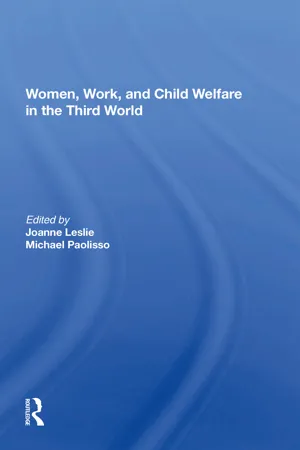
Women's Work And Child Welfare In The Third World
About this book
Recent trends in women's work and child survival and development in developing countries raise concerns about the relationship between these two key elements of development. This paper reviews and analyzes the methodology and findings of 50 studies of both women's work and infant feeding practices, and women's work and child nutritional status. Although the pattern of findings is complex and occasionally contradictory, the paper concludes that overall there is little evidence of a negative effect of maternal employment on child nutrition, and therefore no justification for limiting women's labor force participation on the grounds of promoting child welfare.
Information
1 Introduction
DOI: 10.4324/9780429268656-1
Two fields of social action that have been given increasing attention in the last decade in much of the developing world are the survival and healthy development of children, and the social and economic roles of women. Researchers, policy makers, and program planners in both fields have been concerned about the relationship between women's work and child welfare, although frequently from differing points of view. The primary focus of those in the women in development field has been on ways to enhance women's economic opportunities; this focus has led to a tendency either to deemphasize women's child care responsibilities, or to assume that substitute child caretakers would provide equally good care. In a similarly one-sided fashion, those concerned with child survival and development, usually professionals from education and public health, have tended to view women primarily as an instrument to produce healthy children, ignoring or minimizing the opportunity costs of women's time, and the genuine need in most low-income households for mothers to earn income during the same years that they are bearing and raising children.
Uninformed by an appreciation of women's multiple roles, a main policy inference from research on child health and nutrition has been that reduced malnutrition rates and increased child welfare, result from keeping poor women at home rather than promoting their participation in the marketplace. Uninformed by a child welfare orientation, a main inference from women-in-development literature has been that women's incorporation into the workforce offers only benefits and no costs to women and children.
It is only quite recently that bridges have been built and a fruitful dialogue has begun between the women in development and child welfare fields (Myers and Indriso 1987; Leslie, Lycette, and Buvinic' 1988). A genuine collaboration between those working fo- the survival and healthy development of children and those working to support the social and economic roles of women should produce policy and program recommendations that will improve both the status of women and the welfare of children in developing countries. Initial collaboration has already enriched research in both fields, as is evident from the studies included in this volume.
A Brief History
A precursor to interest in the relationship between women's work and child welfare was an interest in the relationship between women's work and fertility. More than two decades ago, first in industrialized countries and then in developing economies, demographers and economists began to look at the relationship between women's labor force participation and fertility in order to understand population and labor supply trends. In fact, studies on the relationship between women's labor force participation and fertility represent some of the earliest attempts to integrate a gender perspective into economic development research and policy.
The central hypothesis of the research carried out in industrialized economies, which was then transferred to developing ones, was that there was an inverse relationship between female labor force participation and fertility behavior. This hypothesis was based on an assumed incompatibility between women's work in the marketplace and women's reproductive and childbearing functions at home. Extensive empirical research with large data sets demonstrated, however, that the relationship between these two variables was much more complex than originally anticipated. In industrialized countries it was generally found that increased female labor force participation was positively correlated with lower birth rates when women in low income groups were excluded (Oppenheimer 1970). In developing countries, however, the relationship between female labor force participation and fertility varied dramatically depending on, among other things, rural-urban residence, education, and participation in modem or traditional sectors of the economy; the empirical evidence in developing countries often contradicted the original predictions (Piepmeier and Adkins 1973). One principal factor that could explain these opposite empirical findings was the relative lack of conflict in developing countries between women's roles as workers and mothers (Standing 1978). In fact, some authors argued quite forcefully that the notion of incompatibility between labor force participation and reproductive and child care tasks was derived from an ethnocentric Western model that did not apply to traditional and/or rural-based economies where women's work and child care were compatible activities (Ware 1975).
Researchers within the women in development framework, along with more traditional demographers and economists, have continued to undertake empirical studies in order to clarify the relationship between women's market work and fertility patterns, as well as the broader relationship between women's status—measured by women's education and labor force participation — and fertility behavior (Cochrane 1978). These studies have benefited from the knowledge gained in the women in development field and, at the same time, have shed light on the complex nature of women's work in developing economies, particularly of work that takes place outside the modem marketplace (see, for instance, Dixon 1975; Birdsall 1976; and Youssef 1974).
The new household economics, based on the model of the household as a productive unit, has also provided valuable insights and analytical tools in the growing effort to understand die relationship between women's economic and reproductive roles (Schultz 1973). One important contribution of the new household economics has been the explicit consideration of the economic value of goods and services produced and consumed within the family. This has led to a greater recognition of the value of women's economic contribution, since women are the primary producers of goods and services within the home, and to a greater appreciation of the opportunity cost of women's time. Another central feature of the new household economics is the model of the household as a rational decisionmaking unit, which is presumed to lead to an optimal allocation of time by different household members among different domestic and income-generating tasks. While valid questions have been raised about the appropriateness of treating the household as a single decision-making unit (Dwyer and Bruce 1988), an important contribution of the model of the rational household has been to provide a framework within which to examine the tradeoffs between time spent on child care, time spent in the labor force, and other uses of women's time (Birdsall 1980; DaVanzo and Lee 1983).
The original hypothesis of conflict between women's work and childbearing roles, which had positive implications both for increasing women's economic status and reducing population growth in developing countries, took a more negative turn when transferred to the field of public health and child development. A corollary to the hypothesis of the inverse workfertility relationship is the hypothesis that women's labor force participation will be negatively related to child welfare. It is assumed that women's labor force participation is directly related to a reduction in time spent in breastfeeding and child care, which, in turn, has negative consequences for child welfare (Nerlove 1974; Monckeberg 1977; Popkin 1978).
As the studies in this volume indicate, the hypothesized inverse relationship between women's market work and child welfare in developing countries is as fraught with similar complexities and inconsistencies as the earlier postulated inverse work-fertility relationship. Until recently, however, the assumption of a negative relationship between women's market work and child welfare went largely unquestioned in the literature in part because the research did not benefit from collaborative inputs from women in development and child health and development perspectives. It is probable that, as the positive policy implications for women's economic advancement and reduced birth rates nurtured the development of a gender dimension in population studies, contrary or negative policy implications regarding women's economic participation and child welfare built a gulf that, until recently, prevented collaboration between those concerned with women in development and those concerned with child welfare.
Recent Trends
An interest in the relationship between women's work and child welfare is particularly relevant given several recent trends in developing countries. One is women's increased participation and visibility in the market economy. Another is the continuing high levels of child mortality, morbidity, and malnutrition in many developing countries. A third is the recent promotion of child survival technologies, which rely heavily on women as agents in their dissemination. The following sections briefly review these trends to provide a context in which to consider the findings from the studies in this volume.
Trends in Women's Work
The majority of women of reproductive age, in industrialized and developing countries alike, face the need at some point in their lives to combine economically productive work with nurturing their children. The burden of these dual responsibilities, however, falls most inevitably and heavily on low-income women in the Third World. While the true economic contribution made by women in the developing world may not have increased in the post-colonial period, the pattern of women's work has changed substantially. Increased urbanization, industrialization, and migration have caused greater numbers of women to seek income-generating work away from home. The proportion of women officially recorded as being part of the paid labor force in developing countries increased from 28 percent in 1950 to 32 percent in 1985 (Sivard 1985). At the same time, more women have become the primary economic support of themselves and their children. Estimates of the proportion of households headed by women range from almost half in Botswana, to a third in Jamaica, to a minimum of 10 percent in most Arab Middle Eastern countries (Youssef and Hetler 1984).
The worldwide economic recession of the past few years and the severe food production crisis throughout much of sub-Saharan Africa has intensified the burden that poor women in the developing world have to contribute to, if not to assume the sole responsibility for, the economic welfare of their households (Gozo and Aboagye 1985; Savane 1985). Few low-income women have the option of devoting themselves exclusively to nurturing their children, even during the first year after childbirth. At the same time, child care responsibilities during the reproductive years are increasingly being recognized as a major reason for the high proportion of women in informal-sector jobs, many of which are low paying and insecure (Lvcette and White 1988).
The changing nature of women's work in less-developed countries — more women working away from home and more women earning a cash income — and the resultant increased recognition of the importance of women's economically productive roles, is one factor that has led to a desire to understand better how women combine their productive and maternal roles and to what extent, or under what circumstances, the one may interfere with or constrain the other.
Trends in Child Survival and Development
Overall, the chances of survival of children in the Third World have improved considerably in the past 20 years. The infant mortality rate (IMR) in countries that the World Bank defines as "middle-income" declined from an average of 104 per 1000 births in 1965 to 68 in 1985, and child death rates over the same period declined from 17 to 8 deaths per 1000 children aged 1 to 4 years (World Bank 1987). Even in the lowestincome countries, the average IMR fell from 150 to 112 and the average child death rate from 27 to 19. In spite of these substantial declines, however, infant and child mortality rates remain distressingly high, particularly in Sub-Saharan Africa. There is also a growing concern that certain trends, such as the increasing prevalence of female-headed households, and more recently, the economic recession and structural adjustments to it, could be reversing the trend towards improvements in child survival (Comia, Jolly, and Stewart 1987).
One of the earliest issues that focused interest on the relationship between women's work and child welfare was the belief that changing patterns of work among women were a major cause of declining rates of breastfeeding, which in turn were having a negative effect on child survival and nutritional status (Jelliffe 1962; Wray 1978). Recent evidence suggests, however, that changes in breastfeeding patterns have been less dramatic than originally thought, particularly among rural populations. The main change seems to have been a reduction in duration of breastfeeding in urban areas (Popkin, Bilsborrow, and Akin 1982; Millman 1986). In addition, most studies have found that the need to work, or factors related to work, have been cited by a surprisingly small proportion of women as their reason for not initiating breastfeeding, for introducing supplementary bottles, or for terminating breastfeeding (Van Esterik and Greiner 1981). Nonetheless, concern about the influence of maternal work patterns on breastfeeding behavior continues and is one of the reasons that it seemed essential in this volume to carefully review the actual empirical evidence concerning women's work as a determinant of infant feeding patterns (see particularly Chapters 2,4,5, and 6).
Another issue that has gained increasing attention in recent years — one that suggests the possibility of both negative and positive effects of women's work on child health and nutritional status—is the importance of a protein-and energy-dense diet to ensure adequate nutrition among weaning-age children (Gibbons and Griffiths 1984), Children in this age group have particularly high nutritional needs, due to the combined effects of rapid growth and a high prevalence of infectious diseases. Because they are also unable to consume large amounts of food at one time, weaning-age children need frequent, nutrient-dense meals to prevent malnutrition. Mothers who are not working or who work at home may be better able to assure frequent meals and to monitor intrahousehold food distribution to ensure that weaning-age children receive an adequate share. On the other hand, mothers who are working may be better able to produce or purchase the more expensive oils, legumes, and animal source proteins needed to provide energy- and protein-dense diets for their weaning-aged children. The findings from Guatemala reported by Engle in Chapter 8 are particularly interesting in regard to weaningage children. While she found some evidence of a negative effect of maternal work on nutritional status among children less than a year old, she found that, during the second year of life, children of women who worked were less malnourished than children of women who did not work, which she attributed in part to their mothers being better able to buy higher-quality, age-appropriate foods.
Women's Role in Child Survival Interventions
The recent emphasis within the international health community on increasing child survival through the use of selective primary health care interventions relies heavily on women as agents in introducing new health technologies and practices. UNICEF's 1986 State of the World's Children states, "whether we are talking about breastfeeding or weaning, oral rehydration therapy or immunization, regular growth checking or frequent handwashing, it is obvious that the mother stands at the center of the child survival revolution" (UNICEF 1986).
Of the four central components of the child survival approach to selective primary health care, only one, breastfeeding, focuses on a traditional practice. Breastfeeding was felt to warrant promotion, however, precisely due to the concern discussed earli...
Table of contents
- Cover Page
- Half Title Page
- Title Page
- Copyright Page
- Series Page
- Table of Contents Page
- Acknowledgments Page
- Foreword Page
- Chapter 1: Introduction:
- Chapter 2: Women's Work and Child Nutrition in the Third World:
- Chapter 3: Women's Work and Social Support for Child Care in the Third World:
- Chapter 4: The Effects of Women's Work on Breastfeeding in the Philippines, 1973-1983:
- Chapter 5: Breastfeeding and Maternal Employment in Urban Honduras:
- Chapter 6: Women's Market Work, Infant Feeding Practices, and Infant Nutrition Among Low-Income Women in Santiago, Chile:
- Chapter 7: Maternal Employment, Differentiation, and Child Health and Nutrition in Panama:
- Chapter 8: Child Care Strategies of Working and Nonworking Women in Rural and Urban Guatemala:
- Chapter 9: Effects of New Export Crops in Smallholder Agriculture on Division of Labor and Child Nutritional Status in Guatemala:
- Chapter 10: Women's Agricultural Work, Child Care, and Infant Diarrhea in Rural Kenya:
- Chapter 11: Women's Community Service and Child Welfare in Urban Peru:
- Index
- About the Authors
Trusted by 375,005 students
Access to over 1.5 million titles for a fair monthly price.
Study more efficiently using our study tools.
Frequently asked questions
Yes, you can cancel anytime from the Subscription tab in your account settings on the Perlego website. Your subscription will stay active until the end of your current billing period. Learn how to cancel your subscription
No, books cannot be downloaded as external files, such as PDFs, for use outside of Perlego. However, you can download books within the Perlego app for offline reading on mobile or tablet. Learn how to download books offline
Perlego offers two plans: Essential and Complete
- Essential is ideal for learners and professionals who enjoy exploring a wide range of subjects. Access the Essential Library with 800,000+ trusted titles and best-sellers across business, personal growth, and the humanities. Includes unlimited reading time and Standard Read Aloud voice.
- Complete: Perfect for advanced learners and researchers needing full, unrestricted access. Unlock 1.5M+ books across hundreds of subjects, including academic and specialized titles. The Complete Plan also includes advanced features like Premium Read Aloud and Research Assistant.
We are an online textbook subscription service, where you can get access to an entire online library for less than the price of a single book per month. With over 1.5 million books across 990+ topics, we’ve got you covered! Learn about our mission
Look out for the read-aloud symbol on your next book to see if you can listen to it. The read-aloud tool reads text aloud for you, highlighting the text as it is being read. You can pause it, speed it up and slow it down. Learn more about Read Aloud
Yes! You can use the Perlego app on both iOS and Android devices to read anytime, anywhere — even offline. Perfect for commutes or when you’re on the go.
Please note we cannot support devices running on iOS 13 and Android 7 or earlier. Learn more about using the app
Please note we cannot support devices running on iOS 13 and Android 7 or earlier. Learn more about using the app
Yes, you can access Women's Work And Child Welfare In The Third World by Joanne Leslie in PDF and/or ePUB format, as well as other popular books in Social Sciences & Gender Studies. We have over 1.5 million books available in our catalogue for you to explore.