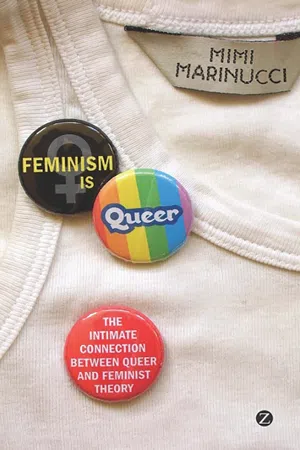
Feminism is Queer is an introduction to the intimately related disciplines of gender and queer theory. Whilst guiding the reader through complex theory, the author develops the original position of queer feminism, which presents queer theory as continuous with feminist theory. Whilst there have been significant conceptual tensions between second wave feminism and traditional lesbian and gay studies, queer theory offers a paradigm for understanding gender, sex and sexuality that avoids the conflict in order to develop solidarity among those interested in feminist theory and those interested in lesbian and gay rights.
An essential guide to anyone with an interest in gender or sexuality, this accessible and comprehensive textbook carefully explains nuanced theoretical terminology and provides extensive suggested further reading to provide the reader with full and thorough understanding of both disciplines.
eBook - ePub
Feminism is Queer
The intimate connection between queer and feminist theory
- 160 pages
- English
- ePUB (mobile friendly)
- Available on iOS & Android
eBook - ePub
About this book
Information
SECTION I: SEXUALITY
“Dear me! Aren’t you feeling a little queer, just now?” Dorothy asked the Patchwork Girl.
L. Frank Baum, The Patchwork Girl of Oz, p. 295
CHAPTER 1
The social construction of sexuality
“You’re likely to see many queer things in the Land of Oz, sir,” said the Wizard. “But a fairy country is extremely interesting when you get used to being surprised.”
L. Frank Baum, The Emerald City of Oz, p. 219
The Kinsey Report
Many people who support the interests of lesbian women and gay men maintain that homosexuality is a universal phenomenon. Drawing on research conducted by Alfred Kinsey and the Kinsey Institute, homosexuality is often estimated to occur in roughly 10 percent of the population. Based on thousands of detailed interviews, Kinsey’s findings were published in two volumes: Sexual Behavior in the Human Male (Kinsey, Pomeroy, and Martin, 1948) and Sexual Behavior in the Human Female (Kinsey, Pomeroy, Martin and Gebhard, 1953). These are often referred to informally as the “Kinsey Reports.” The Kinsey Reports challenged conservative beliefs about sexuality by suggesting that taboo practices, such as masturbation, promiscuity, and homosexuality, were much more prevalent than previously acknowledged.
For better or worse, the oft-quoted statistic that homosexuality occurs at a steady rate of 10 percent is not a straightforward conclusion of the Kinsey Reports. Kinsey actually reported that “37% of males and 13% of females had at least some overt homosexual experience to orgasm” and that “10% of males were more or less exclusively homosexual and 8% of males were exclusively homosexual for at least three years between the ages of 16 and 55.” Kinsey also reported “a range of 2–6% for more or less exclusively homosexual experience/response” among women. Finally, it was reported that “4% of males and 1–3% of females had been exclusively homosexual after the onset of adolescence up to the time of the interview” (as cited by The Kinsey Institute, n.d.). If these figures reveal anything about the rate of homosexuality, it would seem to be that it is largely dependent on the method of accounting. Furthermore, while Kinsey’s subject pool was quite large, it was comprised primarily of white college students in the Midwestern USA. The rate of homosexuality within that demographic during the first half of the twentieth century does not necessarily generalize to other populations. A likely explanation for the widespread commitment to the 10 percent statistic is that it implies that, when it occurs, homosexuality is inevitable, and not a chosen behavior or learned response that can be unchosen or unlearned.
Kinsey’s “Heterosexual-Homosexual Rating Scale,” referred to informally as the “Kinsey Scale,” is often upheld as evidence that both bisexuality and homosexuality are natural alternatives to heterosexuality. The Kinsey Scale classifies sexual orientation along seven categories numbered 0 through 6, with 0 representing those whose experiences and interests are “exclusively heterosexual” and 6 representing those whose experiences and interests are “exclusively homosexual” (Kinsey et al., 1948, p. 638). According to the Kinsey Scale, everyone else has at least some tendency toward both homosexual and heterosexual expression (refer to ). Rejecting “the assumption that homosexuality and heterosexuality are two mutually exclusive phenomena” (Kinsey, 1941, p. 425), Kinsey avoided using “homosexual” as a noun and instead referred adjectivally to homosexual behaviors and attractions.
Kinsey encouraged social awareness and acceptance of sexual diversity, but not by attempting to establish the universal existence of a discretely homosexual population distinct from the larger heterosexual population. Rather, by characterizing sexual orientation as a continuum, Kinsey challenged the widespread belief that, for most people, sexual desire is directed exclusively toward members of just one sex category. Moreover, by concentrating on homosexual behavior instead of homosexual identity, Kinsey implicitly challenged what is sometimes referred to as essentialism.
Figure 1.1 Kinsey’s hetero-homosexual rating scale

0 Exclusively heterosexual with no homosexual
1 Predominantly heterosexual, only incidentally homosexual
2 Predominantly heterosexual, but more than incidentally homosexual
3 Equally heterosexual and homosexual
4 Predominantly homosexual, but more than incidentally heterosexual
5 Predominantly homosexual, only incidentally heterosexual
6 Exclusively homosexual
Source: Kinsey et al., 1948, p. 638 (as published online by the Kinsey Institute, 1999)
Essentialism is the belief that homosexuality and other identity categories reflect innate characteristics that comprise the fundamental nature of the members of those categories. Because the essentialist account regards homosexuality as an enduring feature of the human condition, rather than the product of social contingencies, those who accept essentialism often assume that homosexuality is historically and culturally universal.
Social construction
Some theorists who resist the popular assumption that the interests of lesbian women and gay men are best served by an essentialist perspective on homosexuality instead suggest that the categories associated with sexual pleasure and desire are historical and cultural developments. This thesis, often referred to as “social constructionism,” applies to heterosexual identity as well as alternative sexual identity categories, such as homosexual, lesbian, gay, and bisexual, asexual, and the like. This does not mean that specific sexual acts are unique to the social contexts in which they occur. A wide range of physical interactions and bodily manipulations connected with sexual desire or conducive to sexual pleasure occur across cultural and historical boundaries. The relationship of these interactions and manipulations to socially entrenched concepts of sexuality and categories of sexual identity, however, is far from universal. As Jeffrey Weeks notes, “the forces that shape and mould the erotic possibilities of the body vary from society to society” (Weeks, 2003).
This was the point of a landmark article, aptly titled “The Homosexual Role” (1968), in which Mary McIntosh suggested that homosexuality is not a condition by which people are affected, but rather a social role to which people are assigned. According to McIntosh:
the purpose of introducing the term “role” is to enable us to handle the fact that behavior in this sphere does not match popular beliefs: that sexual behavior patterns cannot be dichotomized in the way that the social roles of homosexual and heterosexual can.
(1968, p. 184)
McIntosh addressed the influence of social role, specifically the role of homosexual male, on perceptions of both self and other:
In modern societies where a separate homosexual role is recognized, the expectation, on behalf of those who play the role and of others, is that a homosexual will be exclusively or very predominantly homosexual in his feelings and behavior. In addition, there are other expectations that frequently exist, especially on the part of nonhomosexuals, but affecting the self-conception of anyone who sees himself as homosexual. These are: the expectation that he will be effeminate in manner, personality, or preferred sexual activity; the expectation that sexuality will play a part of some kind in all his relations with other men; and the expectation that he will be attracted to boys and very young men and probably willing to seduce them.
(1968, pp. 184–5)
Categories of identity determine and are determined by the ways in which people understand themselves and are understood by others. In other words, concepts of identity determine and are determined by the prescriptions and proscriptions that structure and are structured by social existence. Additionally, categories of identity are often binary, established by means of a contrast between the dominant group and those excluded from the dominant group. Indeed, the term “category” ultimately derives from the ancient Greek word kategoria, meaning “accusation” (Iannone, 2001, p. 93). In terms of sexual orientation, the dominant group is established by the distinction between normal and abnormal sexuality, coupled with the accusation that specific forms of sexuality are deviant. I am homosexual only in a culture that, first, has a definition of homosexuality and, second, has a definition of homosexuality that applies to me. Likewise, I am heterosexual only in a culture that, first, has a definition of homosexuality and, second, has a definition of homosexuality that applies to people other than me. The concept of heterosexuality, and hence heterosexual identity, could not exist without the concept of homosexuality, and hence homosexual identity. This inverts the customary way of thinking, in which heterosexuality is regarded as the primary, or original, form of sexuality and homosexuality is regarded as secondary, a mere variation on that first theme. For this reason, it has been suggested that, at least conceptually, homosexuality precedes heterosexuality (Katz, 1996). At the very least, homosexual and heterosexual identities emerge simultaneously and, more to the point, only in the context of a distinction between homosexuality and heterosexuality.
The existence of both homosexuality and heterosexuality is contingent rather than necessary. To describe something a...
Table of contents
- Cover
- Front Matter
- Title Page
- Contents
- Figures
- Acknowledgments
- Preface to the second edition: The cultural currency of queer
- Preface to the first edition: Not just the new “gay”
- Section I: Sexuality
- Section II: Sex
- Section III: Gender
- Section IV: Queer feminism
- Appendix: Terms and concepts
- Index
- eCopyright Page
Trusted by 375,005 students
Access to over 1.5 million titles for a fair monthly price.
Study more efficiently using our study tools.
Frequently asked questions
Yes, you can cancel anytime from the Subscription tab in your account settings on the Perlego website. Your subscription will stay active until the end of your current billing period. Learn how to cancel your subscription
No, books cannot be downloaded as external files, such as PDFs, for use outside of Perlego. However, you can download books within the Perlego app for offline reading on mobile or tablet. Learn how to download books offline
Perlego offers two plans: Essential and Complete
- Essential is ideal for learners and professionals who enjoy exploring a wide range of subjects. Access the Essential Library with 800,000+ trusted titles and best-sellers across business, personal growth, and the humanities. Includes unlimited reading time and Standard Read Aloud voice.
- Complete: Perfect for advanced learners and researchers needing full, unrestricted access. Unlock 1.5M+ books across hundreds of subjects, including academic and specialized titles. The Complete Plan also includes advanced features like Premium Read Aloud and Research Assistant.
We are an online textbook subscription service, where you can get access to an entire online library for less than the price of a single book per month. With over 1.5 million books across 990+ topics, we’ve got you covered! Learn about our mission
Look out for the read-aloud symbol on your next book to see if you can listen to it. The read-aloud tool reads text aloud for you, highlighting the text as it is being read. You can pause it, speed it up and slow it down. Learn more about Read Aloud
Yes! You can use the Perlego app on both iOS and Android devices to read anytime, anywhere — even offline. Perfect for commutes or when you’re on the go.
Please note we cannot support devices running on iOS 13 and Android 7 or earlier. Learn more about using the app
Please note we cannot support devices running on iOS 13 and Android 7 or earlier. Learn more about using the app
Yes, you can access Feminism is Queer by Mimi Marinucci in PDF and/or ePUB format, as well as other popular books in Social Sciences & Feminism & Feminist Theory. We have over 1.5 million books available in our catalogue for you to explore.