Bette Davis's career becomes a vehicle for a deep examination of American race relations.
Bette Davis was not only one of Hollywood's brightest stars, but also one of its most outspoken advocates on matters of race. In Bette Davis Black and White, Julia A. Stern explores this largely untold facet of Davis's brilliant career.
Bette Davis Black and White analyzes four of Davis's best-known pictures—Jezebel (1938), The Little Foxes (1941), In This Our Life (1942), and What Ever Happened to Baby Jane? (1962)—against the history of American race relations. Stern also weaves in memories of her own experiences as a young viewer, coming into racial consciousness watching Davis's films on television in an all-white suburb of Chicago.
Davis's egalitarian politics and unique collaborations with her Black costars offer Stern a window into midcentury American racial fantasy and the efforts of Black performers to disrupt it. This book incorporates testimony from Davis's Black contemporaries, including James Baldwin and C. L. R. James, as well as the African American fans who penned letters to Warner Brothers praising Davis's work. A unique combination of history, star study, and memoir, Bette Davis Black and White allows us to contemplate cross-racial spectatorship in new ways.
- English
- ePUB (mobile friendly)
- Available on iOS & Android
eBook - ePub
Bette Davis Black and White
About this book
Information
Publisher
University of Chicago PressYear
2021Print ISBN
9780226813868
9780226813691
eBook ISBN
9780226813721
Subtopic
African American HistoryChapter One
Introduction Black and White
Personifying vitality, emotional power, intelligence, and independence, Bette Davis was a Hollywood actress like no other. In the 1930s and 1940s, she lived and worked as a feminist, a fact she disavowed and nevertheless embodied decades before the movement’s Second Wave. For nearly fifty years, I have been a votary of the Fourth Warner Brother, as Davis was called in 1941, in honor of her place atop the box office and her tireless war work.1 Yet across that half century, save in the African American press,2 critics, fans, and more recently film scholars have overlooked one of Davis’s most formidable contributions: her on- and off-screen embrace of cross-racial understanding and, in one instance, racist provocation. Bette Davis’s work inspires conversations Americans have not wanted to have about racial fantasy and the dream of reconciliation since well before the birth of talking pictures.
I began research for this project after writing a book about the place of slavery and racial thinking in Mary Boykin Chesnut’s revised Civil War narratives. Wife of the heir to South Carolina’s third-largest plantation holding enslaved persons, Chesnut never fully disavowed the racial fantasies of her class. Yet she knew from childhood that slavery was wrong; wrestled across her chronicle with the ethical bankruptcy of the institution; and shared a dairy business for fifteen years with Molly, her former enslaved cook, during and after the Civil War. Chesnut’s complex racial attitudes did not yield themselves to the abolitionist reading for which I had hoped. In the face of that experience, I have tried to be skeptical about concluding that Davis’s collaborative screen performances and private work on behalf of individual African Americans would necessarily lead to the revelation that Bette Davis was a civil rights pioneer.3
Years of viewing her pictures and working in film archives have led me to consider that Davis’s racial feeling, while almost always egalitarian, was not univocally anti-racist. She was celebrated in the Black press during the 1940s and 1950s for her efforts on behalf of justice for African Americans. In later years, she also made racially insensitive gaffes: Maidie Norman, her Black costar in What Ever Happened to Baby Jane?, reported that “when we had our first meeting seated around the table with [director] Robert Aldrich, Bette Davis had a fit. She said, ‘it’s not good for my image to have killed a colored person,’ but Aldrich said he was sorry—‘that I had a contract.’”4
Davis’s 1962 language was anachronistic: African Americans already considered “colored” a derogatory term; “Negro” had become standard usage; and “Black” would take prominence as civil rights began to yield to Black Nationalism in the late 1960s. The actress seemed more concerned about protecting her reputation than disturbed over playing a murderous racist. In a far more consequential blunder, Davis dressed in Blackface masquerade in 1978, published a photograph of the episode in her third memoir, and displayed the image on the Tonight Show one year before her death in 1989. In my concluding chapter, I explore this incident with Davis’s final Black costar, Ernest Harden Jr., who played her foster son in White Mama (dir. Jackie Cooper, 1980).
Rather than allowing me to defend the proposition that Davis was progressive on issues of civil rights, or to refute that idea, my research has taken me in a broader direction. What can we learn about mid-century American racial attitudes by exploring Davis’s oeuvre? Were her pictures representative of 1930s and 1940s racial feeling in the United States? The movie industry remained plagued by Birth of a Nation caricature. But studios were also shifting into another phase as President Roosevelt attempted to mobilize African Americans to serve in the Second World War. How did Davis’s partnerships with Hollywood’s most distinguished Black actors influence the crafting of characters whose engagement with ethnic others helped distinguish her body of work for its diversity and its depth?5
In films made between the mid-1930s and the mid-1960s, Davis starred in a series of roles in which she teamed with African American performers. Such Black actors were featured as enslaved persons, talented-tenth aspirants, and working-class domestics. Many of these movies were rebroadcast on television while I was an early adolescent, ignorant of Black history save vague notions about Harriet Tubman and the Underground Railroad and unaware of racist American theatrical traditions like Blackface minstrelsy. The Little Foxes, Jezebel, In This Our Life, and What Ever Happened to Baby Jane?, the central works I explore in Bette Davis Black and White, left me distressed and filled with questions.
Why did Jezebel’s enslaved people speak in an extreme form of dialect or, to my early teenaged ears, sound so strange? And why did these on-screen bondspersons carry on in the sometimes-frenzied way that they did? In In This Our Life, aspiring Black law student Parry spoke one way in the picture’s first three-quarters and used a different idiom altogether in his devastating final monologue. To invoke my early adolescent formulation, why in the jailhouse scene did Parry suddenly seem to echo enslaved people from Jezebel? What did it mean that the Black housekeeper in Baby Jane dressed more elegantly than the Hudson sisters and sounded like Blanche as well?6 And why did Jane accuse Elvira of untrustworthiness, ranting to her sister about African Americans that “their people are all liars”?
These films were telling me something about race in America that I could not believe. Dr. Martin Luther King Jr. had been murdered when I was nine. The Black Panthers appeared frequently in the Chicago newspapers my parents read. In 1971, the Reverend Jesse Jackson founded Operation PUSH on the South Side. I knew about both movements from conversations at dinner and photographs in the Chicago Sun-Times. When I was thirteen, a wealthy white southern woman named Lucy Montgomery, the mother-in-law of a beloved neighbor, began working with the Black Panther Party in Chicago, becoming a significant donor.7 In 1972, for reasons that were never explained to me, I was taken to a fundraiser for the Panthers at her Lincoln Park town house. Film critic Roger Ebert was in attendance: I was so busy gawking at him that I never met Mrs. Montgomery’s guests of honor, the three striking African American men in leather jackets and berets.
Reflecting on this close encounter with radical chic nearly fifty years after the fact leaves me agog at the absurdity of including a Jewish girl from the North Shore in such heady political company. It also makes me groan with frustration over the opportunity missed. Instead of learning something firsthand about the state of race relations in 1970s Chicago, I viewed the three Panthers as movie stars to idolize. The evening was my introduction to celebrity charisma eclipsing social consciousness. Little could I have understood that this was a foretaste of America’s movement away from politics based on ideas and into its own version of red-carpet culture.
Recalling Hattie McDaniel’s portrait of Mammy in Gone with the Wind (dir. Victor Fleming, 1939), which I had first seen in 1974 at a thirty-fifth-anniversary showing, only amplified my confusion and concern: there seemed to be a gigantic gap between the African American leaders I had glimpsed on television and in Lincoln Park and the buffoons—another word I didn’t know then—in the old movies I loved. Through the work of Bette Davis, with whom McDaniel would play in two pictures, giving a devastating performance in In This Our Life, I slowly began to understand American racial injustice as something that extended beyond the purview of the official civil rights movement. The concept I didn’t have for the scope of this problem was “cultural.” Davis’s films eventually became my case studies for thinking about the history of racial representation during Hollywood’s Golden Age, 1929–1962. And the actress’s indignation over inequality and unfairness, on screen and off, eventually began to speak to the intellectual work I had begun to do as a scholar of American literature and culture. The questions that engaged me about racial fantasy and cross-racial exchange were alive and well in Davis’s filmography.
As I have indicated, my passion for Bette Davis had long predated my early academic work. Sentimental, melodramatic, and gothic novels produced largely by American women in the 1790s were my object of study as a young literary scholar in the 1990s.8 The philosophical backstory for that first project had been Adam Smith’s Theory of Moral Sentiments (1757), a volume that remains central to my thinking. As my son became a teenager in the 2000s, a particular phrase ambled into our house along with his friends Harvey, Alante, and Jaren. These young men, all African American and two of whom he had known since ages four and seven, would murmur “I feel you” when they recognized each other’s duress. The Urban Dictionary defined the phrase as “I understand where you’re coming from,” which squandered all of the poetry of the three-word phrase. Philosopher Smith, whom these young men would have considered beyond “old school,” had made the word “sympathy” the centerpiece of his paradigm-shifting treatise. In the eighteenth century, fellow feeling involved imaginative migration into the experience of another.
The first modern theorist of this particular form of compassion described sympathy as the ability to be aware of another’s sorrow as if mentally inhabiting his or her way of being. Smithian sympathy entailed the collapse of distance and difference and required the emotional identification of observer and observed. One was absorbed and moved, if only for a short time, by the pain of the other. This mental migration could also describe the twentieth- and twenty-first-century experience of viewing a film. What I came to understand, many years after falling in love with classical Hollywood cinema and, particularly, the work of Bette Davis, was that in their appeal to the viewer, the movies themselves were practicing Smithian sympathy.9
My early wincing over the racialized dialect in the Davis films that I explore in this study was not random, nor did it arise, as I’ve said, from any knowledge of the nineteenth-century tradition of the American minstrel theater. It was based, instead, on my own experience with an African American family in Chicago. On a sticky summer day in 1963, when I was four, my mother took me to the home of Mary Dodson, our Black house cleaner (then called cleaning lady), who had invited us to meet her four young children over lunch. We drove from our townhouse in Rogers Park, then a middle-class Jewish community, to the Henry Horner Homes on Chicago’s South Side, a newish public housing project in an African American neighborhood.10 The Dodsons’ apartment was on an upper floor, which featured a communal balcony that laced the outside of the building; looking out on the vast city below, I experienced my first terror of high places. The vertigo I felt that afternoon began as a physical sensation, but it became translated into a dawning apprehension of inequality that has stayed with me for the duration.11
Mary opened the door, and I met her sons and daughter, including James Dodson, age five, whose warmth was enveloping. For several hours, we played house; I was his wife and his children’s mother; James was my husband and the father of our three toddlers. We engaged in the game with passionate intensity, and when my mother gathered me to go home, I sobbed, begging her to let me stay. It never occurred to me that I would not see James Dodson again,12 or that had we been actual grownups, our marriage across the color line would have been illegal.13 The Dodson family were the only Black people I knew, and it had been love at first sight. I was too young to comprehend that we lived over twenty miles away, in what grownups would call different worlds. The visit is one of my earliest memories, a joy that became a sorrow.
In the early 1970s, finding myself at painful odds with my own parents, and anesthetized by the seemingly arbitrary intellectual and social rigors of my massive, Ivy-oriented high school, I discovered Bette Davis’s repertoire on television. A steady diet of Davis films, from Of Human Bondage through What Ever Happened to Baby Jane? and beyond, awakened me to my own imaginative passions, pushing into a quiet corner the rage and sadness with which I struggled. As a member of the actress’s rerun audience, I could celebrate on the screen the very outsized emotion that was interdicted at home and school. Here was an unconventionally beautiful woman possessed of huge ferocity. I somehow knew about her intensity, even before beginning to read about her life, and intuited that she herself, not just the characters she played, had suffered censure for emotional amplitude.
Her pictures tempered my melancholy, the lyrical eighteenth-century term for mood disorder, my constant companion. Watching Bette Davis feeling the pain of her characters and performing sympathy—even in its monstrous absence—was a revelation. Who else in classical Hollywood had her prescient eyes, swaggering hips, clipped Boston accent, or radiant wit? Davis made being a powerful woman compelling. She reached an enormous prewar, wartime, and postwar audience that included all of my parents’ generation, born between 1925 and 1945, including the great James Baldwin.
The Francophile expatriate author would go on to write about Davis in several key passages of The Devil Finds Work, published in 1976. Uncannily and unbeknownst to my teen self, his book appeared during the first phase of my Bette Davis fever. I believe that Baldwin’s essays on his own experience as a Black film spectator remain among the finest meditations on race and classical Hollywood cinema ever written.14 I came to Baldwin many years after wondering about the significance of racial representation in Davis’s oeuvre. In my fourth chapter, I discuss Baldwin’s personal identification with Davis, his fascination with the bulging eyes that seemed to mirror his own as he watched her on the big screen. Baldwin immediately appreciated the importance of In This Our Life and described the actress’s performance there as shattering the screen.
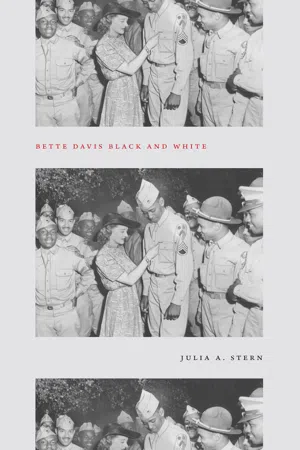
Baldwin thus provided a crucial touchstone on my quest to understand Bette Davis and racial belonging. But it was not until my first trip to the Warner Brothers Archives at the University of Southern California in 2010 that I would learn that Davis had mentored Black actors. She had been invited by Hattie McDaniel to join her all-Black company, which entertained African American troops posted in California en route to the Pacific during WWII. Davis was a member of several Black labor organizations and participated in some of their festive activities on the Fourth of July.15 In 1944, the actress was honored with the Motion Picture Unity Award, traditionally presented to African American performers.16 Reporting on the actress’s achievement, the Chicago Defender noted that Bette Davis was “the white actress having done most to harmonize and create goodwill between the races in Hollywood. Her democratic attitude in relation to colored persons, her work in the Hollywood Canteen and her liberal treatment of Negro artists assigned to her starring vehicles are especially cited.”17 Rex Ingram, a prominent Black actor who had played Adam in Green Pastures (dir. Mark Connelly and Wil...
Table of contents
- Cover
- Title Page
- Copyright Page
- Dedication
- Contents
- Historical Note
- Chapter 1 Introduction Black and White
- Chapter 2 Little Foxes and Little Brown Wrens
- Chapter 3 The Poetics of Color in Jezebel
- Chapter 4 Melodramas of Blood in In This Our Life
- Chapter 5 The Whiteness of What Ever Happened to Baby Jane?
- Chapter 6 Bette Davis Black and White
- Acknowledgments
- Notes
- Index
Trusted by 375,005 students
Access to over 1.5 million titles for a fair monthly price.
Study more efficiently using our study tools.
Frequently asked questions
Yes, you can cancel anytime from the Subscription tab in your account settings on the Perlego website. Your subscription will stay active until the end of your current billing period. Learn how to cancel your subscription
No, books cannot be downloaded as external files, such as PDFs, for use outside of Perlego. However, you can download books within the Perlego app for offline reading on mobile or tablet. Learn how to download books offline
Perlego offers two plans: Essential and Complete
- Essential is ideal for learners and professionals who enjoy exploring a wide range of subjects. Access the Essential Library with 800,000+ trusted titles and best-sellers across business, personal growth, and the humanities. Includes unlimited reading time and Standard Read Aloud voice.
- Complete: Perfect for advanced learners and researchers needing full, unrestricted access. Unlock 1.5M+ books across hundreds of subjects, including academic and specialized titles. The Complete Plan also includes advanced features like Premium Read Aloud and Research Assistant.
We are an online textbook subscription service, where you can get access to an entire online library for less than the price of a single book per month. With over 1.5 million books across 990+ topics, we’ve got you covered! Learn about our mission
Look out for the read-aloud symbol on your next book to see if you can listen to it. The read-aloud tool reads text aloud for you, highlighting the text as it is being read. You can pause it, speed it up and slow it down. Learn more about Read Aloud
Yes! You can use the Perlego app on both iOS and Android devices to read anytime, anywhere — even offline. Perfect for commutes or when you’re on the go.
Please note we cannot support devices running on iOS 13 and Android 7 or earlier. Learn more about using the app
Please note we cannot support devices running on iOS 13 and Android 7 or earlier. Learn more about using the app
Yes, you can access Bette Davis Black and White by Julia A. Stern in PDF and/or ePUB format, as well as other popular books in Media & Performing Arts & African American History. We have over 1.5 million books available in our catalogue for you to explore.