Learning Social Skills Virtually
eBook - ePub

Learning Social Skills Virtually

Using Applied Improvisation to Enhance Teamwork, Creativity and Storytelling

  1. 104 pages
  2. English
  3. ePUB (mobile friendly)
  4. Available on iOS & Android
eBook - ePub

Learning Social Skills Virtually

Using Applied Improvisation to Enhance Teamwork, Creativity and Storytelling

About this book

Digital workshops and meetings have established a firm foothold in our everyday lives and will continue to be part of the new professional normal, whether we like it or not. This book demonstrates how workshops and meetings held online can be made just as interactive, varied and enjoyable as face-to-face events.

The methods from improvisational theatre are surprisingly well suited for online use and bring the liveliness, playful levity and co-creativity that are often lacking in digital lessons and meetings. Applied improvisation is an experience-oriented method that is suitable for developing all soft skills – online and offline. Alongside brief introductions to the most relevant themes, the book contains numerous practical exercises in the areas of teamwork, co-creativity, storytelling, status and appearance, with examples of how to implement them online.

This book, written in the climate of the COVID-19 pandemic, is important reading for everyone – coaches, professionals and executives – looking for new impulses for their digital workshops and meetings, and who would like to expand the variety of their online methods. It offers new perspectives on many soft skills topics and supports interactive, engaging, lively and profitable online learning.

Frequently asked questions

Yes, you can cancel anytime from the Subscription tab in your account settings on the Perlego website. Your subscription will stay active until the end of your current billing period. Learn how to cancel your subscription.
No, books cannot be downloaded as external files, such as PDFs, for use outside of Perlego. However, you can download books within the Perlego app for offline reading on mobile or tablet. Learn more here.
Perlego offers two plans: Essential and Complete
  • Essential is ideal for learners and professionals who enjoy exploring a wide range of subjects. Access the Essential Library with 800,000+ trusted titles and best-sellers across business, personal growth, and the humanities. Includes unlimited reading time and Standard Read Aloud voice.
  • Complete: Perfect for advanced learners and researchers needing full, unrestricted access. Unlock 1.4M+ books across hundreds of subjects, including academic and specialized titles. The Complete Plan also includes advanced features like Premium Read Aloud and Research Assistant.
Both plans are available with monthly, semester, or annual billing cycles.
We are an online textbook subscription service, where you can get access to an entire online library for less than the price of a single book per month. With over 1 million books across 1000+ topics, we’ve got you covered! Learn more here.
Look out for the read-aloud symbol on your next book to see if you can listen to it. The read-aloud tool reads text aloud for you, highlighting the text as it is being read. You can pause it, speed it up and slow it down. Learn more here.
Yes! You can use the Perlego app on both iOS or Android devices to read anytime, anywhere — even offline. Perfect for commutes or when you’re on the go.
Please note we cannot support devices running on iOS 13 and Android 7 or earlier. Learn more about using the app.
Yes, you can access Learning Social Skills Virtually by Susanne Schinko-Fischli in PDF and/or ePUB format, as well as other popular books in Psychology & Mental Health in Psychology. We have over one million books available in our catalogue for you to explore.

Information

Chapter 1

Applied improvisation

DOI: 10.4324/9781003172765-1

1.1 Origin of improvisational theatre

The corona crisis of 2020 showed us how quickly our plans can be thrown to the four winds, and it tested whether, and how, we can deal with this. It certainly helps if we can improvise.
On stage, improvisation has been going on for a long time. In ancient times, it was simply because it wasn’t possible to plan everything. At first, magical rituals and ceremonies were improvised. Texts and procedures began to become fixed only in late antiquity, and improvisation was ousted from the theatre. With the commedia dell’arte, improvisation flourished again in the theatre and was intensively used to criticise the social conditions of the time. It was only censorship that pushed back this form of the Stegreiftheater (improvised theatre).
Jacob Levy Moreno used the Stegreiftheater in his development of psychodrama in the 20th century, and other new forms of improvisational theatre emerged from that. Keith Johnstone developed Theatre-sports, which quickly spread throughout Canada, the United States and later Europe. Today, Theatresports and improvisational theatre are widespread almost all over the world, enjoying great popularity. The players improvise in shorter and longer formats, in response to suggestions from the audience.

1.2 Introduction to applied improvisation

In the 20th century, Jacob Levy Moreno wasn’t the only one to experiment with how to use improvisational theatre off stage. Augusto Boal, for example, developed his “Theatre of the Oppressed” along similar basic principles, and Jonathan Fox developed “Playback Theatre.” In 2002, the Applied Improvisation Network (AIN) was founded by Paul Z. Jackson, Michael Rosenburg and Alain Rostain (http://appliedimprovisation.network), including annual conferences in the United States and Europe with participants from all over the world.
The basic principles of this network can be summarised as follows:
  • attention and contact
  • non-verbal communication
  • co-creation
  • spontaneity and intuition
  • a culture of trust that allows for mistakes
The methods of applied improvisation are becoming increasingly popular, particularly for continuing training. If agility and dealing with insecurity and complexity in working life are increasingly necessary, then the tools of improvisation offer excellent opportunities to expand these skills.
Since 2002, I have been working with the methods of applied improvisation in workshops, on the following topics:
  • performance competence and presentation techniques
  • communication
  • creativity and innovation
  • status and leadership skills
  • storytelling
  • team building
I have described these in more detail in my book Applied Improvisation for Coaches and Leaders (2019).

1.3 Basics of improvisation

To my mind, the following three basics form the core of improvisation:

Attention in the here and now

As in group dynamics or gestalt therapy, the “here-and-now” principle is of crucial importance in improvisational theatre. Because only when we’re in the moment can we really listen to others. Only then can we perceive ourselves and others and react appropriately in the moment. As soon as we start thinking ahead and planning ahead, we easily miss the right instant and the right impulse. The improvised action is constantly co-designed on stage by all the participants and frequently changes direction. That’s why co-creative work relies less on developing our own sophisticated ideas and more on letting go of our own concepts and ideas. As soon as we stick to our own ideas, we miss the moment and the joint development of new possibilities.

“Yes, and …” – accepting offers

The second basic rule when improvising is to accept offers: a “yes” takes up the offer, while the “and” develops the offer further. This is how co-creativity comes about! Incidentally, this also applies to our own ideas and impulses as we bring them into the world in the first place. There are many reasons why offers are so often blocked in everyday life. The most likely cause is trying to not allowing others to influence us or change us – in other words, control. Commitment and involvement do indeed require a certain amount of courage and self-confidence; in a sense, they represent a leap into the unknown, where the future is only developed as a joint venture along the way.

Making your partner look good (“let your partner shine”)

The third improv principle is: make your partner look good. It’s a wonderful tool for any successful teamwork. I would like to describe two experiences:
The first example is from a Zoom meeting with members from the AIN. The participants are spread all over the world, and one participant apologised for still being in her pyjamas. The host replied: “It doesn’t matter at all – on the contrary, it’s an absolute must to take part in pyjamas!
I experienced my second example on the way back from an Applied Improvisation conference on Long Island. Several conference participants were sitting in the same train compartment. A colleague of mine was gushingly thanking another colleague for his great presentation during the conference. Then, it turned out that she had got him mixed up with someone else, which was embarrassing at first, of course. But another colleague immediately jumped in and told me that she would like to thank me for my wonderful lecture, which of course was not true, because she had not participated in any of my workshops. I, in turn, continued to play the game and thanked the next colleague for her brilliant presentation, and so on. Out of an unpleasant situation, a funny improv game had arisen.

1.4 Workshops with applied improvisation online

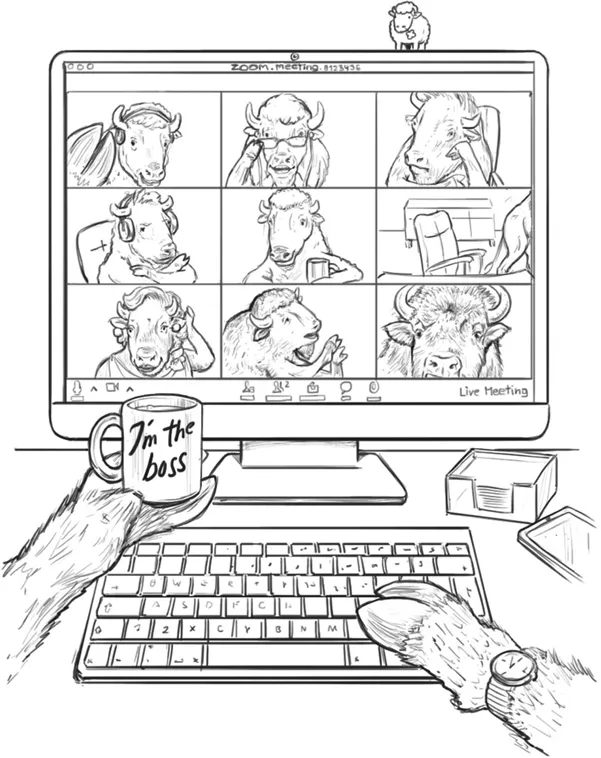
Before the corona crisis, I would never have dreamed that improvisational theatre online could be possible, let alone fun. But in the spring of 2020, it was all about “yes, and …” or no longer have any income … which definitely made the decision to get involved in this new professional adventure easier (Figure 1.1).
Figure 1.1 © Evi Fill

Technology

The videoconferencing tool “Zoom” (www.zoom.us) was helpful in the realisation of the initial ideas. It is very likely that there will be more providers with similar platforms in the future. The decisive factor with Zoom, however, was that you could see all participants (at least with a manageable group size) at the same time, as well as the possibility to run “breakout sessions.” This made it feasible to work with groups methodically in a way that was quite similar to a normal face-to-face workshop.
An important function is that you can turn off your own camera and change the settings (“Hide Non-Video Participantso”), so that only participants with the camera switched on are visible. This creates a stage-like situation in which, for example, two or more players improvise, play a scene with each other or play a role-playing game. The actors are visible, but not the spectators; however, the spectators remain audible when needed.
Apart from Zoom and the digital pinboard “Padlet” (www.padlet.com), I rarely use other online tools. The idea is that in my workshop, interaction always comes first and the technology should remain in the background.

Interaction – camera and microphone on

In order to be able to work really interactively, small groups are needed. That is why I work online with a maximum of 14 participants and focus on the lively activity together, the constant exchange with the participants or animated dialogue between them.
Times must also be adjusted, as online teaching is actually demanding and quite exhausting. Ideal are blocks of a maximum of 3 1/2 hours per day (including 30-minute break). Daily units of 90 minutes distributed over several days also works well. If there’s no alternative, I will also work online for a whole day and plan longer breaks for this. In addition, it is important that the participants are alone in their rooms and cannot be disturbed.
A necessary prerequisite for effective online work is that the participants leave their camera switched on. In order to be in contact with all participants, I almost always switch on the gallery view. Even when I am presenting myself, I try to keep an eye on all participants as much as possible, see their reactions and receive immediate feedback on the process.
Contrary to all official advice, I don’t look at the camera, but at the participants. Their immediate feedback is more important to me because I can straight away refer to a smile or a frown and ask, clarify, build on consent, etc. Through this contact, the participants feel addressed and seen. Ideally, however, the camera should be mounted in such a way that more or less a feeling of eye contact is created.
Also going against the current “received wisdom,” I ask the participants to leave their microphones on most of the time. On the one hand, this allows them to get involved spontaneously, and on the other hand, the background sounds create a lively conversation space that is sooth-ingly reminiscent of “normal” interaction situations: you can hear very real people laughing, breathing, sighing, harrumphing, etc. For me as a trainer, this feedback is important to get a sense of the dynamics and the process, that is, as monitoring information, so that real interactive and spontaneous collaboration can be created.
In order to avoid unnecessary background noise, I’ll usually invite the participants to look for a quiet and undisturbed workplace for the workshop and to ensure that no other people are present in the room.
This also makes it easier for participants to ask questions, volunteer for exercises, express themselves and experiment. I therefore also invite them to speak up at any time, as in a face-to-face workshop, without raising their hands first. This sometimes leads to two people starting to speak simultaneously. Most of the time, this only lasts a moment – it’s worth it for the spontaneous expression and vibrancy that can enter the virtual space.
A major disadvantage of online workshops is that the participants are relatively easily distracted and also answer their emails, for example. This is one reason why many people are so exhausted after an online day: multitasking is and remains very strenuous. This makes it all the more important that the participants can be active and feel involved or, to a certain extent, jointly responsible for the joint success. This is much easier in shorter time blocks and allows participants to concentrate and get involved better. People can be “activated” by, for example:
  • questions
  • addressing participants directly
  • exercises and role-playing games
  • breakout sessions

Chat

I leave the private chat function off because I know from my own experience how much attention is lost when chat messages are exchanged on the side. In general, I try to avoid side conversations and make the lessons as transparent as possible. To this end, chat messages are set so that they come to everyone or just to me as host.
If possible, I prefer que...

Table of contents

  1. Cover Page
  2. Half Title Page
  3. Title Page
  4. Copyright Page
  5. Contents Page
  6. Profiles Page
  7. Preface Page
  8. What you will find in this book Page
  9. 1 Applied improvisation
  10. 2 Creativity
  11. 3 Teamwork
  12. 4 Storytelling
  13. 5 Status and image
  14. 6 Practical examples
  15. Your takeaways from this book
  16. Literature
  17. Index